In investment-grade credit markets, AI-driven debt issuance by hyperscalers is expanding beyond the US, and creating potential opportunities in EUR, GBP and CHF credit markets. We believe investors should remain selective and incorporate rising off-balance-sheet lease obligations into their credit analysis.
September’s widening high-yield market was driven primarily by rates volatility and heavy new issuance rather than deteriorating fundamentals. This may present carry opportunities for investors who focus on higher-quality issuers and avoid refinancing-dependent credits.
Although Swiss bonds offer lower nominal yields than other developed markets, their combination of fiscal strength, historically low inflation, generally high credit quality and defensive characteristics have contributed to their risk and return characteristics over time.
Investment grade
IG credit markets: Exploring new territory
Debt issuance related to artificial intelligence (AI), hyperscalers, and data center providers remains top of mind for investors. We believe it is worth highlighting both the opportunities and risks associated with this theme.
Hyperscalers go global
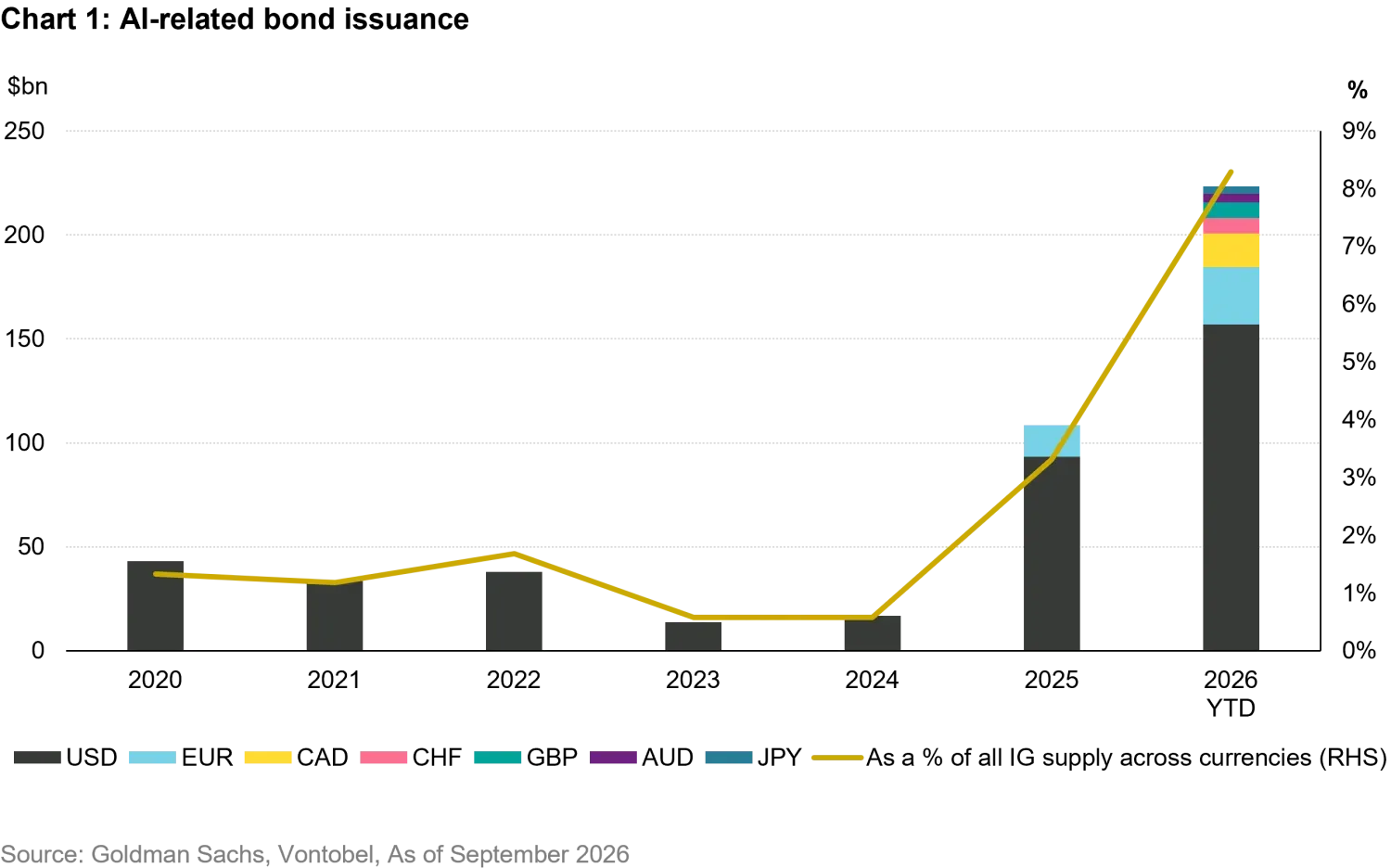
AI-related bond issuance initially emerged in the US market, primarily through USD-denominated bonds. Over the past several months, however, the trend has become increasingly global as large technology companies, particularly hyperscalers, have sought to diversify their funding sources and broaden their investor base.
Earlier this year, for example, Alphabet’s 100-year GBP-denominated bond attracted significant interest from investors seeking to extend the duration of their portfolios. In early September, Amazon issued GBP 4.25 billion in bonds across multiple maturities in a single transaction. As a result, we have seen strong growth in the hyperscaler segment within the euro and sterling corporate bond markets, among others. It is also worth highlighting that these issuers have appeared largely insensitive to prevailing yield levels and have remained willing to issue long-dated bonds, even as yields across most developed markets remain elevated.
Keeping an eye on off-balance sheet debt
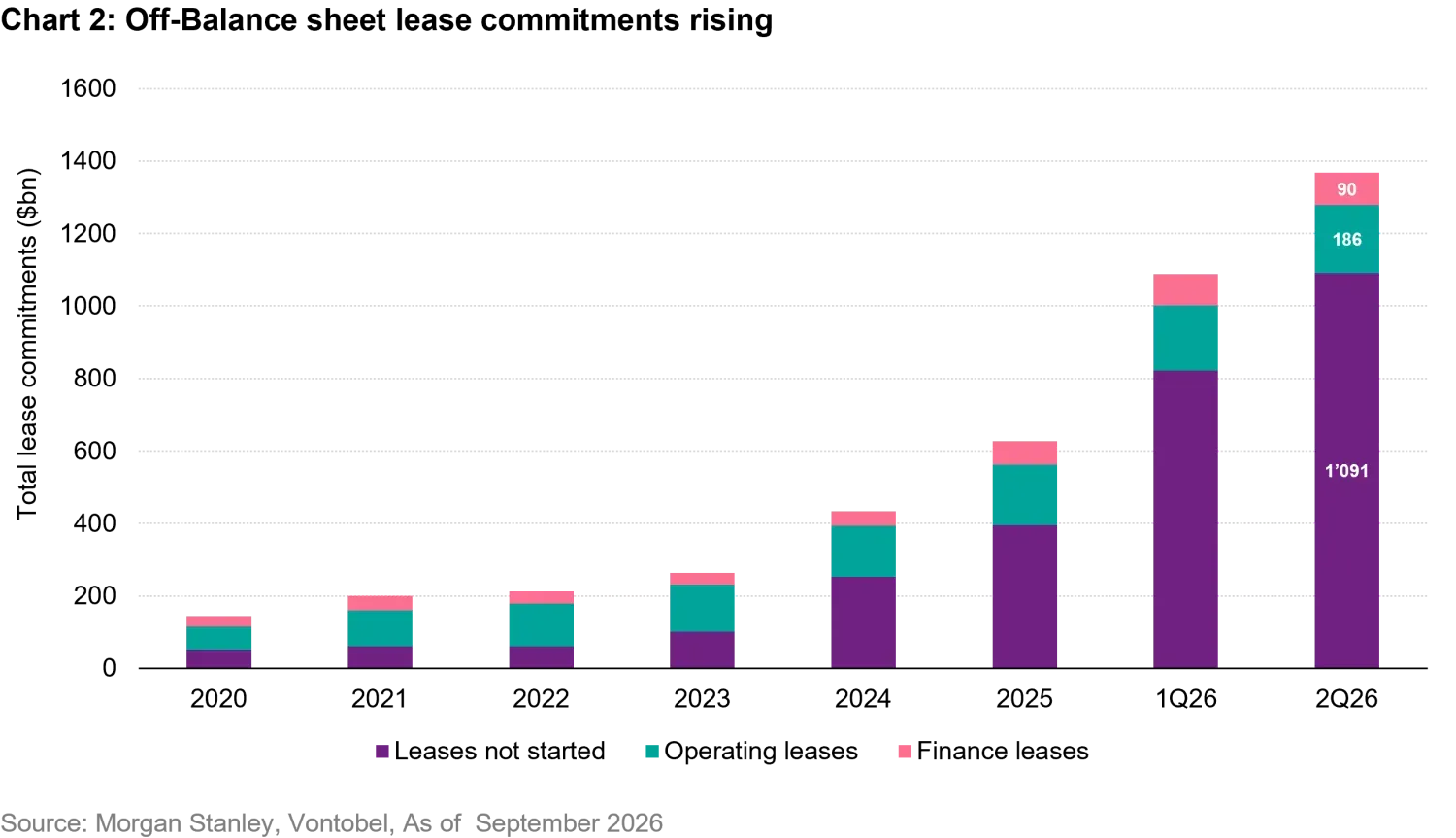
While we believe there are attractive opportunities to consider, investors may also want to remain mindful of the risks. We acknowledge that most hyperscalers are entering the debt market from a position of strength: profit margins are high, free cash flow generation remains robust, and leverage has historically been very low. However, in our view, investors should not overlook off-balance-sheet obligations, which are not yet fully reflected in traditional credit metrics.
In general, hyperscalers may own their data centers outright, hold partial ownership through joint ventures, or lease data centers as tenants without an ownership stake. In the latter case, lease commitments can translate into significant future debt-like obligations once the leases commence, potentially leading to higher leverage over time.
Rating agencies will likely capture these commitments through lease-adjusted leverage metrics, and we believe investors should consider doing the same. Taking these obligations into account is essential to developing a complete view of credit risk and reducing the potential for negative surprises as hyperscalers continue to expand their infrastructure footprints.
What’s in it for the investor?
For investors, bond issuance by hyperscalers in currencies other than USD provides access to a highly rated segment of the credit market, particularly for CHF-, EUR- or GBP-based investors. We believe this segment currently offers an attractive spread pick-up relative to similarly rated issuers. However, in our view, investors should remain mindful of the sustained pace of issuance, which may limit the sector's ability to outperform in the current market environment.
In addition, a careful assessment of potential off-balance-sheet obligations that could be incorporated into future credit metrics may be warranted, potentially resulting in less favorable leverage profiles. As hyperscalers continue to invest heavily in expanding their infrastructure, these considerations are likely to become increasingly important.
In the current market environment, we believe a highly selective approach to new issues remains essential.
High yield
High-yield markets: Navigating the end of summer repricing
Recent weeks in September presented high-yield (HY) markets with a complex interplay of rate volatility, primary market indigestion, and shifting macroeconomic signals. Contrary to fears of a fundamental credit breakdown, the primary catalyst behind recent spread widening was elevated interest rate instability: US HY option-adjusted spread (OAS) widened 50 bps to 324 bps in September, while rates volatility rose to 101, its highest level since the end of March 2026.
Heightened uncertainty surrounding monetary policy, exacerbated by upward pressure on global energy prices as geopolitical risks showed little sign of de-escalating, pushed average US high-grade corporate yields past 6.0% for the first time since 2023 and US HY yields above 8.0% (a level not sustained since last year’s Liberation Day). These elevated yield levels further increased corporate funding costs and expanded spread premium requirements. However, we believe September reflects a rate-led valuation reset rather than a broad fundamental break.
Indeed, aggregate HY credit fundamentals (excluding distressed credits) remain firmly anchored: as of late September, EBITDA growth (+9.0% year-over-year) continues to outpace debt expansion (+3.1% year-over-year), keeping net leverage contained at 3.62x and interest coverage healthy at 4.26x.
Compounding this environment was localized technical pressure in the primary market. The market was called upon to absorb a massive USD 52 billion debt burden across investment grade, HY, and loan tranches to finance a mega-cap media and entertainment M&A transaction. This outsized supply temporarily drained secondary market liquidity and caused newly issued paper to trade a few points lower in cash price post-pricing, as investors questioned post-merger high leverage and deleveraging execution risks against unclear synergy targets. With elevated all-in borrowing costs recently creating a higher hurdle, corporates that can afford to wait are postponing market entry. Although refinancing remains the primary driver of issuance, we believe HY supply in H2 2026 is likely to slow if rates volatility does not find any stability.
Crucially, this backdrop of high interest costs and selective primary demand has driven a pronounced dispersion across rating tiers: while upper-tier BB and solid single-B[KG2.1] issuers have maintained resilient market access, lower-tier CCC-rated US HY spreads recently breached the 1,200 basis point threshold for the first time since 2023, suggesting that refinancing pressure and distress are concentrated among weaker, highly levered balance sheets.
Dispersion is meaningful not only across rating levels, but also across sectors. Companies with high refinancing sensitivity, legacy distress, high leverage, and interest coverage that has eroded over time underperformed significantly in September. In US HY markets, Cable returned -4.22% in September, followed by Telecoms (-3.44%) and Real Estate (-3.04%). Conversely, Technology (-1.58%, benefiting from temporary relief from AI disruption fears in software subsectors), Services (-1.67%), and Healthcare (-1.76%) held up considerably better.
From a macro perspective, the September Non-Farm Payrolls print of 29,000 (well below the 90,000 consensus) alongside negative prior-month revisions started to signal a cooling labor market. Combined with moderating PCE inflation, this soft labor data effectively removed the urgency for Fed tightening in October. While a reduced likelihood of a rate hike provides near-term relief for Treasury yields and allows HY markets to stabilize, it does not resolve broader structural headwinds such as the upcoming maturity wall, heavy primary pipeline and CCC-tier stress. Heading into Q4, the key macroeconomic question is whether labor market softness is a temporary pullback or a sustained slowdown. While the latter would likely support benchmark rates, it could also elevate default risk concerns for vulnerable, lower-tier borrowers.
For HY investors, we believe this environment of secondary softness, technical concessions, and market dispersion may present entry points to capture attractive carry in high-conviction, free-cash-flow-generative names while actively avoiding vulnerable credits, allowing positions to be built that more appropriately reflect the premium for risk.
Ultimately, the HY market enters Q4 with a more cautious tone than in the first half of the year: spread valuations have decompressed, the supply pipeline remains heavy, potentially weighing on Q1 2027 if not addressable before then, and the macro backdrop is less forgiving. We believe the asset class still offers an attractive carry buffer, but selectivity, particularly with regard to deeply distressed and refinancing-dependent issuers, remains a dominant theme heading into year-end, especially given potential headwinds in Q3 earnings should severe margin compression or consumer-led deterioration materialize.
Swiss bonds
Swiss bonds after three years of relative outperformance: Should I stay or should I go?
At first glance, Swiss bonds offer relatively little in terms of nominal yield. But low yields are not necessarily a weakness. In Switzerland, they are also the price investors pay for a combination that has become increasingly scarce across developed markets: strong public finances, low inflation, institutional stability and exceptionally high credit quality.
The Swiss Confederation provides the anchor for this market. Switzerland’s general government gross debt stood at around CHF 353 billion, or 40.7% of GDP, in 2025, while the public sector recorded a financing surplus of roughly CHF 4 billion. Fiscal discipline is reinforced by the constitutionally anchored debt brake, which limits structural deficits and has helped keep public debt under control. Combined with political and institutional stability and the Swiss National Bank’s (SNB) focus on price stability, we believe these factors may provide a strong foundation for the Swiss bond market.
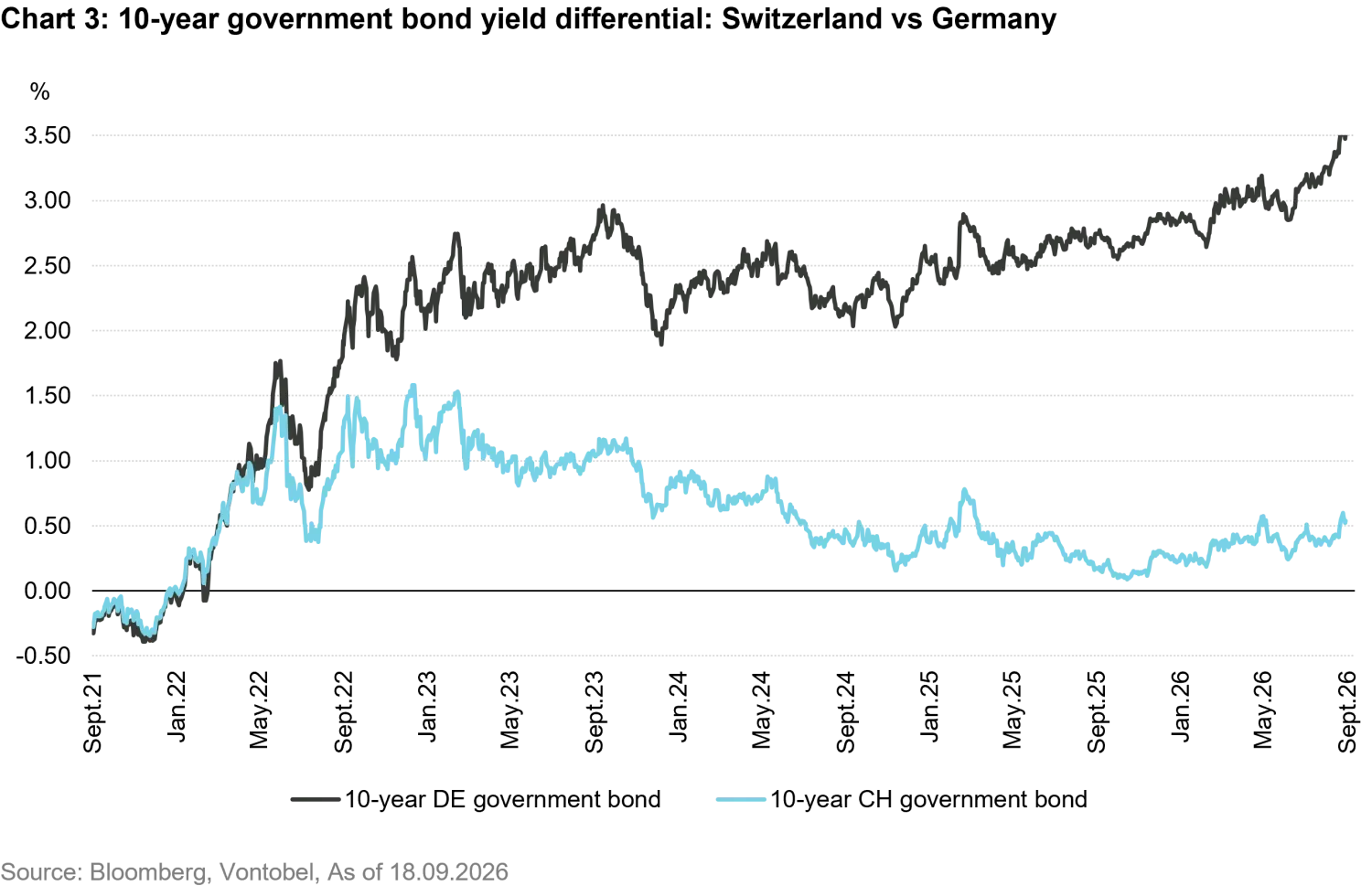
The price of that stability is increasingly visible in relative yields. Interest-rate differentials between Switzerland and other developed markets have widened substantially. The gap between 10-year German Bunds and 10-year Swiss Confederation bonds, for example, is now close to 3 percentage points, a remarkable divergence considering that the spread was around zero not too long ago. Yield differentials versus US Treasuries and other major government bond markets are similarly substantial.
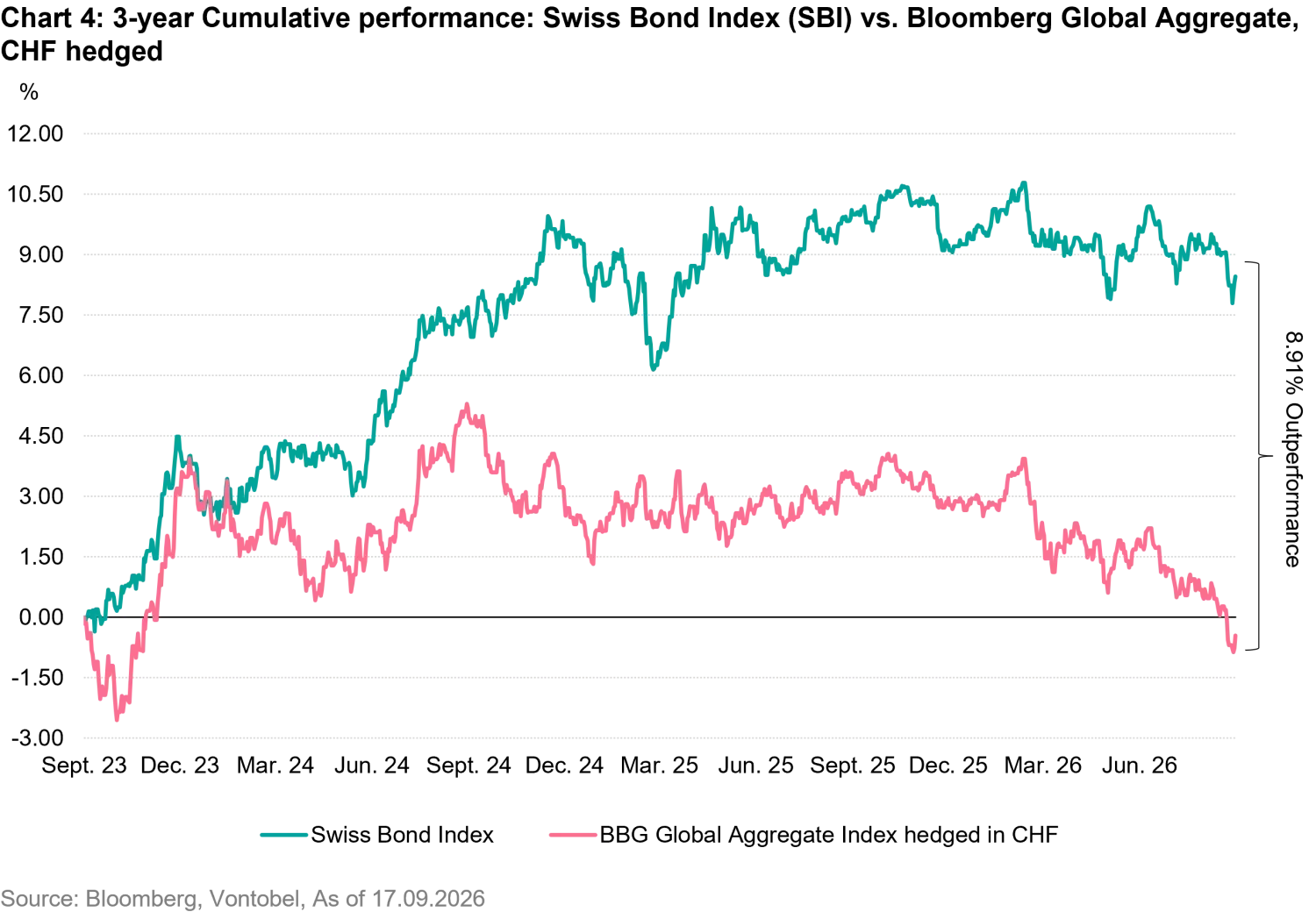
For investors, the temptation may be obvious: why remain in low-yielding Swiss bonds when considerably more carry is available elsewhere? The experience of recent years provides part of the answer. The widening rate differential has been accompanied by significant relative outperformance of Swiss fixed income. Over the past three years, the Swiss Bond Index has outperformed the CHF-hedged Bloomberg Global Aggregate Index by more than 9%.
This highlights an important distinction between yield and total return. Higher starting yields can provide greater carry, but they do not come without risk. Duration, inflation, fiscal policy and interest-rate volatility ultimately determine how much of that additional yield investors get to keep.
After three years of strong relative performance and with yield differentials at unusually wide levels, the question is increasingly relevant: should I stay or should I go? Moving abroad offers substantially more carry. Whether that ultimately translates into superior returns depends on the path of inflation, monetary policy and, increasingly, fiscal policy in the US, Europe, and Japan.
Switzerland offers a rather different proposition: low inflation, strong public finances, high credit quality, and a currency with established safe-haven characteristics. For investors whose objectives include CHF-denominated fixed-income exposure with consistent returns and a defensive portfolio anchor, we believe those qualities continue to have value. The yield may be higher elsewhere, but in fixed income, the highest yield is not necessarily the highest-quality return.
Share via
About the authors
Gregor Kapferer
Head Developed Markets Fixed Income, Portfolio Manager