Key takeaways
- Despite a sustained oil shock, geopolitical uncertainty, and rising US rates, EM fixed income has remained generally resilient. Spreads have stabilized, rating upgrades and inflows have continued, and EM bonds have delivered positive returns year to date.
- Several fragile EM oil importers have undertaken policy reforms and improved their fiscal positions, navigating a shock comparable to 2022 without experiencing the same degree of market stress.
- In our view, EM fixed income continues to be supported by solid fundamentals and attractive carry. In an increasingly AI-driven and correlated market, the asset class can act as a source of diversification.
The US-Iran war remains unresolved, with the Houthis having joined the conflict and disrupting Saudi oil exports through both the East-West pipeline and the Red Sea. Meanwhile, Ukraine has continued to destroy Russia’s refining capacity. Although there are hopes of partial de-escalation, none of these conflicts appears close to a lasting resolution.
In our assessment, the situation is worse than the baseline scenario we envisaged three months ago. The Strait of Hormuz has become a sort of “Schrödinger’s Strait1,” neither open nor fully closed. TankerTrackers estimates that an average of 4.9 million barrels per day (Mb/d) of crude oil went through the Strait since the mid-July US blockade, less than a third of the pre-war flow. Other estimates are higher: Kpler suggests an average of as much as 6.5 Mb/d during the first three weeks of September. Rerouting through pipelines and other ports, which are now also disrupted, allowed total Gulf flows of about 13 Mb/d in August, according to the International Energy Agency. These disruptions have likely contributed to Brent oil prices stabilizing around USD 100 per barrel. However, disruptions to Russian refineries have pushed diesel prices to record highs.
Against this rather challenging backdrop, emerging market (EM) economies have remained resilient. Even oil-importing countries with relatively fragile fundamentals have held up quite well. Sovereign rating upgrades have continued, while inflation has not spiraled; in fact, core inflation remains well anchored in most countries. EM spreads remain relatively tight, and both hard- and local-currency bonds have delivered positive year-to-date returns. This has occurred despite a significant increase in core rates, which has produced negative returns across most of global fixed income. Finally, inflows into the asset class have continued. In the face of such a significant global shock, EM’s strong performance stands out. Why is EM performing so well?
Policy reforms and stronger external balances help drive resilience among EM oil importers
In our view, the answer lies in a combination of stronger policy frameworks, larger macroeconomic buffers, and even some good fortune. To illustrate, let’s focus on a group of countries that we consider fragile oil importers: Turkey, Egypt, Kenya, Pakistan, and Sri Lanka. In theory, these countries should be among the hardest hit by the current shock.
Indeed, sovereign spreads on their hard-currency bonds widened significantly at the onset of the conflict in March 2026. Excluding Turkey, the remaining four countries were among the 15 worst-performing sovereign issuers in March. Yet none is an underperformer year-to-date. In fact, Sri Lanka and Pakistan are among the 15 best performers.
Although this is a heterogeneous group, the countries share some similarities. All are high yield (HY) oil importers, and all faced crises in 2022-2024. Turkey’s inflation peaked above 80% in 2022, while Egypt devalued its currency four times, reducing 68% of its value against the dollar in just over two years. With the exception of Turkey, all lost market access during this period.
Sri Lanka defaulted in 2022; Pakistan came close to default in 2023 but avoided it. Kenya struggled with short-term external debt maturities in 2024 but ultimately avoided a full-blown crisis. Meanwhile, Egypt, Pakistan, and Sri Lanka obtained IMF programs, which are now close to completion and undertook significant policy reforms. Turkey also implemented significant reforms, albeit outside an IMF program. Kenya still faces a precarious fiscal situation, but its external accounts have improved dramatically.
This year, oil-importing countries are facing a global oil shock similar in magnitude to that of 2022. Yet very few countries are in crisis today, and none of the five we highlight here is among them. With the exception of Kenya, the other four have significantly improved their fiscal positions over the past three years, while all five have strengthened their external positions.
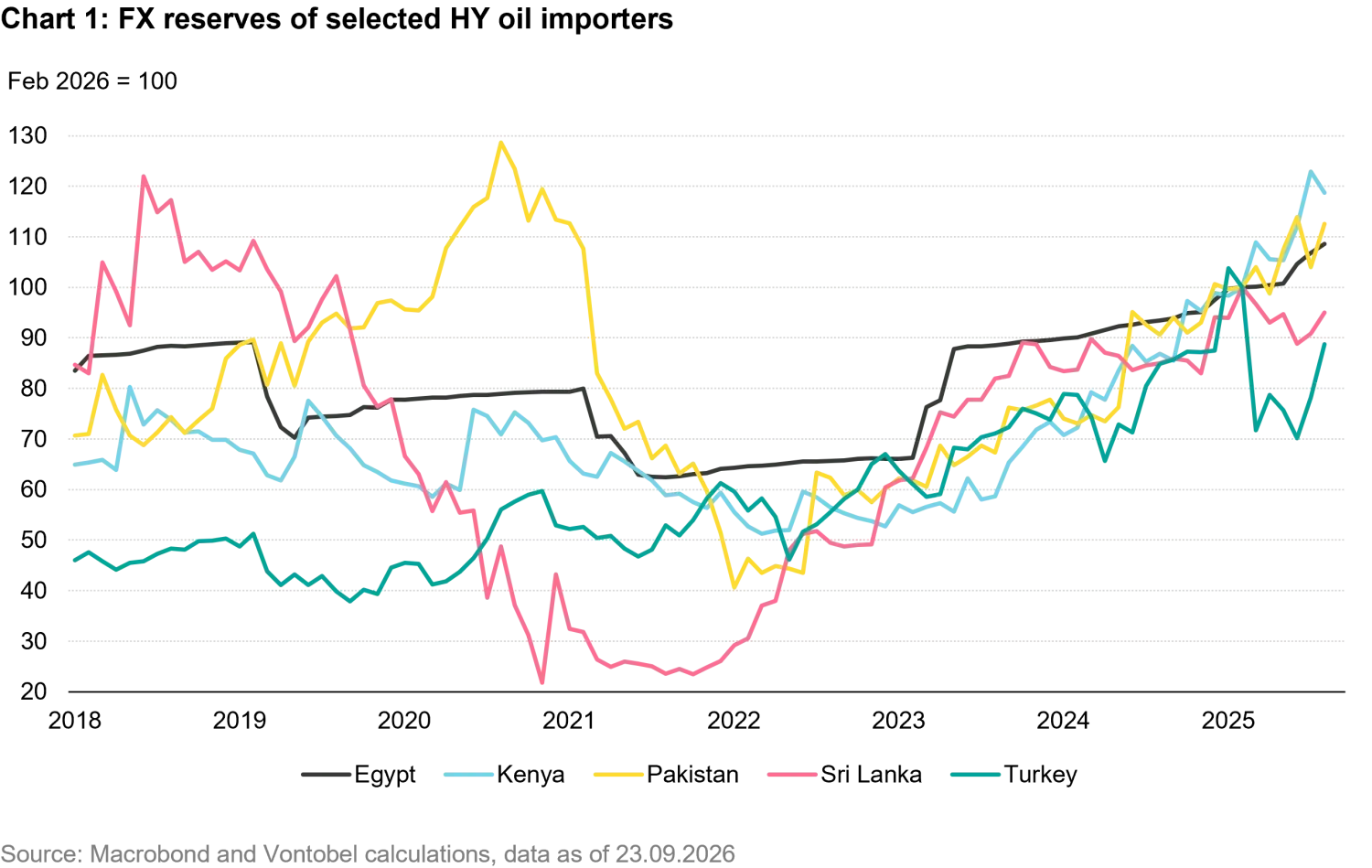
Chart 1 shows international reserves, indexed to February 2026 = 100. All five have accumulated significant reserves since the 2022-23 crisis period. Kenya’s reserves are now elevated, equivalent to more than six months of imports. Reserves in the other four countries remain relatively low, although much improved. More importantly, Egypt, Pakistan, and Kenya have continued to accumulate FX reserves over the past six months despite high oil prices. Sri Lanka’s reserves declined by around 10% during the first few months of the conflict before starting to recover. In Turkey, the central bank used a very large amount of FX reserves, including gold holdings, in March to defend the pace of depreciation under its crawling peg. Reserves then stabilized and recovered strongly in July and August.
Strong remittances from their diaspora communities have supported the current account balances of many emerging markets in recent years, particularly Egypt, Pakistan, and Sri Lanka, and to a lesser degree Kenya. Strong tourism growth has also supported external balances in Turkey, Egypt, and Sri Lanka, and to a lesser extent Kenya. Together, these trends have offset the wider trade deficits caused by higher crude oil and fuel prices.
This helps explain why fragile oil importers have remained relatively resilient despite a negative global shock. The markets have recognized this resilience, and spreads in these and other oil-importing countries are no longer as high as they were at the start of the Iran conflict. Nevertheless, every shock creates both winners and losers. Oil-exporting countries and EM oil companies are enjoying a windfall that is lasting far longer than we and the markets initially expected. Importantly, some oil-related issuers are using this period to deleverage, while others are not.
EM sovereign rating upgrades and inflows continue
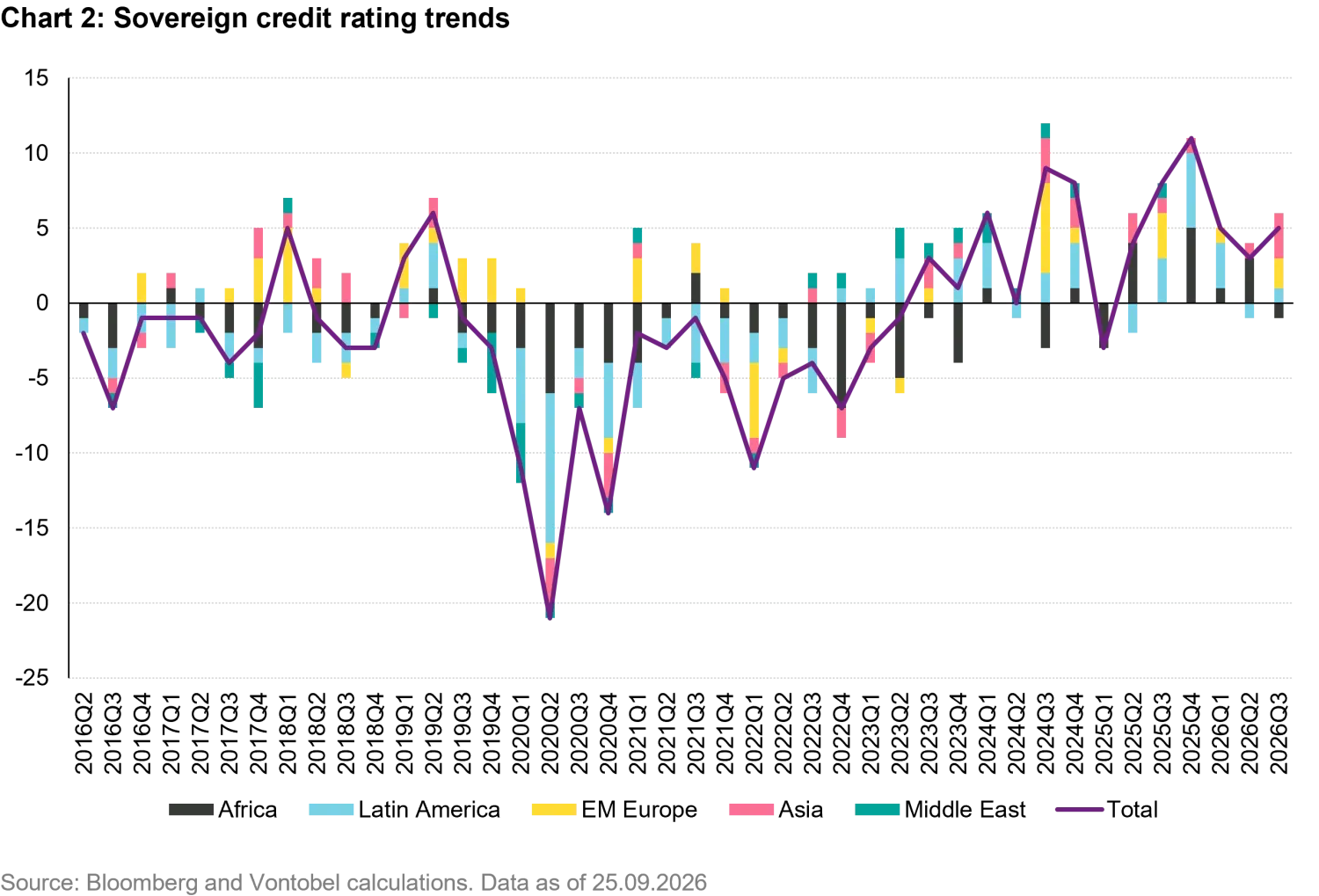
Meanwhile, sovereign rating upgrades across EM have continued. Fitch upgraded Sri Lanka to B- from CCC+. Countries that defaulted in recent years, including Ghana, Sri Lanka, Zambia, Argentina, Ecuador and Belize, have tended to move out of the CCC category relatively quickly. There have also been upgrades on the investment grade (IG) side. For example, S&P upgraded Kazakhstan, a large oil exporter, to BBB in August.
Despite the oil price shock, elevated geopolitical uncertainty, and a more hawkish Federal Reserve (Fed), inflows into EM fixed income have continued. This is very different from the market dynamics observed during the Taper Tantrum over a decade ago. It is also worth highlighting that the US dollar, as measured by the DXY index, has strengthened by 1.7% month-to-date as of 25 September. This move reflects a repricing of Fed policy: markets now expect three additional hikes by April 2027, two more than were anticipated at the end of August.
We think this outlook is too hawkish, as explained in our recent article on global rates. However, EM central bank policy has generally become less closely aligned with Fed policy than in previous years. Many EM countries have their own economic cycles and inflation dynamics, which are not necessarily closely correlated with those of the US. Even in Mexico, which is highly integrated with the US, the central bank held rates unchanged this month and stated that “since macroeconomic conditions are different from those in the United States,” it does not have to mirror Fed policy.
Similarly, EM local-currency bond yields have risen less rapidly than US Treasury yields over the past month. This has resulted in smaller duration-related price losses than for US Treasury bonds of similar maturity. We believe domestic financing conditions are therefore unlikely to tighten as quickly in EM economies as in the US. If this trend continues, it could provide support for EM economic activity and limit the increase in financing costs.
Solid EM fundamentals, diversification benefits, and favorable carry remain key strengths
Overall, we acknowledge that the global outlook is less constructive than we thought three months ago. Geopolitical uncertainty is significantly higher than expected, global financial conditions are likely to become less accommodative, and on aggregate, valuations generally do not appear that attractive in the current context, although relative value opportunities continue to abound. That said, we believe EM fundamentals remain solid, as demonstrated by the economic resilience observed so far. Inflation remains contained, although it is likely to stay elevated given higher hydrocarbon prices and the low probability of a definitive near-term solution to the ongoing geopolitical conflicts.
Against this backdrop, we believe EM fixed income may continue to offer attractive diversification benefits at a time when exposure to the AI boom across large parts of equity markets, including EM stocks due to their exposure to Taiwanese and Koren semiconductors, is becoming a common driver. In our view, there is still a range of idiosyncratic return drivers in EM fixed income that can contribute to portfolio diversification. Moreover, while valuations appear less attractive than they did last year, we believe the asset class continues to benefit from a favorable carry environment.