
EU election headlines explained: what investors need to know
Asset management
Why did this year’s European Parliament elections garner much more investor interest than normal? Held every five years, the elections allow citizens of EU countries to decide who their country’s parliamentary representative will be. Our Chief Economist, Reto Cueni, and Head of Global and Swiss Bonds, Anna Holzgang, analyze the headlines surrounding this June’s election, providing the backstory from an investor's perspective.
French President Emmanuel Macron has called a snap election in France. What does he hope to achieve, and what should bond holders in particular keep an eye on?
Reto: Macron’s reaction to the European election has been to call for French elections on June 30 and July 7, following the heavy defeat of his party by the French right-wing “Rassemblement National”. This is probably the biggest impact of the EU elections on the European political landscape, as it stirs uncertainty about the political course of Europe’s second-largest economy.
If right-wing sentiment surges enough to bypass France’s two-round election system’s normal protection against extreme forces, it could shift the government balance and trigger uncertainty about future fiscal policies. A power shift in the French parliament to the extreme could push for increased public spending, raising the French government at a time when France is likely facing an EU deficit procedure. However, this is happening ahead of the planned French presidential election in spring 2027. Given that foreign and defense policy is primarily a presidential prerogative in the French political system, uncertainty about France’s future collaboration in Europe and geopolitically remains contained until 2027.
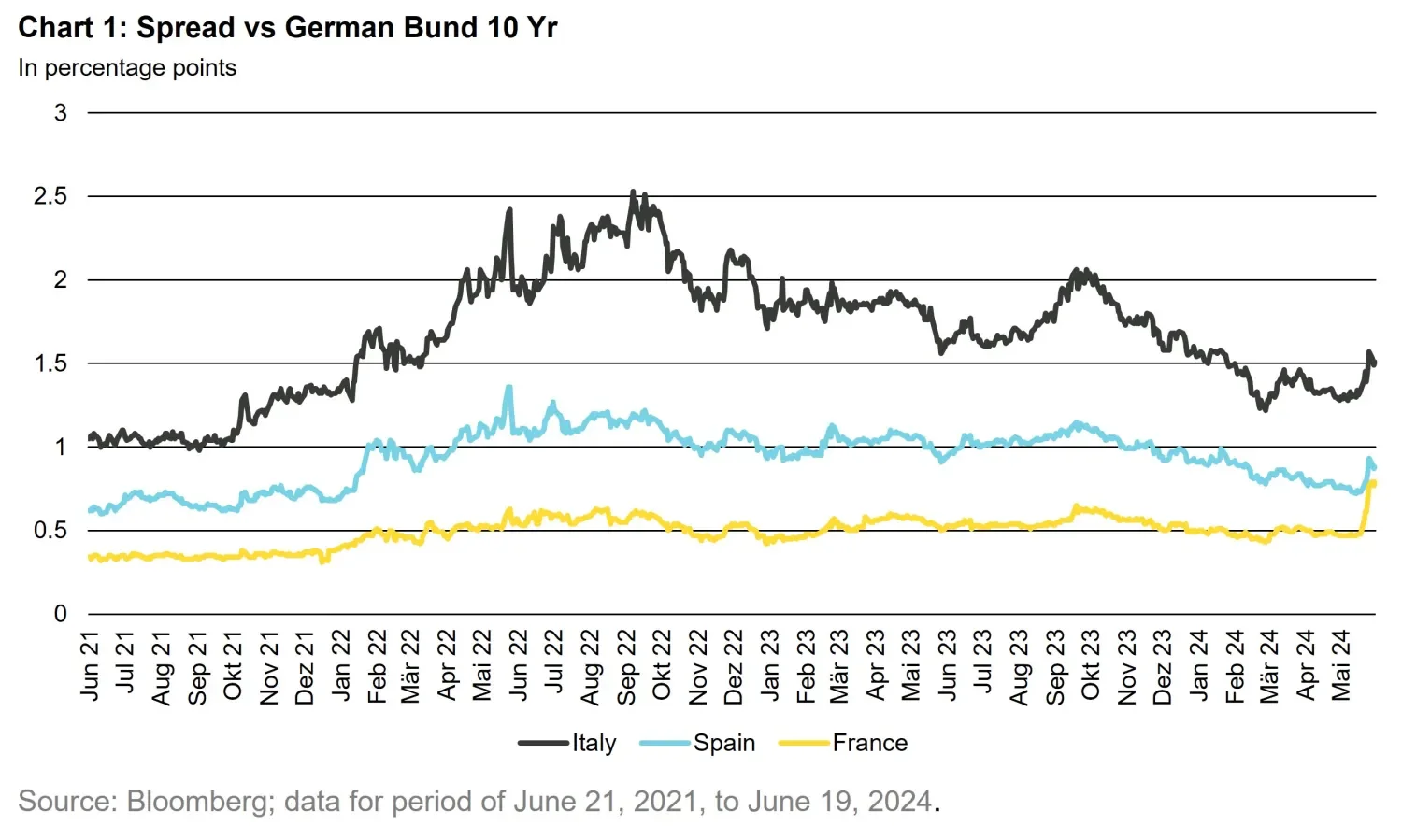
Anna: The key question for markets is whether there will be a major shift towards far-right parties such as National Rally, leading to an outright majority. If this doesn’t happen, the spreads between French and German 10-year government bonds will have limited upward potential, as markets have already accounted for further fiscal deterioration (see chart 1). However, if the far-right parties gain an outright majority, we can anticipate a more significant widening of spreads due to heightened uncertainty.
Centrist parties held their ground and retained the majority. Does this bode well for market stability?
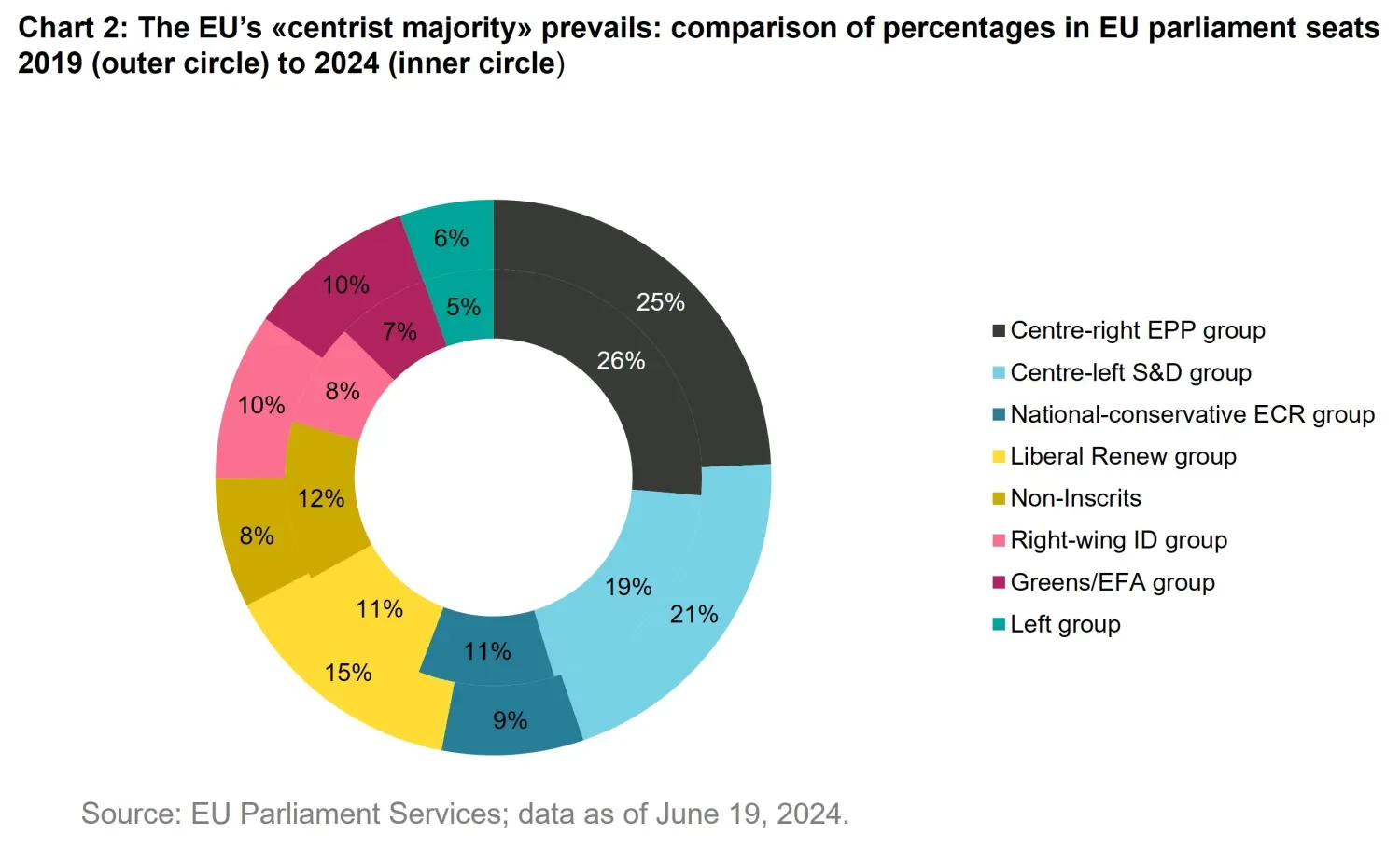
Reto: Yes, that the results indicate a stable “centrist majority” in Europe (see chart 2) is crucial during times of elevated geopolitical uncertainty, the war in Ukraine, and the US-China rivalry. This is positive news for investors. However, the coming weeks will reveal if the centrist parties can collaborate and elect a centrist European Commission president for the new five-year term. We’ll monitor the EU Council’s nominations for the EU Commission presidency at the end of June. By mid-July, when the EU parliament votes on the new EU presidency, investors will also have seen how the election’s political shifts have manifested in political reality.
Anna: Since the impending fiscal consolidation challenges are largely accounted for, the spreads between 10-year French OATs and 10-year German Bunds should stay roughly at their current levels.
What do far-right gains imply? Where should investors stay alert to either opportunity or challenge?
Reto: The shift towards more “anti-establishment” right-wing parties opposing the “new green deal” and prioritizing national security and border control indicates a change in Europe’s political focus. With the “Green block” losing ground in parliament, the political momentum for the “green transition” is hindered, increasing the likelihood of reduced public spending on green initiatives and increased spending on defense, national security, and border control during the legislative period. Investors should pay attention in mid-July when the candidates for the next EU presidency term present their programs, providing insights into the parties’ agenda setting and the political momentum in Europe.
Anna: Historically, European government bond markets were unsettled when nationalist parties with anti-euro rhetoric gained momentum. However, as the current situation with Italian Prime Minister Giorgia Meloni shows, an anti-euro stance no longer guarantees electoral victory. Consequently, the worst-case scenario (Frexit) is no longer a major market concern, and any spread widening should be limited.
Related insights

Swiss franc corporate bonds: deserving investors’ attention now

Fundamentals, technicals, and complacency are outweighing uncertainty

Beneath the hawkish headlines: What’s next for the European Central Bank, Federal Reserve, and Bank of Japan?

Credit at a crossroads: AI-driven IG supply, hidden dispersion in HY, and Swiss stability

Replay: Rates, credit & market reality — what matters now?
