
A Turning Point for European Markets?
Multi Asset Boutique
After an eventful start to the year1, March has brought even greater market turbulence, with European asset prices moving sharply. In the first weeks of the month, the euro posted its strongest weekly gain against the US dollar since the Great Financial Crisis, rising 4.5%. Meanwhile, the 10-year Bund saw its steepest weekly sell-off since German reunification, as yields jumped 50 basis points. These moves reflect shifting dynamics in European bond markets and a potential change in investor sentiment.
In equities, the S&P 500 recorded its biggest weekly drop since last autumn, falling 3.1%. While not historic, this correction challenges one of 2025’s strongest market views: US outperformance over Europe. Between November 27 and March 10, the Euro Stoxx 50 outpaced the S&P 500 by 22 percentage points —its third-best run of relative gains in a decade. A key driver has been policy uncertainty in the US, with Trump’s latest announcements unsettling investors.
At the same time, sentiment toward European assets is shifting, partly due to Germany’s elections in late February. Three years after Olaf Scholz’s landmark Zeitenwende (turning point) speech2, Europe’s stance on defense and infrastructure spending has evolved. Trump’s first two months back in office have spurred European governments to act, reinforcing commitments to strategic investment.
The key question: can Europe finally shed its "value trap" reputation, or will skepticism persist? Could this shift in policy and sentiment mark a true turning point for European markets? Our hybrid investment team is closely tracking these developments to help investors navigate the changing landscape.
The growth challenge: Europe’s fragmented integration
The Great Financial Crisis and the European debt crisis exposed a fundamental weakness in the Eurozone: incomplete integration. A key limitation has been its decentralized fiscal policy, which has held back economic potential3.
The COVID crisis marked a small step toward change with the introduction of a European Government Bond (EGB) market. Yet, the absence of full debt mutualization remains a structural flaw. This gap has driven up risk premiums for peripheral countries and constrained growth across the region.
Market fragmentation4 adds to the challenge. The Eurozone’s internal market remains divided across multiple jurisdictions, making it harder for businesses to scale efficiently. In contrast, companies in the U.S. and China benefit from more unified regulatory environments, helping them grow to a globally competitive size.
Regulatory inconsistencies across member states continue to weigh on the Eurozone’s economic prospects. For investors and policymakers alike, addressing these structural barriers is critical. Resolving them remains key to unlocking Europe’s full growth potential.
The above is nothing new, but we feel obliged to reiterate our view on the largest structural impediment to economic growth. Without a real union, Europe remains second league compare to large, cohesive economies like the U.S. and China.
The productivity trap: how fiscal constraints weakened growth
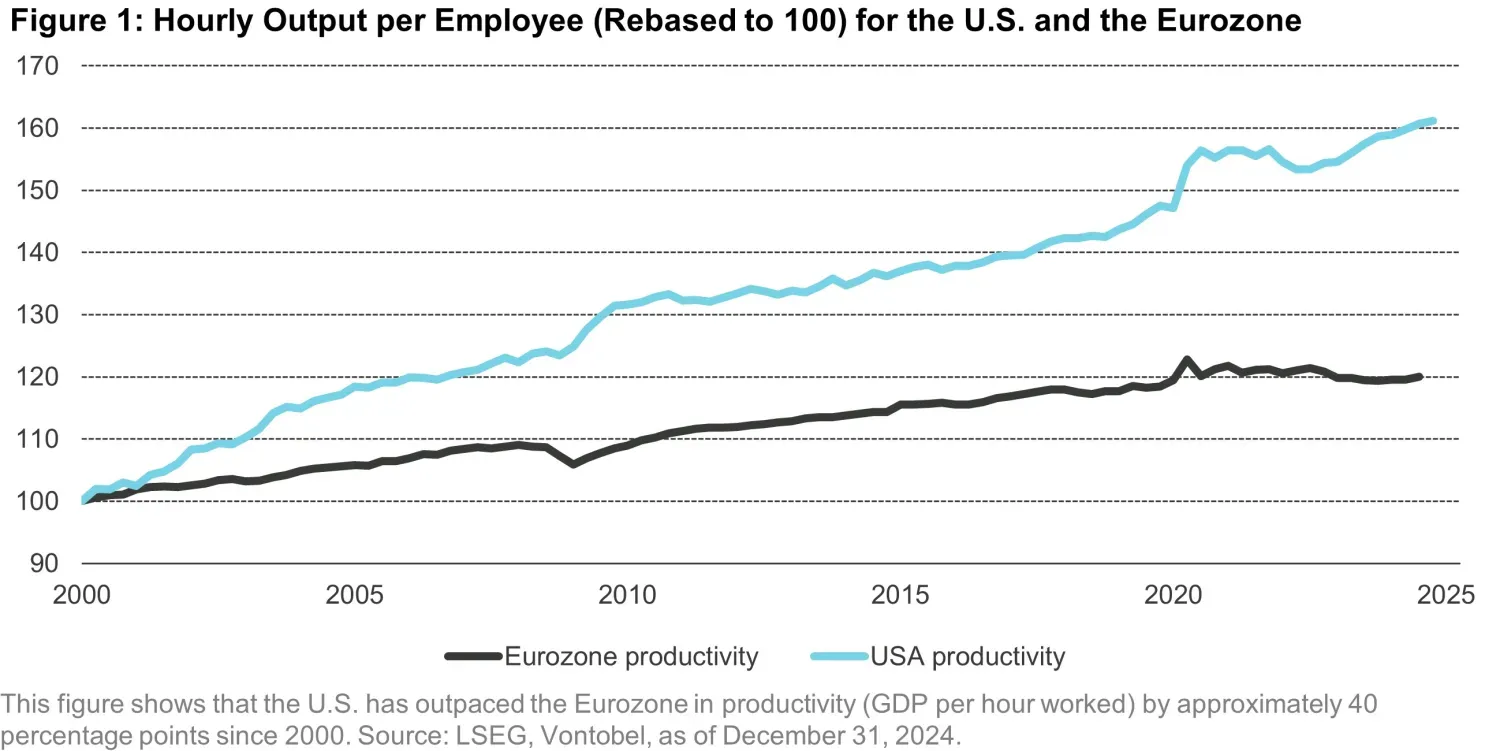
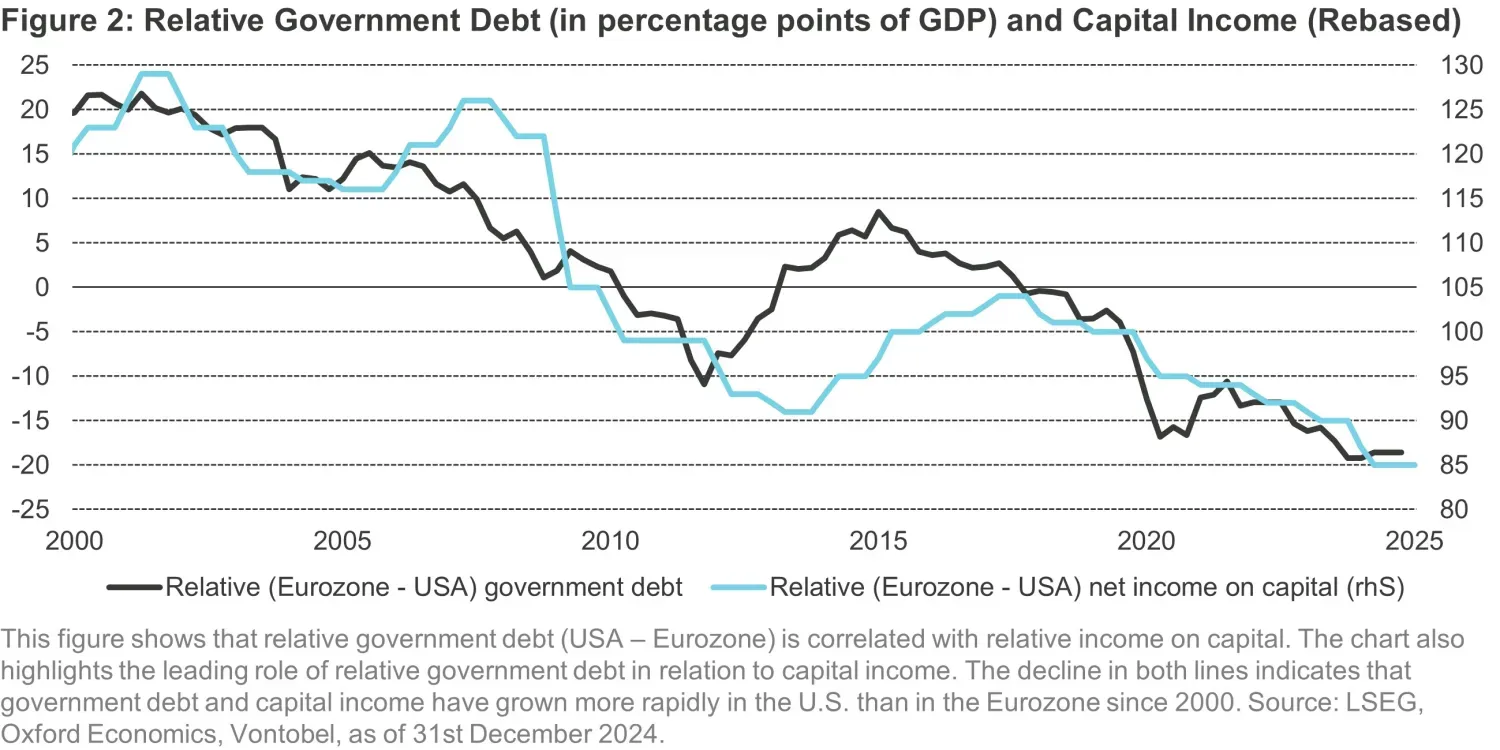
Europe’s incomplete integration has also deepened another challenge: weak productivity, which is shown in Figure 1, where hourly output per employee across the U.S. and European are plotted over the last quarter of century (rebased to 100 at the beginning of the millennium). After the debt crisis, several Eurozone economies teetered on the brink of collapse. In response, governments tightened fiscal rules, while Germany’s debt brake capped structural deficits. But this discipline came at a cost, limiting investment capacity and reducing returns on invested capital across the region as the capital stock aged. The link is clear and shown in Figure 2 —lower public investment has correlated with weaker productivity growth.
While corporate investment could have helped bridge the gap, the Great Financial Crisis brought tighter regulations, forcing businesses and banks to deleverage. This led to years of underinvestment, leaving Europe with lower returns on capital than the US—a key driver of asset prices.
The long-term impact? A drag for economic competitiveness. For Europe to close the gap, a more balanced approach to fiscal and corporate investment is essential5. Investors will be watching closely to see if policymakers take decisive action.
The energy squeeze: another drag on European profits
Beyond structural challenges, Europe has faced a historic headwind since 2022: the energy crisis. A sharp post-COVID recovery, combined with sanctions on Russia, sent global energy prices soaring. But while the US, with its energy self-sufficiency, was largely shielded, Europe—heavily reliant on Russian imports—bore the brunt.
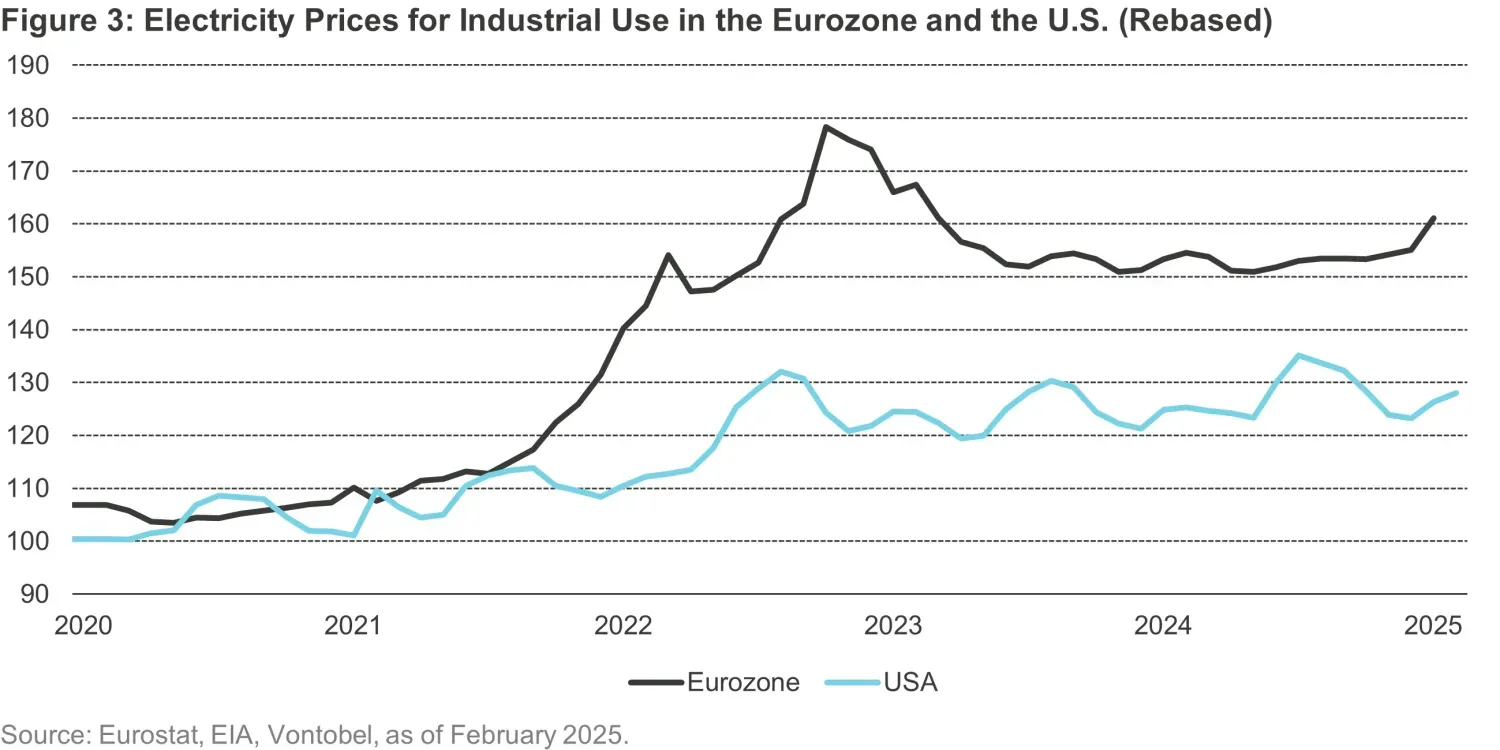
Between August 2020 and 2022, US natural gas prices rose from $2 to $8 per MMBtu. In Europe, they surged from $2 to $85, squeezing corporate profitability. The gap in electricity prices for industrial use between the two regions also widened, as shown in Figure 3. While price gaps have narrowed, they remain wide, continuing to weigh on European businesses.
For investors, the key question is whether Europe can secure more stable and competitive energy sources—or if high costs will remain a structural drag on corporate earnings6.
A turning point for Europe?
With Germany loosening fiscal constraints and Donald Trump’s disruptive policies pushing European leaders into action, the outlook for Europe is shifting. While key figures like Emmanuel Macron and Friedrich Merz do not advocate for greater European federalism, there is growing recognition that overregulation has hindered growth. If Merz joins the German government, the previously strained Franco-German relationship could improve, paving the way for more coordinated and pragmatic policies7.
Germany’s fiscal stance is evolving. A likely CDU/CSU-SPD coalition plans to allocate several hundred billion euros to infrastructure, artificial intelligence, and defense, signaling a clear departure from past austerity. Proposals to reform the debt brake and sidestep restrictions on defense spending signal the end of strict fiscal conservatism. This shift could unlock higher investment and capital formation, with positive spillover effects across Europe.
Meanwhile, one of Europe’s biggest headwinds—elevated energy costs—may begin to ease. Shifting sentiment in Ukraine, Europe, and the US suggests a growing push for peace. With the US halting financial aid to Ukraine, pressure for negotiations is increasing. If the war moves toward resolution, what was a drag on European growth could become a catalyst for recovery.
At the same time, private sector deleveraging is already well advanced in many European economies, setting the stage for stronger investment and expansion. For investors, the question is no longer whether Europe can grow, but how much momentum it can build over the next five years.
How we navigate
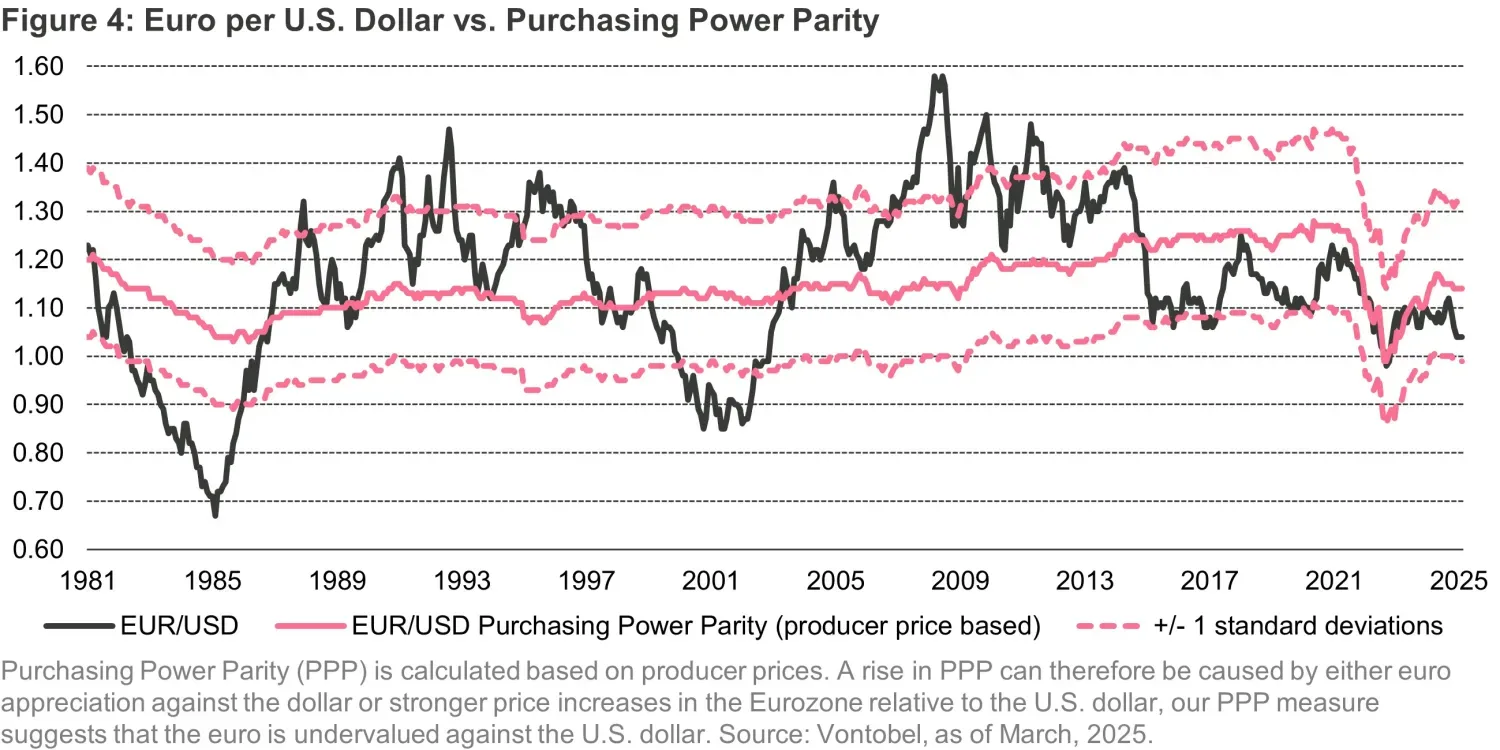
Given the recent strong performance of European equities, particularly relative to U.S. markets, we prefer to express our constructive medium-term view on cyclical European assets through an overweight position in the euro rather than equities, especially in the current volatile market environment. Additionally, news on reciprocal tariffs could temporarily sour sentiment and result in a disproportionately larger impact on equities, which, for the time being, holds us back from taking an outright long position in European equities. As highlighted in our latest Quanta Byte, valuation matters—and the Euro is currently undervalued by around 9%8 along Purchasing Power Parity arguments as shown in Figure 4.
In our view, monetary policy easing in the Eurozone is more advanced than in the US. While US growth is slowing from higher-than-normal levels, the Eurozone is recovering from near-zero growth in the first half of last year, creating a more favorable environment for the currency.
The biggest risk to our positive outlook on Europe is a potential decline in political will, particularly in Germany. While challenges remain—such as the need for a two-thirds majority in the Bundestag to reform the debt brake and resistance from the Green party—there is broad recognition across major parties of the need for increased infrastructure spending. Both the Green party and others are committed to meeting defense expenditure targets of 2% of GDP or more.
In short, while challenges remain, the broader direction is positive. The Euro is undervalued, and fiscal policy is shifting toward more investment, providing a solid foundation for growth and a medium-term constructive outlook for European equities.
1. See “Humble New Year Resolutions” for our assessment of market risks in 2025.
2. See Olaf Scholz’s “Zeitenwende” speech delivered on February 27, 2022, which called for higher military spending, a stronger German role in NATO, and an urgent reduction in Germany’s dependence on Russian oil and gas.
3. See for example “Towards a Genuine Economic and Monetary Union”, European Council, June 2012
4. See the ECB Monetary Dialogue “10 years after ‘whatever it takes’: fragmentation risk in the current context” for the economic implications of market fragmentation.
5. See the ECB keynote speech by the ECB Vice President Luis de Guindos “Bridging the gap: reviving the euro area’s productivity growth through innovation, investment and integration for a good summary of the discussion.
6. See the European Commission Discussion Paper “Navigating Shocks: The Performance of the EU Corporate Sector from the Pandemic to the Energy Crisis” for a detailed discussion.
7. See the Economist “Can Friedrich Merz get Europe out of its funk?” as of March 5, 2025
8. In the above analysis, we are using producer prices. According to Purchasing Power Parity based on consumer prices, the euro is undervalued by 16% against the U.S. dollar.
This marketing document was produced by one or more companies of the Vontobel Group (collectively "Vontobel") for institutional clients.
This document is for information purposes only and nothing contained in this document should constitute a solicitation, or offer, or recommendation, to buy or sell any investment instruments, to effect any transactions, or to conclude any legal act of any kind whatsoever.
Although Vontobel believes that the information provided in this document is based on reliable sources, it cannot assume responsibility for the quality, correctness, timeliness or completeness of the information contained in this document. Except as permitted under applicable copyright laws, none of this information may be reproduced, adapted, uploaded to a third party, linked to, framed, performed in public, distributed or transmitted in any form by any process without the specific written consent of Vontobel. To the maximum extent permitted by law, Vontobel will not be liable in any way for any loss or damage suffered by you through use or access to this information, or Vontobel’s failure to provide this information. Our liability for negligence, breach of contract or contravention of any law as a result of our failure to provide this information or any part of it, or for any problems with this information, which cannot be lawfully excluded, is limited, at our option and to the maximum extent permitted by law, to resupplying this information or any part of it to you, or to paying for the resupply of this information or any part of it to you. Neither this document nor any copy of it may be distributed in any jurisdiction where its distribution may be restricted by law. Persons who receive this document should make themselves aware of and adhere to any such restrictions. In particular, this document must not be distributed or handed over to US persons and must not be distributed in the USA.
Sobre el autor

Fondos relacionados
Sobre el autor
Temas:
Ver siguiente:
Towers and the Starlink ThreatInsights relacionados

Towers and the Starlink Threat

Perspectivas Trimestrales sobre Materias Primas – Pitido de Descanso: Los fundamentales saltan al campo de juego

Investors’ Outlook: Y ahora, algo completamente diferente

Investors’ Outlook: Ajustando el enfoque

Investors’ Outlook: Sin rodeos en el estrecho
