
Humble New Year Resolutions
Multi Asset Boutique
Equities have delivered exceptional returns year to date, with global markets (MSCI World All Countries) rising 22% and the S&P 500 surging 28%. Investors would be tempted to assume continuation of the favorable trend. While we don’t disagree, as we step into 2025, there are reasons to approach the market with caution. In this article, we’ll update you on which data we’re looking at, and what we’re making of if for our positioning.
The past two years of equity gains are historically remarkable. Consecutive S&P 500 annual returns exceeding 20%—as seen in 2023 and 2024—have occurred, on average, just once per decade since 1900, with the last instance in the 1990s. Historical data also suggests only a 7% likelihood of another positive year after such strong back-to-back performances.
As we plan for 2025, these insights encourage us to set humble resolutions, balancing optimism with prudence.
Sentiment Suggests Caution
Market sentiment reinforces a cautious outlook. The CNN "Fear & Greed Index" does not indicate extreme greed, partly because the rally has been driven by the "Magnificent Seven" stocks. However, several sub-indicators warrant prudence1.
For instance, Put/Call Ratios show a reduced appetite for downside protection, signaling complacency among investors. Additionally, bullish sentiment among retail and institutional investors is nearing a decade high, making equities an increasingly crowded trade.
As we consider positioning for 2025, these signals remind us of the importance of balancing opportunity with risk awareness.
Macro suggests optimism…
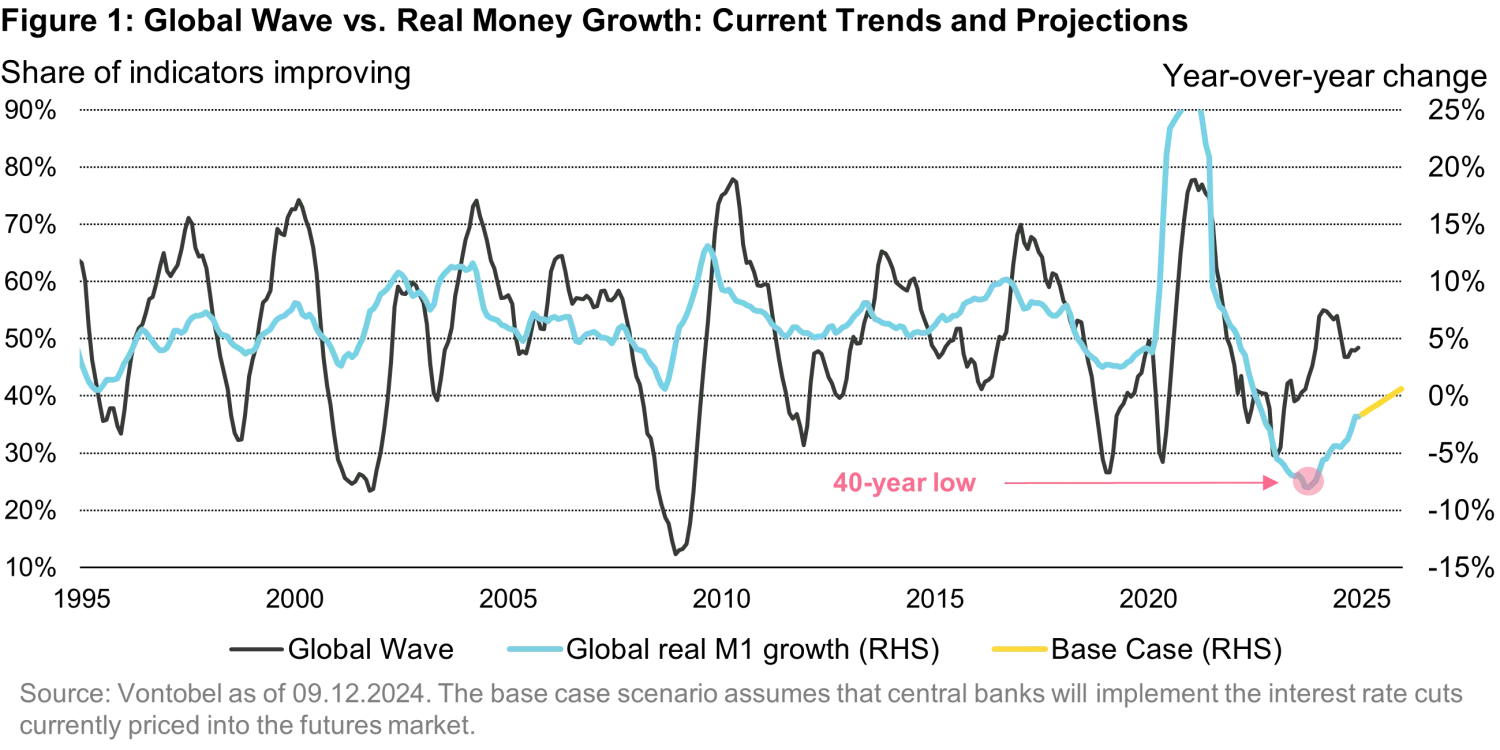
While current market sentiment appears somewhat overly optimistic, the economic outlook has improved since early 2024. Our business cycle indicator Wave2, illustrated in Figure 1, has shown signs of strengthening momentum in recent months. As depicted in Figure 1, where the Wave indicator (black line referenced on the left axis, denoting the share of macro indicators that are improving vs. a year ago) is plotted along an indicator of monetary supply (M1 growth, cyan line referenced on the y-axis), we are currently in a situation where the macro environment is improving, and the monetary supply is coming off of its 40-years low, both of which are supportive of risky assets, including equities.
Declining corporate and household leverage ratios since the Great Financial Crisis have bolstered the resilience of developed market economies3. This resilience has allowed private sector balance sheets to manage the lagged impact of the most aggressive policy tightening cycle in decades relatively well4.
As central banks are expected to continue easing, the economic strain from earlier tightening should gradually subside. Assuming central banks deliver what future markets currently anticipate, real money growth is projected to return to positive territory in the second half of 2025. This is our base case estimate, as depicted by the yellow line in Figure 1.
…and seasonality too
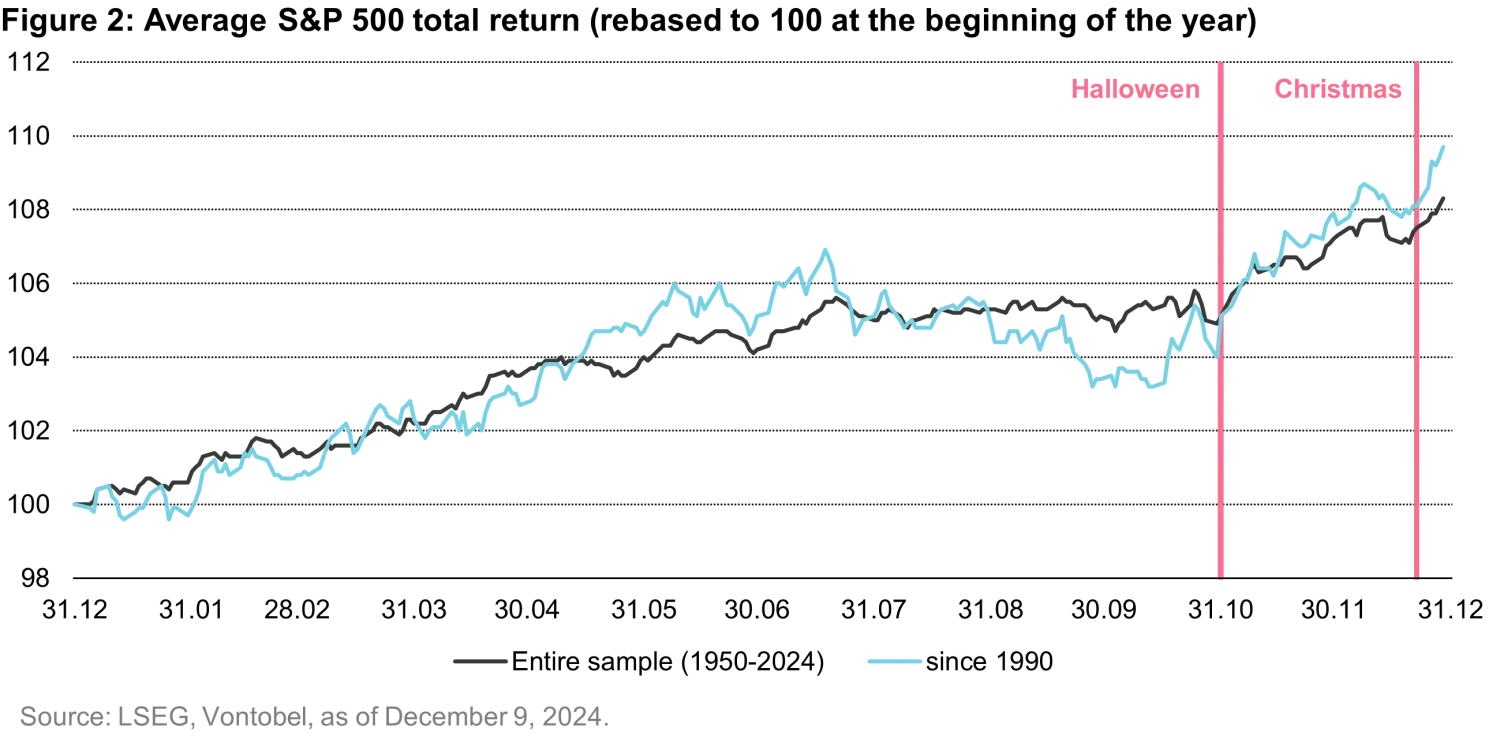
Despite the strong rally in 2024—which seems difficult to replicate—a continuation of the year-end rally into the new year is not uncommon. Over the past 50 years, U.S. equity markets have averaged a 4% gain in the last two months of the year, with these rallies often extending into the next. Historically, about 70% of U.S. equity returns occur between November and March.
Being underweight in equities at the start of the year has historically been costly for investors, a trend that has intensified since the 1990s. As shown in Figure 2, S&P 500 gains tend to be strong in the first quarter and even more pronounced toward year-end.
To avoid missing out on a continuing equity market rally, as indicated by our Wave indicator, we plan to maintain outright equity exposure. However, rising optimism and the risk of a market correction call for caution. To address this, we aim to increase hedges on market strength. Alongside existing positions, such as the yen, we are prepared to trade some equity upside for downside protection through equity index puts. Compared to outright long-duration positions, equity options appear more suitable as a hedge in a multi-asset context, as a strong bond rally would require significant macroeconomic deterioration—an outcome not currently supported by our Wave indicator.
1. You will find the “Fear and Greed Index” and its breakdown here.
2. See “The Vontobel Wave – a superior business-cycle model” for more on our business-cycle model.
3. We have elaborated in recent years on the increased resilience of financial corporations in “Breaking stuff is part of the Fed’s job” and on the household sector in “Fed pivot postponed”
4. The still significant negative growth rate of our preferred liquidity measure suggests that the impact of past policy tightening is ongoing.
This marketing document was produced by one or more companies of the Vontobel Group (collectively "Vontobel") for institutional clients.. This document is for information purposes only and nothing contained in this document should constitute a solicitation, or offer, or recommendation, to buy or sell any investment instruments, to effect any transactions, or to conclude any legal act of any kind whatsoever.. Although Vontobel believes that the information provided in this document is based on reliable sources, it cannot assume responsibility for the quality, correctness, timeliness or completeness of the information contained in this document. Except as permitted under applicable copyright laws, none of this information may be reproduced, adapted, uploaded to a third party, linked to, framed, performed in public, distributed or transmitted in any form by any process without the specific written consent of Vontobel. To the maximum extent permitted by law, Vontobel will not be liable in any way for any loss or damage suffered by you through use or access to this information, or Vontobel’s failure to provide this information. Our liability for negligence, breach of contract or contravention of any law as a result of our failure to provide this information or any part of it, or for any problems with this information, which cannot be lawfully excluded, is limited, at our option and to the maximum extent permitted by law, to resupplying this information or any part of it to you, or to paying for the resupply of this information or any part of it to you. Neither this document nor any copy of it may be distributed in any jurisdiction where its distribution may be restricted by law. Persons who receive this document should make themselves aware of and adhere to any such restrictions. In particular, this document must not be distributed or handed over to US persons and must not be distributed in the USA.
About the author

Related funds
About the author
Explore related topics:
Up next:
Towers and the Starlink ThreatRelated insights

Towers and the Starlink Threat

Quarterly Commodity Outlook - Halftime Whistle: Fundamentals Take the Field

Investors’ Outlook: And now for something completely different

Investors’ Outlook: Adjusting the focus

Investors’ Outlook: Strait forward
