Fixed Income Boutique
Based in Zurich and New York, the Fixed Income Boutique is an active manager aiming to capitalize on market trends and inefficiencies.

Speed, breakdowns, crashes, acceleration, and low margin for error. All part of the theater of Formula One racing. Also, all qualities in common with high-yield bond investing, except for one. While Formula One is steeped in glamour, high yield is not.
High yield is the place in bond investing where the unloved bonds reside – the beaten up, the fragile, and the shunned. But it’s also the universe of hope and promise, with rising stars, like Lewis Hamilton in 2007. It’s this combination of uncertainty and aspiration that create opportunities and generate returns for diligent investors.
From the start of 2020 to today, the high-yield market has been one eventful Grand Prix, with fast-changing conditions and a real test of investors’ driving skills – Monaco’s street circuit pales in comparison.
For high yield, 2020 started off quick in fair weather, accelerating the market to 3% until mid-February. Then, as we all know, a torrential downpour flooded the market in March in the form of a global pandemic with high yield sliding to the tune of -20%. From there it was a long and bumpy ride, until the sun came out again. Now, with the roll out of vaccinations, the road ahead is drying out and we see the high-yield market back in black, doing better than most fixed-income asset classes.
This experiences of the past year hold important lessons for high-yield investors. During the ride, there were several critical situations, when stress-resistance, experience, and the ability to make quick decisions were tested.
In Formula One, tiny differences in lap times lead to significant differences in performance over time. It’s the same in high-yield bonds, and this is where active investing can be the differentiator. Through thorough bottom-up credit analysis and a willingness to take immediate action when needed, we believe an active approach to high-yield bonds can deliver attractive long-term risk-adjusted returns.
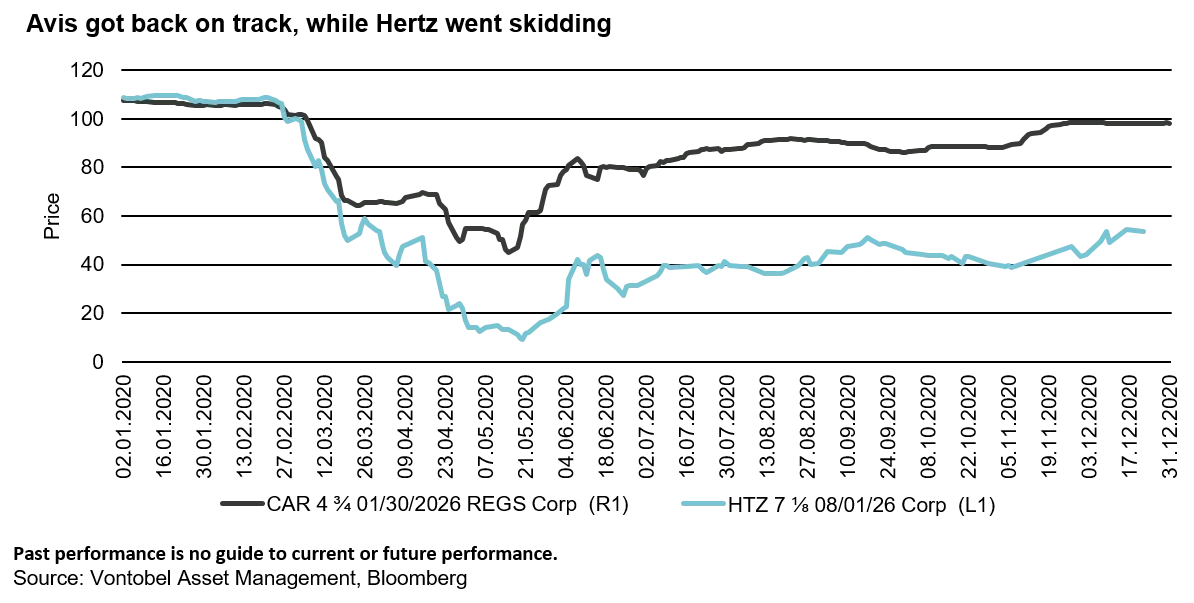
Let’s look at an example, using two instantly recognizable rivals: Hertz and Avis, the global rent-a-car giants. This was one of the sectors hardest hit by the pandemic. Leisure and business travel came to a standstill as business meetings went from face-to-face to Facetime and leisure travel to the Costa Del Sol became prohibido.
Given the positive economic outlook at the beginning of 2020, we were more confident than most on the travel segment and car rental companies in particular. During that time it was a case of avoiding crashes – a major and non-recoverable price decline due to a default or restructuring. The way to avoid a crash, when the market is facing a storm, is for a firm to have sufficient liquidity (cash or readily available cash) to ride out the bad weather, and manageable leverage and short-term debt obligations.
By their very nature, high-yield firms often have higher than average leverage and lower than average liquidity, so it takes a considerable amount of bottom-up analysis and a deep knowledge of the companies to arrive at a true assessment of their viability. Just because you like a certain sector doesn’t mean everything there is a buy. Going into the corona pandemic we held both Hertz and Avis. From the start of the pandemic, we were convinced it would be temporary, but how long – a few or many months – that was something that we couldn’t predict for certain, although we had the feeling that complete shut-downs would not be too prolonged, with companies on the whole losing about a quarter of their cash flows. Therefore, it was necessary to take another close look at all our holdings to determine, which companies and bonds we felt could manage the shock and downturn over the long haul. This entailed precision work and examining:
Based on the above and other factors, we decided to sell our Hertz bonds due to a substantial default and restructuring risk given their weakened financial liquidity, their inability to service their debt obligations that were coming due soon and their much higher leverage. In sum, their margin for error was non-existent.
In contrast, we held onto Avis, even adding to our position at the lower prices on offer. Compared to Hertz, we saw Avis as the best-in-class company in the sector with more conservative leverage and better liquidity than its peers. Therefore, we felt Avis would be a survivor. The bonds of both companies dropped significantly – at times to reach just over 50 (see chart). Despite some scary market noise, Avis’ financial and operational profile was sounder than thought, and the bonds recovered back to par, while Hertz was forced into Chapter 11 for restructuring.
While in Formula One the attention and glory falls on the drivers, in reality it’s a team sport . It’s no different when it comes to high-yield investing, the real success happens in the background. It is a team effort by analysts and portfolio managers and a diligent adherence to tried-and-tested credit selection processes, which are designed to uncover opportunities. It is this work, done in the background and based on years of credit analysis experience that decides the outcome of the race.