Quality Growth
Global equities specialists since 1984. We provide a boutique investment experience for institutional and intermediary clients around the world.

For centuries, inventors chased the perpetual motion machine, a device that would run forever and produce energy at no cost. They all failed. The laws of thermodynamics are unforgiving: energy does not come from nothing, and it cannot be converted without loss. There is no free energy. There is only energy at a price.
In investing, stock prices follow earnings growth over the long run, but growth is never free. Its price is risk; growth without risk would be a perpetual motion machine. Growth indicates activity in the future. The faster the growth rate, the more the value of a stock rests in future years, with a wider range of possible outcomes. And just as a well-oiled machine works with the least loss of energy, we believe quality is what allows an investor to maximize growth with the least amount of risk.
Today's AI cycle is a clear example. The technology is real, but real technology does not automatically translate into returns. History shows that change takes longer than expected: electricity took 40 years to transform the factory floor. We know that hyperscalers are investing roughly $750 billion in AI infrastructure in 2026 alone, trillions of dollars cumulatively over the decade. What we don’t know is what the returns will be or when they will come.
Meanwhile, semiconductors and AI-related stocks are leading market returns. They are the fastest-growing segment in revenues and profits, yet the sustainability of that growth rests on the future profitability of the AI ecosystem, namely hyperscalers and the large language models (LLMs).
Maximizing portfolio growth without considering risk is easy but not sustainable. A portfolio of pure AI stocks would have outperformed the benchmark over the last twelve months, but as the old saying goes, it is never wise to put all of your eggs in one basket. The art of portfolio management is maximizing growth per unit of risk.
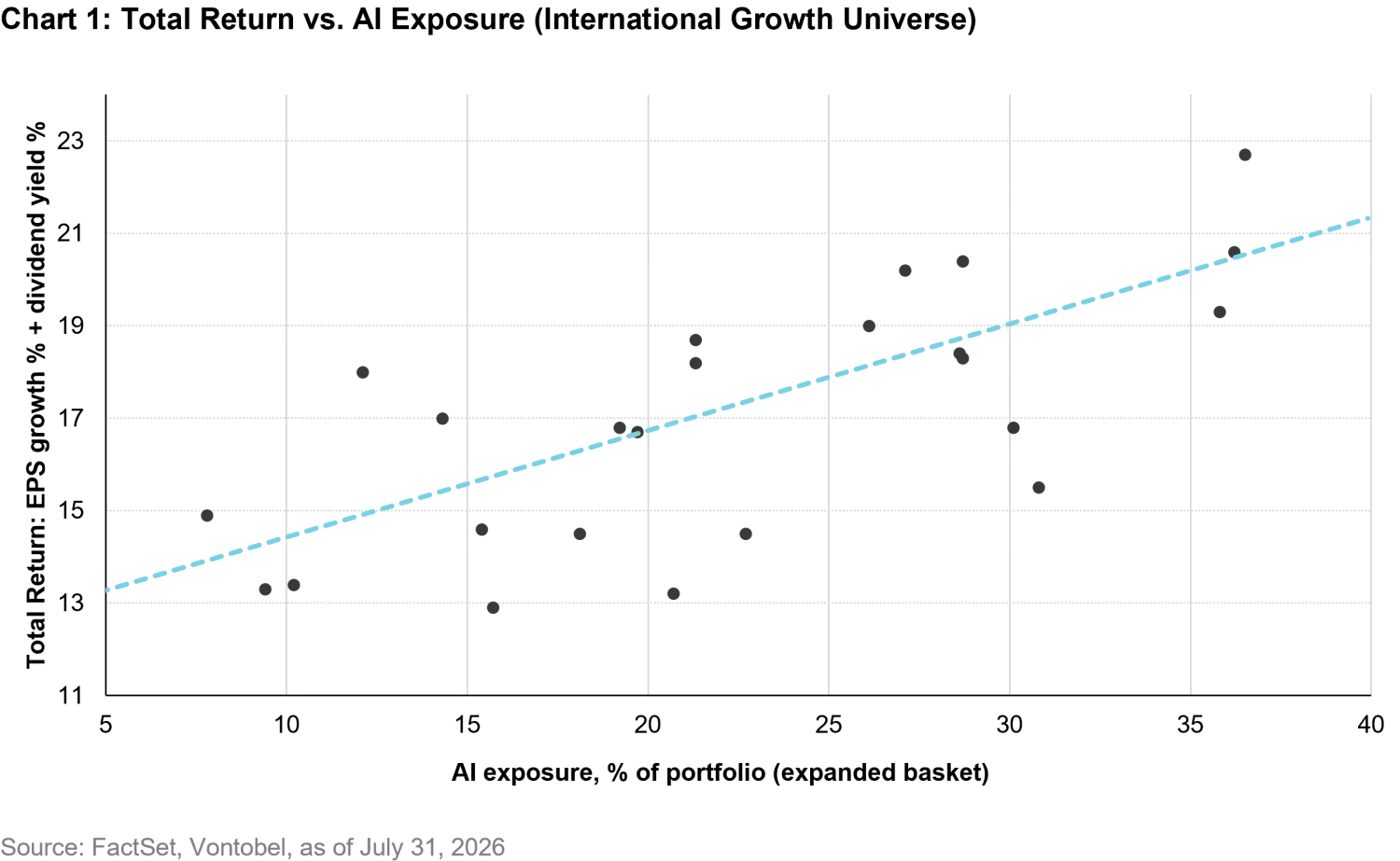
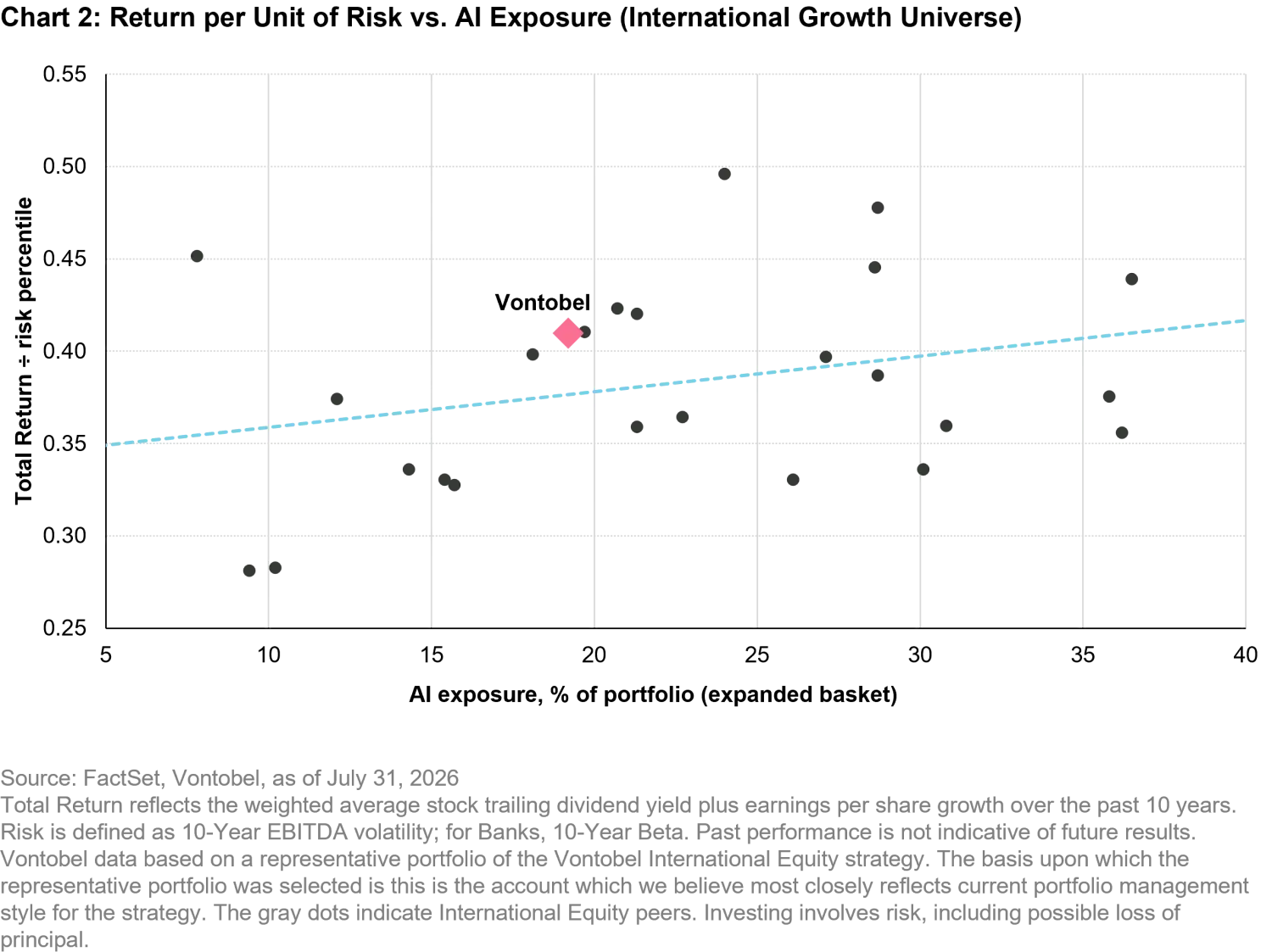
As Chart 1 indicates, there is a strong correlation between a portfolio’s AI exposure and its total return (earnings per share (EPS) growth + dividend yield). Nevertheless, higher AI exposure does not always compensate for the extra unit of risk (Chart 2).
To improve the risk/return relationship, we classify quality companies into three groups.
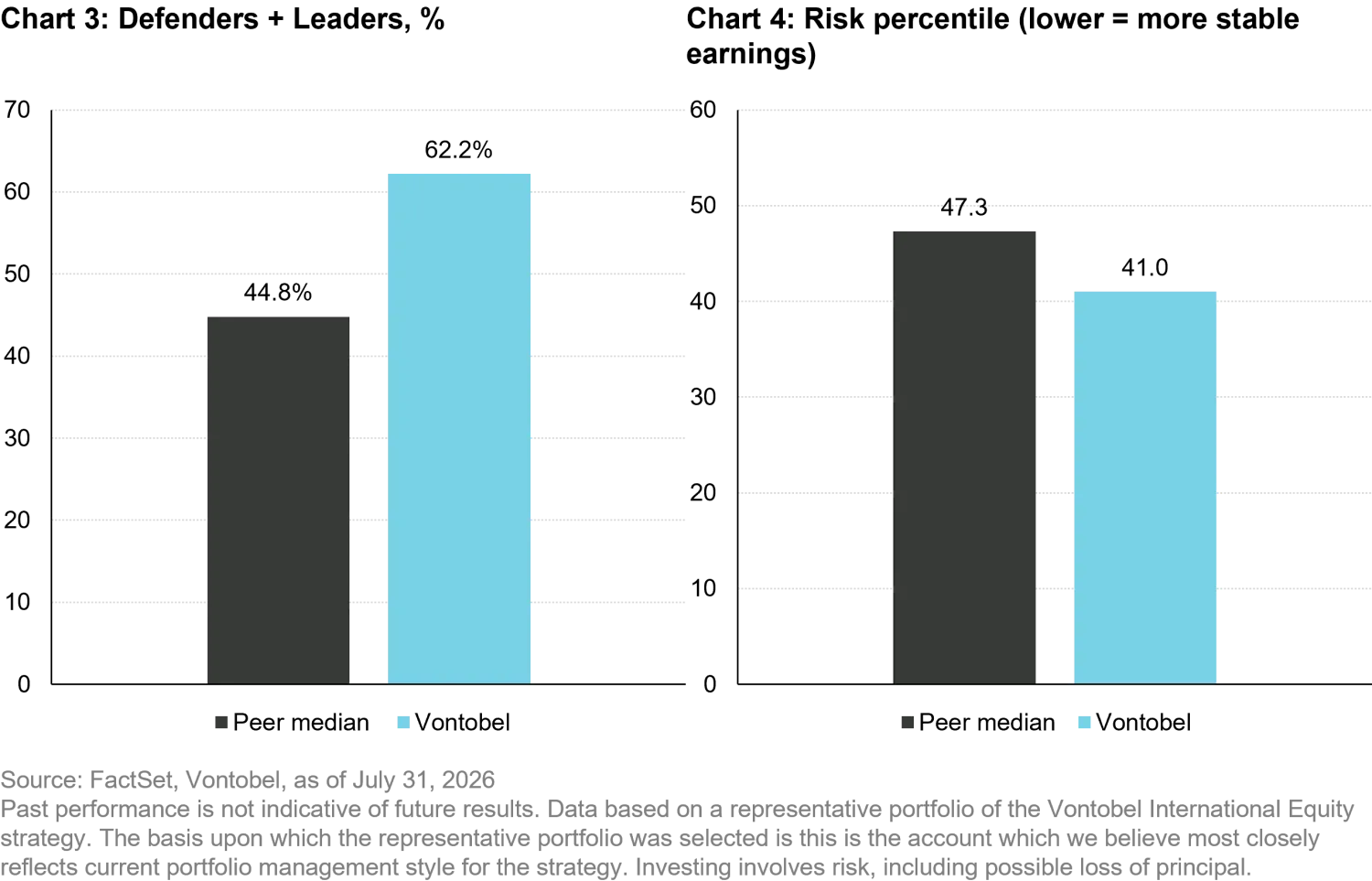
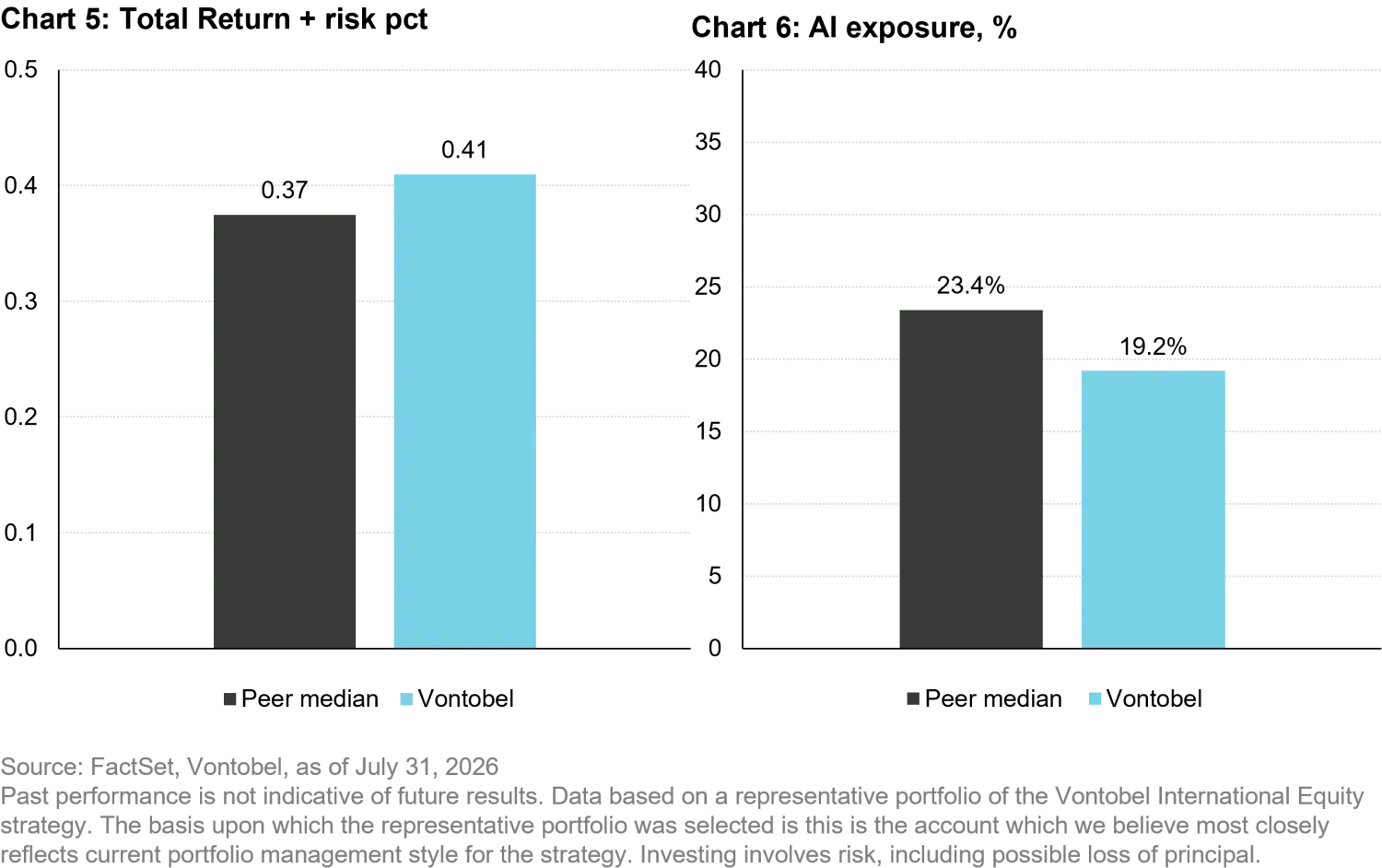
The discipline is in the proportions. We aim to keep at least 60 percent of the portfolio in the lower-risk core, Defenders and Leaders, enough to target returns well above the benchmark with lower market risk than the index. The Vontobel International Equity strategy holds a higher exposure to Defenders and Leaders than the peer median and a lower exposure to AI, and it still delivers a higher return per unit of risk (Charts 3–6).
There is no free lunch in investing. Growth pays for returns; risk pays for growth; no machine runs without fuel. The skill is in the trade-off. We believe balance and situational awareness are what compounds.
Any projections or forward-looking statements regarding future events or the financial performance of countries, markets and/or investments are based on a variety of estimates and assumptions. There can be no assurance that the assumptions made in connection with such projections will prove accurate, and actual results may differ materially.