Quality Growth
Global equities specialists since 1984. We provide a boutique investment experience for institutional and intermediary clients around the world.

“The reports of my death are greatly exaggerated,” Mark Twain famously told a reporter in 1897 after rumors circulated that he had died. Most quality managers have lagged the market over the last fourteen months, ourselves included, and clients and consultants are asking a fair question: is quality investing dead?
In this article, we explain why we believe the rumors about the death of quality investing may also be greatly exaggerated. Recent underperformance has been driven by an extreme concentration of returns in a small group of stocks, mostly those tied to artificial intelligence (AI) infrastructure, which have outperformed the market by a wide margin. Based on our analysis, these concentration levels are among the highest we have seen in the last decade, including during the years when the Magnificent Seven carried the benchmark, and comparable only to the internet bubble of 1998 to 2000. As another quote attributed to Twain suggests, “History does not repeat itself, but it often rhymes.”
Something changed in mid-2025, and it changed across a number of major markets at the same time. From July 2017 to June 2025, a basket of quality stocks outperformed its benchmark more often than the rest of the market – about half the time in the US and two-thirds of the time internationally. Since July 2025, however, those figures have fallen sharply to 22% and 15%, respectively, below the rest of the market for the first time in the sample.
Emerging markets (EM) declined less, from 64% to 43%, because a large number of the highest-quality EM stocks are in the semiconductor industry and linked to the AI trade. Breadth, defined as the share of all stocks outperforming the index, also dropped to the lowest reading in 10 years.
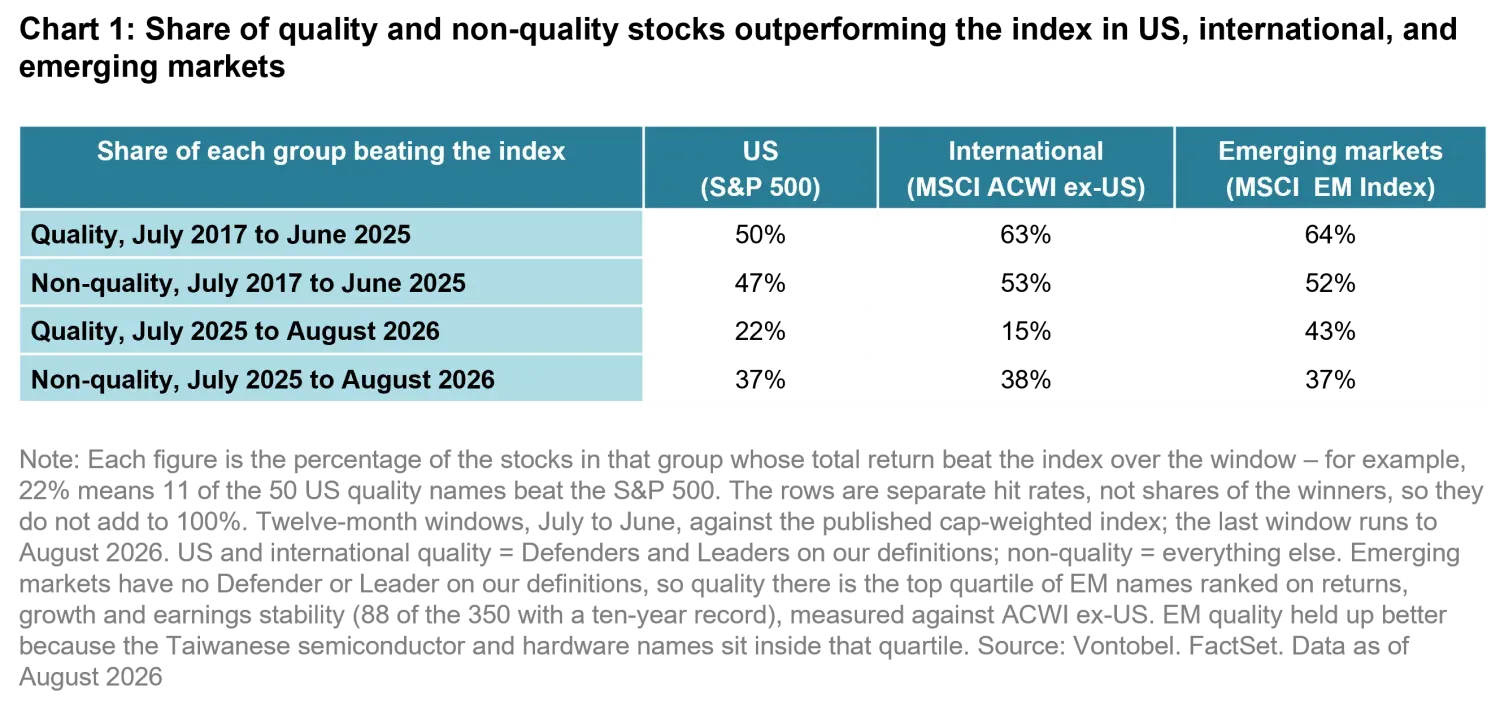
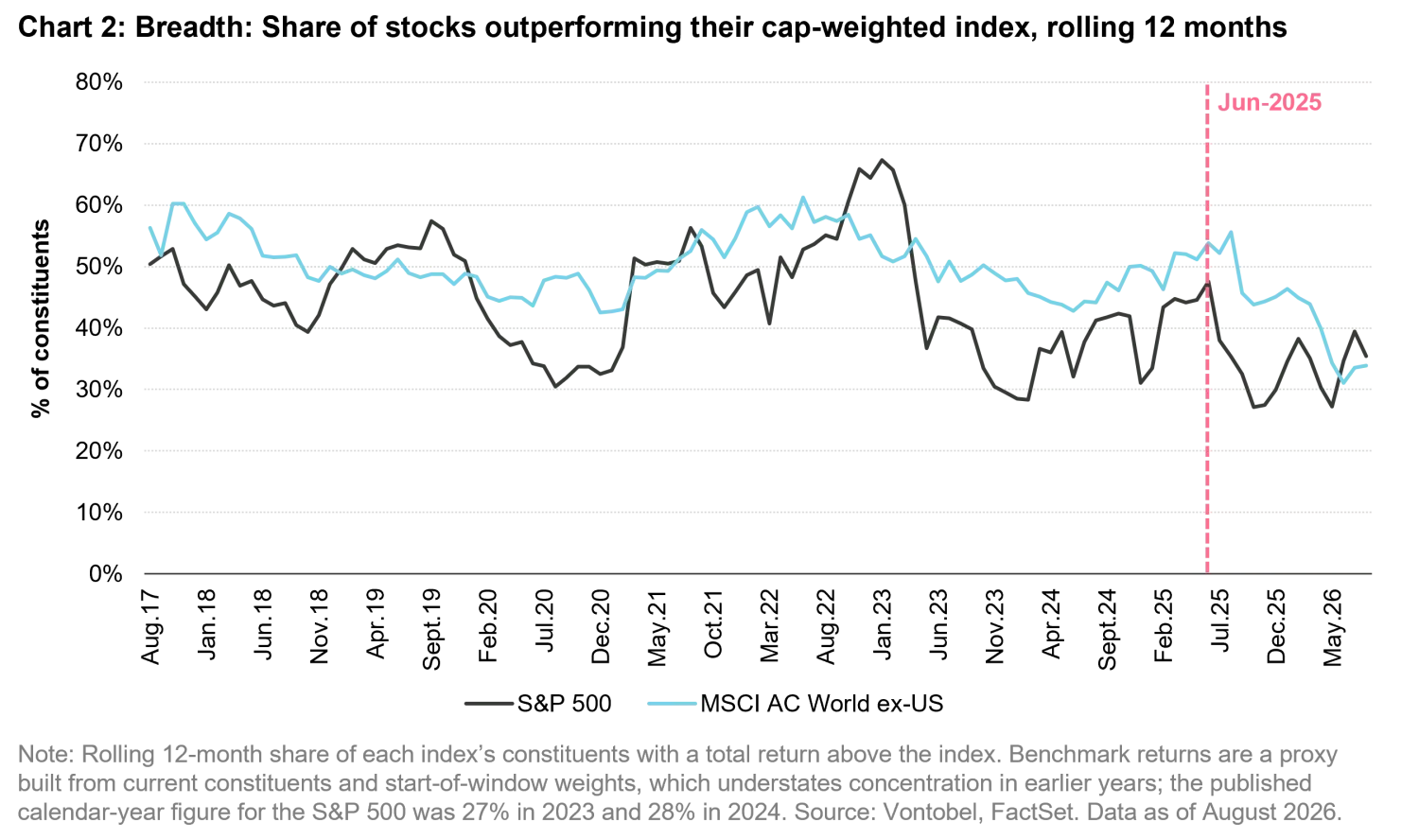
While the data may lead to the conclusion that quality stocks have underperformed over the last 14 months, it is interesting to note that the share of both quality and non-quality names outperforming the index declined during this period.
In our view, this suggests that quality investing did not stop working in the last 14 months; rather, the type of quality stock that outperformed changed.
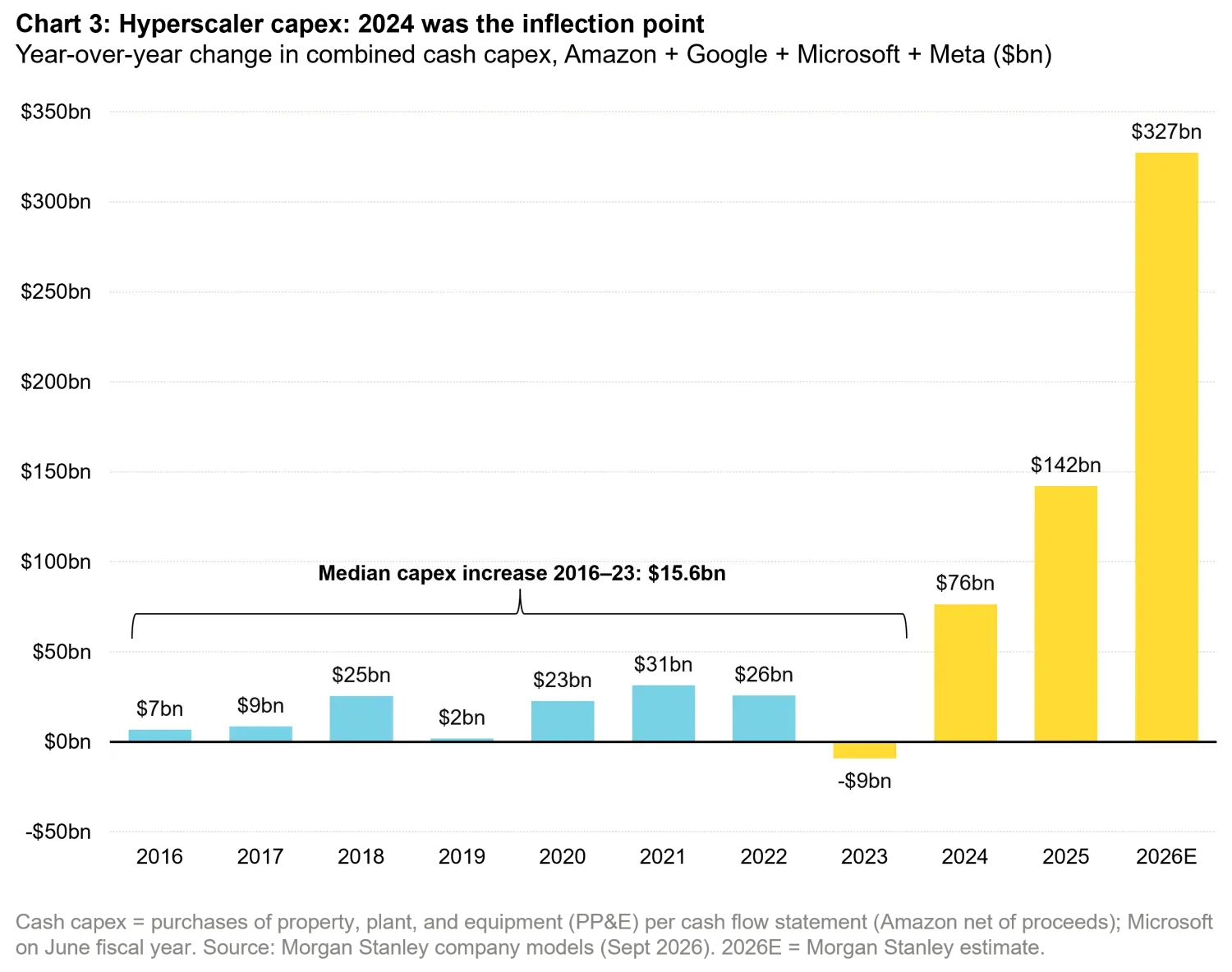
During the first period, outperformance was spread among a large number of sectors. In the second period, performance became heavily concentrated in the technology sector, particularly in stocks related to the AI trade. More than half of the total market outperformance came from the IT sector, and within it the top 10 names accounted for nearly 80% of the sector’s contribution – Micron, AMD, Nvidia, and SK Hynix among them, all linked to the large and fast-growing investment in AI infrastructure.
The number of sectors outperforming the index fell to just three out of 11 in both the US and international markets, the lowest level in 10 years for international equities. The spread in performance between the top and bottom deciles of stocks is close to a historical high.
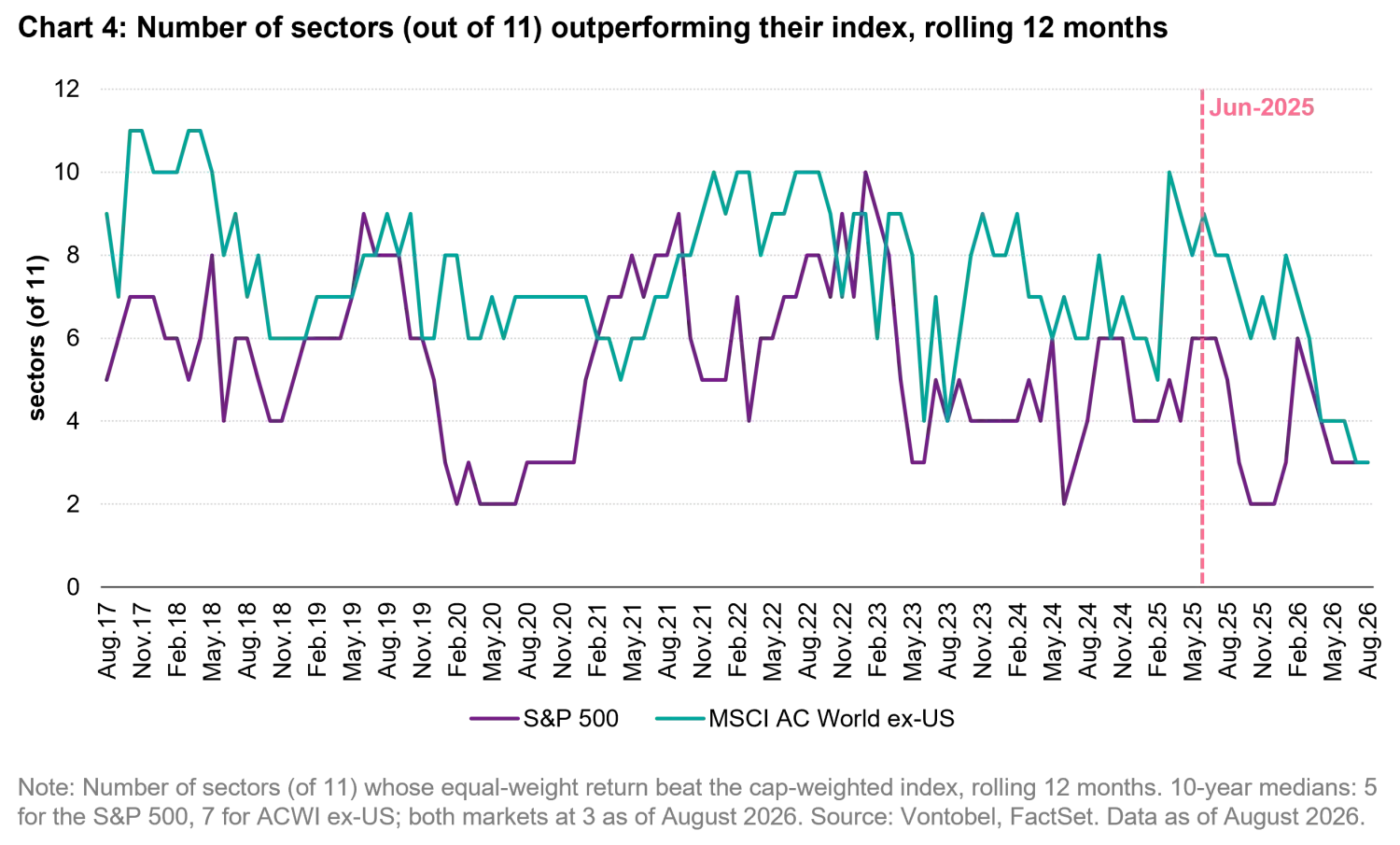
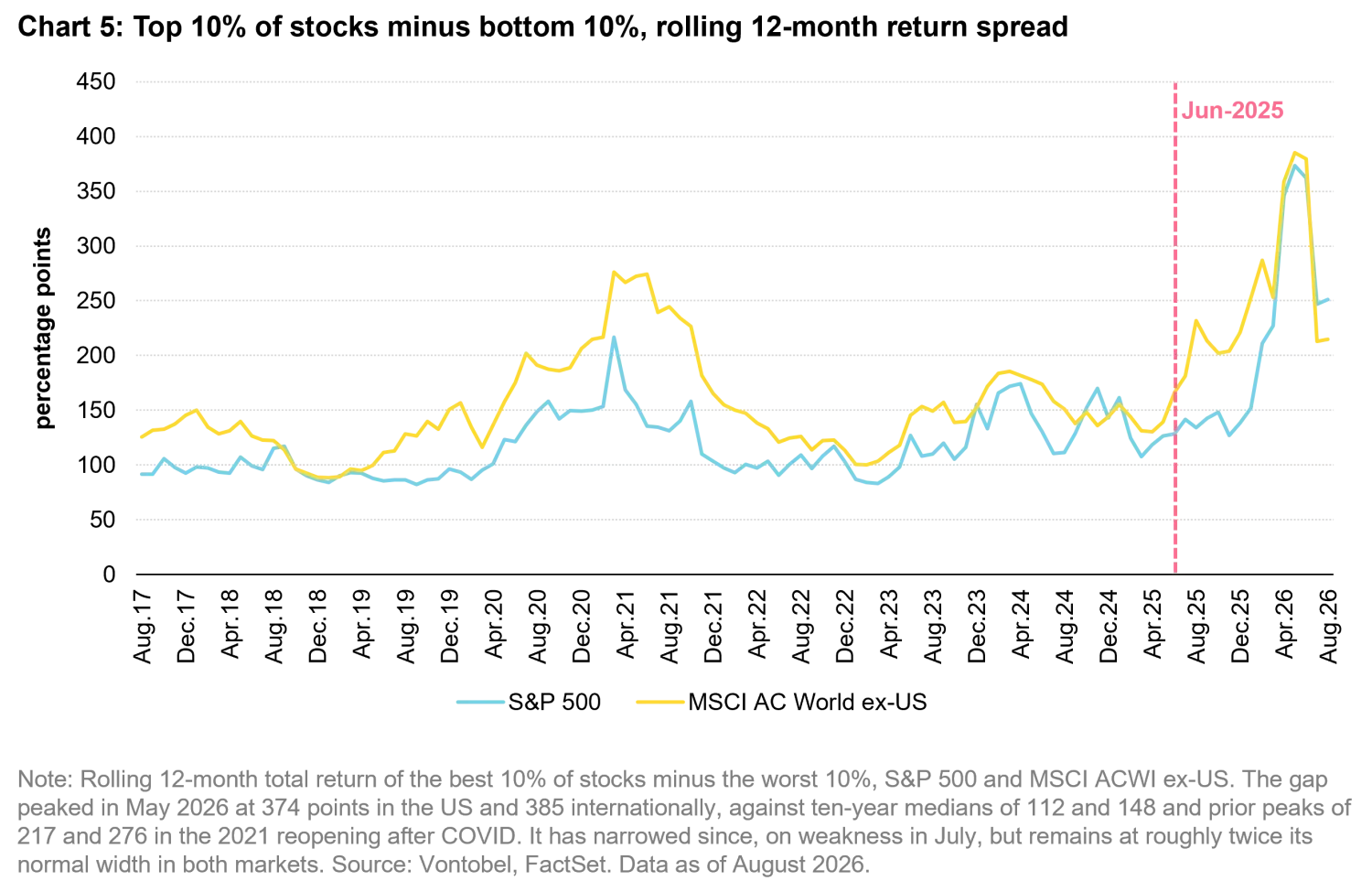
The closest precedent is the 1998–2000 period, and by the available measures today, the current period is already the more extreme of the two. The last time only a small minority of S&P 500 stocks beat the index two years in a row was in 1998 and 1999. In 2023 and 2024, the shares fell to 27% and 28%, respectively, the two lowest readings since 1980. The cap-weighted S&P 500’s three-year outperformance of its equal-weight version peaked at 31% in early 2000; by the end of 2025 it had reached 32%, a record. The 2000 episode unwound over roughly two years, and the broadening that followed was led by quality and value.1
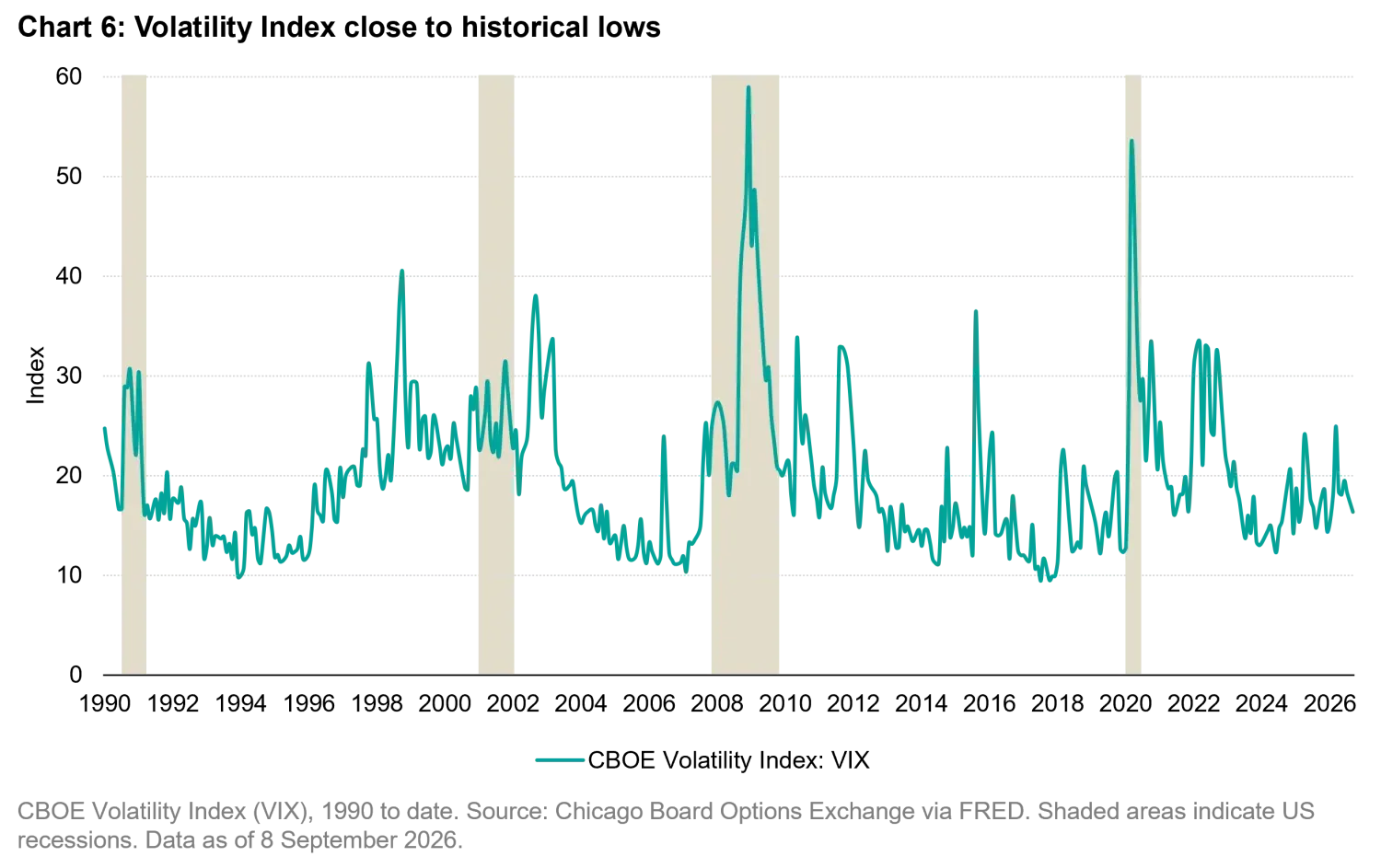
Benchmark leadership narrowed to a small group of companies expected to benefit from the future of AI. Due to their increasing correlation, they behaved less like independent securities and more like a single exposure. Common sense and chicken soup never go out of fashion and, as my mother used to say, never put all your eggs in one basket. Funny enough, the market does not seem concerned about this risk: the Volatility Index (VIX), also known as the fear index, is close to its historical lows despite a level of market concentration similar to the historical highs of 1999.
In practical terms, the extreme market concentration in AI names means that the chances of a manager picking 40–60 quality stocks across a range of sectors, to reduce correlation and to maintain downside protection, and still beating the market has become extremely low.
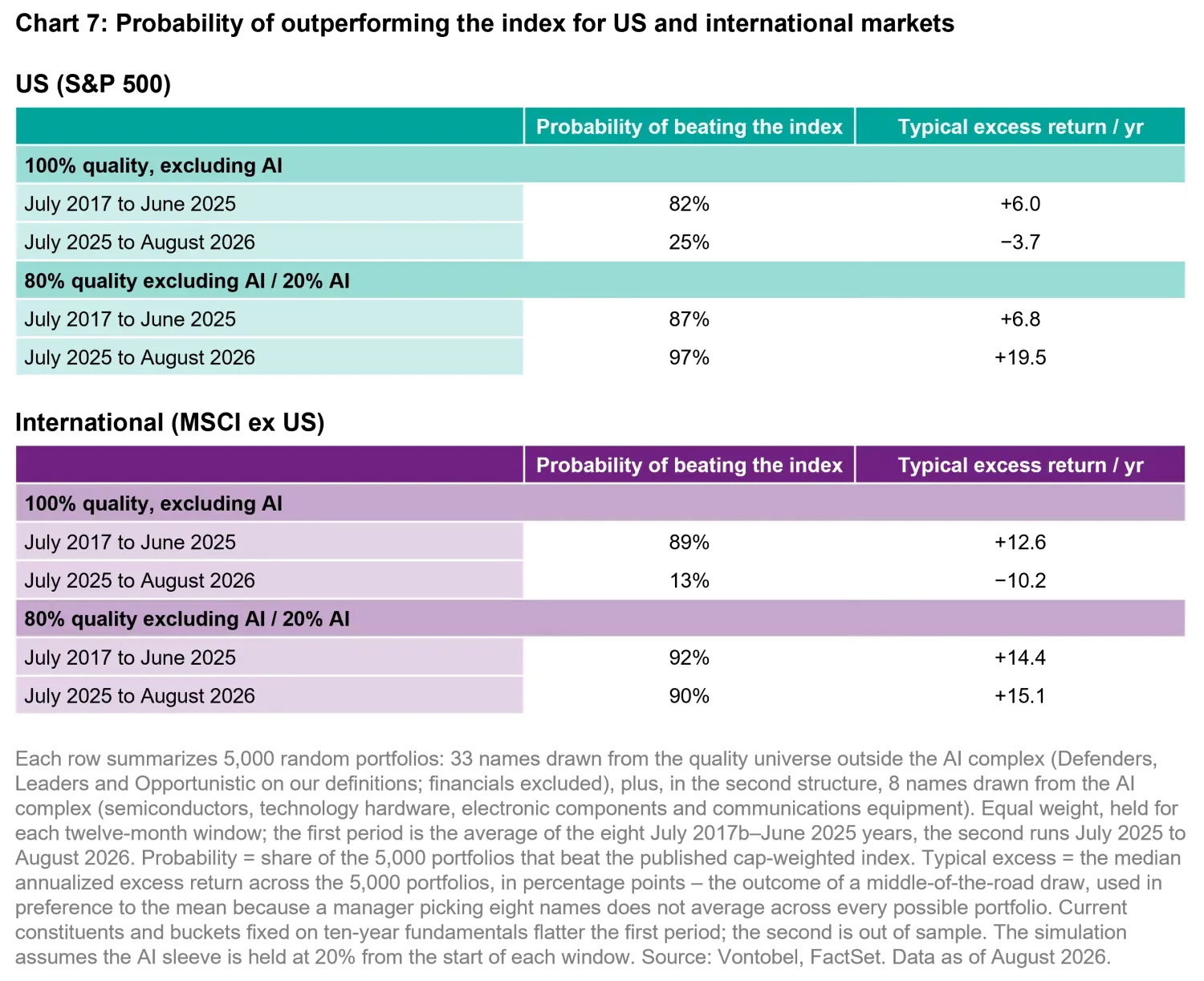
To put numbers behind it: in the first period (July 2017 to June 2025), the odds of a random portfolio of non-AI quality stocks beating the market were higher than 80%, with a typical excess return of about 6% a year in the US and 13% internationally. The contribution of AI-related stocks to that excess was marginal.
In the second period (July 2025 to August 2026), the odds of the same portfolio beating the market dropped to 25% in the US and 13% internationally, and the typical excess return turned negative in both. With a 20% sleeve of AI stocks, the probability of beating the market rises above 90% in both markets and the typical excess return recovers to about 20% and 15% a year. In the first period, AI played a marginal role; in the second period AI became the story.
For us, quality is a tool to manage risk, first and foremost. A great manager is right less than half of the time in stock picking2. Since the performance of a portfolio depends on the performance of the underlying stocks, in our view, a focus on quality can help reduce the risk of investment mistakes and support the potential for outperformance.
We believe a robust portfolio needs a multitude of drivers so that the positions are not all correlated. We seek to achieve that by structuring the portfolio across three main buckets – Defenders, Leaders, and Opportunistic. Defenders and Leaders are both highly predictable businesses, but Leaders tend to grow faster. Opportunistic are quality businesses that are more cyclical. To manage risk, we allocate at least 60% to Defenders and Leaders. AI stocks, the main driver of recent market performance, fit in our Opportunistic bucket. And, because the future of AI-related companies is so unpredictable, we have decided to keep our exposure at roughly 20%.
While recent results have been underwhelming, and performance is our reason to exist, we also believe that risk management is not a secondary goal. Quality, growth, and diversification remain the tripod of our approach.
We believe market conditions will eventually return to normal. Or maybe one day AI-related stocks will prove to be as predictable as death and taxes, and they could become a larger part of our portfolios. For now, though, predicting their future development can feel a little like forecasting weather in London, and we would rather carry an umbrella than regret getting caught in the rain.
1. Sources: S&P Dow Jones Indices, Dispersion, Volatility & Correlation Dashboard, Aug-2026 (S&P 500 dispersion since 1990); RBC Wealth Management, The “Great Narrowing”, Jan-2026 (cap- vs equal-weight three-year relative performance, 1993–2025); Barchart / The Motley Fool, Jan-2025 (share of S&P 500 stocks beating the index since 1980). All three series are for the S&P 500; the precedent is a US one.
2. Source: The Art of Execution by Lee Freeman-Shor