


Quality Growth
Global equities specialists since 1984. We provide a boutique investment experience for institutional and intermediary clients around the world.

From 2010 to 2023, investors in emerging markets (EM) endured a long stretch of disappointment. The MSCI Emerging Markets Index returned just 3% annualized during the period as a stronger US dollar, regulatory crackdowns in China, and the end of the commodity supercycle weighed heavily on performance. The asset class developed a reputation as a tactical trade, something to own briefly when the macro backdrop was favorable, rather than a market capable of generating sustained wealth through compounding.
Emerging markets have staged a decisive comeback, rising 34% in 2025 and a further 24% in the first half of 2026, comfortably outpacing developed markets. Yet what makes the current upswing interesting is not the magnitude of the rally, but the quality of its drivers. This does not look like a short-lived rebound fueled by a weaker dollar or improving commodity prices. Instead, the foundations appear broader, deeper, and more structural.
We believe the most visible catalyst is the global AI infrastructure buildout. Taiwan and South Korea have evolved from peripheral export economies into indispensable nodes in the global technology supply chain. TSMC has become one of the most significant semiconductor manufacturers globally, producing more than the entire US semiconductor industry. More broadly, emerging markets are home to many of the global leaders enabling the AI ecosystem, from semiconductor design and testing to substrates, power management, liquid cooling, and AI server assembly.
Recent volatility in AI-related stocks has understandably raised questions. Some concerns are valid. Investors are debating the sustainability of current spending levels, whether hyperscalers will ultimately earn attractive returns on their enormous capital investments, and how value will be distributed across the AI stack. We believe these debates are largely about economics and timing, not direction. The proliferation of AI remains one of the most significant technological shifts in decades, and emerging markets occupy a critical position in making that transformation possible.
Over the past decade, the composition of emerging markets has changed meaningfully. Traditional sectors such as energy, commodities, and financials have gradually ceded ground to technology, advanced manufacturing, and consumer-oriented businesses. As a result, earnings growth is becoming less dependent on commodity cycles and increasingly driven by innovation, productivity, and domestic demand. Consensus expectations continue to call for double-digit earnings growth in FY26 even after excluding the technology sector.
We believe the policy backdrop has also improved. In China, regulators have apparently moved away from the period of abrupt and often unpredictable intervention that weighed on investor confidence, adopting a more transparent and growth-supportive approach. Across many emerging economies, macroeconomic credibility has strengthened as well, reflected in earlier and more disciplined monetary tightening cycles, positive real interest rates, and healthier sovereign balance sheets.
There is also the matter of positioning. Despite the recent rally, many global investors remain structurally underweight emerging markets after more than a decade of disappointing returns. This combination of improving fundamentals, stronger earnings growth, stronger macroeconomic foundations, and valuations still at a meaningful discount to developed markets, suggests that emerging markets may be entering a more sustained period of growth.
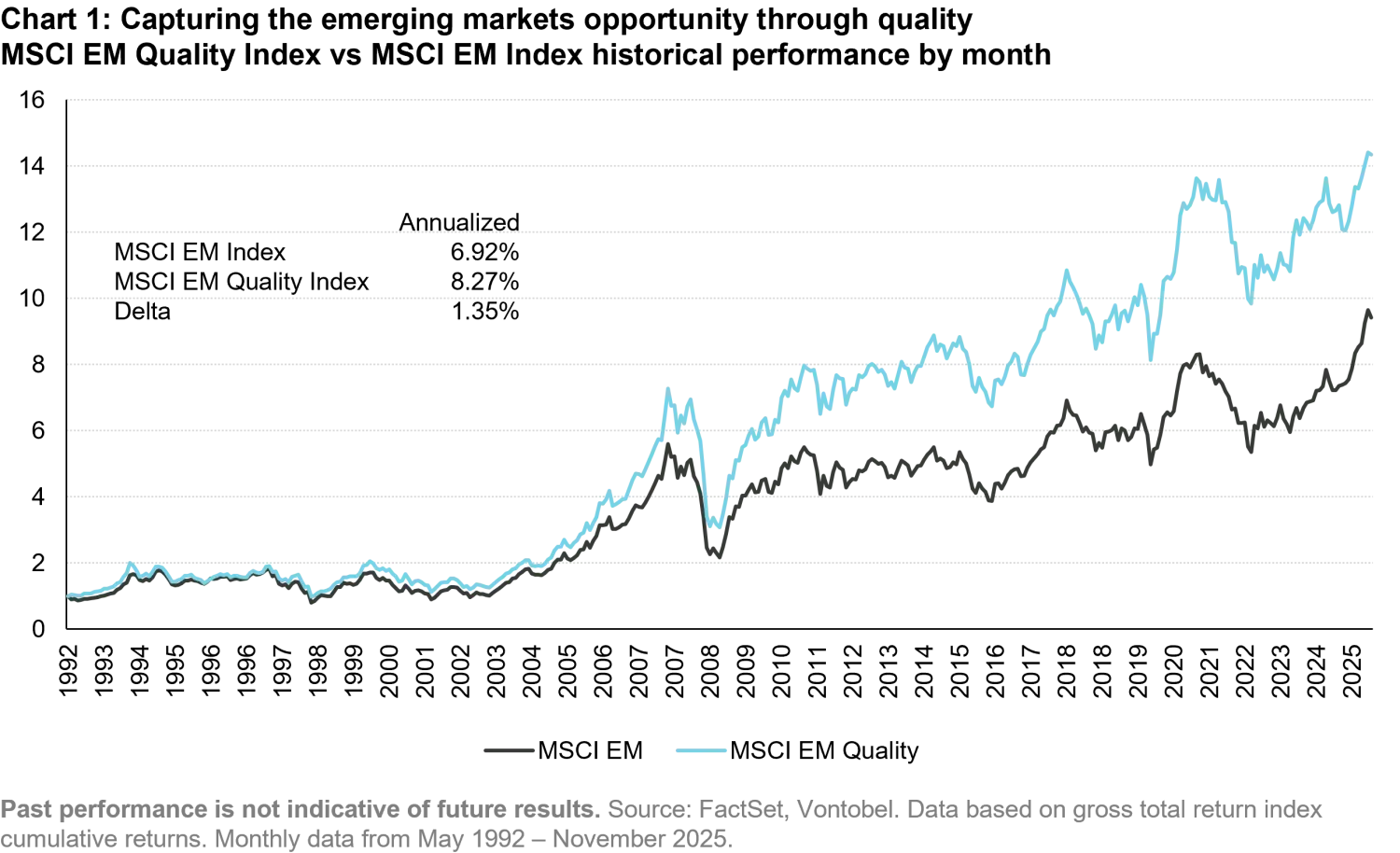
From 1992 to 2025, the MSCI Emerging Markets Quality Index, which systematically selects companies with high returns on capital, conservative balance sheets, and stable earnings, outperformed the broader MSCI Emerging Markets Index by approximately 135 basis points per annum.
Importantly, the EM Quality Index’s excess returns were associated with steadier compounding and lower downside capture. Across many of the major risk-off episodes of the past three decades, including the Asian Financial Crisis, the dot-com bust, and the Global Financial Crisis, quality experienced lower downside capture versus the broader benchmark.
Chart 2: MSCI EM Index vs MSCI EM Quality Index
Financial Crises Peak-to-Trough Return | MSCI EM | MSCI EM Quality | Delta |
Asian Financial Crisis | -45.7% | -38.1% | 7.5% |
Dot Com Bust | -43% | -39% | 4.3% |
Great Financial Crisis | -61.4% | -57.9% | 3.6% |
Eurozone Crisis | -25.6% | -18.3% | 7.3% |
China CNY Devaluation; Commodity/Oil Crash | -27.5% | -22.4% | 5.1% |
Trade War | -22% | -22% | 0.1% |
China Regulatory Crackdown & Property Sectro Crisis | -33% | -23% | 10.8% |
Source: Vontobel, FactSet. As of 21 August 2026. Time frame for Asian Financial Crisis is Jul 97-Jan 99; Dot Com Bust is Mar 00-Sep 02; Global Financial Crisis is Oct 07 – Feb 09; Eurozone Crisis is Apr 11-Sep 11; China CNY Devaluation; Commodity/Oil Crash is Apr 15 – Jan 16; Trade War is Jan 18-Oct 18; China Regulatory Crackeown & Property Sector Crisis is Feb 21-Oct 22
The drivers behind this outperformance is intuitive and enduring. Quality companies tend to generate higher profitability, stronger free cash flow, and superior returns on capital. They are also less reliant on external capital markets to fund growth, allowing them to compound more consistently through economic cycles. These attributes are particularly valuable in emerging markets, where the cost of capital is higher and more volatile, funding conditions can contract sharply during periods of stress, and currency and macroeconomic shocks are more frequent and severe.
In fact, it is during times of stress that quality companies tend to shine, as their higher earnings resilience and low financial leverage enable them to continue chugging along while weaker competitors retrench. As Warren Buffett has famously reminded us: “only when the tide goes out do you discover who’s been swimming naked.” In emerging markets, where the waters are rougher and the tides more volatile, the distinction between quality businesses and the rest becomes especially apparent.
While a systematic approach to identifying quality has delivered attractive long-term results, we believe a more deliberate, nuanced, and active approach is better suited to emerging markets. The reason is straightforward: quality in emerging markets is inherently less persistent than in developed markets.
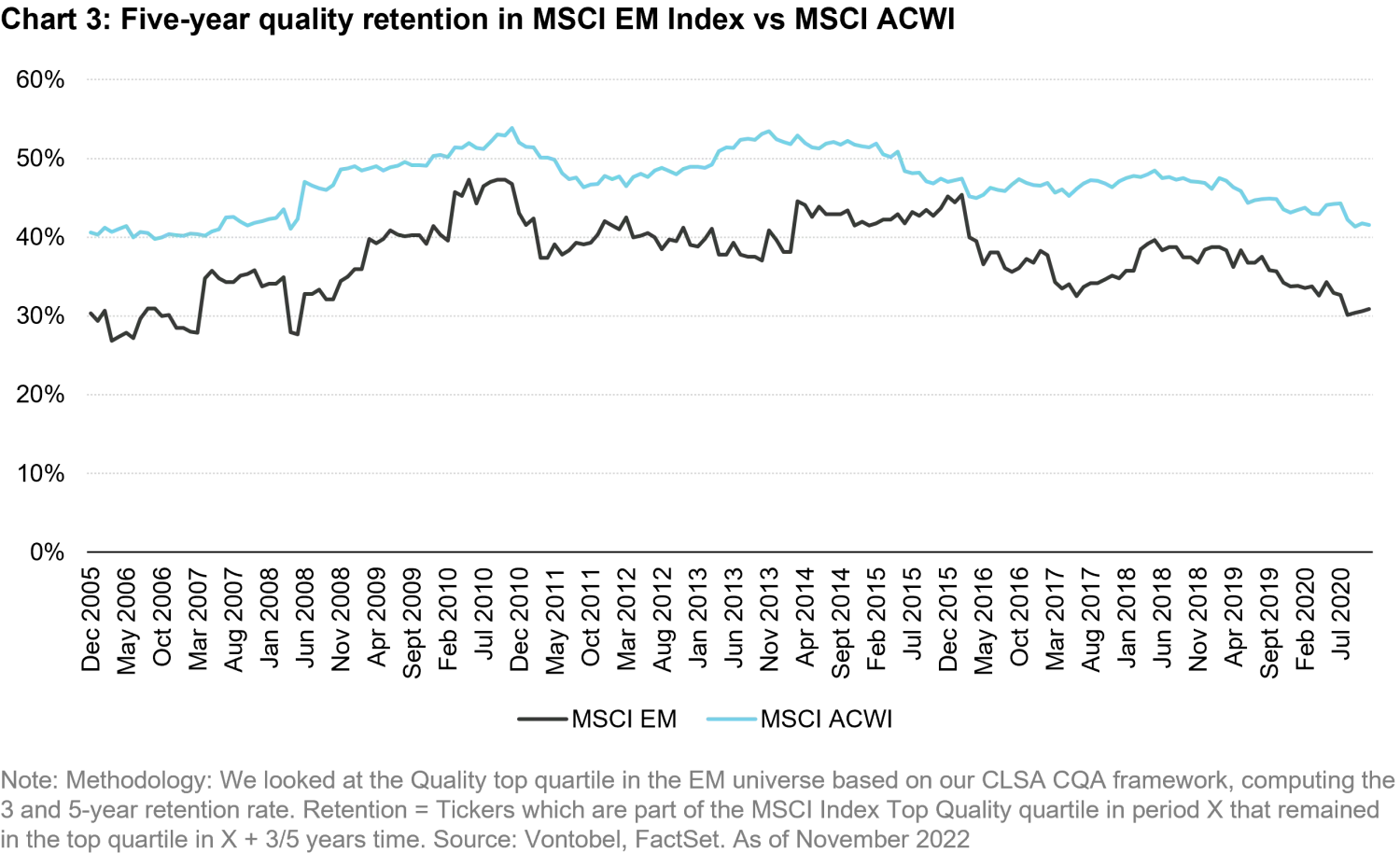
This is supported by empirical evidence. Between 2006 and 2022, an average of 46% of top-quartile quality companies in emerging markets remained in the top quartile three years later, and just 37% remained there after five years. By comparison, the equivalent figures for the MSCI ACWI were 55% and 47%, respectively. Put differently, nearly two-thirds of companies that initially ranked among the highest-quality businesses in emerging markets had lost that status within five years. The roughly nine-percentage-point persistence gap relative to developed markets suggests that quality leadership changes more frequently in EM and that historical measures of profitability and earnings growth are less predictive of future quality.
This distinction is important because many systematic quality strategies are inherently backward-looking. They select companies based on historical characteristics such as return on capital, earnings stability, and balance-sheet strength. While these metrics are valuable, they are less effective when the competitive advantages that underpin them are more vulnerable to change.
Competitive advantages are often younger, less established, and more vulnerable to change. Consumer preferences evolve quickly, technology adoption can be rapid, and industry structures are often less mature, allowing competitive dynamics to shift over relatively short periods of time. With less legacy infrastructure in place, new business models can gain scale more quickly, while established leaders may find it harder to defend their positions.
Strong structural growth can also make quality more difficult to assess. During periods of rapid growth, multiple companies can grow and generate attractive returns without facing significant competitive pressure. Profitability may therefore appear robust, even where barriers to entry are limited or competitive advantages are not particularly durable. Over time, however, as growth normalizes and new entrants are drawn to the enlarged profit pool, competition can intensify and returns can erode quickly.
Beyond competition, external forces also play a larger role. Regulatory interventions can materially alter the economics of entire industries, particularly where corporate objectives are not aligned with government priorities. Governance standards and capital-allocation discipline can vary significantly across markets, while recurring episodes of macroeconomic and currency volatility add another layer of uncertainty. Together, these dynamics make it more challenging to distinguish between businesses benefiting from temporary tailwinds and those possessing genuinely durable competitive advantages.
Historical measures of profitability, earnings stability, and balance-sheet strength provide valuable information, but they are only a starting point. The key question is not which companies have been high quality, but which are likely to remain high quality. This typically requires an investigative approach to understanding a company's value proposition, business model, and position within its value chain; identifying the sources of its competitive advantages; evaluating its relationships with customers, suppliers, regulators, and other key stakeholders; and assessing how those advantages will evolve in order to form a judgment about the durability of its market position and long-term profitability.
Executing this research-intensive strategy is inherently bottom-up. Emerging markets are not a monolithic asset class but rather a collection of distinct economies, each shaped by their own competitive intensity, regulatory environment, macroeconomic conditions, and corporate governance standards. For example, the competitive dynamics and policy backdrop in China, the reform trajectory and structural growth drivers in India, and the commodity sensitivity of many Latin American economies are not interchangeable inputs. Understanding these local nuances is often critical to determining whether a company’s quality is fleeting or truly enduring.
International Container Terminal Services (ICTSI) is a good example of a durable quality business in emerging markets, in our view. The company operates 34 container ports across Asia, Europe, Latin America, and other emerging regions under long-term concession agreements. A key feature of its strategy is its focus on origin and destination (O&D) ports that serve local import and export demand rather than transshipment hubs that depend on shipping routes. This makes volumes more predictable, provides greater pricing power, and creates opportunities to earn additional revenue from services beyond basic cargo handling. ICTSI has also built a strong track record of improving assets after acquisition through operational upgrades, capacity expansion, and better commercial execution. As a result, volumes and yields have risen consistently, driving 19% compounded annual growth in earnings per share over the last 15 years. While the company today has grown much larger, our view is that the runway for ICTSI to keep executing its strategy remains significant. We believe a favorable trade backdrop, ongoing expansion projects, and management’s disciplined capital allocation may support continued business growth.
PriceSmart illustrates that enduring quality can emerge from seemingly simple business models. Often described as the “Costco of Latin America and the Caribbean,” PriceSmart operates 57 membership-based warehouse clubs across 12 countries and one US territory, serving more than 2.1 million members. Its value proposition is supported by scale purchasing, a curated product assortment, and a growing private-label offering. More importantly, the membership model creates an unusually predictable earnings stream. Membership income reached USD 96 million over the past 12 months, supported by an approximate 90% renewal rate and steadily growing member count. Membership fees now represent roughly 40% of the company’s operating profit, providing a resilient and recurring source of earnings. With recently announced openings in Chile, Costa Rica, Guatemala, and Jamaica, the company continues to execute a disciplined expansion strategy.
Lion Finance is another example of a quality compounder. The investment case is underpinned by Lion Finance's dominant competitive positioning in two structurally attractive banking markets. In Georgia, where the group generates most of its earnings, it commands approximately 40% of loans and 46% of deposits within an effective duopoly alongside TBC Bank, with the two institutions controlling roughly 80% of the market. This translates into a structural moat. Scale like this is indicative of low funding costs, which can flow straight through to superior margins and profitability. Armenia adds a second engine. Following the acquisition of the country's leading bank, Lion Finance now holds approximately a 20% share there too, with the market contributing roughly a fifth of group earnings.
The macro backdrop remains supportive. The IMF forecasts strong GDP growth for both countries, providing a favorable environment for sustained credit expansion.
We believe Lion Finance may benefit from a strong competitive position in Georgia and Armenia. In our view, its scale, market position, and operating environment may support future growth opportunities.
The emerging markets of today are very different from those that investors have grown accustomed to over the past decade. Beneath the headlines and macroeconomic volatility lies a growing collection of high-quality businesses with durable competitive advantages, attractive reinvestment opportunities, and the ability to compound value over long periods of time.
The challenge is that quality in emerging markets cannot be identified through screens alone. Competitive positions must be continually tested against changing industry structures, regulatory environments, and economic conditions. Historical metrics can tell us where a company has been. They tell us far less about where it is going.


