
Currency of Emotions
Asset management
The debate over market efficiency is as old as modern finance itself. Are markets truly efficient, or do human biases create exploitable opportunities? So long as humans remain a part of the equation – interpreting data, making decisions, or even just pressing a button – behavior will ripple through markets. These biases, far from random, offer fertile ground for systematic strategies to capitalize on inefficiencies.
Nowhere is this debate more contentious than in currencies, often heralded as the most efficient asset class. In this article, we examine the intersection of human behavior and machine intelligence, exploring how we can harness sentiment data to create predictive trading signals for the most efficient markets of all: currencies. First, we revisit two opposing doctrines that underpin this debate.
Out of the blue corner: market efficiencies
The Efficient Market Hypothesis (EMH) finds its strongest adherents in the currency market, which stands as one of the most efficient and complex of all asset classes. With trillions of dollars traded daily, liquidity and information dissemination are unparalleled, leading many to believe that currency prices reflect all available information almost instantaneously. In 1983, Kenneth Rogoff and Richard Meese famously concluded that currency markets resemble a random walk: even the most sophisticated models failed to outperform the simplicity of random chance in predicting exchange rates. And unlike equities, bonds, or commodities, which are often tied to company- or industry-specific fundamentals, currency valuations are deeply intertwined with macroeconomic forces, geopolitical developments, and relative interest rate dynamics. As a result, seeking inefficiencies in currencies requires strategies that go beyond fundamental analysis.
Out of the red corner: behavioral finance inefficiencies
We live in a world where biases reign supreme: fear and greed drive markets; gut feelings overpower spreadsheets; our aversion to loss outweighs the allure of gain; and we often act against our own long-term interests. Far from rational automatons, we’re creatures of instinct, and these instincts ripple through markets, shaping economies in surprisingly predictable ways. Behavioral finance argues that human behavior can profoundly shape markets -- and it undeniably does.
This raises a question: are humans hopelessly inept, or is there another explanation for our seemingly irrational tendencies? Thankfully for our collective dignity, it’s the latter. Our biases aren’t random acts of irrationality; they follow remarkably consistent and predictable patterns, captured by the notion of sentiment: the aggregate emotions, optimism, pessimism, and expectations of the market. Sentiment can drive prices in ways that might not align with an asset’s intrinsic value; and it tends to oscillate between intense highs and lows, shifting between a deep “propensity to speculate” to a manic “propensity to panic,” thereby amplifying market movements in either direction.
News as a sentiment barometer
But how might we uncover such collective behavioral patterns? What data might we, as quants, harness to distil the currency market’s undercurrents? The answer lies in the news, and specifically macro news. Imagine having access to every article, tweet, earnings call transcript, and blog post about anything affecting currencies over the past month. Enter Natural Language Processing (NLP), a machine learning tool that can process and quantify this data in seconds, providing insights that would otherwise remain buried in noise. NLP assigns sentiment scores to unstructured text, categorizing it as positive, negative, or neutral. Financial news, in particular, which is published at a rate of one article every 0.2 seconds globally, is a key sentiment indicator: a surge in negative news on any given asset often correlates with immediate price declines as investors react in real time.
The transmission mechanism of macro news
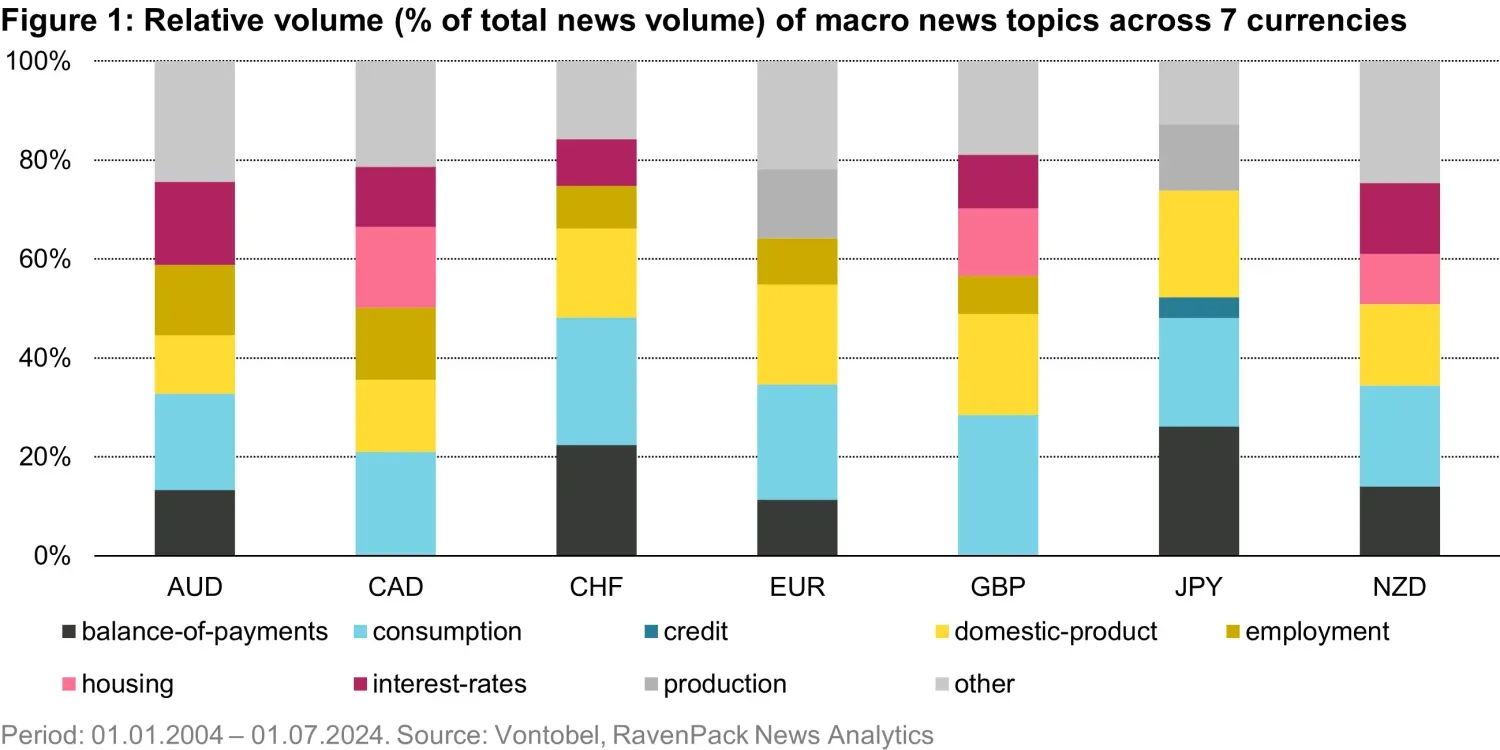
Macroeconomic news releases, such as nonfarm payrolls, CPI reports, and central bank decisions, are pivotal in shaping currency markets, often triggering significant volatility as market participants reassess their expectations. Exchange rate movements typically exhibit heightened volatility around these announcements, particularly when surprises deviate from consensus. Yet, interpreting macro news is far from straightforward; its impact depends heavily on preexisting market positioning and broader risk assessment. For instance, a strong U.S. employment report might boost the dollar in one scenario but weaken it in another if risk-off sentiment dominates and safe-haven flows favor currencies like the Swiss franc. Figure 1 illustrates the relative prominence of macroeconomic news, broken down by topic, across 7 currencies, underscoring the breadth of factors driving currency valuations. While macroeconomic news provides the broader narrative, sentiment captures the market’s emotional response, offering an orthogonal perspective often uncorrelated with traditional factors like price momentum. Indeed, research shows that macroeconomic news can affect currency prices directly, but also indirectly via order flow, accounting for 36 percent of total daily price variance.
From sentiment to strategy
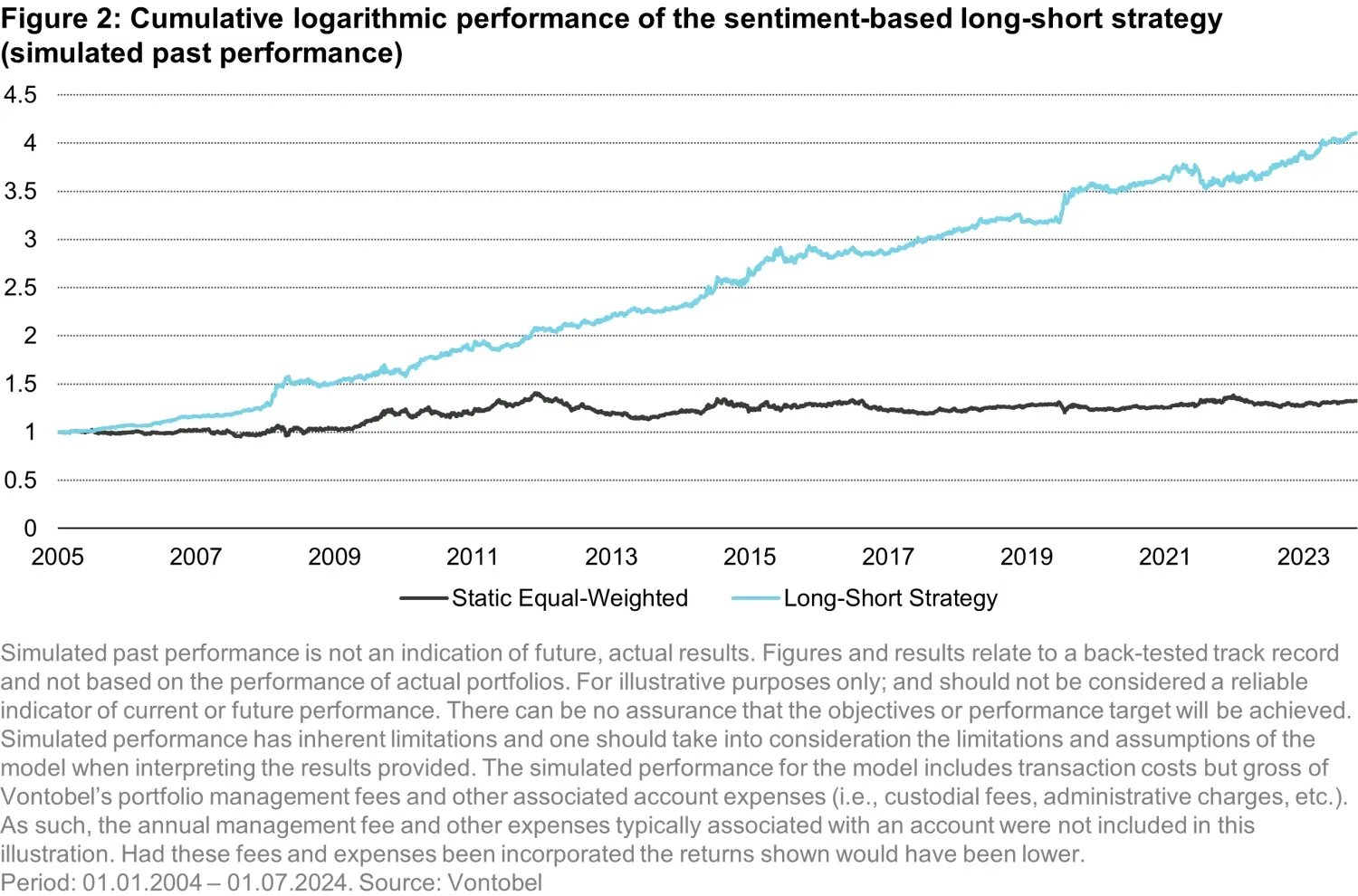
Sentiment data on macroeconomic topics and currency events is incredibly vast, capturing nuanced insights into growth, inflation, and policy expectations for each economy. The hypothetical strategy we examine begins with a deceptively simple premise: leveraging such sentiment signals derived from macroeconomic news and currency-related events across 7 economies using RavenPack News Analytics. The strategy rebalances monthly, taking equally weighted long positions in 7 currencies against the USD with positive sentiment and short positions in those with negative sentiment, based on aggregate sentiment scores. Figure 2 compares its cumulative logarithmic returns to a naïve benchmark of equally weighted long positions across the same seven currency pairs. From 2005 to 2024, the strategy delivers consistent profitability, achieving a Sharpe ratio of approximately 1.2.
Fear trumps greed
Notably, the performance of Figure 2 is driven primarily by the short leg of the currency positions. Put simply, the strategy proves far more effective capitalizing on fear than on greed. Indeed, negative news tends to have a stronger and more immediate impact on market prices than positive news. This asymmetry is hardly surprising when you consider the human instinctual response: fear is a mechanism for survival, while not acting on greed merely implies a missed opportunity.
Historical episodes highlight the outsized impact of negative sentiment. During the 2008 financial crisis, for instance, fears surrounding banking collapses and sovereign debt drove steep declines in high-risk currencies like the British pound, while the U.S. dollar surged. Similarly, the Brexit referendum of 2016 saw the pound plummet to multi-decade lows amid uncertainty about the UK's economic and political future. More recently, the onset of the COVID-19 pandemic in 2020 triggered a sharp sell-off in emerging market currencies like the Brazilian real and South African rand, as investors sought refuge in safe-haven assets.
Closing thoughts
Forecasting currency returns has always been a formidable challenge, shaped by the interplay of macroeconomic forces and market psychology. In this article, we revisited the longstanding debate between the efficient market hypothesis and behavioral finance inefficiencies and found that perhaps both hold a kernel of truth. When viewed solely through the lens of macro data, markets appear efficient, but by examining the sentiment that shapes how market participants interpret the same data, inefficiencies come to light. Behavioral finance gives us the tools to understand these dynamics, while machine learning provides the tools to seize the opportunities. Together, they enable us to transform sentiment into signal – even in the most efficient of markets. In the words of Kahneman, "We are blind to our blindness," but with machine intelligence, we are beginning to see the patterns within seemingly irrational noise.
About the author

About the author
Explore related topics:
Related insights

Replay: Rates, credit & market reality — what matters now?

Power moves: The new energy order

Portable Alpha: Rethinking the Architecture of the Portfolio

Still waters run deep in global markets

Emerging markets: the train has left the station, but you can still catch it
