
Winning by not playing
Asset management
When it comes to winning, it’s not just about how often you hit the mark, but how well you manage the misses. This holds in sports as much as it does in investing. A common coaching mantra in most sports is that there are two ways to win points: by hitting more winners through aggressive play, or by making fewer mistakes through restraint. The very best players do both.
Consider tennis for example. For its Big Three – Federer, Nadal, Djokovic – the margins are razor-thin. On average, they hit only a few more winners than errors, or vice versa. Often, the edge goes to the player who tilts this delicate fragile balance – either by raising their winner count or, just as often, by keeping mistakes down. The data backs this up: a stronger win-loss ratio is closely linked to match wins. As the saying goes, matches are rarely won by brilliance alone – more often, they’re lost through unforced errors.
The same holds in forecasting. If wins are the signal, errors are the noise. And like elite tennis players, forecasts in the delicate and efficient currency markets tend to hover around a modest accuracy of 50-55%. That narrow edge matters. Small, consistent gains in confidence, if accurately gauged, can translate into real performance. But acting on shaky signals only compounds randomness and erodes returns. And making errors in investing carries a weight beyond just the financial loss – and certainly more so than in tennis. If you lose half your value, you then need to double it just to break even. The math makes the cost of errors feel even sharper.
In this second instalment of the Quanta Byte series on systematic FX, we look at how we’ve come to treat uncertainty in FX markets not as a flaw, but as a signal in its own right – one that plays a key role in shaping conviction. This shift has changed how we separate real insight from noise dressed up as information. Put differently: we began treating noise not as something to suppress, or as an inevitable curse to plow through, but as a decision layer on top of our FX forecasting model. And it has a profound impact on performance – not because our raw predictive accuracy improved, but because we learned when not to act.
This requires a change in mindset: away from determinism and toward a probabilistic lens. Model outputs are no longer binary signals to trade on, but degrees of belief, continuously revised as fresh data arrives. In what follows, we lay out the three main steps that this perspective involves:
Step 1: Recognize that signal and noise go hand in hand.
Step 2: Resist the illusion of knowledge.
Step 3: Let the model abstain.
We close this article by showing the value of our humble approach: better-timed trades, lower turnover, and a strategy that becomes more selective – and more effective – by knowing when to remain on the sidelines.
Step 1: Recognize that signal and noise go hand in hand
If you’ve ever tried to trade FX systematically, you know the drill. Forecasting signals often feels like mirages: brief, seemingly convincing, then gone before we know it. The prevailing belief is that there’s simply no signal strong enough in FX to act on. And so the first response is to dig deeper: engineer better indicators, refine models, add more theory, and smooth out the volatility. Anything to extract a cleaner signal and suppress the noise.
The key, however, isn’t to filter out the noise entirely, but to use it. Indeed, at the core of any forecasting model is a simple decomposition:
Observation = signal + noise
Signal is the systematic repeatable part of the world. Noise is everything else – the randomness, the misspecification, the market regime shift, or the headline that moves the Eurodollar by 80 bps overnight. The signal is the component that improves predictive accuracy when generalized out-of-sample. Noise doesn’t. In FX, noise reflects not just randomness, but misspecified dynamics, data limitations, and latent macro shocks. More importantly, it shifts dynamically. A model might extract a signal well for a period, but if the underlying relationships change, yesterday’s signal becomes today’s noise.
Signal-to-noise ratios precisely measure that balance between meaningful information and random variation. A simple way to grasp this concept is through a visual analogy. Imagine training a machine learning model to recognize cats in images. The signal is strong: cats have clear features – ears, whiskers, fur patterns – that reliably distinguish them from other animals. Given enough training data, i.e. enough images of cats, a model quickly learns to generalize. Image recognition accuracy quickly climbs well beyond 90%. The signal is crisp, and noise in the form of, say, random lighting, different backgrounds, or posture changes, is marginalized.
In FX, there’s unfortunately no equivalent of “cat ears” in the data, no consistently reliable patterns. Relationships shift, and indicators that mattered last year may not mean much today. As a result, FX signals are faint and unstable. Forecast accuracy hovers near the 50-50 mark, even with the deepest models and broadest features. And so while cat recognition is a high-signal problem, FX forecasting is inherently low-signal. That doesn’t mean it is hopeless though. It means we need to treat noise not as a nuisance but as part of the system, and perhaps as a source of insight in its own right.
Step 2: Resist the illusion of knowledge
Once we accept that signal and noise are inseparable, the real risk becomes in mistaking one for the other. John von Neumann1 put it sharply: “With four parameters I can fit an elephant, and with five I can make him wiggle his trunk” – a caution that flexible models, if left unchecked, can latch onto noise, dressing it up as insight and creating a false sense of precision.
Take a simple simulation. In Figure 1, we generate pure random noise – no trend, no structure – and fit polynomials of increasing complexity to the data. With just a few parameters, the model captures broad tendencies, if any. But as the polynomial degrees rise, the curve starts chasing every fluctuation. By degree 15, it hugs nearly every point yet says nothing. The fit is perfect – and perfectly meaningless. We’ve manufactured a signal where none exists.
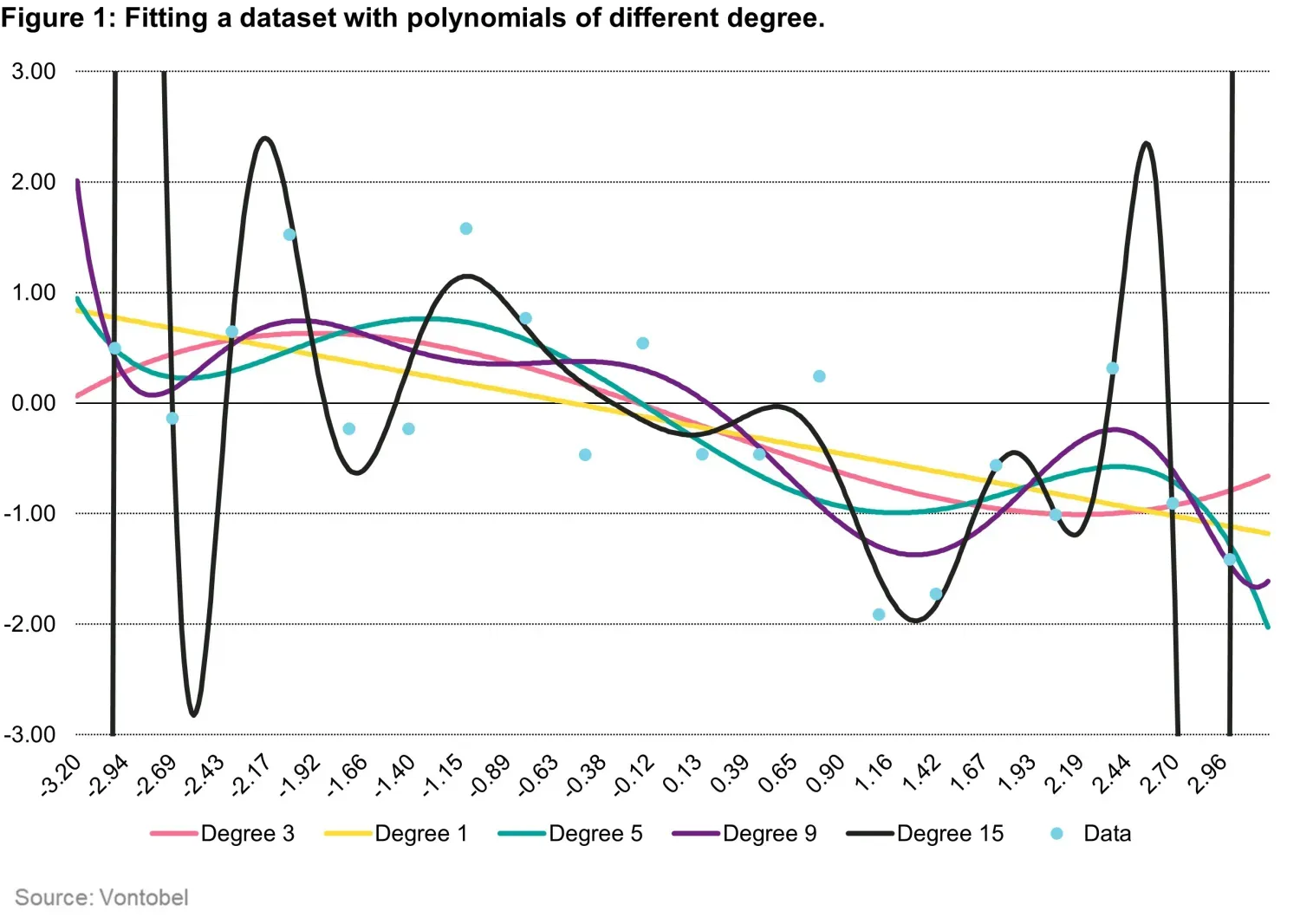
This isn’t just a toy example. It captures real risk in financial modeling. Most quantitative strategies assume that the true signal can be isolated with enough smoothing, features, or tuning. But FX doesn’t play by those rules. Trying to pin down a stable pattern often leads to precisely what we illustrated above: overfitting noise and mistaking it for structure.
The takeaway isn’t just statistical – it’s psychological. We’re wired to see patterns, even where none exist. And in FX, where noise is high and true signals are fleeting, this tendency can be costly. More data often leads to more confidence, but not necessarily more accuracy. The real risk isn’t noise itself, it’s the conviction with which we act on what we think is signal.
Step 3: Let the model abstain
The added complexity is that noise in FX is far from static. It evolves with shifting regimes, macro shocks, or data instability. A model that worked last quarter may no longer be reliable. The key is knowing when the signal is strong enough to trust and when to dial it down.
How do we handle this? Instead of asking what the model predicts, we also ask how confident It is in that prediction. To this end, we borrow from a mindset that is built to handle uncertainty in the face of new information: conformal prediction.2 Unlike traditional forecasts, which issue firm calls, conformal methods provide confidence levels alongside each prediction. For example, a forecast might suggest the dollar will rise against the euro, but only with 60% confidence – useful information when deciding how to act.
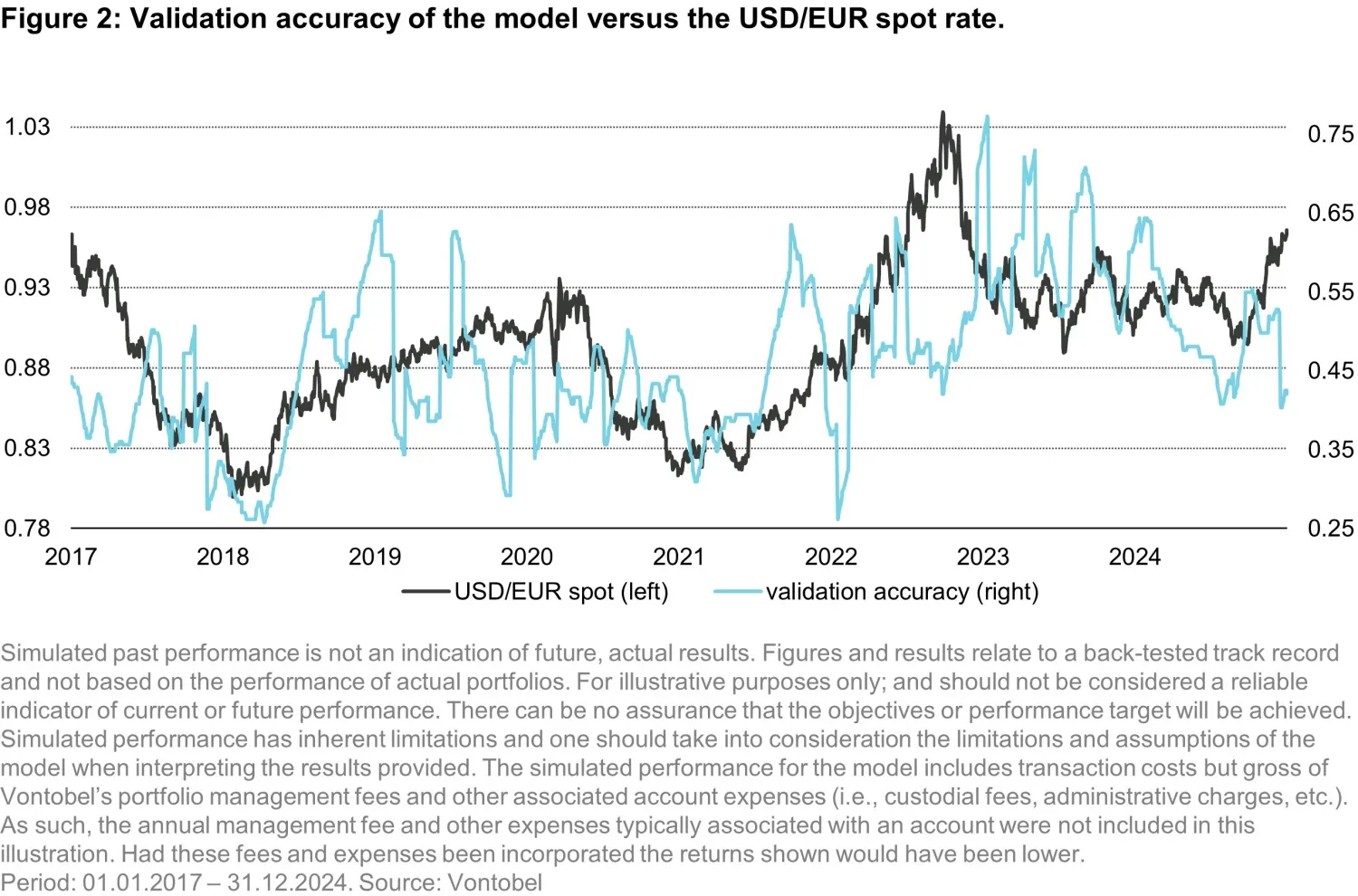
This is where the soft abstention layer comes in. The model continues to produce forecasts and adjusts the signal strength according to its confidence. We implement this using a practical stand-in for trust: rolling validation accuracy. Practically speaking, we track on a daily basis how well the model is performing out-of-sample. If validation accuracy drops, we scale down the signal weights, thereby reducing exposure during times of uncertainty. If the validation accuracy is rising, we let the model implement its directional bet without further intervention. In simple terms, we ask the model “have you done well lately,” and if so, we’ll trust you. If not, we’ll hold off heeding your advice and save our chips for later. Figure 2 shows the rolling validation accuracy for a systematic USDEUR signal, indicating when confidence in the signal rises and falls3.
We call this mechanism “soft abstention” – a continuous modulation which filters out weak signals and reduces false positives without fully giving up trading opportunities. In short, we trade less aggressively when the model is less confident – lowering noise and protecting capital – but continue to act when the signal retains some validity.
The value of humility
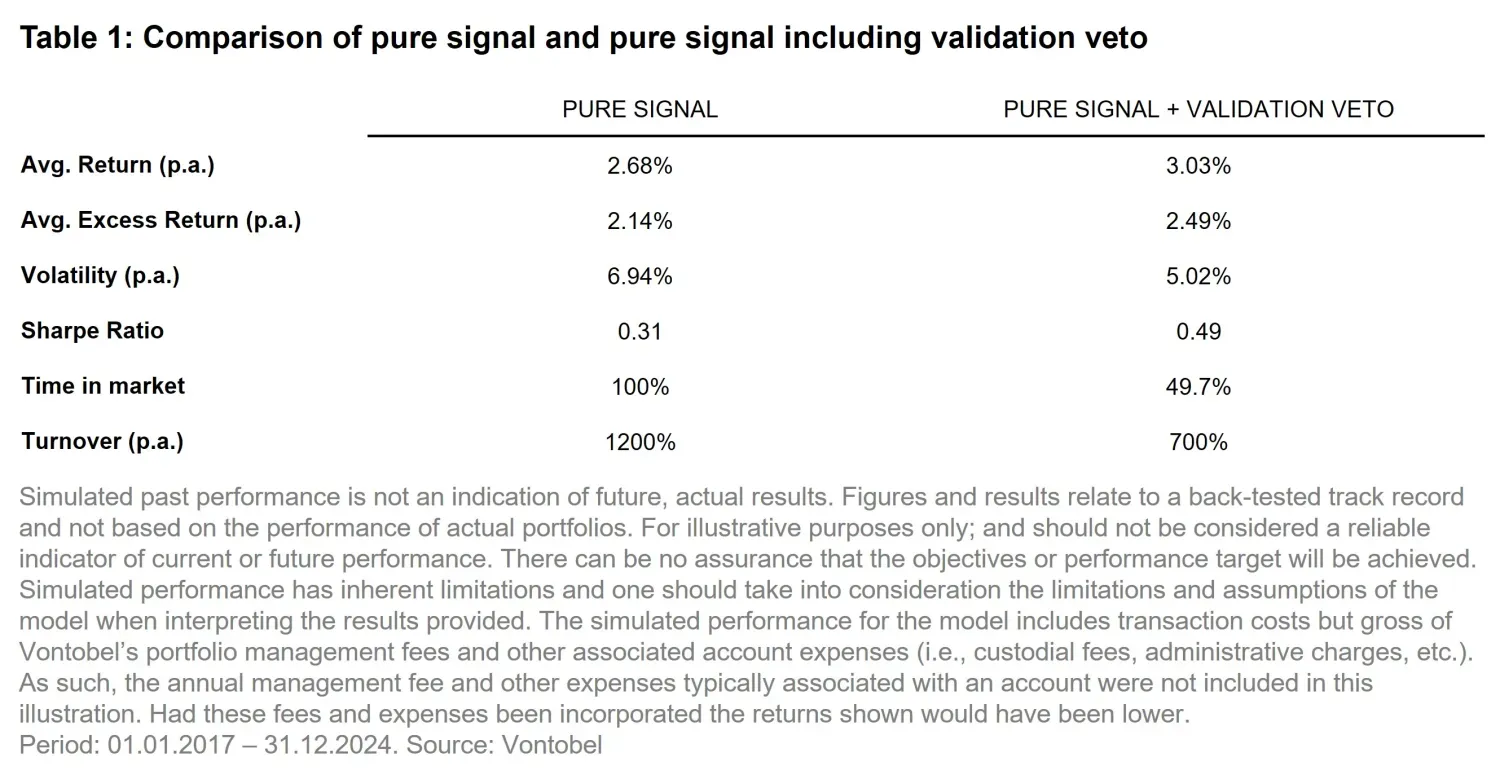
This restraint has tangible benefits. When we compare performance with and without the soft abstention layer, the difference is clear: accuracy improves, risk-adjusted returns increase, and false positives decline. The model trades less aggressively but with greater precision.
One key metric we track is time in the market, that is how often the strategy takes directional risk. In our EUR/USD example, the model generates monthly signals. But once the confidence filter is applied, it only acts about half the time at full conviction; the rest of the time, the signal is scaled down according to the model’s lower confidence, as described above. This fundamentally changes the character of the strategy. It becomes more selective, less reactive, and better timed. We enter a position when we believe the model genuinely has an edge – what we call practical accuracy. In effect, we’re increasing the signal-to-noise ratio by concentrating exposure on high-conviction forecasts and attenuating low-confidence signals.
As shown in Table 1, the result is lower turnover, stronger Sharpe ratios, and a quieter but more confident strategy that avoids chasing noise. The model’s hesitation becomes a form of guidance in its own right. Over nearly a decade, this approach delivers a comparable return while being actively invested only 49% of the time. That not only reduces risk and trading costs – it also frees up a risk budget. In a typical multi-asset portfolio, this budget can be reallocated elsewhere during the FX strategy’s quieter periods.
Conclusion
One of the most underrated qualities – in people as much as in models – is quiet confidence: the ability to act decisively when it matters, and to hold back when it doesn’t. The best leaders embody this. So do the best tennis players. They don’t force every shot. They wait for the right moment, trusting their read of the game and just as importantly knowing when not to overreact.
In traditional quantitative investing, there’s often an implicit belief that a model should always have an answer. But FX is an intrinsically noisy, low-margin game where small edges matter. Knowing when not to trade can make the difference between signal and noise, between alpha and overreach. It’s a strategy built not just on what we know, but on an honest reckoning with what we don’t. Or, as Confucius put it: “Real knowledge is to know the extent of one’s ignorance.”
In the next part of this Quanta Byte series, we’ll explore the other layers of our systematic FX process: how we capture trend, and how we design models that adapt to changing regimes. But it all starts right here: by giving the model permission to say, “I don’t know,” and building that humility into the foundation of the strategy.
1. Silver, N. (2012). The signal and the noise: why so many predictions fail--but some don't. Penguin Press.
2. Source: https://www.stat.berkeley.edu/~ryantibs/statlearn-s24/lectures/conformal.pdf
3. We are well aware that the world quotes this exchange rate as EUR/USD; however, the models discussed here assume a EUR denominated investor and currencies are taken against the eur, hence the direction of the pair as USD/EUR
About the authors


About the authors
Explore related topics:
Related insights

Machine Learning in FX: Learning the Unlearnable

Think you’re diversified? Check your FX
