Reality check for artificial intelligence: correction or end of cycle?

Conviction Equities Boutique
Read 12 min

Key takeaways

  • We expect the artificial intelligence (AI) cycle to continue, as we currently see no signs of oversupply.
  • AI infrastructure investments continue to expand, even if increasingly supported by debt financing.
  • We track monetization as well as adoption and see support from underlying fundamentals.
  • Considering the various supply bottlenecks, we see potential for significant earnings growth at attractive valuations.


Note: For explanations of AI terminology, please see glossary at the bottom of the Viewpoint.

Putting the sell-off into perspective

Asian technology supply chains sit at the heart of the AI investment boom led by US tech giants. They have therefore witnessed exceptional earnings growth and stellar share price performances. Since the launch of ChatGPT in 2022, the MSCI Emerging Markets Information Technology Index has increased more than fivefold, and along the way, fears around an AI bubble and concerns over a lack of return on investment (ROI) repeatedly triggered corrections. So far, these pullbacks have been followed by periods of strong market recovery.

2026-08_reality-check-for-ai_chart1_en.png


The latest sell-off seen in June 2026 followed a familiar pattern. Concerns about AI ROI, end-of-cycle fears, rising Chinese competition, and economic uncertainty surrounding renewed US-Iran tensions weighed heavily on sentiment. Elevated levels of investment leverage, given many private investors used borrowed capital, amplified the decline. In our view, however, the market reaction overstates the risks, as large-scale investment plans, moderating memory price hikes, and lower-cost Chinese AI models do not imply an oversupply environment. Instead, we view the recent correction as another opportunity to gain exposure to a compelling long-term growth theme, even if near-term weakness might persist.

The big picture: how we track the AI cycle

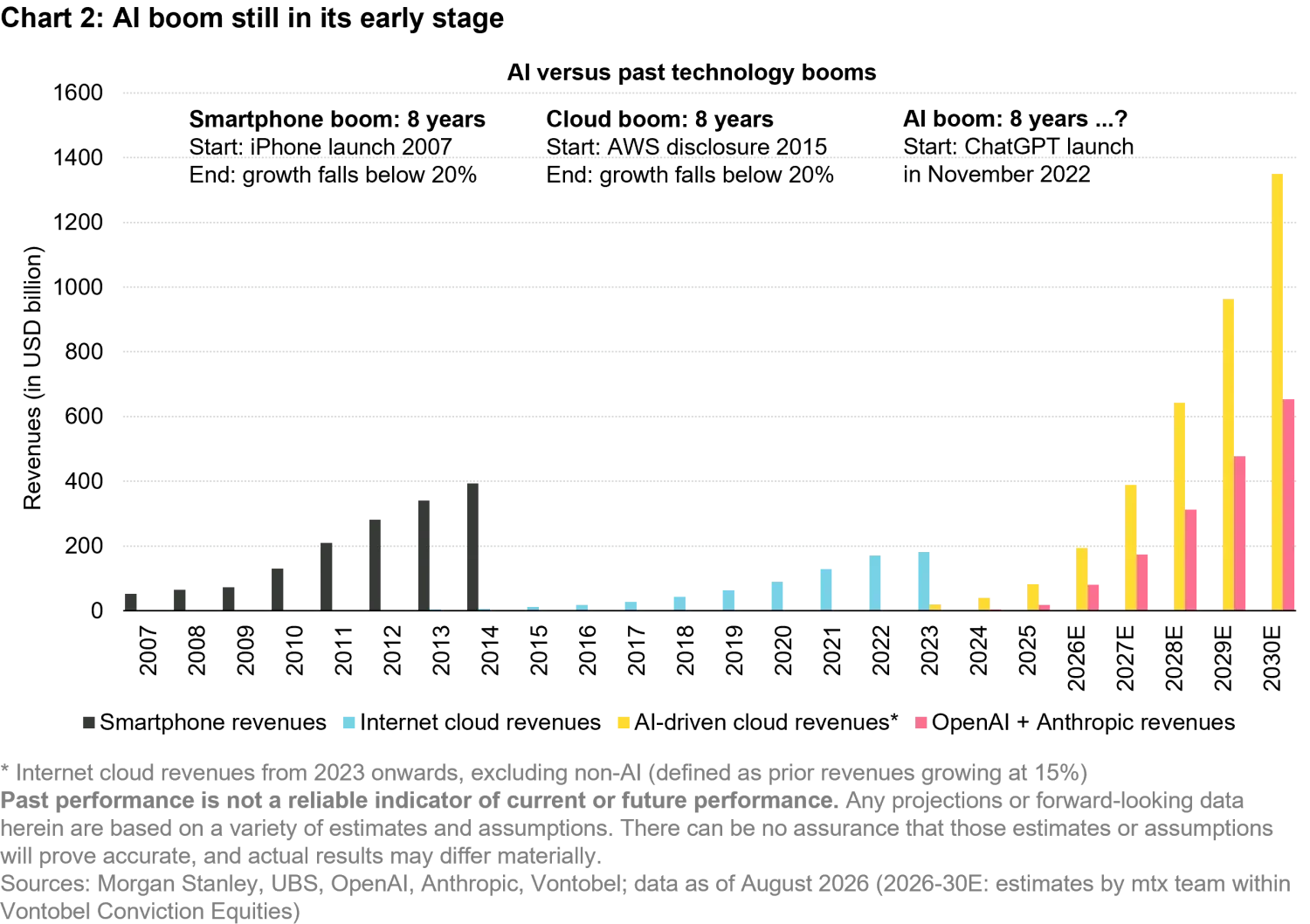
From a historical perspective, the AI investment cycle seems to be at a relatively early stage. Previous technology waves, such as smartphones and public cloud computing, lasted more than eight years before revenue expansion slowed down to below 20%. Less than four years have passed since ChatGPT's launch in November 2022, and we believe AI could ultimately surpass both these technology revolutions. The impact is already evident: Cloud revenue growth reaccelerated, towards 50%, while AI leaders such as OpenAI and Anthropic reportedly quadrupled their revenues in 2025. Yet enterprise adoption remains at an early stage, and agentic AI workflows are only beginning to scale, which may indicate a long growth runway.
2026-08_reality-check-for-ai_chart2_en.png


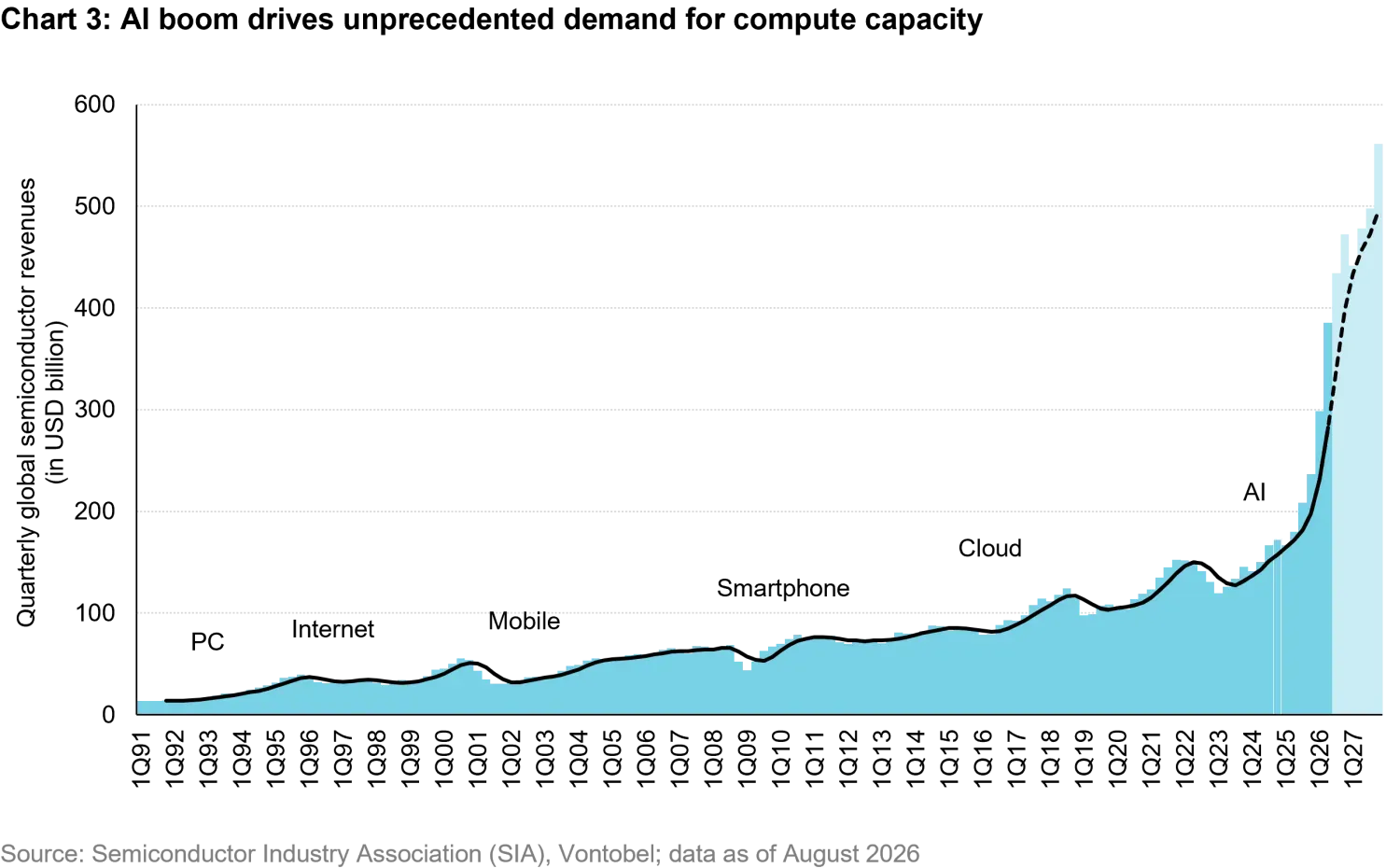
The unprecedented surge in demand for compute capacity also led the overall semiconductor market to triple, fueling a broad ecosystem of datacenter technology providers.
2026-08_reality-check-for-ai_chart3_en.png


A long-term perspective on the semiconductor industry highlights the recurring pattern of boom-and-bust cycles with periods of undersupply eventually followed by overcapacity, even within powerful secular growth trends. The cloud computing boom, for example, accelerated after Amazon disclosed AWS in 2015, yet still experienced significant corrections during the 2018 inventory adjustment and the slowdown related to the Covid pandemic in 2022. This underscores the importance of closely monitoring the supply-demand balance. Given US hyperscalers account for the bulk of global datacenter investments and their capital expenditure (capex) should total roughly USD 745 billion this year, we believe the key questions are whether this level of spending creates value and whether the strong outlook is supported by satisfactory return expectations.


Chart 4: AI Tracker – no bubble, but financing and datacenter pipeline to watch

Key dimensions

 Key recent datapointsTracking

Investments

Hyperscaler capex

  • Accelerating to 80%+ year on year in 2026 and further strengthening outlook indications

Expanding further


Financing

  • Free cash flow (FCF) of top-5 hyperscalers narrowing, Google now in negative territory

  • Their debt issuance rose to USD 194bn year to date as of July 9

  • Anthropic initial public offering (IPO) reportedly imminent, OpenAI likely in 2027

FCF decline and more room for debt issuance, IPOs raise funds

Demand

Monetization

  • Cloud revenues 50%+ year on year, GPU rental prices rising

  • Anthropic and OpenAI's annualized revenue run-rates reportedly around USD 65 billion and over 40 billion in July, respectively

  • Enterprise spend per employee up (median below USD 11, top 10% below USD 516)

Accelerating


Token usage

  • Token consumption growing exponentially year to date

  • Token pricing of new frontier model launches show US holding up, while prices of Chinese ones increase

Ramping up

Supply

Supply chain tightness

  • Supply shortage worsens across supply chain, with notable industry participants like TSMC (chips), SK Hynix (memory), and Unimicron / Ibiden (substrate) seeing shortage until at least 2029-30

Tightening


Datacenter pipeline

  • Global datacenter capacity under construction and in pipeline continues to grow

Challenging

Exuberance

Valuations

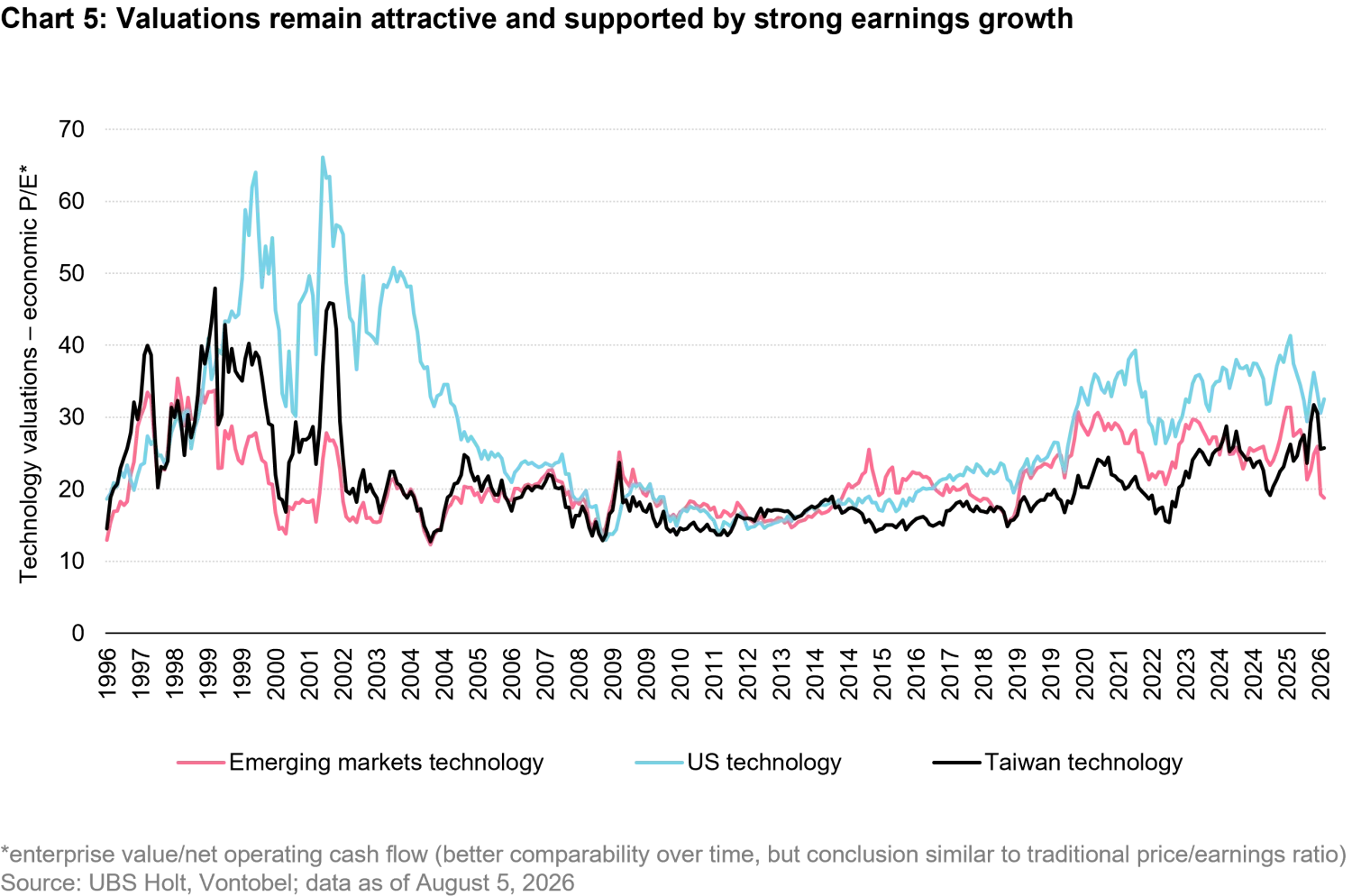
  • Technology sector valuations in US/emerging markets/Taiwan at 49%/28%/39% of dot-com bubble peak (economic P/E for better comparability)

Attractive

Sources: Bernstein, Bloomberg, BofA, Morgan Stanley, Goldman Sachs, OpenRouter, Ramp, Silicon Data, UBS, Vontobel; data as of August 5, 2026

Infrastructure investments continue, albeit increasingly via debt and equity financing

We expect hyperscalers’ capex to grow by more than 80% this year, and recent developments may support a further upward revision of the outlook. Alphabet recently increased its capex guidance by another USD 15 billion, although this exceeds its operating cash flow for the first time in history, and even indicated "significant" further expansion next year. Amazon is also accelerating its investments, expecting “compelling returns” after a three-year payback period and a "striking" demand expected for 2028.

The reason is simple: Compute capacity appears to remain well short of rapidly expanding demand. If demand continues to exceed supply, higher investments could remain both economically attractive and strategically important to preserve competitiveness. While increasing reliance on debt financing requires close monitoring, we view it as a yellow rather than a red flag. In fact, we consider both debt and equity issuance supportive of further growth in the near term, and we expect hyperscalers to increase debt as long as their investment-grade credit ratings, usually a sign of high creditworthiness, remain intact. The initial public offerings (IPO) of Anthropic and OpenAI provide additional funding for capacity expansion. Another yellow flag is the rise of so-called circular financing, where for instance, hyperscalers take stakes in major customers. While this increases leverage both up- and downwards the ecosystem, it also supports investment growth in the near term.

Potential path to higher profitability becomes clearer

The durability of the AI cycle ultimately depends on profitability and returns on invested capital (ROIC). Hyperscaler cloud businesses on aggregate have accelerated to almost 50% growth with operating margins of 35-40%. Newer chip generations, in-house silicon such as Google's TPU, and selling access to in-house models running on that capacity could support margins as the AI mix grows. Hyperscalers earn strong returns on new capacity, but not yet on the whole capital base. A well-utilized, current-generation datacenter could earn around 20-30% ROIC when rented to customers, but much of the total capital is still under construction, running older chips, or absorbed by internal training. Therefore, we think returns are initially just around the cost of capital, or slightly below, and we expect they can rise over time, as capital utilization increases. Rental prices remain supportive.

Frontier AI labs also exceeded expectations in terms of both user and revenue growth. OpenAI just surpassed one billion monthly users after less than four years – Meta took nine years to achieve this – while Anthropic's last reported annualized revenue run rate of USD 47 billion surpassed software companies like SAP or Salesforce, which took decades to achieve a similar scale. Model makers are generally still loss-making, even if some estimate that Anthropic is already turning towards positive operating profit thanks to its enterprise focus and a less aggressive capacity expansion compared to OpenAI. In any case, we see a possible path to higher profitability over the longer term. Expensive training and free users initially weigh heavily on profitability. But gross margins on inference – which is the phase when a trained model applies its knowledge and generates revenue – are reportedly around 70% in the enterprise business. So, as inference grows relative to training, margins and returns on investment could improve. And although OpenAI currently seems to face more challenges with a customer base skewed to consumers, we see that potential improvement could come from higher enterprise adoption, advertising opportunities, and deeper vertical integration.

Competition from much cheaper Chinese AI models remains a key concern, but DeepSeek demonstrated that lower token prices can boost token volume consumption. For frontier models, usage growth outpaced price declines by far, which explains the exponential growth in revenues of frontier labs. Moreover, while the recent launch of Chinese model Kimi 3 from Moonshot AI surprised the market with its strong performance, it also comes with higher pricing, comparable to that of US frontier models, as it requires high compute capacity. This underscores that, contrary to common perception, leading Chinese open-weight models are not for free and not that cheap after all. It also demonstrates the so-called scaling laws that model performance predictably improves with more compute, training data, and model size.

Supply shortage may take longer to resolve

Technology cycles typically turn when supply catches up with demand and concerns about oversupply emerge. Alongside the massive spending plans of hyperscalers, investments in the multi-billions recently announced by chip makers stoke such fears. TSMC raised its capital expenditure outlook and announced an additional USD 100 billion investment in advanced chip manufacturing facilities in the US. Meanwhile, Korean memory producers Samsung Electronics and SK Hynix unveiled long-term expansion plans worth over USD 1.7 trillion and USD 750 billion, respectively.

However, much of these investments will be made beyond 2030. With semiconductor projects taking years to complete and ramp, supply may remain tight in the meantime. As a result, memory prices rose roughly tenfold since early 2025, and customers are increasingly willing to commit to long-term contracts at elevated prices to lock in future supply. Supply constraints appear to remain widespread across the AI supply chain, extending beyond semiconductors to critical components and input materials. We therefore closely monitor pricing and capacity. Further downstream, datacenter deployment continues to face bottlenecks related to power supply, building permits, and capacity delays, slowing timely deployment. Hence, this is another key area for us to track progress.

Current valuations attractive and far from bubble territory

Taken together, we believe that the AI cycle should still have further room to run. While valuations were elevated before the recent price correction in technology stocks, they remained well below the levels seen in the dot-com era from 1995 to 2001, when the rapid rise of the Internet caused a massive stock market boom driven by internet-based startup companies, which ended in a dramatic crash. Unlike some previous speculative episodes, today's technology rally has been supported by strong earnings growth and sustained infrastructure demand. After the sell-off, we believe that current valuations look attractive and that the long-term drivers of the AI cycle remain broadly intact.

2026-08_reality-check-for-ai_chart5_en.png


AI glossary

Basics 

  • Token: The unit a model reads and writes: roughly three-quarters of a word, or a few characters. Everything is priced and measured in tokens – labs charge per million tokens in and out – which makes it the industry's basic unit of both capacity and revenue.
  • Training: The one-off process of building a model by feeding it vast amounts of data and adjusting billions of parameters until it learns the patterns. It runs for weeks or months across tens of thousands of GPUs wired together, and the result is a fixed set of weights – the finished model. Frontier training runs now cost hundreds of millions to low billions of US dollars; economically it is capital expenditure, spent upfront and depreciated over the model's commercial life.
  • Inference: Running the finished model to answer an actual query. Each request is cheap and takes seconds rather than months, but it happens billions of times a day, so inference is the recurring operating cost that scales with usage. It is also what generates the revenue: Labs charge per token of inference, and whether that revenue covers training plus infrastructure is the core question in AI unit economics.
  • Frontier models: The most capable models available at any given moment (e.g., GPT-class, Claude Opus, Gemini Ultra); expensive to train and to run; the "top tier" of the market. Called frontier because they sit at the leading edge of what AI can do – a boundary that shifts with every major release.
  • Open-weight models: Models whose trained parameters are published, so anyone can download and run them on their own hardware rather than paying per token via an application programming interface. Rarely truly "open-source" — the training data and code usually stay private, so the term is loose. Examples: Meta's Llama, DeepSeek, Moonshot's Kimi.
  • Agentic AI: Instead of answering one question at a time, an agentic AI carries out a multi-step task on its own: planning, using tools (search, code, files), checking its work, and iterating until done.
  • ChatGPT: OpenAI's consumer chat product (the app, not the model) launched in November 2022, which runs on OpenAI's GPT models.
  • Scaling laws: The empirical observation that model performance improves predictably as you increase three inputs: model size, training data, and compute. First documented by Baidu researchers in 2017, formalized by Kaplan and colleagues at OpenAI in 2020, and refined by DeepMind's 2022 Chinchilla paper, which showed most models until then had been badly undertrained relative to their size. This is the intellectual justification for the entire capital expenditure boom – if capability reliably follows spending, spending more is rational. Note they are observed regularities, not physical laws.

Hardware 

  • GPU (graphics processing unit): A chip originally for graphics, now the workhorse of AI, because it does thousands of calculations in parallel. Nvidia dominates this market.
  • SIC (application-specific integrated circuit)/custom silicon: a chip designed for one specific job rather than general use. Hyperscalers build their own ASICs (Google: TPU; Amazon: Trainium; Meta: MTIA) to cutcost and reduce dependence on Nvidia.
  • TPU (tensor processing unit): Google's own AI accelerator chip – the best-known example of custom silicon, used to train and run Gemini.
  • TSMC (Taiwan Semiconductor Manufacturing Company): The world's largest contract chip manufacturer. It designs nothing itself but fabricates chips for others – Nvidia, Apple, AMD, and the hyperscalers' custom silicon all run through its Taiwan fabs. Effectively a monopoly at the leading edge, making it a choke point for the entire AI buildout and the focal point of geopolitical risk around Taiwan.
  • Memory: Where a chip keeps the data it is currently processing. Main memory (DRAM: dynamic random-access memory) is fast but temporary; storage (using NAND flash or SSD chips) is slower but holds data permanently. AI chips use HBM (high bandwidth memory), a stacked high-speed form of DRAM; supply-constrained and a big share of GPU cost, which makes Samsung, SK Hynix, and Micron direct AI beneficiaries.

Infrastructure 

  • Datacenter: The physical building housing thousands of servers, plus power, cooling and networking. AI datacenters are now measured in megawatts or gigawatts of electricity rather than square meters.
  • Cloud: Renting computing power, storage, and software over the internet instead of owning servers. You pay per hour/per use.
  • Hyperscalers: The handful of companies operating cloud computing at enormous scale: Amazon, Microsoft, Google, and the large in-house builder Meta. They own the datacenters on which most AI runs.
  • AWS (Amazon Web Services): Amazon's cloud division and the largest cloud provider; the original hyperscaler and a major profit engine for Amazon.
  • Meta: Parent of Facebook/Instagram/WhatsApp. Relevant to AI as a huge datacenter builder and publisher of the open-weight Llama models. Counts as a hyperscaler by capital expenditure and datacenter scale, but unlike AWS, Azure, and Google Cloud it builds for its own use rather than selling compute – though it has signaled it may rent out spare capacity.

Labs 

  • Frontier labs: The small group of organizations building the most advanced AI models: OpenAI, Anthropic, Google DeepMind, xAI, Meta, and Chinese players like DeepSeek.
  • OpenAI: US AI lab behind the GPT models ChatGPT and Sora. Founded in 2015 as a non-profit; restructured in October 2025 so that the non-profit (OpenAI Foundation) controls a for-profit public benefit corporation (OpenAI Group PBC). Closely partnered with Microsoft.
  • Anthropic: The US safety-focused AI lab behind the Claude (the AI assistant) models. Backed by Google and Amazon; strong enterprise and coding orientation
  • DeepSeek: Chinese AI lab that drew global attention in early 2025 by releasing frontier-adjacent open-weight models trained at reportedly far lower cost, raising questions about AI capital expenditure assumptions.
  • Moonshot AI: Moonshot AI is a Chinese AI lab backed by Alibaba and maker of the Kimi models and chatbot. Notable for releasing open-weight models at almost frontier quality – K3 (July 2026) is the largest open-weight model available and was claimed to rival Anthropic's Fable 5. Alongside DeepSeek, the main evidence that Chinese labs are narrowing the capability gap.

Financials 

  • ROI (return on investment): Net profit divided by cost of investment, a simple ratio over the whole lifetime. A one-gigawatt datacenter costing USD 50 billion that generates an annual net profit of USD 10 billion over its lifetime of five years returns USD 50 billion in total after depreciation – an ROI of 100%, or an average 20% a year. In AI, it's a central open question, and the term is often used loosely.
  • ROIC (return on invested capital): Unlike ROI, ROIC is the rate of return on the capital tied up in a business. This metric allows for comparison across companies and years and can serve to judge whether an investment creates value (if ROIC exceeds cost of capital). It is defined as net operating profit after tax, divided by invested capital (debt plus equity minus cash). Both ROI and ROIC are sensitive to assumptions about GPU lifetime, datacenter utilization, and token pricing.
  • Circular financing: When a company invests in, or lends to, a customer who then spends that money buying the investor's own products. Common criticism of AI deals (e.g., chipmakers or cloud providers funding AI labs that then buy their chips/compute) and often read as a sign that demand is inflated; the harder problem is that it concentrates supplier, creditor and shareholder exposure in the same few counterparties


References to specific companies, securities or issuers are provided for illustrative and informational purposes only and do not constitute investment advice, a recommendation, an offer, or a solicitation to buy or sell any security nor should any assumption be made as to the profitability or performance of any company identified or security associated with them. The companies mentioned have been selected solely to illustrate developments within the ecosystem of artificial intelligence and should not be regarded as representative of any portfolio, investment strategy, or future investment opportunity.

Any projections, forward-looking statements, or estimates contained in this document are speculative and, due to various risks and uncertainties, there can be no assurance that the estimates or assumptions made will prove accurate, and actual events or results may differ materially from those reflected or contemplated in this document. Opinions expressed in this document are subject to change based on market, economic, and other conditions. Information in this document should not be construed as recommendations, but as an illustration of broader economic themes.
 

About the authors

Related insights
