Key takeaways
- Climate finance is finally taking off – it has more than doubled since 2017, and commercial financial institutions account for almost a third of flows. Finance generally touches every sector, extending its influence far beyond financial institutions’ own operations. We believe scale and leverage are key to the industry being a green multiplier.
- By financing environmental solutions, enabling climate adaptation, supporting client transitions, and shaping market practices, we believe they can help unlock environmental progress at a scale few other sectors can achieve.
- Assessing environmental impact in financial institutions is more complex than in many other sectors. We therefore believe a data triangulation approach is required, evaluating multiple dimensions simultaneously, including environmentally aligned lending and investment activity, sustainable finance flows, environmental outcomes, and evidence that the institution is influencing clients and markets.
Financial institutions (FIs) are often considered indirect contributors to environmental impact because they sit one or more steps away from real-world outcomes. However, in our view, focusing solely on direct attribution can overlook the important role that FIs play in enabling those outcomes. Environmental outcomes ultimately occur in the real economy through renewable energy projects, energy-efficient buildings, or lower-carbon industrial processes, but financing, risk transfer, and incentives often determine whether, how quickly, and at what scale those outcomes occur. As a result, assessing their impact involves demonstrating influence and contribution, rather than relying solely on direct attribution.
The importance of scale and leverage
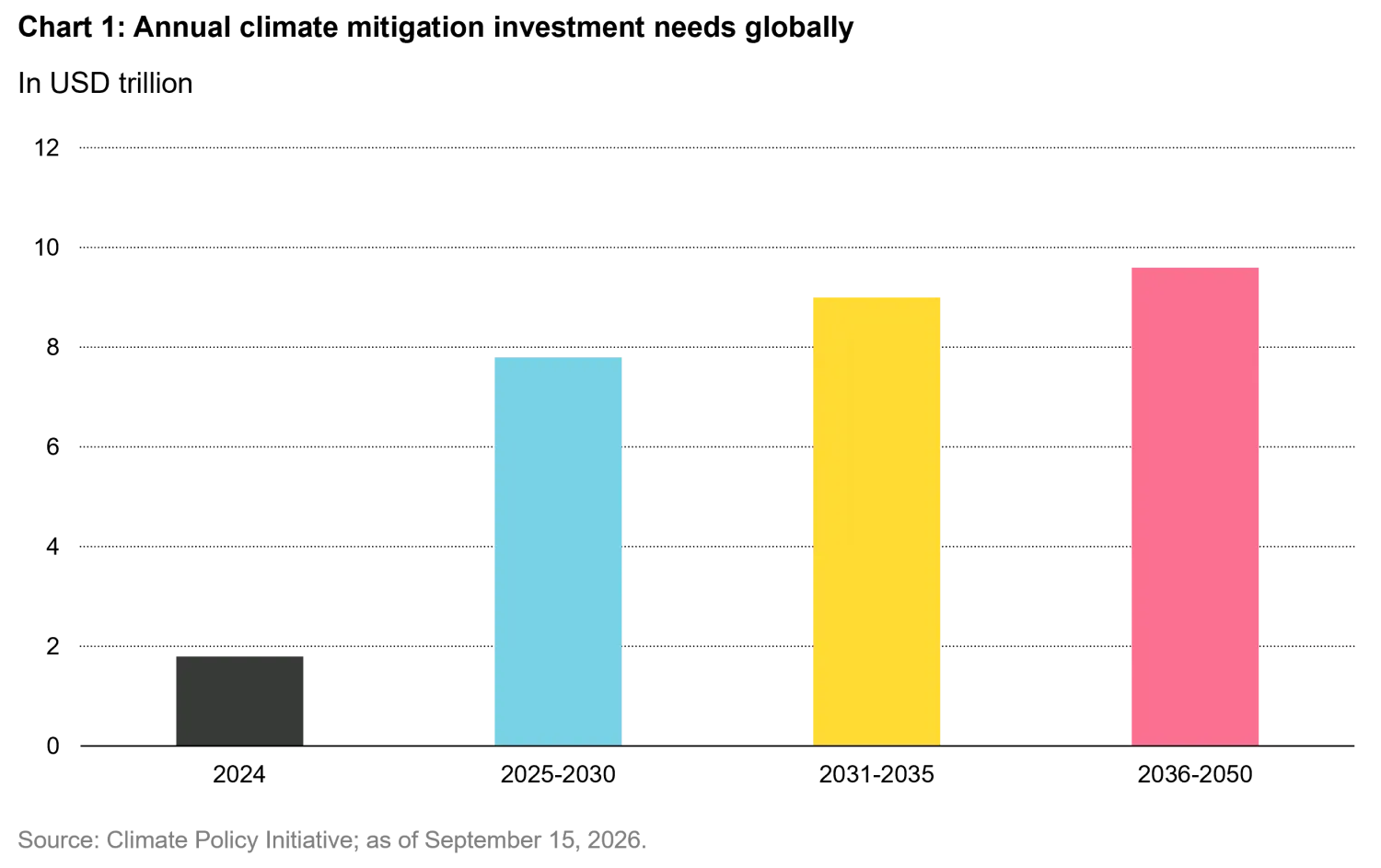
The two key attributes that the financial industry brings to this causality chain are scale and leverage – its ability to act as a green multiplier. FIs sit at the center of the global economy's capital-allocation system. To a certain extent, each lending, underwriting, investment, and advisory decision can either accelerate or slow the transition to a low-carbon, nature-positive, and climate-resilient economy. Finance generally touches every sector, extending its influence far beyond FIs’ own operations through the companies, projects, households, and markets they finance, insure, and advise, as well as through their powers of leverage to motivate more sustainable behaviors. This role is becoming increasingly important as achieving global climate goals will require a substantial increase in investment over the coming decades (see chart 1).
A renewable energy developer may build a wind farm, but banks provide the financing, insurers help manage operational risks, and investors supply long-term capital. Their scale and reach help FIs influence environmental outcomes across large portions of the economy simultaneously, making finance a potentially powerful green multiplier.
Multiple pathways to impact
We recognize the broad spectrum of impact that FIs can have, ranging from direct financing of environmental solutions to wider market influence. While attribution becomes less direct as we move down the hierarchy, the potential reach across the economy often increases. Across all of these pathways, we look not only for growth in environmentally aligned activities, but also for evidence that exposure to high-emitting activities is declining over time. The balance between “green” and “brown” activities therefore provides important context when assessing whether a FI is contributing positively to environmental outcomes.
Table 1: Four impact pathways for financial institutions
Source: Vontobel; as of September 2026.
1. Financing and insuring environmental solutions
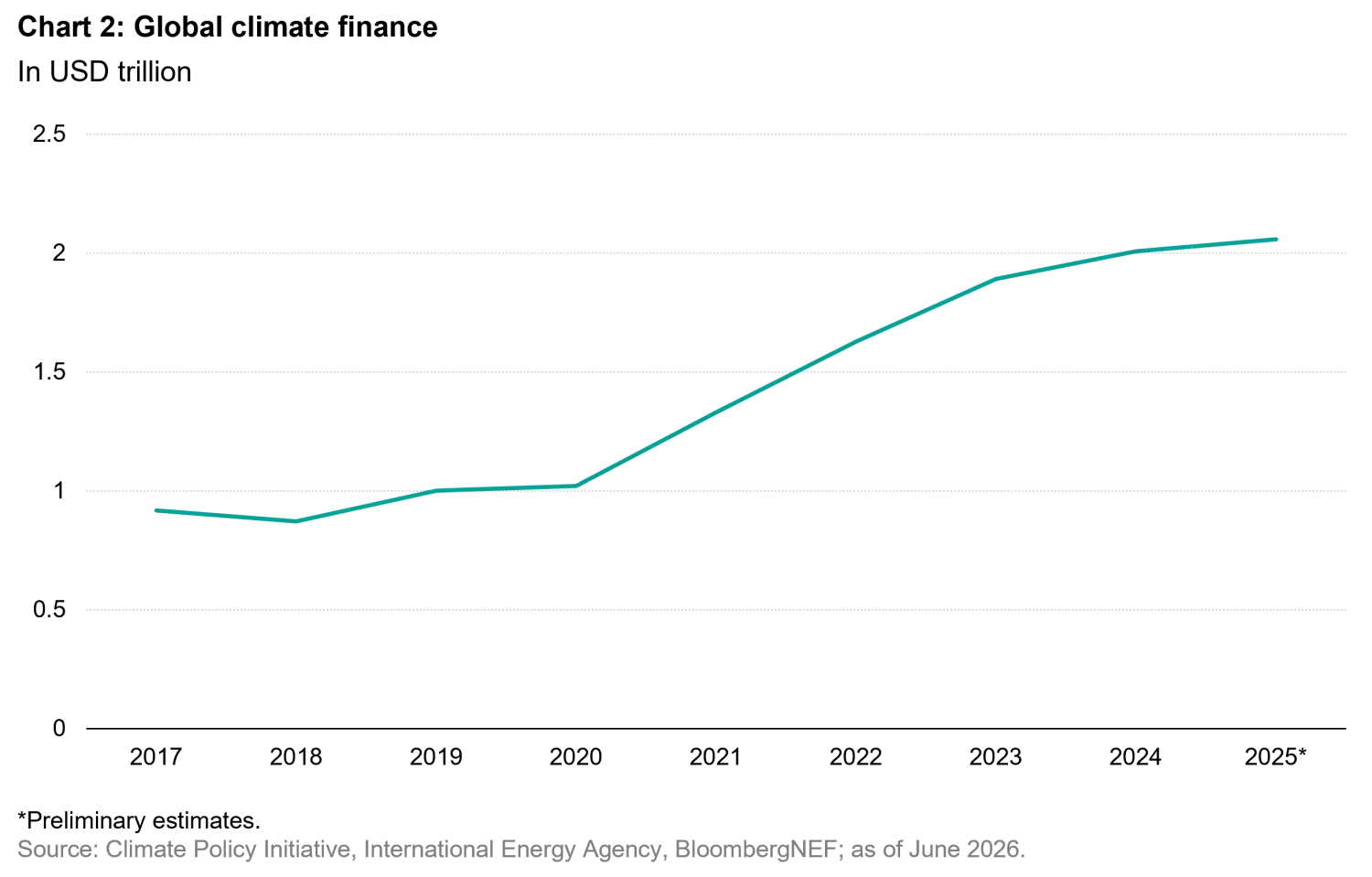
At the most direct end of the spectrum, banks can finance renewable energy projects, energy-efficiency investments, clean transportation, and grid infrastructure. We believe developing specialist expertise in these fast-growing markets can create a virtuous circle of impact and financial returns: better technical knowledge can enable banks to assess and price in risks more accurately, finance a broader range of viable projects, and provide higher-value advisory services, while building market share and fee income. Climate finance has more than doubled since 2017 (see chart 2), with commercial FIs accounting for 28 percent of flows.1 Fifth Third Bancorp, for example, has facilitated more than 190,000 residential solar installations through its specialized platform, which is intended to lower barriers to any solar investments, and has deployed USD 53 billion in sustainable finance.2 Standard Chartered has mobilized USD 157 billion in sustainable finance focused on renewable energy and grid infrastructure in capital-constrained emerging markets, acting as a super-connector to enable North-South flows.3
Insurers provide the risk transfer required for many projects to proceed. They increasingly provide specialist technical knowledge to cover emerging clean technologies, helping projects secure the risk transfer needed for deployment at scale.
2. Environmental risk reduction and adaptation
We believe FIs can contribute to environmental impact by helping households, businesses, and communities adapt to the physical risks associated with climate change. Insurers use climate-risk modelling, resilience advice, and premium and deductible incentives to encourage measures such as flood protection, firebreaks, and more resilient construction practices. Companies such as MS&AD are increasingly using their climate expertise to help clients understand, mitigate, and adapt to physical climate risks.4
Insurers can also influence how assets are repaired or rebuilt following climate-related events, giving them significant influence over whether materials are repaired, reused, recycled, or replaced. Leading practice therefore seeks to embed circular principles into claims fulfilment and “build back better” approaches. Insurers such as Gjensidige also work with customers and suppliers to encourage repair, reuse, and circular rebuilding practices following climate-related events, illustrating how insurers can influence environmental outcomes beyond traditional risk transfer.5
Reinsurers play a complementary role at a more systemic level. While insurers are often closest to end-clients and can directly influence adaptation behaviors through pricing, coverage conditions, and resilience advice, reinsurers such as Munich Re exert influence through catastrophe modelling, risk-pricing frameworks, and the provision of risk capacity across entire markets.6 By shaping how climate risks are assessed and priced throughout the insurance value chain, they help support the long-term insurability of climate-exposed assets and activities.
3. Client transition and behavioral influence
In our view, FIs can accelerate the transition to a lower-carbon economy by influencing how clients invest and operate, redirecting capital away from high-emitting activities and toward environmental solutions, and offering incentives for sustainable actions. Importantly, supporting these transitions can also reduce long-term credit and underwriting risks while creating opportunities in growing low-carbon markets, helping align environmental and commercial objectives. Sustainability-linked loans, green mortgages, transition-finance products, environmental covenants, and sustainability advisory services can encourage businesses and households to adopt more sustainable practices, while phase-out policies for activities such as thermal coal can help avoid carbon lock-in and stranded-asset risk.
Standard Chartered and Fifth Third Bancorp illustrate how FIs increasingly combine financing, advisory services, and transition support to help clients pursue emissions reductions and improve resource efficiency. Similarly, insurers such as MS&AD increasingly provide risk advisory services and transition support that encourage clients to adopt more climate-resilient and lower-emission business practices.
4. Market and system influence
Finally, we believe FIs can shape markets more broadly through stewardship, engagement, exclusions, and underwriting standards and adaptation incentives. By influencing climate targets, transition plans, disclosure standards, and financing conditions, they may affect capital allocation across entire sectors. While these forms of influence are difficult to measure, they can shape market norms and capital allocation across entire industries, amplifying impact well beyond individual transactions.
As climate change intensifies, there is greater focus on insurance against climate perils and closing the uninsured gap. Natural disasters caused around USD 224 billion in economic losses in 2025, of which just under 50 percent was insured.7 Protection gaps are expected to widen further as climate-related risks intensify. We believe insurance companies can contribute to market resilience through risk modelling, pricing, catastrophe expertise, and collaboration with public authorities. These activities can help shape adaptation measures, building standards, permitting zones, and broader capital allocation decisions.
For banks and investors, market influence comes largely from strength of stewardship programs, including voting and engagement, as well as pro-climate policy lobbying, stringent transition policies for high-emitting sectors, clear phase-out plans for coal and unabated oil and gas, and the broader signaling power of advanced net-zero strategies.
Why measuring impact in finance is different
Our central approach to identifying impactful companies is to require at least 20% of revenues to come from impact-aligned products and services. For most companies this provides a relatively intuitive test. For FIs, however, there is no single, consistent denominator against which its materiality of environmental contribution can be assessed.
We therefore use a data triangulation approach. Rather than relying on a single indicator, we assess multiple dimensions, including environmentally aligned lending and investment activity, sustainable finance flows, the balance and trajectory of green versus brown financing, environmental outcomes, and evidence that the institution is meaningfully influencing clients to transition. The objective is not to relax the 20% hurdle for financials, but to adapt how it is evidenced to reflect the way FIs conduct and report their business. Standard Chartered illustrates this well. The bank reports USD 157 billion of sustainable finance mobilized since 2021, USD 23.4 billion sustainable assets on the balance sheet, more than USD 1 billion of sustainable finance income, and approximately 4 million tons of avoided emissions annually.8 Together, these metrics trace the sustainable finance chain from flows to income, stock and environmental outcome. Yet despite impressive magnitude, none individually reaches our 20% hurdle.
The quantitative evidence is therefore complemented by analysis of the operational levers through which the bank can influence transition across its client base. Acting as a super-connector, the bank utilizes its global footprint to facilitate North-South capital flows into areas such as renewable energy and grid infrastructure in capital-constrained regions. In addition, its climate transition framework applies to corporate lending, representing c.37% of its loan book – a material mechanism through which the bank seeks to influence client transition.
This more flexible framework allows us to retain a strong bias towards hard metrics while incorporating qualitative and semi-quantitative evidence where it captures a material and demonstrable transition mechanism. Such evidence is not treated as a substitute for data: it must meet a similarly high evidentiary bar, with emphasis on observable implementation, scale and real-world outcomes rather than policies or commitments alone. The approach can therefore become increasingly systematic across the financial sector, while retaining some case-specific judgement where business models and disclosure differ.
Looking beyond direct attribution
A common misconception is that impact diminishes as the connection between finance and environmental outcomes becomes less direct. We would argue that the opposite can often be true. Direct financing provides the clearest link to impact, but we believe broader forms of influence can operate across much larger parts of the economy. The real challenge is therefore how impact can be identified and measured credibly, not whether impact exists.
Viewed through this lens, FIs are more than intermediaries. By financing environmental solutions, enabling adaptation, supporting client transitions, and shaping market practices, we believe they can help unlock environmental progress at a scale few other sectors can achieve. In our view, this combination of reach and leverage is what gives finance the potential to be a powerful green multiplier.