
Replay: How private and public markets can steward solutions to societal changes
You can now watch the replay of our webinar: How private and public markets can steward solutions to societal changes.

Many of the challenges of our time, such as climate change, energy security, and economic inequality, are deeply interconnected. We believe that their solutions are as well. The global climate transition is not solely a technological or political issue; it’s also a capital challenge. Investment decisions made today, across both private and public markets, can set the tone for how we shape our energy systems, infrastructure, and economies for decades to come.
Climate policy has become increasingly politicised, and some countries are either rolling back or challenging their climate targets. This political noise can create uncertainty and volatility. But beneath the headlines, the heartbeat is still strong: climate solutions are reaching economic tipping points as renewable energy is now often a competitive source of new power. Over the past decade, the cost of solar and onshore wind energy has plummeted by more than 80 percent and nearly 70 percent, respectively1. Electric vehicles are nearing cost parity with internal combustion engines2. Energy efficiency retrofits can offer short-term paybacks in commercial real estate3.
These shifts are increasingly driven by economics, not just policy, and we have yet to observe any major reversals of this trend. In fact, we believe that political volatility can create investment opportunities. As uncertainty spooks some investors, quality climate solution providers may temporarily trade at discounted valuations, creating attractive entry points for those seeking structural growth over the coming decades.
Much of the conversation around climate investing tends to focus on private markets – and rightly so. Their role in providing innovation the room to breathe and giving investors a seat at the board room table is critical. Private markets take on the role of enablers and hands-on partners to enable transformations, improvements and projects which require significant capital expenditure. This kind of support is especially important in areas where infrastructure needs and high upfront costs might slow progress.
Take infrastructure investment manager Ancala, for example, which has invested more than EUR 1 billion in companies and projects related to the energy transition. One example is Spain’s Magnon Green Energy , the country’s largest generator of renewable energy from biomass, which has an innovative project to capture and reuse biogenic CO2 at its plant in Huelva, Spain. This initiative supports the production of low-carbon e-methanol, replacing traditional grey methanol made from natural gas. This is an example of a project and that we believe can have a critical to accelerating the transition to cleaner energy sources and that can have a material positive impact on the value of the business.
Ancala approaches sustainability with a long-term horizon and looks for ways to enhance critical infrastructure companies across all sectors that not only deliver positive outcomes but align with creating lasting value for all stakeholders. Ancala takes a pragmatic and focused stance, identifying and prioritising areas that have the potential to deliver the greatest impact and best return on capital. In order to achieve this, Ancala takes a holistic point of view, considering value creating sustainability initiatives across the entire investment cycle.
Ancala’s period of ownership4 in UK LNG terminal Dragon LNG is a great example. Dragon is just one of three LNG terminals in the UK. LNG is likely to continue to play a crucial role in the UK’s energy mix while it transitions to greener sources of energy. To support this shift, Ancala worked with Dragon LNG’s management team to identify and progress a number of key energy transition initiatives. These included installing a 10MW solar farm on site, securing and progressing plans to install a 13MW wind farm and developing new partnerships to help decarbonise the industrial cluster in the Milford Haven where Dragon and a number of other leading energy companies operate. Ancala’s support to embed decarbonisation considerations and projects into the terminal’s operations enhanced Dragon LNG’s long-term value.
In many cases, private markets provide the foundations and flexibility to pursue long term growth plans. Beyond private markets, public markets open up a larger pool of investors to support future growth plans.
So, how do private and public markets go hand in hand in impact investing? They play different but complementary roles in the financial ecosystem, with the former excelling at nurturing long-term growth and innovation and the latter at providing an additional and broader pool of capital to continue to scale (see chart 1).
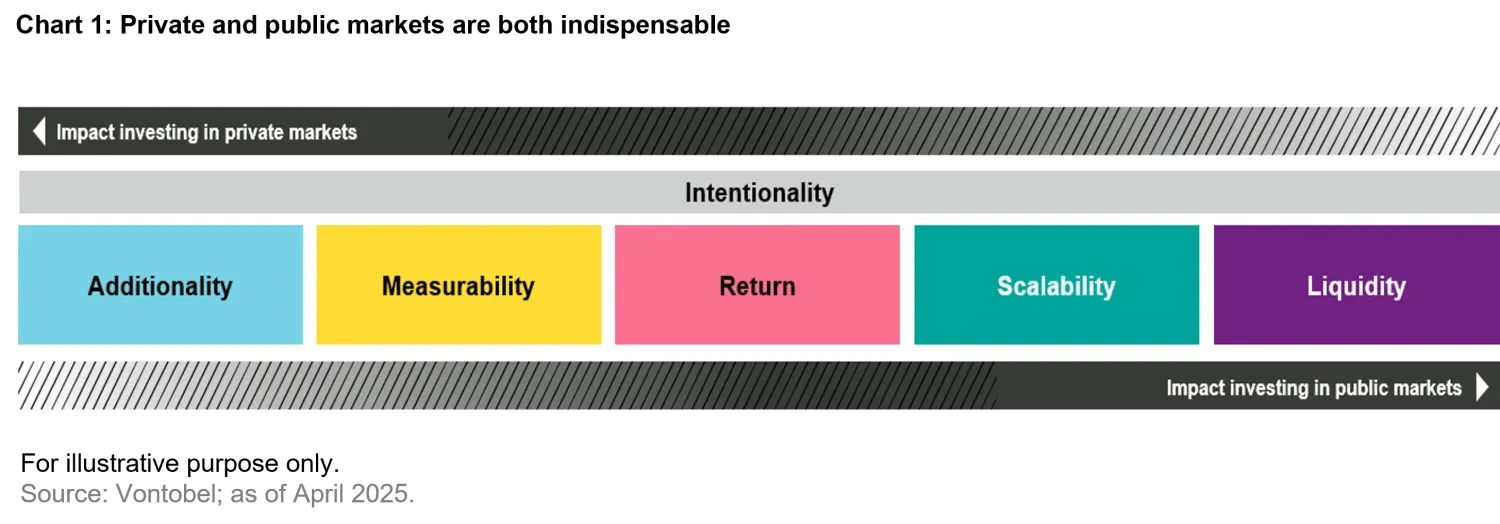
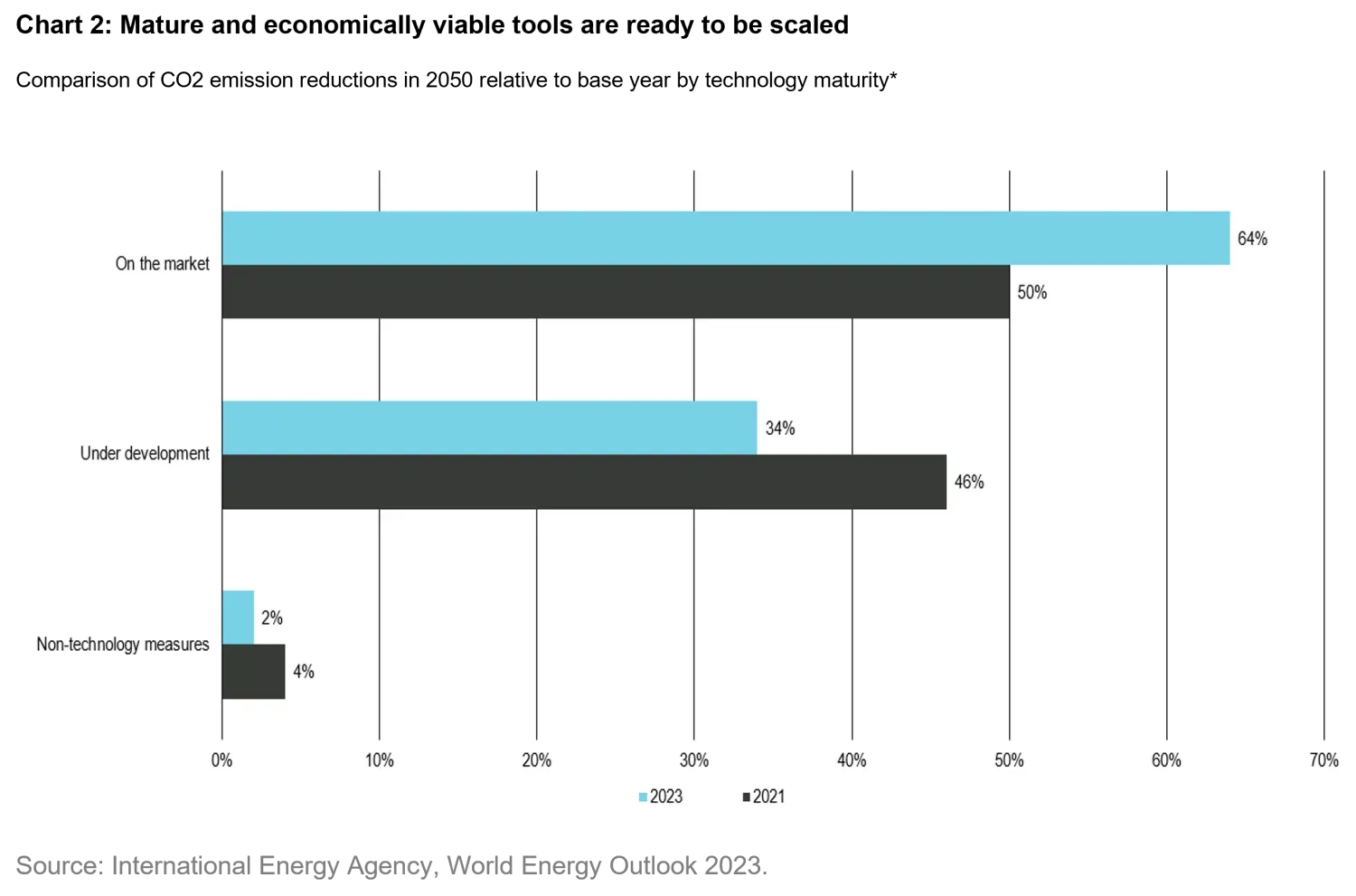
As an example, think of renewable power generation5, energy-efficient building materials6, or low-emission transportation alternatives7. Many of these solutions are now proven and accepted, and often economically viable. As a result, they are increasingly incorporated in infrastructure projects and are gaining access to additional capital pools through public markets (see chart 2).
Vontobel’s impact investing team, for instance, highlights Saint-Gobain, a leading French producer of building materials. The company manufactures lightweight materials for the construction and renovation industry, which includes specialty glasses for solar panel production and improved insulation technology such as double- and triple-glazed windows and special reflective coatings. These innovations help reduce noise pollution as well as cooling and heating demand across a plethora of applications, such as homes, vehicles, or airplanes, and thus improving both energy efficiency and quality of life. Lightweight materials also benefit the transportation industry via energy efficiency. Around 25 percent of Saint-Gobain’s product lineup is less than five years old, underscoring its commitment to innovation and its ability to capture market share on a global scale. As such, more than three-quarters of the company’s revenues contribute to impactful outcomes.
Despite the crucial role public markets can play, many investors remain skeptical about the impact potential of public equities. In private markets, the link between investment and outcome feels tangible: investors fund, say, a clean energy company, and that company grows. In public markets, the connection can feel less obvious. After all, how does buying a share in a listed company result in a real-world reduction in emissions? Rather than focusing narrowly on portfolio-level carbon footprints, we believe impact-focused public market investors need to approach the question from a different angle: What real-world outcomes are my investments helping to create?
Impact in public markets is a two-step model. First, investors allocate capital and actively engage with companies through shareholder voting, stewardship, and dialogue. Second, companies put that capital to work, scaling up the production and delivery of climate-positive products and services. The real-world impact is progress, and not just on balance sheets.
So, what kind of companies might active managers typically target in public markets? Three factors are key:
Active managers tend to prioritize companies that offer low-technology risk and credible solutions. It’s about investing in technologies that are already on the market, already working, and already gaining traction. These are companies that we believe can make a difference today, not just hypothetically in the future.
Size matters. To generate real impact, solutions must go global. Active managers would likely look for companies with the operational capacity, market demand, and supply chain resilience to significantly scale their solutions. Without scalability, even the most ingenious ideas can only achieve limited impact.
Another important aspect would be companies that can monetize their solutions with profitability and a competitive advantage as they’re more likely to expand their positive impact over time. These businesses align impact with performance.
Many of these companies are witnessing structural growth trends, such as electrification, sustainable transport, circular economy, and energy efficiency , that are poised to become ever more important to the global economy over the coming decades. Governments, companies, and consumers alike are creating growing demand for climate solutions, which is likely to translate into return potential. Additionally, looking at businesses through an impact lens introduces an alternative way to assess companies, which can add diversification to a traditional portfolio.
Private and public markets are not just adjacent to the climate transition – they are central to it. Together, they can join hands and form a continuum of capital, offering investors a broad spectrum of investment possibilities. Impact, in this context, is not just theoretical. It can be measurable, profitable, and, most of all, scalable.
1. Source: International Renewable Energy Agency, published August 29, 2023. https://www.irena.org/News/pressreleases/2023/Aug/Renewables-Competitiveness-Accelerates-Despite-Cost-Inflation#:~:text=Between%202010%20and%202022%2C%20solar,the%20cheapest%20fossil%20fuel%20globally.
2. Source: Gartner report, published March 7, 2024. https://www.gartner.com/en/newsroom/press-releases/2024-03-07-gartner-outlines-a-new-phase-for-electric-vehicles
3. Source: EDGE article, published January 18, 2024. https://edgebuildings.com/could-property-linked-finance-be-the-silver-bullet-to-propel-green-retrofits-at-scale-in-cities/
4. Source: Ancala press release, published May 8, 2024. https://ancala.com/ancala-agrees-to-exit-its-interest-in-dragon/
5. Source: International Renewable Energy Agency, published in 2024. https://www.irena.org/mwg-internal/de5fs23hu73ds/progress?id=dKZWOlCmYtqz7zutANQomSvk_Djt_uNOLYVOEtsL8j8,&dl
6. Source: Global Market Insights, published November 2024. https://www.gminsights.com/industry-analysis/energy-efficient-materials-market
7. Source: Bloomberg article, published September 24, 2024. https://www.bloomberg.com/news/newsletters/2024-09-24/cheaper-truck-batteries-usher-in-dawn-of-emissions-free-rigs
Important Information:
This marketing document was produced by one or more companies of the Vontobel Group (collectively "Vontobel") for institutional clients. This document is for information purposes only and nothing contained in this document should constitute a solicitation, or offer, or recommendation, to buy or sell any investment instruments, to effect any transactions, or to conclude any legal act of any kind whatsoever. This document is not the result of a financial analysis and therefore the “Directives on the Independence of Financial Research” of the Swiss Bankers Association are not applicable. Vontobel and/or its board of directors, executive management and employees may have or have had interests or positions in, or traded or acted as market maker in relevant securities. Furthermore, such entities or persons may have executed transactions for clients in these instruments or may provide or have provided corporate finance or other services to relevant companies. Although Vontobel believes that the information provided in this document is based on reliable sources, it cannot assume responsibility for the quality, correctness, timeliness or completeness of the information contained in this document. Except as permitted under applicable copyright laws, none of this information may be reproduced, adapted, uploaded to a third party, linked to, framed, performed in public, distributed or transmitted in any form by any process without the specific written consent of Vontobel. To the maximum extent permitted by law, Vontobel will not be liable in any way for any loss or damage suffered by you through use or access to this information, or Vontobel’s failure to provide this information. Our liability for negligence, breach of contract or contravention of any law as a result of our failure to provide this information or any part of it, or for any problems with this information, which cannot be lawfully excluded, is limited, at our option and to the maximum extent permitted by law, to resupplying this information or any part of it to you, or to paying for the resupply of this information or any part of it to you. Neither this document nor any copy of it may be distributed in any jurisdiction where its distribution may be restricted by law. Persons who receive this document should make themselves aware of and adhere to any such restrictions. This material may contain forward-looking statements, which are subject to uncertainty and contingencies outside of Vontobel's control. Recipients should not place undue reliance upon these forward-looking statements. Past performance is not indicative of future results. Equity investments are subject to market risk, active management risk, and growth stock risk; dividends are not guaranteed. References to holdings (past/current) and/or other companies for illustrative purposes only to elaborate on the subject matter under discussion. The securities identified and described do not represent all of the securities purchased, sold, or recommended for clients. There is no assurance that any securities discussed will remain in the portfolio or that securities sold have not been repurchased. You should not assume that any investment is or will be profitable.