Swiss Equities
Investing in excellent companies in Switzerland.

When the Swiss National Bank (SNB) cut its key interest rate by 25 basis points to 1.5% in March1, it compounded the belief that interest rates have peaked and kicked off the rate cuts widely expected but not yet implemented by its European and US counterparts. In response to SNB action, yields on 10-year Swiss government bonds fell. The dividends of many Swiss companies remain relatively higher by comparison, as the broader Swiss equity market index shows (see chart 1). This points to why equity dividends, generally considered a stable and reliable investment strategy, tend to be increasingly favored in times of lower growth, lower inflation, and falling interest rates.

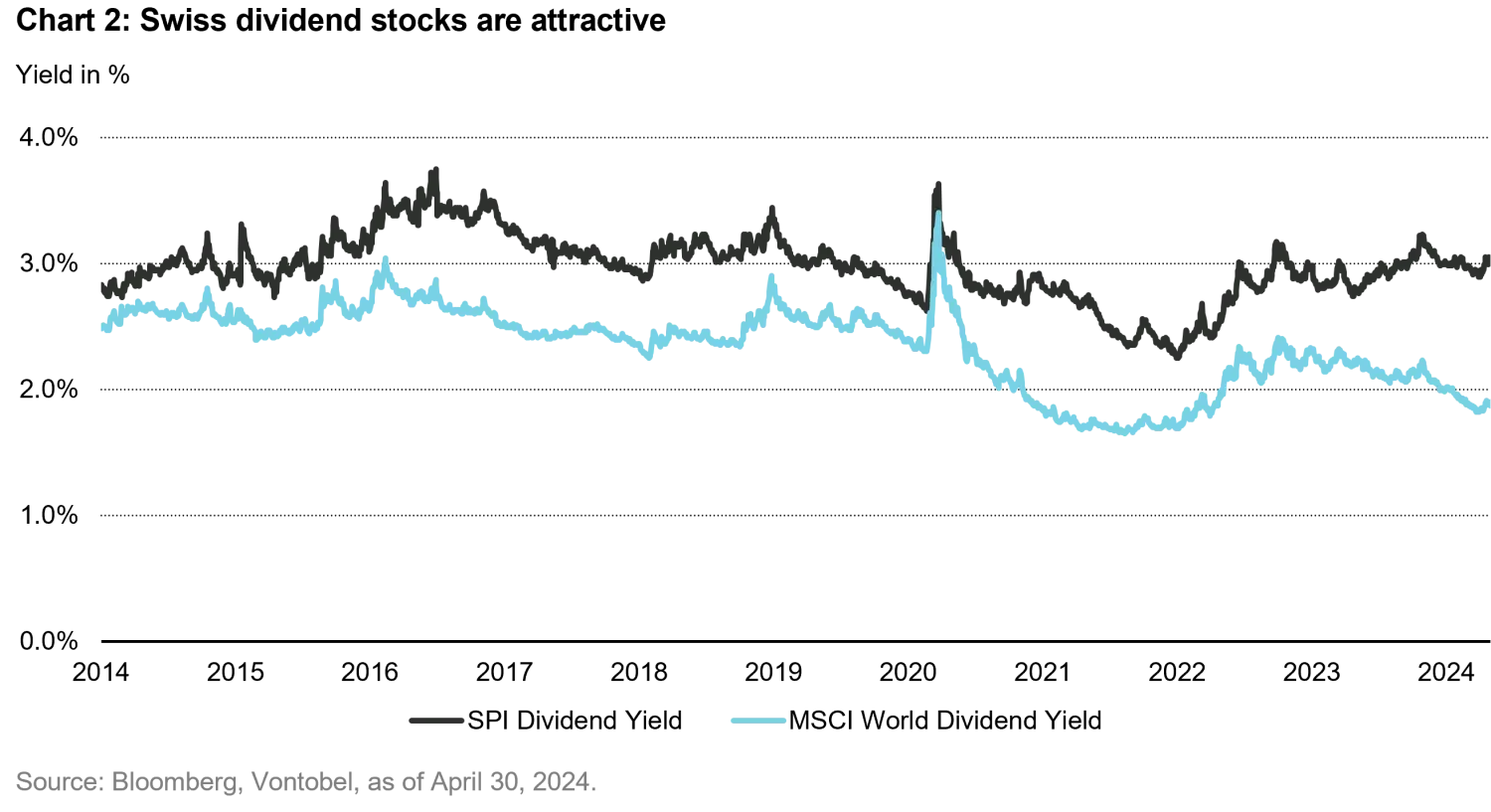
The Swiss stock market seems particularly well suited to so-called dividend strategies. Swiss equities are characterized by quality, diversification, and defensiveness. Compared to the most important European and US country indices, historical data shows the Swiss Performance Index (SPI) returns both a higher average dividend yield and more stable payments with lower fluctuations (see chart 2). In addition, the real dividend yield in Switzerland is comparatively stronger due to the lower Swiss yield levels.
Another factor, says Marc Hänni, Head of Swiss Equities at Vontobel, is the important role dividend payments play in total shareholder returns, as evidenced by the last 10 years in most Swiss stocks. “Looking at dividends as a signal of economic strength, the Swiss market shows 15 companies that have increased dividends year-on-year for the past decade,” Hänni explains. “And, despite the volatile market environment, we expect Swiss companies to show a record amount of dividend payments for both 2023 and 2024. Dividend payments should therefore play an important role in investment decisions and stock selection, as they significantly contribute to the total return of a stock.”
Picking the right quality stock matters. It’s not a question of simply selecting companies currently delivering a high dividend yield; the consistency and stability of these dividends count, as does a company’s long-term potential to maintain them.
Vontobel’s SSEIP fund seeks to create alpha through a concentrated selection of quality Swiss companies. Limited to 30-35 companies, the portfolio is nevertheless broadly diversified with regards to sector allocations. Selected against high standards for global market leadership and innovative strength, factors considered include:
SSEIP aims to outperform the SPI over the market cycle, including by leveraging Vontobel’s experience with Swiss mid-caps. As a market segment, Swiss mid-caps have clearly outperformed the broader Swiss market over a 10- and 20-year investment horizon. Swiss mid-caps, which we defined in this case as stocks with a market capitalization of above CHF 3 billion, will form a maximum of 25% of the portfolio.
The fund targets a return potential of 7-8% per year, with around one-third generated from dividends and two-thirds from option premiums. The options strategy, commonly referred to as a covered call strategy2, is designed to provide some protection in market downturns. It is tax-optimised for investors domiciled in Switzerland.
Vontobel’s SSEIP fund uses a sophisticated options strategy to generate regular additional income. The fund strategically writes call options on both individual stocks and the index, adjusting its approach depending on market conditions and economic cycles to maximize returns while taking advantage of growth opportunities where possible.
It does this in two ways:
In summary, the fund’s Swiss equity strategy aims to generate increased distribution yields through dividends and option premiums. As Hänni explains: “This offers Swiss-domiciled investors attractive income potential from dividend yield and tax-free option premiums, with the high quality and defensive characteristics of its stocks aiming to provide relative outperformance over a market cycle.”
1. https://www.snb.ch/en/publications/communication/press-releases-restricted/pre_20240321
2. It’s been said that writing call options is like selling an "insurance policy”. “Covered call” is the term used when a long position is held in a certain stock, while a call option (of the same size) is also sold on the same asset. The seller of the call option receives a premium for the sale, while the buyer receives the right to buy the underlying stock at a predetermined price. Additional income is generated by collecting the (insurance) premium.