Swiss Equities
Investing in excellent companies in Switzerland.

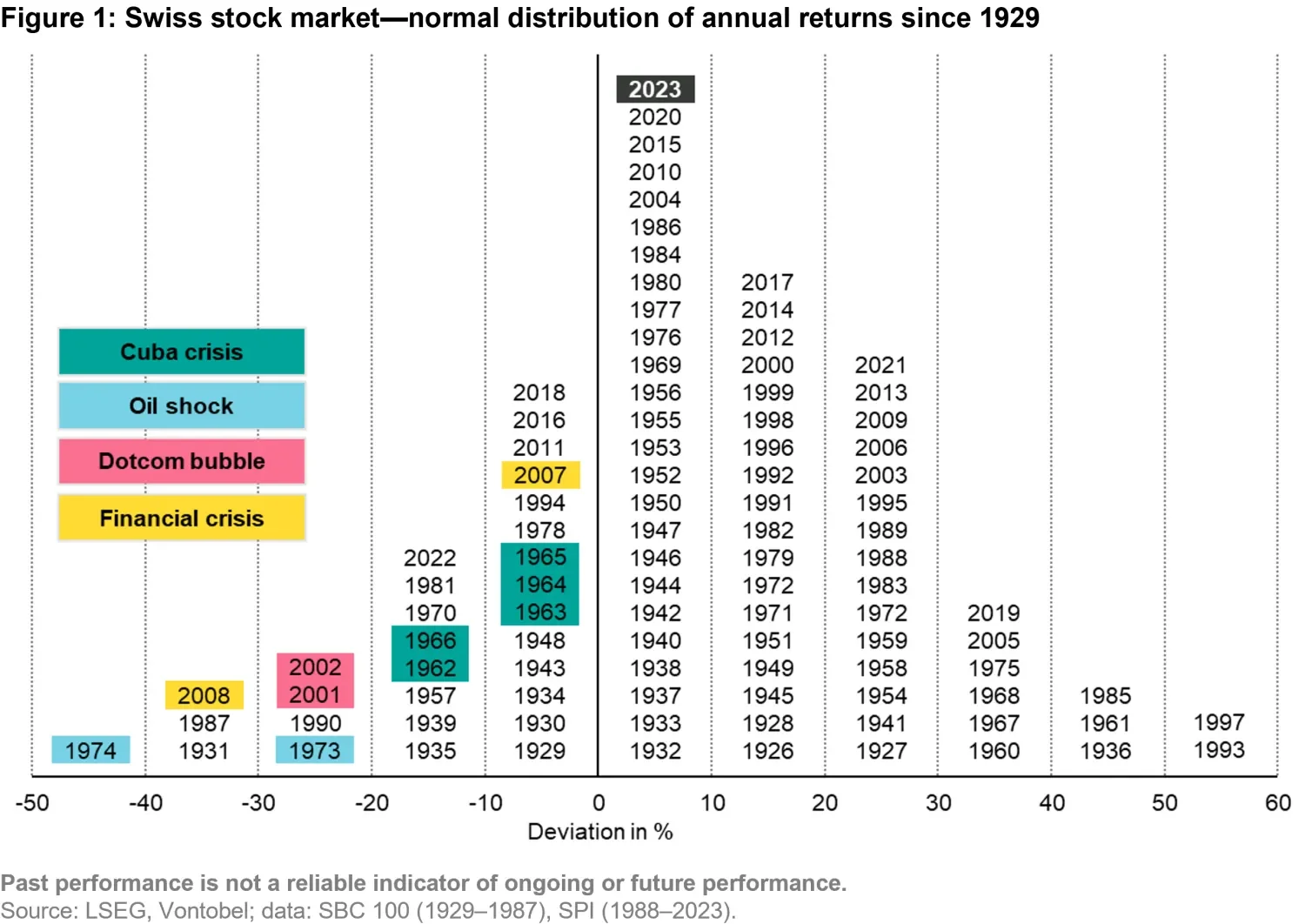
In the history of the Swiss stock market, 2023 will be remembered as an average year with a performance of 6.1 percent, as measured by the diversified Swiss Performance Index (SPI). In line with the normal distribution of modern financial theory, its annual returns over the last 95 years were mainly in the middle range of 0 to 10 percent (Figure 1). Significantly positive or negative deviations from this were less frequent, and several consecutive negative years on the stock market were rather the exception to the rule. Since the mid-1960s, investors in the Swiss stock market have always achieved positive returns over five consecutive years. We therefore consider a medium- to long-term investment horizon to be sensible when making equity investments, especially because the current investment environment is fraught with uncertainty from both an economic and a geopolitical standpoint.
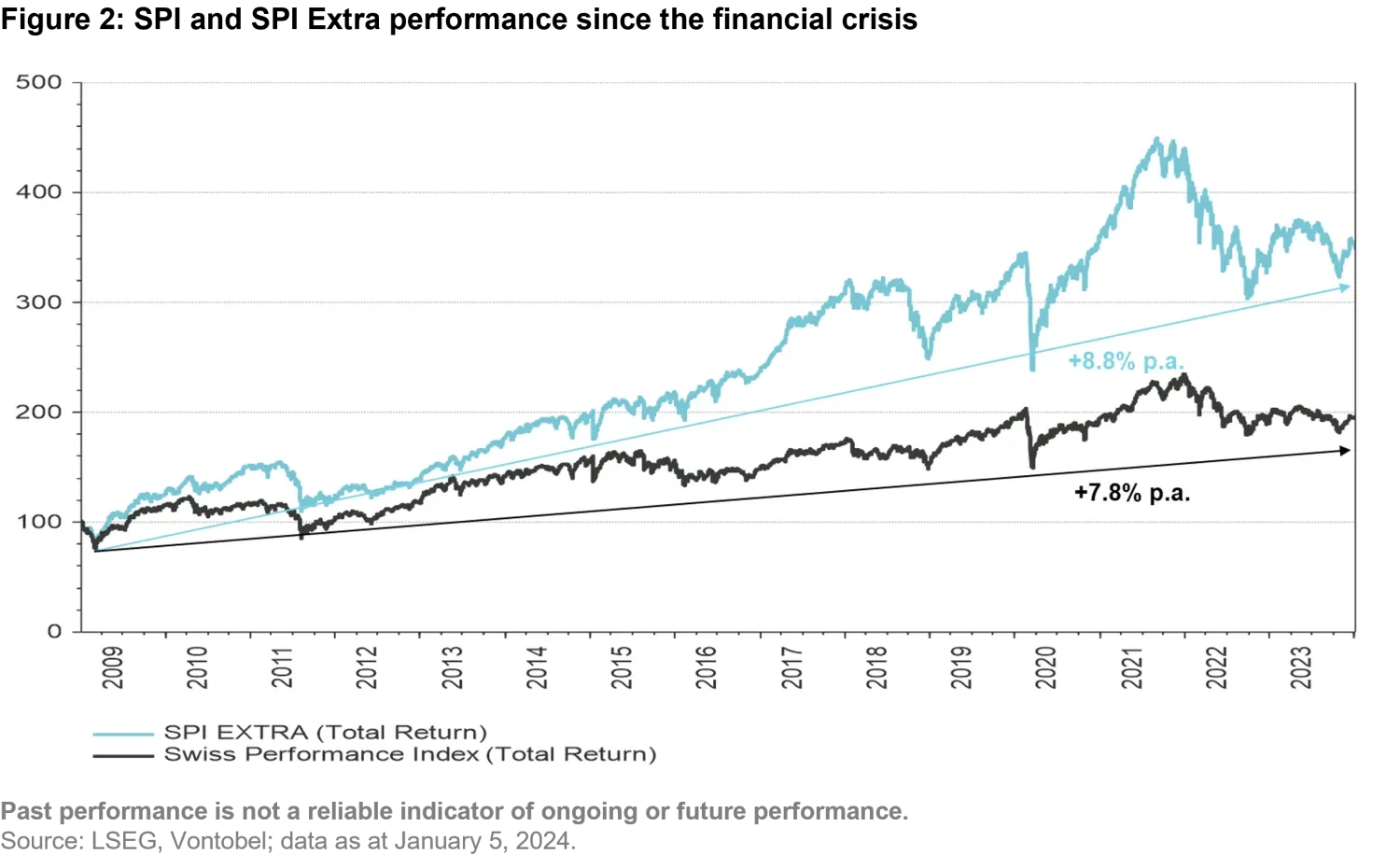
Over the last 15 years—from the 2009 global financial crisis to the end of 2023—Swiss small & mid caps generated an annual return of 8.8 percent as measured by the SPI Extra, outperforming the SPI by 1 percent (Figure 2). The difference in overall performance from 1995 to the end of 2023 is even more impressive: 1,080 percent for the SPI Extra compared to 570 percent for the SPI. The reason for this is the success of numerous Swiss companies that started with small to medium-sized market capitalizations. In the 30 years that followed, these companies from many different sectors became global market leaders, such as Kühne + Nagel, Lindt & Sprüngli, Logitech, Sika, Straumann and VAT.
It was a different situation over the last five years. The intensified trade war, the pandemic, restricted supply chains, high inflation, aggressive base rate hikes by central banks and geopolitical instability affected Swiss small & mid caps more strongly than the more defensively oriented Swiss large caps, such as food multinational Nestlé or pharmaceutical giants Novartis and Roche. That’s because the former are more dependent on the economy. Still, we believe in the quality of many Swiss small & mid caps in the medium to long term. Accordingly, we expect that they will regain their former strength with an investment horizon of over a year.
Given the strong final spurt in stock prices in 2023, we believe the base rate cuts anticipated in the current year are already partially priced in. We do not expect interest rates to ease until the second half of 2024. Until then, companies will continue to face high refinancing costs.
We do not foresee a hard landing for the US economy, which we believe is already in a mild recession. European countries are currently painting a heterogeneous economic picture. The situation is particularly difficult in the construction and automotive industries in Germany, for example, which is Switzerland’s second-most important trade partner. In China, there are delays to the economic recovery that we expected last year following the lengthy pandemic-related shutdowns. Based on our current assessment, the situation there should gradually improve as the year progresses, in part thanks to support measures from the Chinese government.
We closely monitor geopolitical uncertainties and always take the possible consequences of these into account when making our investment decisions.
The valuation of the Swiss stock market based on the price/earnings ratio (P/E ratio) is currently in line with the average of the last 15 years (Figure 3). In our opinion, Swiss small & mid caps are currently particularly attractively valued compared to the historical average. At the end of 2021, they were still trading at a premium of 35 percent compared to the long-term average, but they are currently trading at a discount of around -13 percent.

Relative consideration is more important to us than absolute valuations. While we contrast Swiss companies’ valuations with those of their direct competitors—many of them based abroad— we also compare the valuation performance of individual companies over the last five or 10 years. We believe that this is relevant, as the current valuations of many Swiss companies are high compared to those of their direct competitors. As an example, this is the case for Ems-Chemie, Lindt & Sprüngli, Straumann and VAT. This is justified in our view, as many Swiss companies from a wide range of sectors achieve by far the highest margins in the world.
The quality of the companies is key to our investment process. By “quality,” we mean companies with a leading position in the global market, a strong balance sheet with low levels of debt, the ability to innovate, pricing power, stable margins, exemplary corporate culture, and a sustainable dividend policy. In times of economic uncertainty, as is currently the case, we favor companies that are only slightly dependent on economic trends or interest-rate developments because they have a resilient business model in addition to the quality-related characteristics mentioned above.
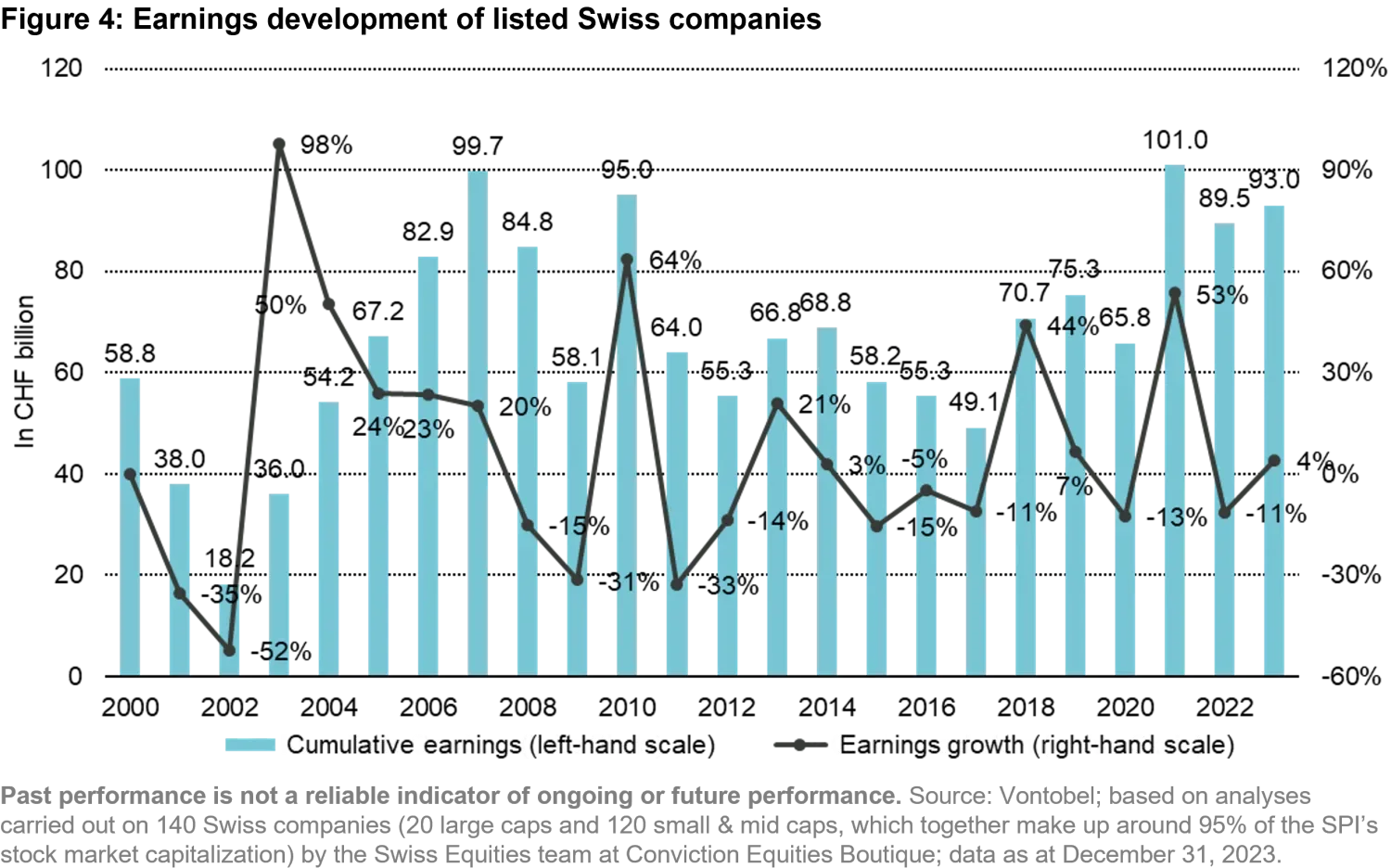
We also prioritize expected corporate earnings in our investment process because they have a significant impact on the stock markets. This can be seen in the historical profit performance of the 140 Swiss companies we analyzed—20 large caps and 120 small & mid caps, which together make up around 95 percent of the SPI’s market capitalization (Figure 4). Their earnings fell by 11 percent in 2022 compared to the previous year, and those of small & mid caps even fell by 25 percent, as measured by the SPI Extra. Stock prices also fell accordingly in 2022 (SPI: -16 percent vs. SPI Extra: -24 percent). Based on our estimates for 2023 (as the actual annual results are not yet available for many companies), earnings are likely to have again grown by around 4–5 percent compared to the previous year.
Comparing the most important stock markets over the last three years, the Swiss stock market stands out for having the heaviest downward earnings revisions, especially last year and particularly in the second half of last year. This stands in contrast to the US stock market, for example, which showed significant upward revisions due to the high proportion of technology companies that benefited from the tailwind brought by artificial intelligence (including ChatGPT). As a result, we conclude that the current prices on the Swiss stock exchange are already anticipating some recessionary fears. The magnitude of the earnings currently expected seems realistic to us, i.e., we do not foresee any further substantial downward revisions for the time being.
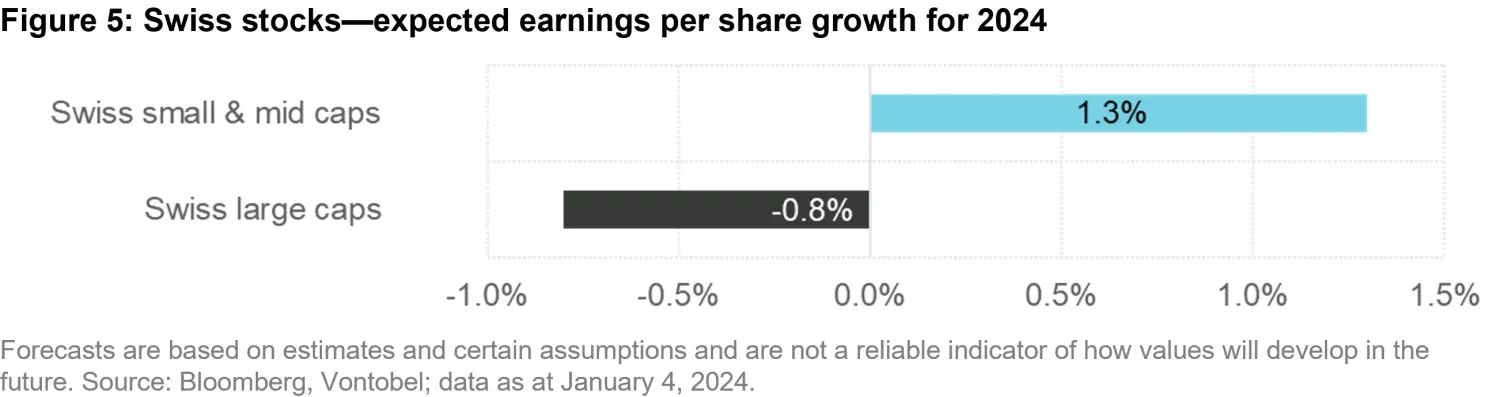
Our assessment is that 2024 earnings expected for Swiss large caps are likely to fall slightly or stagnate, while those for Swiss small & mid caps are likely to increase by 1.3 percent (Figure 5). This estimate is based on the assumption that many companies will initially face challenges, but that their order numbers will then pick up in the second half of the year. In turn, this will ultimately have a positive impact on their stock price—especially given their valuations, which are considered attractive in historical terms.
The Swiss small & mid caps segment is significantly more cyclical than Swiss large caps because the latter are strongly represented in defensive sectors such as food, healthcare, and telecommunications. In the past, Swiss small & mid caps have performed worse than Swiss large caps when the global economy cooled and purchasing managers’ indices (PMI) have dropped or fallen below the growth threshold of 50 (Figure 6). Once the period of declining PMI was over, it was a good time to shift into small & mid caps. In our view, this is likely to be the case again in the next two to three quarters.
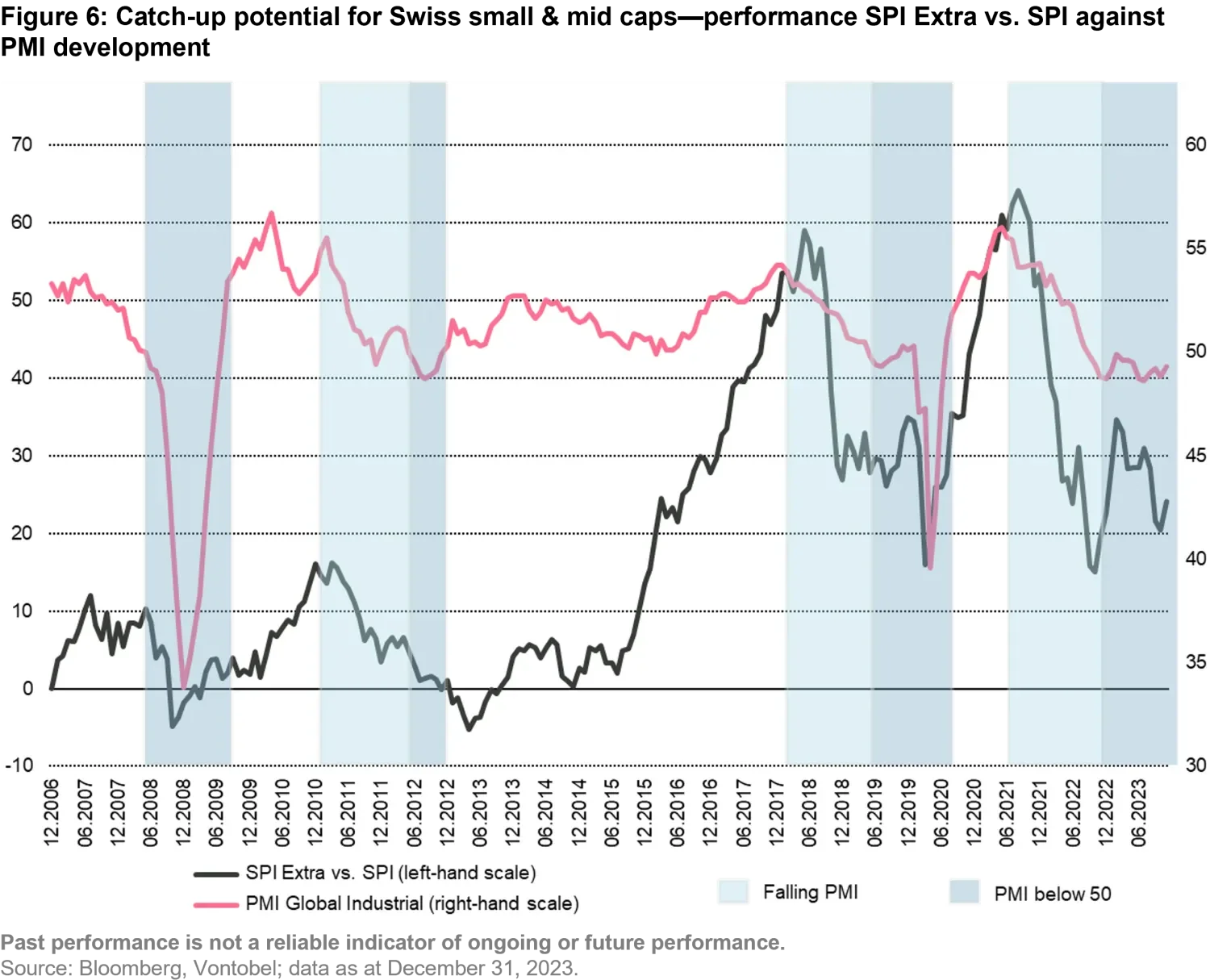
In our close communication with companies, we currently sense little visibility for the coming months. Even the figures for the fourth quarter of 2023 showed that incoming orders in the industrial sector, as an example, are continuously falling. As a result, companies’ outlooks for the current year are likely to be cautious for the most part, as they will not want to set expectations too high. However, we assume that the global economic situation will improve in the second half of 2024, helped by cuts in key interest rates by various central banks.
Many companies mention the persistently strong Swiss franc as another obstacle. This is particularly difficult for companies that cannot move their production facilities abroad or closer to their clients for various reasons. However, many Swiss-based companies have been dealing with this problem for over 20 years. Quite a few of them have been able to adapt surprisingly quickly to changing circumstances time and again, demonstrating agility, especially on the cost side, and deploying innovative strategies to turn the competitive disadvantage of a strong franc into an advantage.
We are generally positive about Swiss stocks with an investment horizon of over one year. At the same time, we believe that Swiss small & mid caps will regain their former strength in the medium to long term. Finding the right time to start investing is sometimes the biggest challenge. However, history has shown that successful investors are better off positioning themselves for the next economic upswing a little too early as opposed to too late.
We currently hold a balanced portfolio of defensive and early-cycle Swiss quality stocks. Given the current uncertainties, we make our investment decisions with a medium to long-term investment horizon of 18 to 24 months. We have high quality standards when it comes to selecting companies and are not prepared to compromise on this.
We believe that the more uncertain the times, the more important it is to be close to companies. Our regular discussions with representatives on boards of directors and administrative boards always give us important insights, as do our on-site company visits. This extra knowledge forms the basis for successful investing, paired with the wealth of experience of our specialist Swiss equities team—which it has built up over many years.
Past performance is not a reliable indicator of ongoing or future performance. Forecasts are based on estimates and certain assumptions and are not a reliable indicator of how values will develop in the future.