Fixed Income Boutique
Based in Zurich and New York, the Fixed Income Boutique is an active manager aiming to capitalize on market trends and inefficiencies.

So far, 2026 has been a favorable year for Brazilian local assets, despite the outbreak of the conflict in Iran and the resulting disruptions to crude oil and refined product supply chains. Setting aside the volatility experienced by equities, Brazilian local assets have generally delivered a relatively steady and positive performance compared with their emerging market peers.
The Brazilian real (BRL) has benefited from its attractive carry and favorable terms of trade, while local bonds have been supported by the monetary easing cycle and the gradual re-anchoring of inflation expectations. We believe this improvement in sentiment has been reinforced by the stronger BRL, which has helped alleviate inflationary pressures in tradeable goods, and provided additional room for the central bank to continue easing monetary policy, given the slowdown in economic activity.
In hard currency, sovereign bonds have been unremarkable in either direction. Given that the vast majority of Brazil's public debt is domestic, its external debt tends to trade more as a beta play than an idiosyncratic one. Corporate credit is a different story: the universe offers a broad range of issuers across different risk profiles. It ranges from stable state-owned names such as Banco do Brasil and Petrobras, which trade close to the sovereign, to well-managed companies across a variety of sectors, to idiosyncratic credits such as CSN or Raízen, where active management can potentially add significant value.
Looking ahead, a key watchpoint for Q4 will be the October general election. Until recently, President Luiz Inácio Lula da Silva had maintained a clear lead in both opinion polls and prediction markets. However, the Banco Master scandal has altered the course of the campaign, particularly after allegations linked to the affair reached several Supreme Court justices widely perceived as being aligned with the administration. Flávio Bolsonaro has substantially narrowed the gap in the polls, despite his own reported connections to Banco Master CEO Daniel Vorcaro1.
In our view, the outcome of the election will likely be a major driver of Brazilian asset performance heading into year-end, shaping market expectations for fiscal policy, institutional stability, and the medium-term outlook for growth and inflation.
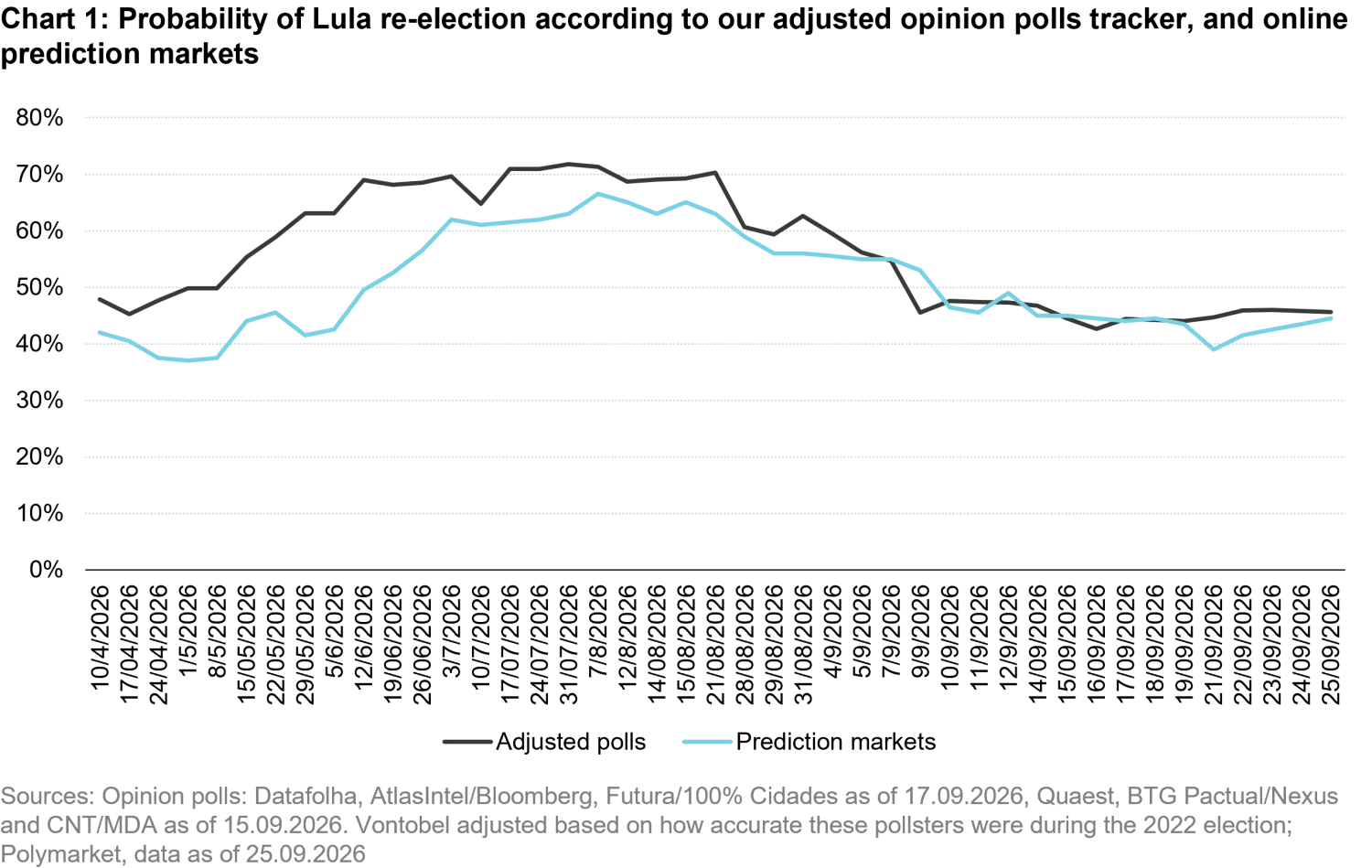
It remains to be seen whether a potential Flávio Bolsonaro victory would ultimately be able to deliver the deep fiscal adjustment Brazil urgently requires. Nevertheless, we believe markets may give him the benefit of the doubt, pricing in the prospect of a functional coalition between conservative and center-right parties in Congress that may be capable of advancing the structural reforms needed to halt the debt snowball and reverse the unsustainable fiscal trajectory that has been a feature of the current Lula administration, but also the final years of Jair Bolsonaro’s presidency.
With that, we view nominal domestic Treasury bond curve (NTN-Fs) as offering an attractive combination of implied inflation expectations and term premium. In our assessment, yields could compress significantly more under a scenario of a Bolsonaro victory than they might widen with a Lula re-election. This creates, in our view, a compelling asymmetric risk-reward profile. We see a similar potential asymmetry in the BRL, although likely to a lesser extent than in nominal rates, given the currency's already strong performance over the past two years.
1. https://www.ft.com/content/c49c583f-940c-4592-ad7e-c206b6c3c75?utm_source=chatgpt.com&syn-25a6b1a6=1
Any discussion of political, legislative, regulatory, or geopolitical developments is provided for informational purposes only and reflects our assessment of potential market impacts. Such commentary should not be construed as political endorsement, advocacy, or investment advice, and there is no guarantee that any views or expectations expressed will be realized.