
Not Your Ordinary FX
Asset management
Foreign exchange has long been the overlooked middle child of global markets – too macro for micro; too noisy for macro; and too fast for fundamental investors. The reasons are familiar: FX is often seen as “too efficient”, “too noisy”, “unable to trend”, or as a market where “macro models stopped working years ago.” To many investors, currencies remain just a passive cost center – something you passively hedge or even ignore, not something you actively allocate to.
And that’s a mistake.
At Vontobel, we’ve been quietly challenging each of these assumptions. FX is far from a passive costly nuisance, but rather a liquid, diversifying source of alpha. FX may be noisy, but that noise holds structure. FX may not always trend, but when it does, the breadth of the moves can be exploited. And while macro may have struggled, alternative data coupled with machine learning offer a new lens.
In this four-part Quanta Byte series, we will walk you through that stance. We will show that many of the perceived limitations of FX – its noisiness, its lack of trend, its resistance to classic macro, its pure hedge perception – can be reframed as opportunities. What’s ahead over the coming weeks is the why, what, how, and when of FX:
- Part 1: The case for FX – on why FX matters now more than ever.
- Part 2: Noise is signal – on what uncertainty reveals about signal in FX markets.
- Part 3: You can’t always trend when you want – on how FX trends come and go.
- Part 4: Letting data and time speak – on when temporal models can learn from data.
This week, we start with Part 1, by making the case for FX.
The Case for FX
When the dollar moves, it’s never just about the dollar. And when Trump makes a move, it’s never just about America.
Over the past century, the story of the dollar has been entangled with the story of the global financial order itself. Today, that order is shifting. Trade tensions are rising, old alliances are straining, and tariffs are returning. And in that context, currencies are more than just exchange rates. They are barometers for global macro environments. They are shields. And increasingly, they are opportunities. Yet despite being the most liquid and globally connected market, FX is often sidelined; treated as a passive byproduct of cross-border investing or a cost center for passive hedging of macro positioning.
There is one other reason to care about FX: willingly or not, if you invest globally, you’re taking an implicit position in FX – whether you hedge or not. So you might as well pay attention. As we’ve seen in recent weeks, sharp moves in the Eurodollar can wipe out double-digit returns in no time.
In this first part of our FX Quanta Byte series, we lay out the argument for why FX is no longer a peripheral concern for the international investor. It is a central concern; a full-fledged asset class in its own right, with unique characteristics that make it essential in the new regime. We explore why currencies are a macro hedge with teeth; how they diversify in ways that other assets can’t; and how alpha can be generated through active, data-driven currency positioning, offering an additional layer of opportunity for the sophisticated investor.
FX is not a sideshow. It is central stage. Now more than ever. Let’s make the case in four acts.
Act I: Why now
For much of the past decade, currency markets were relatively stagnant. Between 2015 and 2022, with interest rates anchored near zero and central bank policies aligned, volatility was low, and trends were muted. As a result, FX movements lacked conviction, carry was compressed, and most systematic strategies struggled to generate consistent returns.
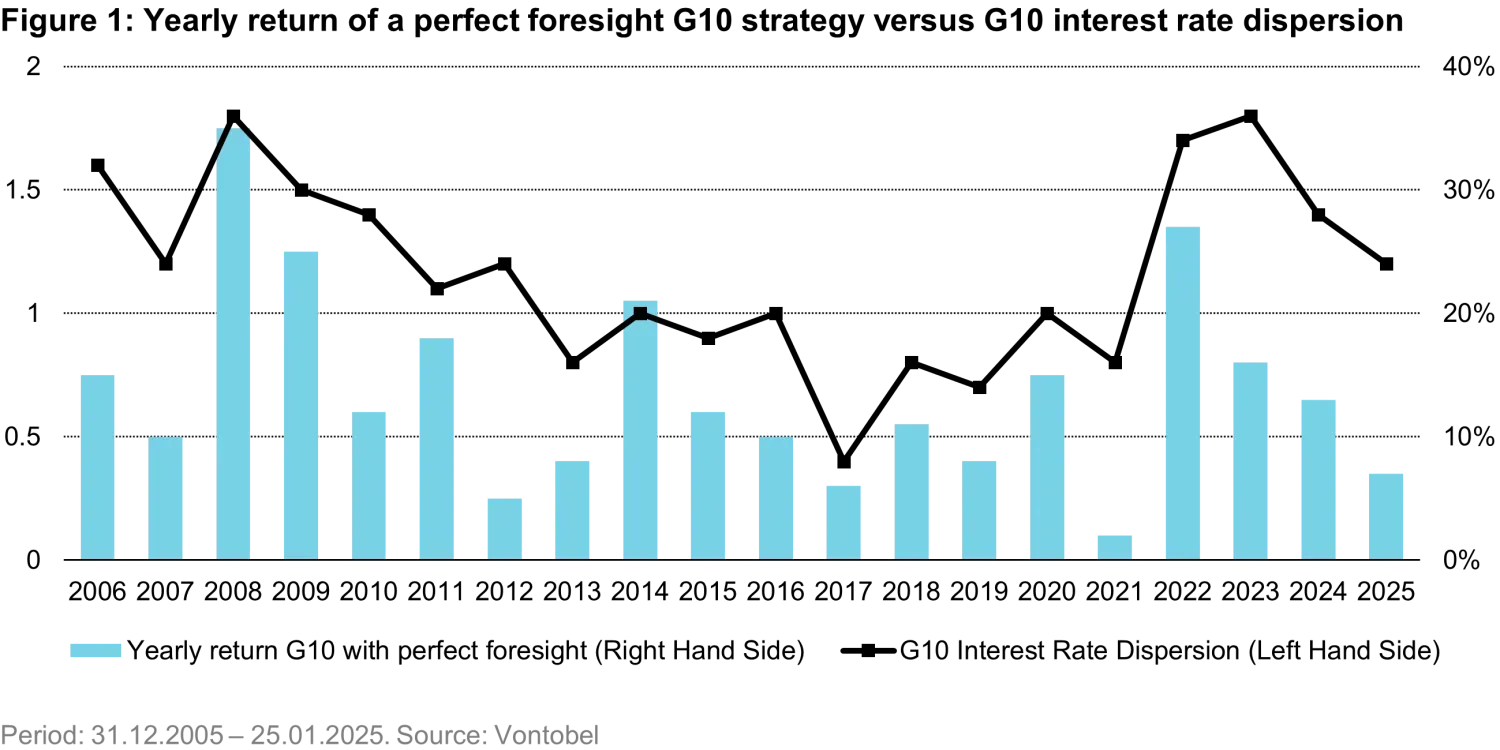
That regime is now over. Since 2022, the macro environment has shifted dramatically. The end of ZIRP (Zero Interest Rate Policy) has led to a significant repricing of interest rate differentials. Central banks are no longer synchronized: some are hiking rates, some are holding, and some are cutting. This divergence has reintroduced volatility and dispersion, creating fresh opportunities for FX strategies, because rate dispersion is fuel for FX movement.
Figure 1 shows the yearly performance of a simple trend-following strategy with perfect foresight. At the end of each month – from 2006 to 2025 – we look at the next month’s returns for each G10 currency pair against the euro. If the currency appreciated versus the euro, we take a long position; if it depreciated, we short. These positions are equally weighted across the G10 and held for one month. While this approach assumes perfect knowledge of future returns, it’s important to remember that even with this perfect foresight, returns in the FX market can be limited. Our goal here is to test a basic hypothesis: that greater interest rate dispersion – an inevitable outcome of moving away from zero interest rate policies – leads to greater dispersion in FX returns, and by extension, more opportunity for trend-following strategies.
The strategy performed well in the post-2008 recovery period, when divergent monetary policies fueled significant FX moves. However, between 2015 and 2022, returns flattened due to the lack of meaningful interest rate differentials and synchronized central bank policies, which suppressed volatility and limited trend development. Since 2022, the landscape has changed once again. With the end of ZIRP and the subsequent repricing of interest rate differentials across economies, the shift has reignited opportunities for FX strategies, as trends become more pronounced.
Act II: FX the macro barometer
Currencies are the purest reflection of macro regimes. Unlike equities or bonds, which often reflect domestic narratives and only respond indirectly to policy or growth shifts, FX markets absorb and express macro dislocations almost immediately. When central banks diverge, geopolitical tensions flare, or trade flows get rerouted, currencies move. Sometimes abruptly and violently. And they move not in isolation but relative to one another. Because every FX trade expresses a macro call: long one economy, short another.
We’re seeing this now in real time. After a long stretch of dollar dominance, the greenback has shown signs of fragility. Since late 2024, the dollar has weakened against a broad basket of G10 currencies, a shift that reflects not just rates, but rising geopolitical uncertainty, waning confidence in US fiscal discipline, and the growing risk premium around American leadership in the Trump 2.0 era. Markets are questioning the stability of institutions, the unpredictability of policy, and the reliability of global cooperation. And they are pricing that uncertainty through the dollar.
Bu this is not (just) a dollar story. In Europe, the euro has become a proxy for geopolitical risk tolerance, influenced by factors like energy security, defense spending, and the increasing focus on strategic autonomy. In Japan, currency movements reflect the ongoing balance between the country’s ultra-loose monetary policy and external pressure to normalize. Even in more stable economies like Australia or Canada, currencies are responding to shifting commodity cycles and trade alliances.
As a result, currencies aren’t merely reacting, they are narrating the global macro story. And they are not merely sensitive to regime changes, they provide a vehicle for navigating them. For investors, that makes FX a uniquely responsive asset class, allowing for real-time positioning across macro narratives: dovish versus hawkish; globalist versus protectionist; risk-on versus risk-off.
Act III: FX the zig to the zag
True diversification isn’t just about adding more assets to the mix, it’s about finding exposure that is quiet when markets scream. In conventional portfolio construction, diversification is often invoked but rarely earned. Investors spread capital across asset classes only to find that in moments of stress, everything moves together. Correlation rises, protection vanishes, and diversification turns out to be more narrative than substance.
FX is different. It is structurally uncorrelated with most traditional assets. Its return drivers – monetary divergence, capital flows, geopolitical shocks – are often orthogonal to the business cycle dynamics that drive equities and credit. And because currency trades are inherently relative – long one country, short another – they can remain active even when global risk appetite is muted. This is a crucial point: for all other asset classes, the decision is always ‘in’ versus ‘out’. For FX, since you are almost always ‘in’, it’s about long versus short a pair. The result is an asset class that doesn’t just dilute portfolio volatility but diversifies in moments that matter.
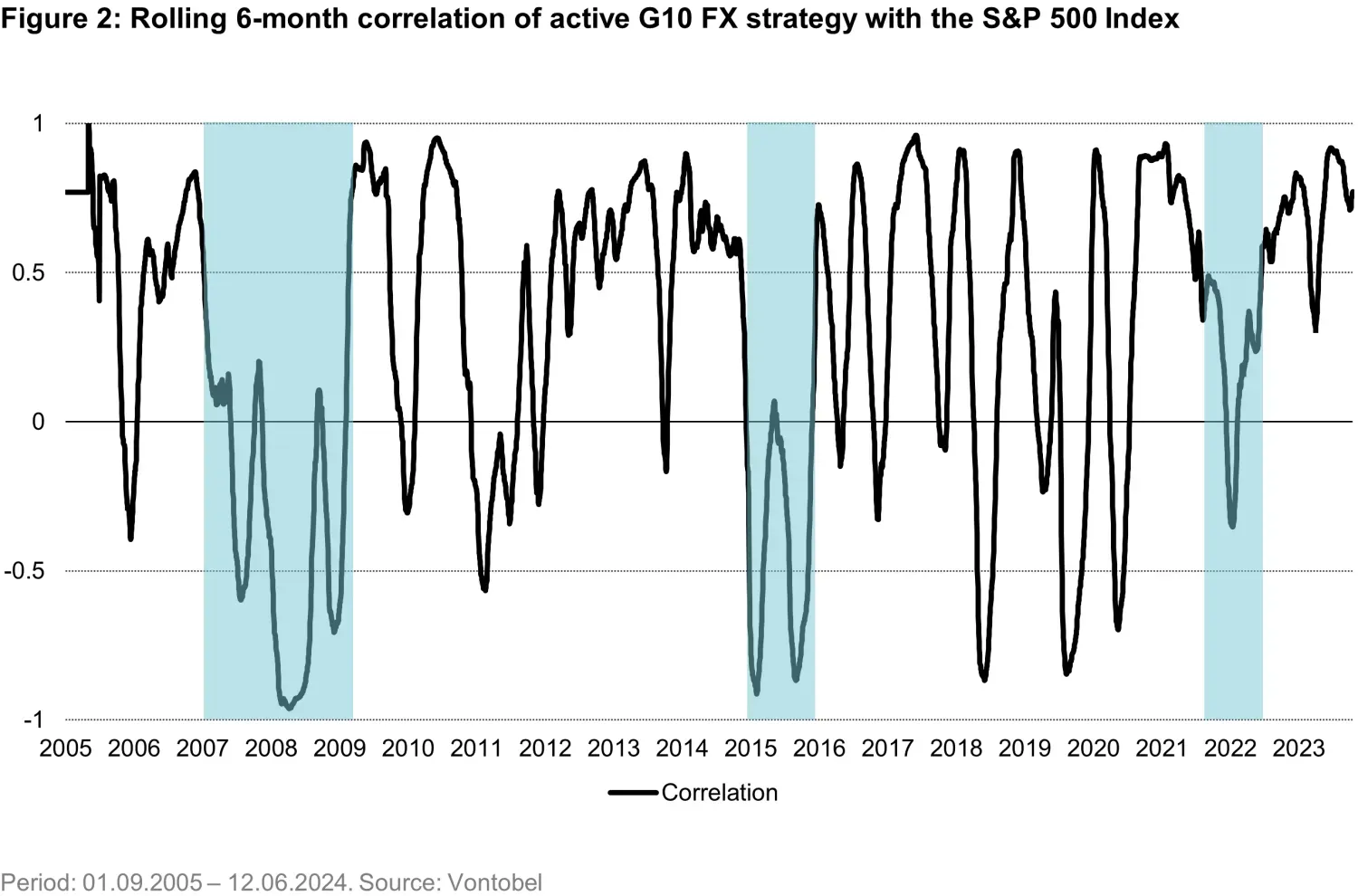
Consider our long-short currency strategy, which takes positions in the G10 currencies against the euro based on sentiment and momentum indicators. Figure 2 displays the rolling 6-month correlation of our strategy with the S&P 500. In periods of significant market turmoil, the rolling correlation fluctuates between 0 and -1. During the 2020 COVID shock, the 2015 stock market sell-off, and the 2022 inflation spike, the strategy has held value precisely when core assets stumbled.
What makes FX especially compelling is that this low correlation is not a result of cash drag or complexity – it’s embedded in the FX structure. Unlike risk assets, currencies are not tied to earnings; unlike bonds, they are not constrained by nominal yields; and unlike some commodities, they are not driven by supply and demand dynamics. Currencies move in response to relative expectations, not absolute outcomes. That’s precisely what makes FX a powerful shock absorber. When volatility erupts, currencies, and especially the traditional safe havens, often rally. When policy paths diverge, FX markets price it first. And when geopolitics overwhelms fundamentals, it’s often FX that provides the purest hedge.
Act IV: FX the alpha engine
Currency markets are vast, liquid, and continuously traded. In 1983, Kenneth Rogoff and Richard Meese famously concluded that currency markets resemble a random walk. But, unlike popular opinion, currencies remain surprisingly inefficient. That’s where the alpha potential lies. This inefficiency stems from the currency market’s unique intrinsic structure and its participants’ behavior. Because FX is inherently a relative value market, with every trade pitting one economy against another, the number of ways a mispricing can emerge is multiplied. Moreover, retail participation is relatively low, and institutional flows by central banks, corporates, and sovereign wealth funds, are often non-speculative in nature. This results in a market that is deep, but not always efficient.
Three primary alpha sources emerge from this unique structure.
Alpha 1: Flow-based dislocations.
A large share of FX volume is not driven by investors chasing returns, but by institutions whose positions are not necessarily return-seeking. Central banks intervene for monetary policy reasons; multinational corporations hedge exposures; sovereigns rebalance reserves. These flows can overwhelm fundamentals in the short term, creating transitory mispricings. For example, a central bank’s desire to maintain a pegged exchange rate can lead to persistent overvaluation or undervaluation. Or a corporation repatriating overseas earnings might cause an abrupt currency move unrelated to underlying macro trends. These dislocations present systematic opportunities. Strategies that detect and exploit flow-driven anomalies, whether through order book dynamics, trade volume imbalances, new analytics, or liquidity stress proxies, can capitalize on short-term price pressures.
Alpha 2: Behavioral signals.
FX markets are not immune to investor psychology. Herding, overreaction to news, regime changes, and momentum crashes occur here just as they do in equities – sometimes more dramatically due to the global, around-the-clock nature of trading. Behavioral biases often manifest in sentiment and positioning data. When speculative positioning becomes one-sided, it may signal crowded trades for reversal. Conversely, rapid sentiment shifts, driven for example by headlines or macro surprises, can trigger overshooting. Sophisticated sentiment analysis using Natural Language Processing (NLP) to financial news can capture these shifts in real time. When combined with positioning metrics, they form a behavioral lens that complements more traditional macro models, offering entry and exit signals that reflect how the market feels, not just what it knows.
Alpha 3: Big data.
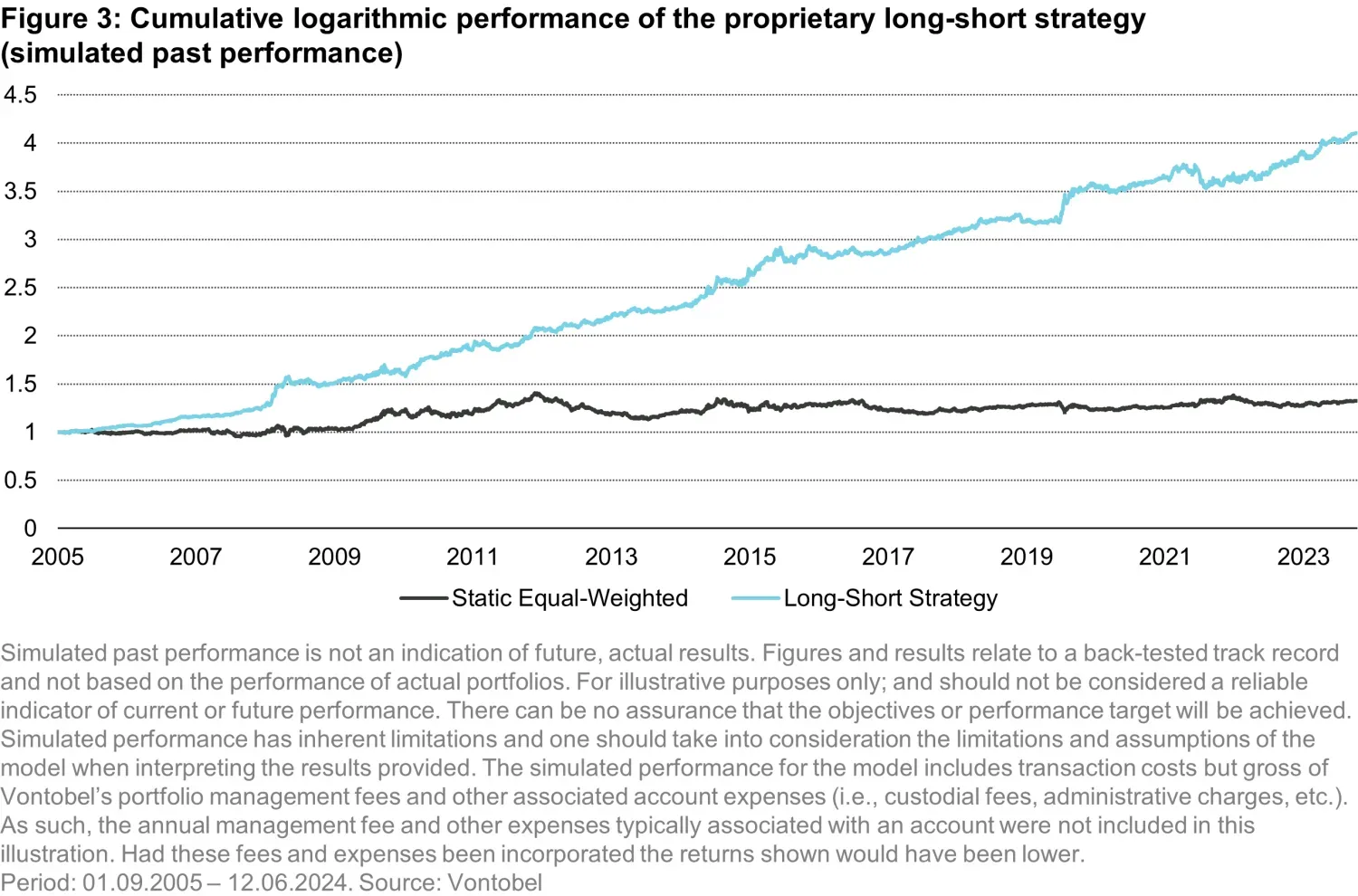
Perhaps the most exciting frontier for FX alpha lies in machine learning (ML) and alternative data. The sheer complexity of currency markets makes them ideal for systematic approaches that can process diverse data sources and learn non-linear relationships. Modern machine learning models can synthesize the variety of drivers of currency markets: traditional macro indicators; text-based sentiment from news and social media; price and volume patterns; central bank communications; or even satellite or shipping data as proxies for trade dynamics. These ML models don’t just mimic human logic. Rather, they uncover the hidden structure in data that conventional econometrics and our limited cognitive ability might miss. Crucially, the relative-value nature of FX aligns well with classification and ranking frameworks, where the task is not to forecast a level, but to forecast the likelihood of currency appreciation. The result is a growing edge for investors who combine economic intuition with computational power. Figure 3 displays the cumulative returns of our proprietary data-driven FX strategy along with a static long position in the underlying G10 currency pairs. In the next three Quanta Bytes, we will give you an intuition for how we construct this strategy with a data-driven, unbiased approach that is orthogonal to the conventional macro approach.
Conclusion
FX is the world’s macro compass, and it is time we start reading it carefully. Especially in today’s world of geopolitical tensions, inflation, protectionism, and economic fragmentation, currencies are key to understanding shifting macro regimes. For investors who embrace the FX market’s structural peculiarities, behavioral nuances, and data complexity, currencies can be a core, persistent source of alpha.
A final word of caution. Our narrative so far has focused on macro events, political decisions, and other human-driven factors shaping FX markets. You might be wondering, “if these are the main drivers, how can a quant approach extract alpha?” It seems paradoxical – unless of course we could predict what global leaders will say today (which we cannot, yet). The key is the time horizon. We’re not after FX moves of today or tomorrow, but those that unfold over weeks or more. And when that is the time horizon, algorithms can assess whether a politician’s statement will have an impact that lasts longer than a day.
In the next Quanta Byte, we will explore how we harness that alpha and extract a meaningful signal from the apparent noise.
Important Information: The content is created by a company within the Vontobel Group (“Vontobel”) and is intended for informational and educational purposes only. Views expressed herein are those of the authors and may or may not be shared across Vontobel. Content should not be deemed or relied upon for investment, accounting, legal or tax advice. It does not constitute an offer to sell or the solicitation of an offer to buy any securities or other instruments. Vontobel makes no express or implied representations about the accuracy or completeness of this information, and the reader assumes any risks associated with relying on this information for any purpose. Vontobel neither endorses nor is endorsed by any mentioned sources. AI-driven investment strategies are not available in all jurisdictions.

Insight correlati

Machine Learning in FX: Learning the Unlearnable

Think you’re diversified? Check your FX
