
Where to put 10 trillion dollars
Multi Asset Boutique
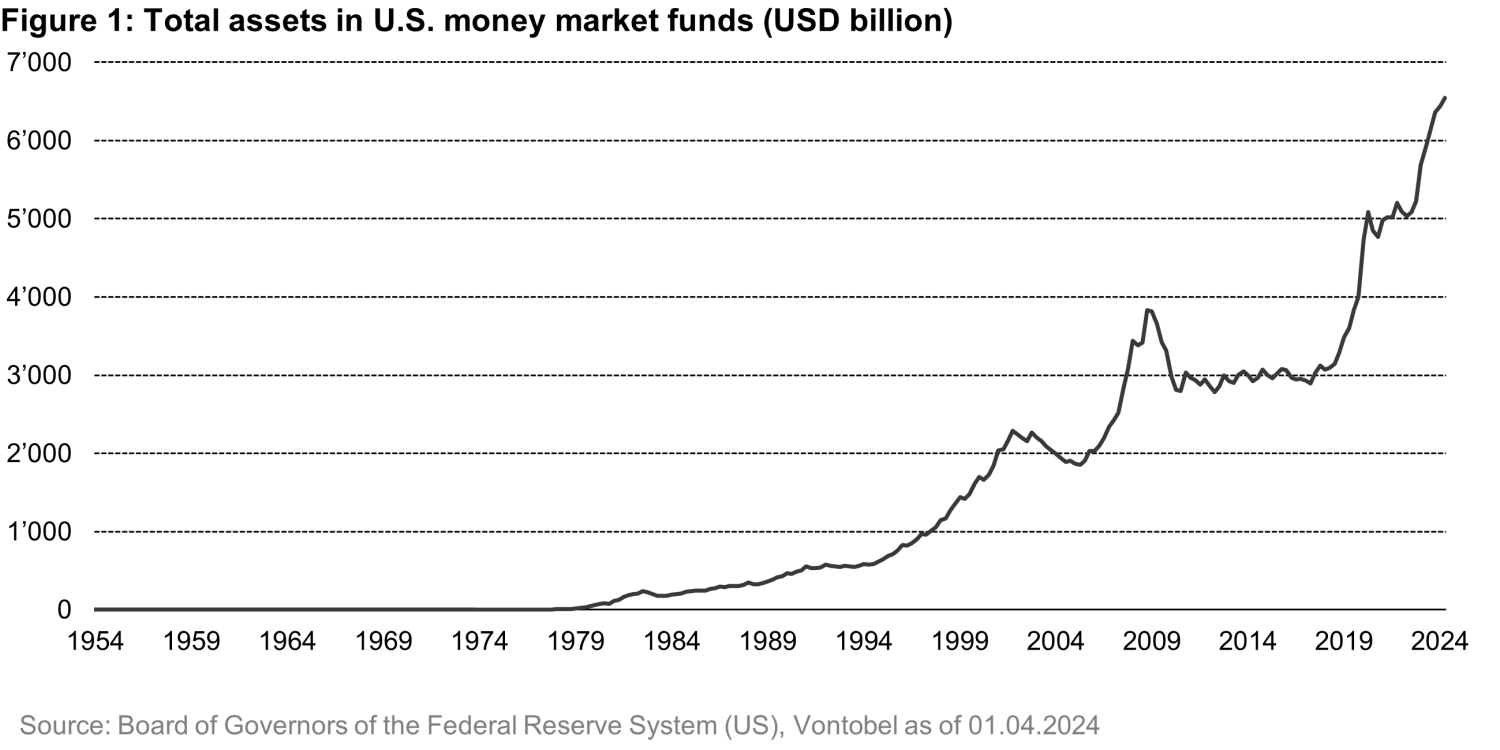
Money market funds have been making headlines, repeatedly hitting historical highs in assets under management. Since the COVID-19 crisis in 2020, assets in global money market funds have doubled to approximately USD 10 trillion, with USD 6.5 trillion managed in the US alone, as illustrated in Figure 1. The growth comes after a period of long apathy. In the decade between 2009 and 2019, hardly any movement was registered in assets under management, as visible in Figure 1. Recent growth is noteworthy, but we urge caution. While the rise in global interest rates has certainly boosted the appeal, current rates alone don’t fully justify staying invested at this stage.
Money market investors typically expect safety and diversification, and in this article, we argue that – at this juncture – their objectives are better served by defensive multi-asset portfolios. Let’s delve deeper to understand why.
Money market vs. defensive multi-asset
To assess how money market funds compare against defensive multi-asset portfolios, we designed three Euro-denominated portfolios, each with 10% in global equities and 90% in fixed-income or money-market-equivalent assets as follows:
- Portfolio 1: 90% in the global aggregate bond index (Euro);
- Portfolio 2: 90% in the global aggregate bond index with low duration (1–3 years, Euro);
- Portfolio 3: 90% in Euro-denominated money market funds.
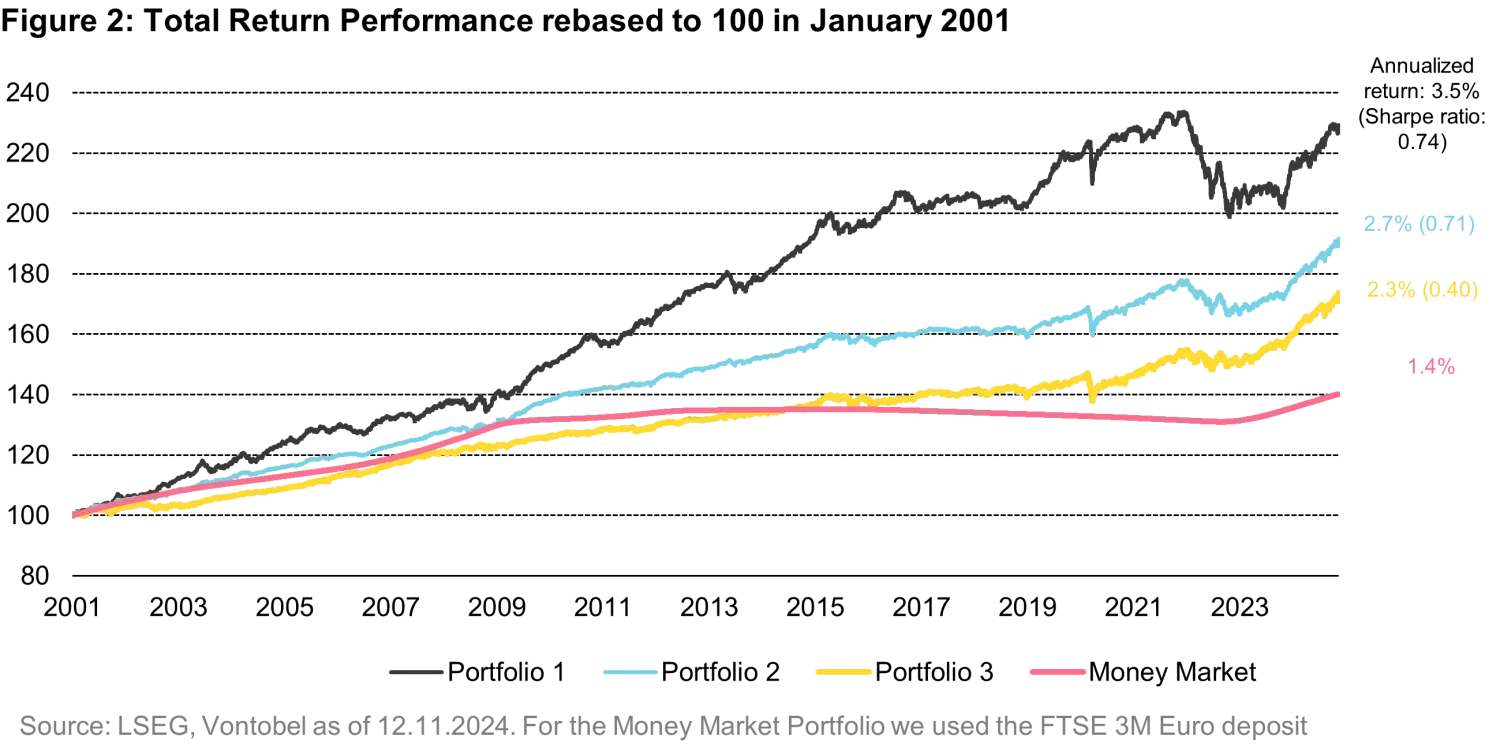
Portfolio 2 is inherently less risky than portfolio one, given the lower duration. For comparison, we also examined the total return of a 100% Euro money market fund, whose performance was proxied by using the FTSE 3M Euro deposit rate. As expected, money market funds showed minimal volatility (i.e., high safety) but relatively low returns, as illustrated in Figure 2. This stability is appealing for safety-seeking investors. It's challenging to dispute this safety factor, and we wouldn't want to if it aligned with maximizing investor utility.
However, we challenge the notion that money market investments serve as better portfolio diversifiers than fixed-income products with minimal duration risk. Notably, the two portfolios holding the global aggregate bond index (portfolios 1 and 2, depicted as black and blue lines in Figure 2) demonstrate not only a higher annualized return but also more attractive Sharpe ratios.
This finding reinforces an old principle in investments. Minimizing short-term drawdowns (something that can be achieved by solely investing in money market funds) does not necessarily mean optimizing for risk-adjusted returns, which is another way of looking at risk. It depends on how you measure things of course. But if you used Sharpe ratio as a proxy, the statement is certainly true.
Treasury departments of large corporates out there ought to take note, as their portfolios are typically loaded with money market funds and other cash-like equivalents. Also, note how the performance of portfolios 1-3 is accelerating since 2022. While part of it is also driven by higher rates (also visible by observing the ascent of the coral-colored money market performance), it’s not enough ‘per se’ to explain the performance acceleration. Something else is going on, and it’s got to do with a favorable macro-economic environment.
Rating rates
Whether or not money markets remain attractive compared to other asset classes depends on the outlook on rates and investor fear to a large extent. So where are we on both fronts? We are skeptical that further hikes are in the card. We’ve witnessed them in the period 2006-2008 as a mechanism to cool down the leveraged US economy, and in 2022-2023 as a tool to control rampant inflation. They’ve achieved their objectives in both cases, they also hit the economy hard. Coming out of such a hit just recently, we don’t think the time for hikes is anywhere near. It’s not in anyone’s interest to trigger a correction in the economy at this stage. Frankly, it’s not needed either.
On the fear side, we feel that most of the uncertainty (typically your main driver of investor fear) has been cleared after the results of the U.S. election. With the Republicans dominating both the House of Representatives and the Senate, there’s also little fear (or uncertainty) as to whether policies can be implemented.
Adding to the evidence, our business cycle indicator Wave1 points to improving growth momentum. China’s recent stimulus package—the most aggressive since COVID-19—provides further support. Additionally, Donald Trump’s policy agenda, which emphasizes growth-supportive measures, including increased investment and tax cuts, is conducive to a benign environment for risky assets.
We expect the Fed to stay on an easing path. The Fed, like many others around the globe, are fare away from their target rate (neutral rate2). Finally, from an investor flow perspective, we interpret the elevated levels in money market funds as an indication that investors are rather defensive now. Hence, there is room for them to move assets into riskier assets.
Trump: friend or foe?
In the paragraph above we provided several arguments in favor of shifting assets away from money markets into defensive multi-asset portfolios. Among them was Trump’s policy. However, it can also present risk to the scenario we forecast.
Trump’s intended tax cuts may be driving demand-driven inflation. This is a kind of inflation that is different from the supply-side inflation of 2022. Markets have already reacted, as seen in the recent sell-off in government bonds, pushing yields higher. In our view, government bonds are well along in pricing in this inflation risk, though yields could rise further in the short term. Despite the risk, we believe we're in the advanced stage of repricing.
Conclusion
Our analysis shows that defensive multi-asset portfolios – those that have a mix of money market instruments and global aggregate bond indices – generally achieve better returns and higher Sharpe ratios over the cycle. In addition, we argued that if there was a time to make a shift from the one to the other, that time would be now. This is because we see the likelihood of additional rate hikes (thus making the case for money market again) as highly unlikely and foresee a benign environment for riskier assets.
This is good news for treasurers of corporate balance sheets out there, in that there is an opportunity to commit capital to a better risk-adjusted trade than just money market funds. The Quantitative Investment team at Vontobel has significant experience and a compelling track record in managing defensive multi-asset portfolios via its Multi-Asset Defensive (MAD) and Multi-Asset Solutions (MAS) flagship funds. While both belong to the Morningstar Euro Cautious category, MAD targets a lower risk than MAS. Please consult the information provided here, feel free to reach out to find out more.
1. An introduction to our hybrid investment process and the Wave business cycle model can be found here. Our latest update on the Wave business cycle model can be found here.
2. More information on the Fed’s current natural rate estimate can be found here.
This marketing document was produced by one or more companies of the Vontobel Group (collectively "Vontobel") for institutional clients, for distribution in AT, DE, LU, CH and IT.This document is for information purposes only and does not constitute an offer, solicitation or recommendation to buy or sell shares of the fund/fund units or any investment instruments, to effect any transactions or to conclude any legal act of any kind whatsoever. Subscriptions of shares of the fund should in any event be made solely on the basis of the fund’s current sales prospectus (the “Sales Prospectus”), the Key (Investor) Information Document (“K(I)ID”), its articles of incorporation and the most recent annual and semi-annual report of the fund and after seeking the advice of an independent finance, legal, accounting and tax specialist. This document is directed only at recipients who are institutional clients, such as eligible counterparties or professional clients as defined by the Markets in Financial Instruments Directive 2014/65/EC (“MiFID”) or similar regulations in other jurisdictions, or as qualified investors as defined by Switzerland’s Collective Investment Schemes Act (“CISA”). Neither the fund, nor the Management Company nor the Investment Manager make any representation or warranty, express or implied, with respect to the fairness, correctness, accuracy, reasonableness or completeness of an assessment of ESG research and the correct execution of the ESG strategy. As investors may have different views regarding what constitutes sustainable investing or a sustainable investment, the fund may invest in issuers that do not reflect the beliefs and values of any specific investor. Past performance is not a reliable indicator of current or future performance. Performance data does not take into account any commissions and costs charged when shares of the fund are issued and redeemed, if applicable. The return of the fund may go down as well as up, e.g. due to changes in rates of exchange between currencies. The value of the money invested in the fund can increase or decrease and there is no guarantee that all or part of your invested capital can be redeemed. Interested parties may obtain the above-mentioned documents free of charge from the authorized distribution agencies and from the offices of the fund at 49 Avenue J.F. Kennedy, L-1855 Luxembourg. , the representative in Switzerland: Vontobel Fonds Services AG, Gotthardstrasse 43, 8022 Zurich, the paying agent in Switzerland: Bank Vontobel AG, Gotthardstrasse 43, 8022 Zurich, the European facilities agent for Germany: PwC Société coopérative - GFD, 2, Rue Gerhard Mercator B.P. 1443, L-1014 Luxembourg, Email: lu_pwc.gfd.facsvs@pwc.com, https://gfdplatform.pwc.lu/facilities-agent/view/vf-de, the facilities agent in Austria: Erste Bank der oesterreichischen Sparkassen AG, Am Belvedere 1, A-1100 Vienna. Refer for more information on the fund to the latest prospectus, annual and semi-annual reports as well as the key (investor) information documents (“K(I)ID”). These documents may also be downloaded from our website at vontobel.com/am. A summary of investors rights (including information on representative actions for the protection of the collective interests of consumers under EU Directive 2020/1828) is available in English under the following link: www.vontobel.com/vamsa-investor-information. Vontobel may decide to terminate the arrangements made for the purpose of marketing its collective investment schemes in accordance with Article 93a of Directive 2009/65/EC. Refer for more information regarding subscriptions in Italy to the Modulo di Sottoscrizione. For any further information: Vontobel Asset Management S.A., Milan Branch, Piazza degli Affari 2, 20123 Milano, telefono: 0263673444, e-mail clientrelation.it@vontobel.com. Although Vontobel believes that the information provided in this document is based on reliable sources, it cannot assume responsibility for the quality, correctness, timeliness or completeness of the information contained in this document. Except as permitted under applicable copyright laws, none of this information may be reproduced, adapted, uploaded to a third party, linked to, framed, performed in public, distributed or transmitted in any form by any process without the specific written consent of Vontobel. To the maximum extent permitted by law, Vontobel will not be liable in any way for any loss or damage suffered by you through use or access to this information, or Vontobel’s failure to provide this information. Our liability for negligence, breach of contract or contravention of any law as a result of our failure to provide this information or any part of it, or for any problems with this information, which cannot be lawfully excluded, is limited, at our option and to the maximum extent permitted by law, to resupplying this information or any part of it to you, or to paying for the resupply of this information or any part of it to you. Neither this document nor any copy of it may be distributed in any jurisdiction where its distribution may be restricted by law. Persons who receive this document should make themselves aware of and adhere to any such restrictions. In particular, this document must not be distributed or handed over to US persons and must not be distributed in the USA.
About the author

Related funds
About the author
Explore related topics:
Up next:
Towers and the Starlink ThreatRelated insights

Towers and the Starlink Threat

Quarterly Commodity Outlook - Halftime Whistle: Fundamentals Take the Field

Investors’ Outlook: And now for something completely different

Investors’ Outlook: Adjusting the focus

Investors’ Outlook: Strait forward
