Traditional brick and mortar stores have received terrible press over the past few years. Companies such as Kmart and J.C. Penney in the U.S. and Debenhams in the U.K. have been eclipsed by e-commerce and a changing retail landscape, despite a strong economy. Many others, such as Toys “R” Us and Brookstone, have filed for Chapter 11 bankruptcy.
However, for businesses with the right offerings, expansion through traditional stores can deliver faster growth, high returns, and strong free cash generation. Space growth can also provide predictability. By owning and operating the end retail space, and by generating incremental growth from e-commerce, owners of strong branded products can benefit from much better control over pricing, inventory, display of that inventory, and service quality.
In the Vontobel Fund – Global Equity, we are selective in our approach and look for companies to pass several tests before deciding to buy a stock. These include clear and distinct competitive advantages, attractive industry structures, headroom for space growth, good control over brands and distribution, and the ability to adapt well to e-commerce. We discuss these points in further detail below.
Areas where we find the successful use of traditional stores include:
-
Direct-to-Customer (DTC) channels for powerful brands owned by companies, such as Nike, Adidas, LVMH, and Inditex
-
Convenience store chains, such as Couche-Tard, 7- Eleven and Casey’s General Store
-
Food and beverage, including Starbucks and Yum China
-
Off-price retail, particularly TJX
-
Segments less threatened by e-commerce, such as Home Depot
We have a strong preference for companies that own brands, as opposed to those that distribute brands (such as traditional department stores).
Clear competitive advantages
As with any company we seek to invest in, we look for a clear and distinct competitive advantage that can sustain over the long term. A compelling offer is critical. The guiding principle of successful retailing according to Walmart founder Sam Walton was to ‘give your customers what they want’. But how do retailers adapt as those “wants” change?
Success in the apparel industry hinges on offering contemporary fashion that evolves with changing consumer tastes. Many companies start out contemporary, but fail to evolve. To us, a company that exemplifies this ability to adapt is Spanish global fast-fashion retailer Inditex, owner of the Zara brand, among others. Inditex is able to quickly turn out high street fashion directly from designs inspired by catwalks in Milan and New York. Importantly, Inditex offers these looks at affordable prices. It can adjust collections within 15 days if a product fails to sell, which is a rate three to four times faster than typical retailers. In order to do this, it uses a fast response logistics and supply chain. Through centralized manufacturing and by working closely with suppliers in and around Spain, it can deliver products from manufacturing to storefronts at an unparalleled pace. This results in consistent achievement of mid-single digit plus same-store sales (growth in sales from stores open more than one year), whereas competitors have been flat to negative. It also results in higher realized gross margins (58% to 60%), helped by fewer mark-downs. This has also proven to be very difficult to emulate—particularly on a global scale.
One emerging market retailer that models its strategy closely on Inditex is Lojas Renner, which provides affordable fashion in Brazil. Renner has carved out a clear speed-to-market advantage over competitors by adjusting collections regularly, and has a strong local supply chain which allows it to be responsive. Renner is also able to compete well versus the foreign multinationals which are impacted by Brazil’s high import duties. This is an important dynamic in EM, as foreign multinationals can often be the biggest competitive threat—as we’ve seen in markets like China, South Africa and Indonesia.
TJX, the leading player in off-price retail, is a notable exception we like as a distributor of other brands. Its consumer proposition is compelling as it offers attractive brands at significant discounts (i.e. off-price) as retailers need to clear excess inventory. TJX achieves this through its leading store network, strong merchandising capabilities, and relationships with a diverse merchant base. Buying scale is a crucial factor, and TJX has an unparalleled lead versus the competition, with two and a half times the purchasing scale of the number two player Ross Stores, and nearly seven times that of the number three player Burlington. This scale allows TJX to pay a larger amount upfront to its suppliers (i.e. the retailers), thereby attaining access to higher-quality inventory.
And we can also get defensive growth
Areas like food retail and convenience stores can bring the benefit of attractive growth as well as cyclical protection. Convenience stores are an attractive segment as they have strong, consistent repeat traffic, tend to differentiate through stronger fresh food offerings, and are less impacted by e-commerce given the more immediate consumption. The convenience store market is consolidating rapidly with the scale and service of chains taking market share through both acquisitions and organic growth. In the U.S., only around 30% of the convenience store market is still held by chains such as Alimentation Couche-Tard (ATD) or 7-Eleven. ATD is the largest convenience store operator in North America, with a 13% overall market share, and it is also the largest operator in Europe. We see this company able to lift its growth rate through acquisitions from solid mid-single digit organic growth to mid-teens levels.
Across the emerging markets, convenience store operators that we believe have strong franchises include: CP All which has a 70% market share of the convenience store market in Thailand with its 7-Eleven franchise, coupled with the leading Cash and Carry format Makro. Femsa in Mexico operates the Oxxo convenience chain as the backbone of this powerful consumer staples company. In addition to solid space growth and mid-single digit comparables, an improved sales mix from freshly prepared food and new services offers longer-term margin expansion opportunities.
In traditional food retail—i.e., supermarkets and hypermarkets—we are very selective given that privately held discounters like Aldi and Lidl have won foot traffic from the established players, significantly impacting their profitability in the process, and are likely to be an ongoing threat. Additionally, there are the significant challenges for food retailers to operate e-commerce in a manner that enhances returns.
Walmex is one of the exceptions, as it is the dominant food and hypermarket retailer in Mexico and Central America, with a market share of 25% to 30% in the markets in which it operates. In its core market of Mexico, it is two times its biggest peer and bigger than all the formal retailers combined. It also has a multi-format retail platform which caters across mass market, premium and cash and carry. Importantly, the company continues to drive its purchasing scale back into lower prices, which gives it a pricing advantage versus competition (averts any potential threat from discounters), and drives consistently stronger same-store sales. Margins are expected to remain flat for Walmex but we view this as a positive sign as it means that it is driving more value back to consumers. There are several examples of food retailers in developed markets, such as Tesco in the UK and Woolworths in Australia, which gradually increased pricing and gross margins over several years, allowing the discounters to take meaningful share. Gross margin expansion driven by pricing can be a bad thing.
Direct to consumer (DTC) – brand and products matter
For DTC, the brand and product offering is vital. Few companies have the brand strength to profitably drive footfall. Athletic footwear is a space where the two global players—Nike and Adidas—dominate market share across almost every region. On a combined basis, Nike and Adidas market share stands at 40% globally across overall sportswear, and within that, footwear is even higher, at 60%. Market share has been steadily increasing over the last 10 years. So why is this the case?
It is very difficult to gain credibility in athletics without investing a tremendous amount in marketing and product over decades. Over the last 30 years, Nike, which began as a challenger in running, successfully progressed to conquer basketball, followed by soccer sportswear and footwear. Under Armour’s inability to gain a meaningful presence outside either basketball or its home market in the U.S. is an indication of how high the barriers are.
Nike is predominantly wholesale-dependent, with 70% of its revenues coming from this channel; however, it has strong control over the quality of its wholesale partners and is increasingly shifting its mix to DTC (retail and e-commerce). DTC comprises 30% of the mix now (versus 15% in 2008) and is expected to reach 50% over the next 5 to 10 years, particularly as the e-commerce mix picks up.
Luxury is another industry we find attractive. In luxury, the quality brands benefit from a long history, stretching back more than a hundred years in cases like Louis Vuitton, Hermes or Bvlgari. These brands have also evolved over time and still produce high quality products that retain an element of desire among consumers. Hence, it is difficult for upstart brands to disrupt the established players.
One thing we consider in this space is diversification of brands. Brands can go through cycles where they fall out of favor or don’t sufficiently innovate. We like LVMH as it has a strong and wide portfolio of distinctive brands across the luxury space.
Rate of space growth matters
Space expansion is important as a provider of growth visibility. However, space growth needs to be measured — we are wary of companies that have aggressive space growth targets. A variety of problems can result, including: taking on sub-optimal locations, cannibalizing existing stores, and managing brand perception. While equity markets can get excited about the near-term growth outlook, there is a higher risk that it will lead to weaker same-store sales and margins down a track from which it can be hard to reverse. One such example is fashion retailer H&M, which stuck to its 10% to 15% space growth target for a number of years despite evidence of cannibalization and a clear pick up in competition from the likes of Primark.
In the case of luxury, controlling space growth is critical because overexpansion can lead to a loss of desirability and exclusivity. Companies like Hermes and LVMH have been disciplined in sticking to low single-digit space growth over a number of years, even when they could have grown faster. In luxury, it’s better to have the top line driven by same-store sales rather than space growth.
Prada is an example of a company that we felt expanded too aggressively after its IPO in 2011, where it targeted 15% to 20% space growth. Prada has faced negative sales growth since 2015, underperforming the sector significantly.
The excessive reliance on outlet stores or off-price channels to sell excess inventory tends to go hand-in- hand with overexpansion. This can be an early red flag as it damages longer-term brand equity, and in recent times Coach and Ralph Lauren have been more notable examples of paying the price for this strategy, which they embarked on several years ago.
The following chart illustrates the relationship between space growth, same-store sales, and margin expansion. The examples on the left are names that we believe to have taken a more thoughtful approach to space growth. To the right, H&M, Prada, and Magnit (Russia) have grown space more quickly but are struggling with same-store sales and margins. To be sure, company-specific competition and trading factors play a part in these struggles, but we believe that overexpansion was a material contributor.

Controlling distribution
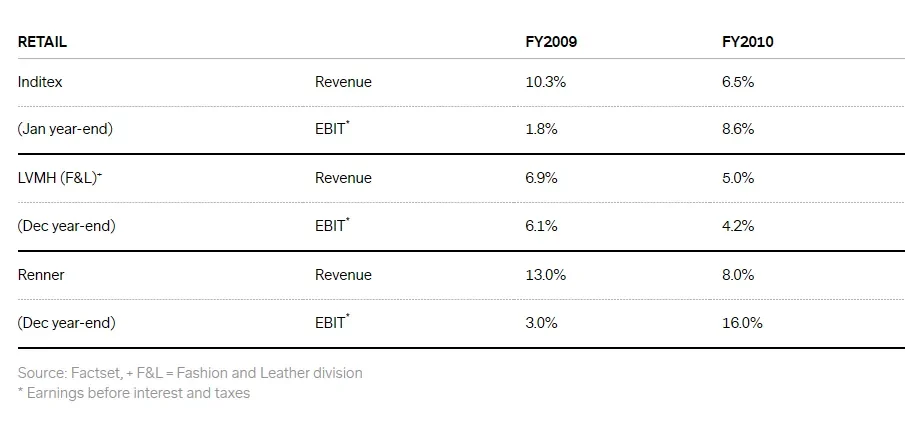
By owning and operating the end retail space, companies have much better control over pricing, inventory, and displays. While the fixed costs are higher, ultimately the long-term benefits of controlling the inventory more than compensate, and for manufacturers they gain the wholesale and retail margins that would otherwise have gone to third-party sellers. In luxury, it is even more important to control retail as brand perception is a major selling point. This was one of the problems that has impacted Michael Kors in recent years. Retail brands such as LVMH, Inditex, and Lojas Renner (Brazil fast retail) control their end distribution, which we believe gives them an important advantage. As the table below shows, their operating earnings held up well and continued to grow even through the financial crisis.
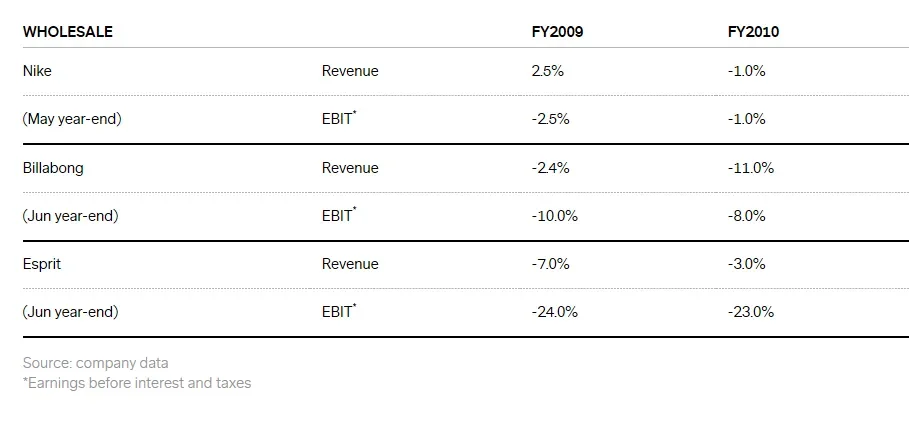
Wholesale-driven businesses, such as the examples we show below, declined during this period. Among these, Nike protected its top and bottom lines well, and we believe this to be a function of its better control and selection of wholesale partners. Further, as we highlighted earlier, Nike has been shifting more aggressively to a DTC model which means it should prove even more defensive in a future downturn.
Adapting to e-commerce
E-commerce is becoming an increasingly important channel for retailers and comprises 10% to 20% of retail sales in most developed markets. One of the key elements that determines whether a retailer can benefit from e-commerce is if it owns the key brands it sells.
Multi-brand distribution formats like department stores or even specialty sportswear formats tend to be more at risk from e-commerce, as the brands they distribute can go directly through those e-commerce channels. Hence, e-commerce often becomes cannibalistic.
The key is to ensure that e-commerce can be done in a way that is neutral or incremental to returns, and that it integrates well with the brick and mortar store base. An important part of the strategy is that retailers must be able to offer click-and-collect and effectively handle returns both on-line and through the stores. Players with off-line stores have an advantage over pure on-line players in that the in-store pickup option encourages repeat business, adding opportunities for customers to interact with staff. To do this, inventory systems must be integrated between off-line and on-line stores, which has been a challenge for a number of retailers. In apparel, Inditex and Nike have made the transition well, generating a meaningful percentage of faster growing sales on-line, and at margins which are at least the same—if not better than off-line.
Home Depot (HD) is also adapting well to e-commerce, in our view. The predominance of big, bulky products which often require technical knowledge has enabled the home improvement market to withstand the disruption that e-commerce has posed for retailers. Even so, HD formulated its own on-line strategy, developing a strong consumer interface and integrated fulfillment capability. On-line now comprises about 7% of sales and is the fastest-growing part of the business (at 20% plus)—with around half of the on-line orders picked up at the store.
TJX, a multi-brand distributor whose virtues we discussed earlier, competes effectively in an on-line world since brands prefer that off-price (discounted) products not be sold nationally on-line. So TJX faces less direct on-line competition. Rather, TJX’s near 3,000 strong store base in the U.S. allows brands to distribute off-price products without damaging brand image or creating channel conflicts.
Attractive and sustainable returns
We always look for high returns, but the question of whether a company can sustain those high returns ultimately hinges on successfully meeting several of the above criteria. We generally look for mid-teens or better ROICs from retailers, as illustrated by the chart below. These companies are sustainably managing store growth, and have been consistently generating high returns over the last decade.

Below we highlight some of the retailers that have achieved high returns in the past but have failed to sustain those returns due to slippage on one or more of the measures we’ve described in this piece. The companies below either suffered from: not having a compelling enough offering, over reliance on weak wholesale channels, over expansion, or being a multi- brand distributor in the department store space disrupted by e-commerce.

Conclusion
While the retail space is littered with names that have fallen by the wayside, we see great potential from physical stores for the right franchises as the market changes.
Companies with a strong brand and product line-up are providing their customers with the opportunity to see, try out and discuss the products with well-trained sales people and are amenable to how the customer chooses to buy or return, whether in store or on-line.
In the Vontobel Fund – Global Equity, we favor industry structures that are attractive or improving, companies that have a healthy balance between space growth and same-store sales, and a strong control over brands and distribution. Finally, we seek to ensure that each company is well placed to generate incremental growth at decent returns from e-commerce. Meeting these criteria is a tall order for a retail company, but a high threshold for quality is essential to help ensure attractive rates of sustainable growth. There are not many of these businesses across the planet, but there are some that we are excited about.