
Reserves no more? Not yet.
Multi Asset Boutique
In early April, markets were perplexed by the weakness of the U.S. dollar, gold, and Treasuries amid rising risk aversion. While gold and equities rebounded from the early April tariff shock, following the U.S. administration’s rollback of tariffs, Treasuries and the dollar showed a somewhat slower recovery1.
Two key questions arose. First, will the U.S. dollar continue to serve as the world’s ‘reserve currency’? Second, can U.S. Treasuries still be considered a safe haven? Our short answer is yes to both. In this Quanta Byte, we explain why. In a nutshell, we attribute the April sell-off in Treasuries to technical adjustments, rather than a sign of a permanent capital flight, or diminished investor confidence in U.S. assets.
Despite the ongoing trend of foreign investors diversifying away from the dollar, we expect this shift to be gradual, with the current political environment offering little incentive to reverse course. To better understand these trends, we first explore the fundamental criteria that define a reserve currency and a safe haven asset— and support our claim with statistical evidence.
What makes a currency a safe haven currency?
The concept of safe haven currencies emerged in the 1960s, explored by economists like Charles Kindleberger and Robert Mundell. Today, Barry Eichengreen’s framework2 largely shapes the understanding. A currency must meet key conditions to maintain reserve status: a stable economy, deep financial markets, robust political institutions, and geopolitical influence, including military power.
Reserve currencies like the U.S. dollar typically appreciate during financial stress, since much global trade and investment, particularly in commodities, are dollar-denominated. That is, when commodities are sold, or more broadly risky assets, investors tend to receive U.S. dollars in returns.
But trade itself also creates demand for the dollar debt. To participate in global commerce, companies need access to dollar liquidity—often secured through trade credit or short-term loans. These obligations remain, even when trade slows. So, if a demand shock interrupts the flow of dollar revenues, the need for dollars can increase. Loans still need to be repaid, and payments still need to be made.
Next, we examine whether the U.S. dollar still meets these reserve and safe haven criteria.
Is the Dollar losing its reserve currency status?
The global role of the U.S. dollar is shifting, but the decline will likely be slow. In previous work, we argued that the dollar’s dominance will erode only gradually3. A fresh look at key indicators supports this view.
China is the U.S.’s main economic rival and will likely remain so over the next decade. By some measures, it has overtaken the U.S. in economic weight4. In innovation, for example, China led in patent filings in 2023, with nearly 800,000 applications compared to 323,0005 in the U.S. But this edge has not yet translated into corporate dominance. Of the 20 largest listed companies by market value, 85% are based in the U.S., just 5% in China—and none in Europe6. The picture is similar among unicorns: 65% are U.S.-based, 20% are in China, and 5% in Europe7.
U.S. institutions like the Federal Reserve face political pressure, raising questions about their credibility and independence8. Still, the U.S. system of checks and balances acts as a safeguard against full government control. That stands in clear contrast to countries such as China, where central banks operate under direct government influence.
The dollar’s dominance in global trade and reserves is expected to decline gradually over the next decade, and the data already show early signs. Around 50% of global trade contracts are currently quoted in U.S. dollars, while the U.S. accounts for only 12% of global trade9. This points to an overrepresentation of the dollar. The shift is underway, as countries like China, Russia and other emerging markets increasingly conduct bilateral trade in alternative currencies.
The shift away from the U.S. dollar by investors and central banks is likely to remain slow and gradual. Over the past five years, IMF data shows only a modest decline in the dollar’s share of global reserves. Similarly, the U.S. dollar continues to dominate global foreign exchange markets. According to BIS data, it appears on one side of 88% of all currency trades, compared to 31% for the euro and just 7% for the Chinese yuan10. This means that, as we stand now, the U.S. dollar is the chosen measurement unit for monetary value globally.
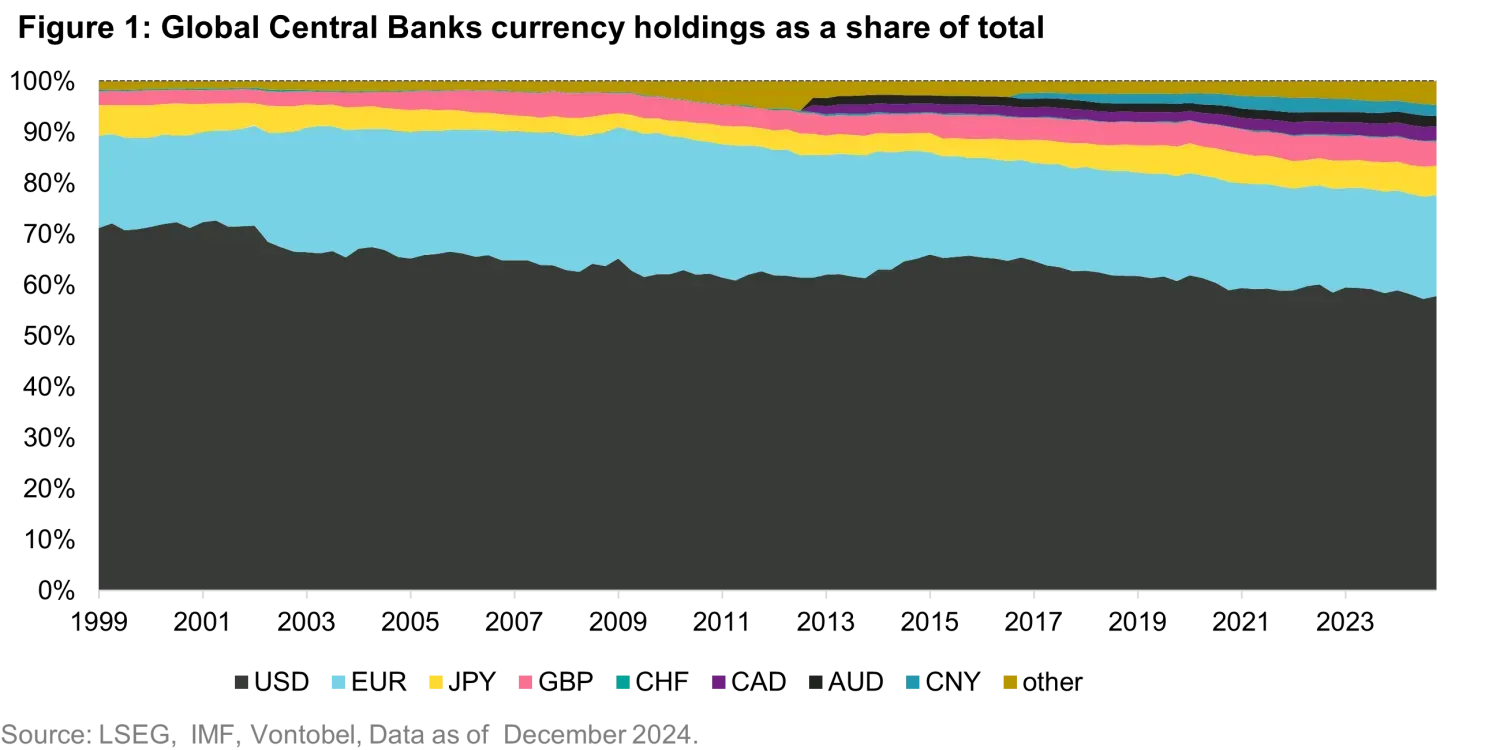
This analysis leads us to conclude that, despite rising competition, the U.S. dollar remains the best-positioned currency to serve as the world’s reserve. At the same time, the growing influence of countries like China suggests that the dollar will likely continue to lose market share in global reserves and trade over time.
This is visible in Figure 1, where the market share of global central bank reserves is depicted during the quarter of a century spanning from the beginning of the new millenniums until now. While the decline of the U.S. dollar is visible and irreversible, it is a slow adjustment.
When the usual relationship between financial market stress and strength in Treasuries and the U.S. dollar breaks down—as it did in April, we are left to wonder whether something changed forever. This is equivalent to pondering: could this unusual behavior signal a more rapid erosion of the dollar and Treasuries as safe haven assets?
April Treasury sell-off had little to do with capital flight
As we mentioned earlier in this article, we believe the U.S. dollar’s sell-off amid rising risk aversion was less about a sudden shift in investor sentiment and asset withdrawals, and more about investors needing to fulfill margin calls, leading them to liquidate highly liquid assets such as gold and U.S. Treasuries. Additionally, technical factors, such as dealers' balance sheets already being saturated with U.S. Treasuries, likely contributed to the low bidding prices for these assets. Let’s take a closer look at the data.
TIC data11 for February 2025 did not support the idea of capital flight during a period of rising risk aversion. In fact, foreign investors increased their holdings just before the April sell-off. Auction participation data also revealed that in the first half of April—after the tariff announcement—foreign investors bought 22% more Treasuries compared to the first half of March12.
This does not suggest that foreign investors won’t diversify away from U.S. assets in the future. However, it indicates that this was not the primary cause of the U.S. dollar and Treasury sell-off in early April. From a longer-term perspective, we see strong potential for a rerating of Europe, particularly after the German elections13. We anticipate that investors will adopt a more balanced view on European and U.S. assets moving forward, a trend already visible in institutional investors' portfolios.
How we navigate
Our conclusion is that the unusual behavior of the Dollar and Treasuries (sell-off) in early April was more related to technical issues with dealer balance sheets and margin calls, rather than a loss of trust in U.S. assets as a safe haven. This leads us to believe that both assets will likely experience mean reversion in the coming months, and that U.S. assets may continue to serve as a valuable option for portfolio diversification.
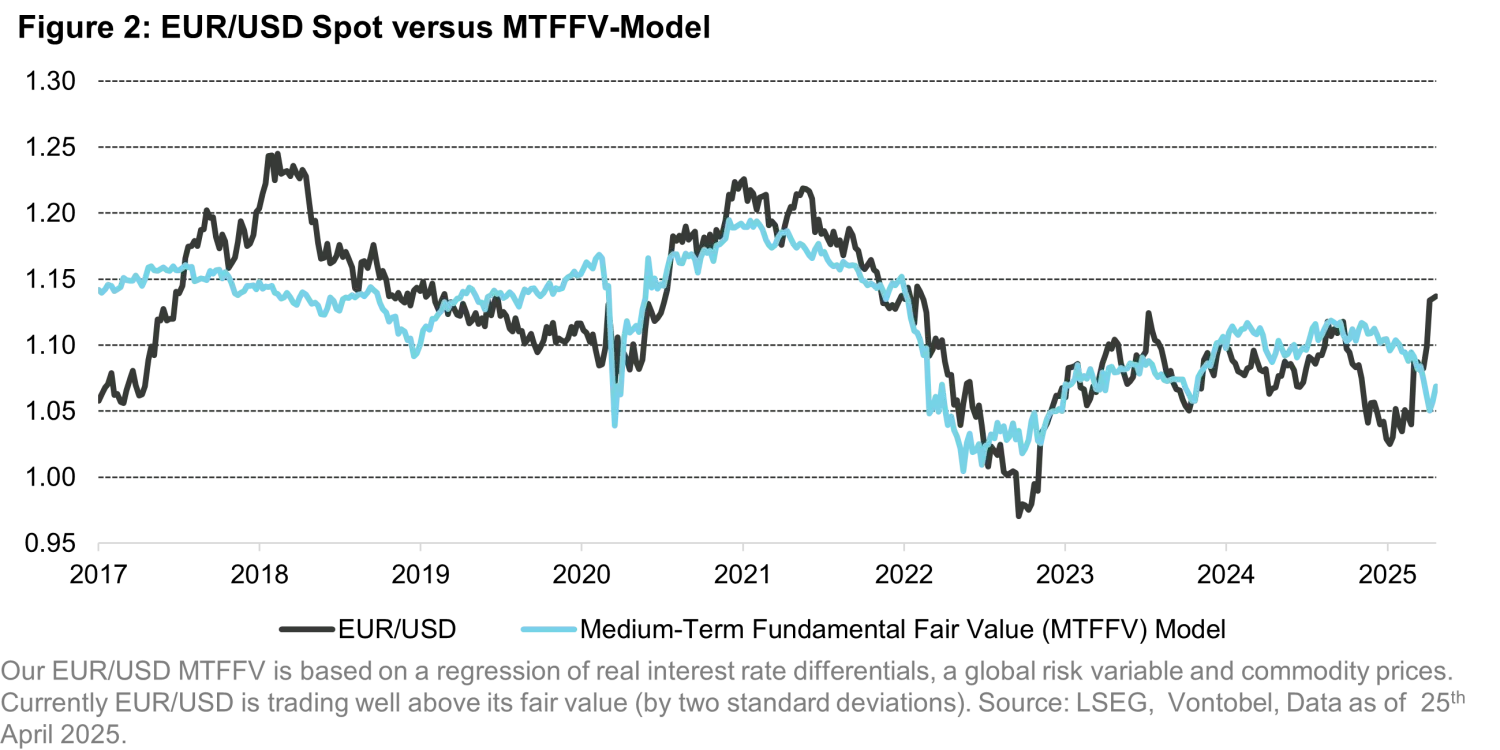
As we remain cautious on financial markets following the recent rally, we are considering buying the U.S. dollar again. Currently, it is not trading in line with short- to medium-term fundamentals. As shown in Figure 2, our model, which includes real rate spreads, a global risk variable, and commodity prices, indicates that the U.S. dollar is trading more than two standard deviations away from its short- to medium-term fundamentals.
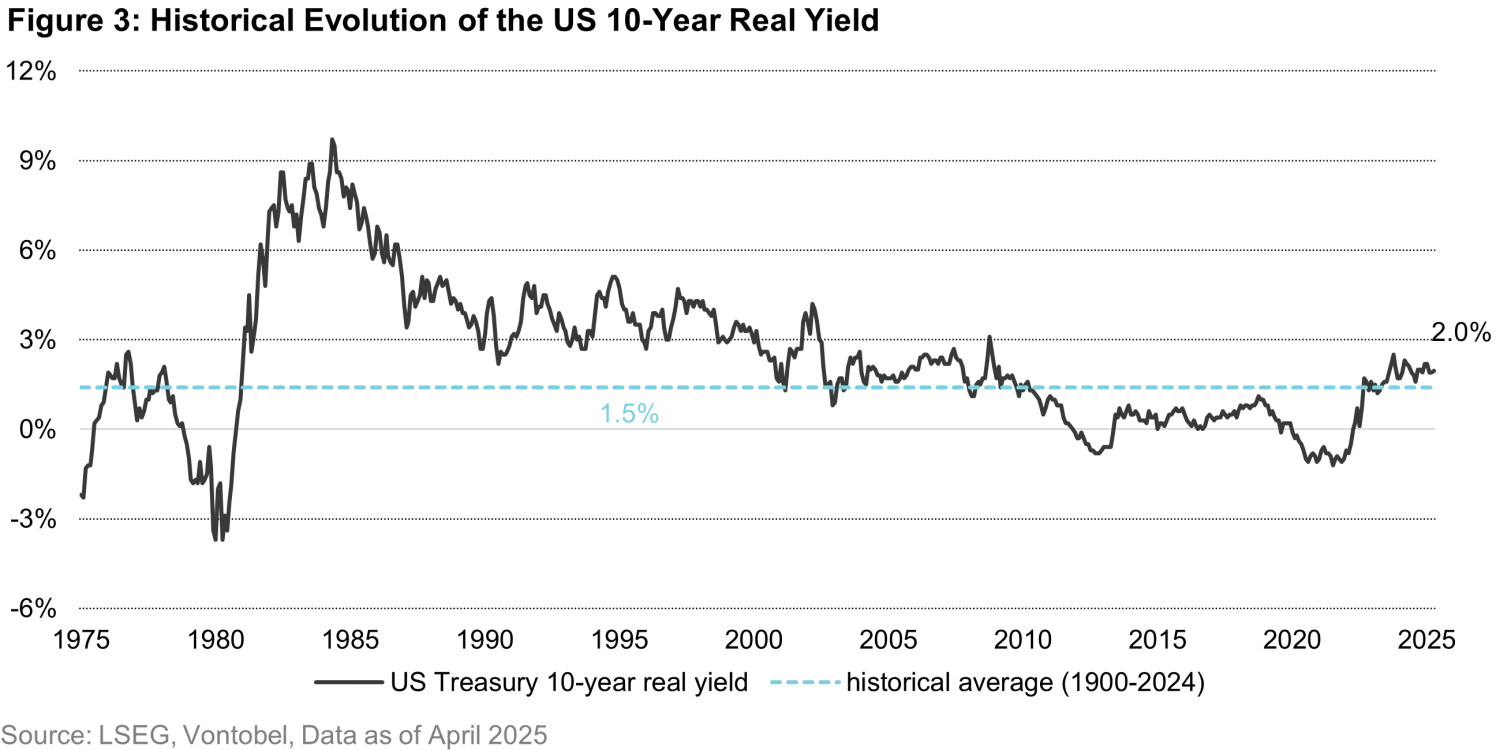
In addition to the U.S. dollar, we continue to see upside potential for gold, which, unlike the U.S. dollar, has already recovered. As highlighted in a previous Quanta Byte14, with real yields currently around 2%, one would not expect gold to do well. This is because gold tends to appreciate with negative real yields (i.e., inflation hovering higher than nominal rates). And this is because in that situation, you’d rather sell your bonds, which give you nominal rates, and buy gold, which appreciates along inflation.
So why is it that we hold a positive outlook on gold? The real 10-year U.S. Treasury yield, as shown in Figure 3, is above its historical average. Assuming the Fed’s long-term inflation target of 2% and its natural rate estimate (long-term federal funds projection) of 3%, the implied long-term real yield estimate is 1%. This figure is slightly below the historical U.S. real yield average of 1.5%, supporting the case for falling real yields and further gold support. In short, we think the market is pushing gold higher because of the expectation of falling real yields, and not their current levels.
To conclude, we see both gold and the U.S. dollar as valid options for us in terms of portfolio diversification.
1. For our view on the conditions needed for a lasting market recovery, see “Decoding the Market Response to U.S. Tariffs”.
2. See Barry Eichengreen (2011) “Exorbitant Priviledge”, Oxford University Press.
3. See “US dollar stands firm as world reserve currency but tech war is a threat”
4. While China surpassed the U.S. in annual nominal GDP in purchasing power parity terms, it still lacks the U.S. in market priced nominal GDP.
5. See www.wipo.int for the 2024 data.
6. See Companiesmarketcap.com. Data as of April 2025.
7. See CBInsights. Data as of January 2025.
8. The Trump administration’s communication has, at times, placed pressure on institutions like the Federal Reserve to align their actions with political goals. For instance, the former U.S. president openly criticized Fed Chairman Jerome Powell, raising concerns among investors that he might seek to replace Powell with a more compliant candidate. More recently, Stephen Miran, serving as Chair of Economic Advisors for the U.S. Government, suggested during his remarks at the Hudson Institute that foreign investors benefiting from the U.S. geopolitical and financial umbrella—such as access to U.S. Treasuries—should contribute their fair share. Introducing a fee for holders of U.S. Treasuries could be seen as a partial default, undermining trust in one of the world’s most important financial markets.
9. See the 2020 IMF Working Paper “Patterns in Invoicing Currency in Global Trade”.
10. See the 2022 “Triennial Central Bank Survey” of the BIS.
11. See the “TIC Data” from U.S. Department of The Treasury.
12. See the U.S. Treasury’s allotment report data on the auction participation.
13. See “A Turning Point for European Markets?” for the rationale behind the improved outlook for European assets.
14. See “Renewed macro support for gold” for a more detailed analysis.
This marketing document was produced by one or more companies of the Vontobel Group (collectively "Vontobel") for institutional clients. This document is for information purposes only and nothing contained in this document should constitute a solicitation, or offer, or recommendation, to buy or sell any investment instruments, to effect any transactions, or to conclude any legal act of any kind whatsoever. Although Vontobel believes that the information provided in this document is based on reliable sources, it cannot assume responsibility for the quality, correctness, timeliness or completeness of the information contained in this document. Except as permitted under applicable copyright laws, none of this information may be reproduced, adapted, uploaded to a third party, linked to, framed, performed in public, distributed or transmitted in any form by any process without the specific written consent of Vontobel. To the maximum extent permitted by law, Vontobel will not be liable in any way for any loss or damage suffered by you through use or access to this information, or Vontobel’s failure to provide this information. Our liability for negligence, breach of contract or contravention of any law as a result of our failure to provide this information or any part of it, or for any problems with this information, which cannot be lawfully excluded, is limited, at our option and to the maximum extent permitted by law, to resupplying this information or any part of it to you, or to paying for the resupply of this information or any part of it to you. Neither this document nor any copy of it may be distributed in any jurisdiction where its distribution may be restricted by law. Persons who receive this document should make themselves aware of and adhere to any such restrictions. In particular, this document must not be distributed or handed over to US persons and must not be distributed in the USA.
About the author

Related funds
About the author
Explore related topics:
Up next:
Towers and the Starlink ThreatRelated insights

Towers and the Starlink Threat

Quarterly Commodity Outlook - Halftime Whistle: Fundamentals Take the Field

Investors’ Outlook: And now for something completely different

Investors’ Outlook: Adjusting the focus

Investors’ Outlook: Strait forward
