
Renewed macro support for Gold
Multi Asset Boutique
Financial markets initially responded positively to the outcome of the U.S. election. Government bond yields rose, initially absorbed well by cyclical asset classes like equities, as they reflected higher growth expectations tied to Trump's policy agenda.
However, the mood shifted in December as Donald Trump’s increased public appearances drew attention to potential U.S. trade policy risks. His suggestion that Canada might become the 51st U.S. state with Justin Trudeau as governor—if Canadian authorities believed they could not withstand a proposed 10% tariff on U.S. imports—was likely a joke, but it signaled to markets that trade policy could become an immediate focus following Trump’s inauguration on January 20, 2025.
Trade tariffs often lead to higher inflation and higher rate expectations. This prospect has already cast a shadow over Wall Street. Beyond trade policy, uncertainty surrounding Trump’s foreign policy stance—particularly regarding the war in Ukraine and tensions in the Middle East—adds to the unpredictability of geopolitical risks.
As the inauguration date approaches, preparing for market volatility in 2025 becomes essential1. Investors should consider strategic hedges to navigate these evolving risks effectively.
We recently reviewed the gold allocation in our multi-asset hybrid mandates and decided to keep a moderate overweight in light of two considerations. First, we would like to keep a hedge against geopolitical risks, which we see rising. Second, we believe gold should benefit from our outlook on real yields. In this piece, we outline our reasoning in detail and the evidence backing this up.
Gold: A Reliable Tool for Portfolio Diversification
Gold’s role as a portfolio diversifier remains compelling, especially in times of heightened geopolitical risk2. We conducted an event analysis using the Geopolitical Risk Indicator (GRI) developed by Dario Caldara and Matteo Iacoviello, as shown in Figure3.
Our findings reveal that the GRI closely aligns with major geopolitical events over time, accurately tracking 40 well-documented instances. For deeper insights, we highlighted the highest 18 spikes (events) in the graph and conducted a detailed scenario analysis to assess gold’s performance during such periods.
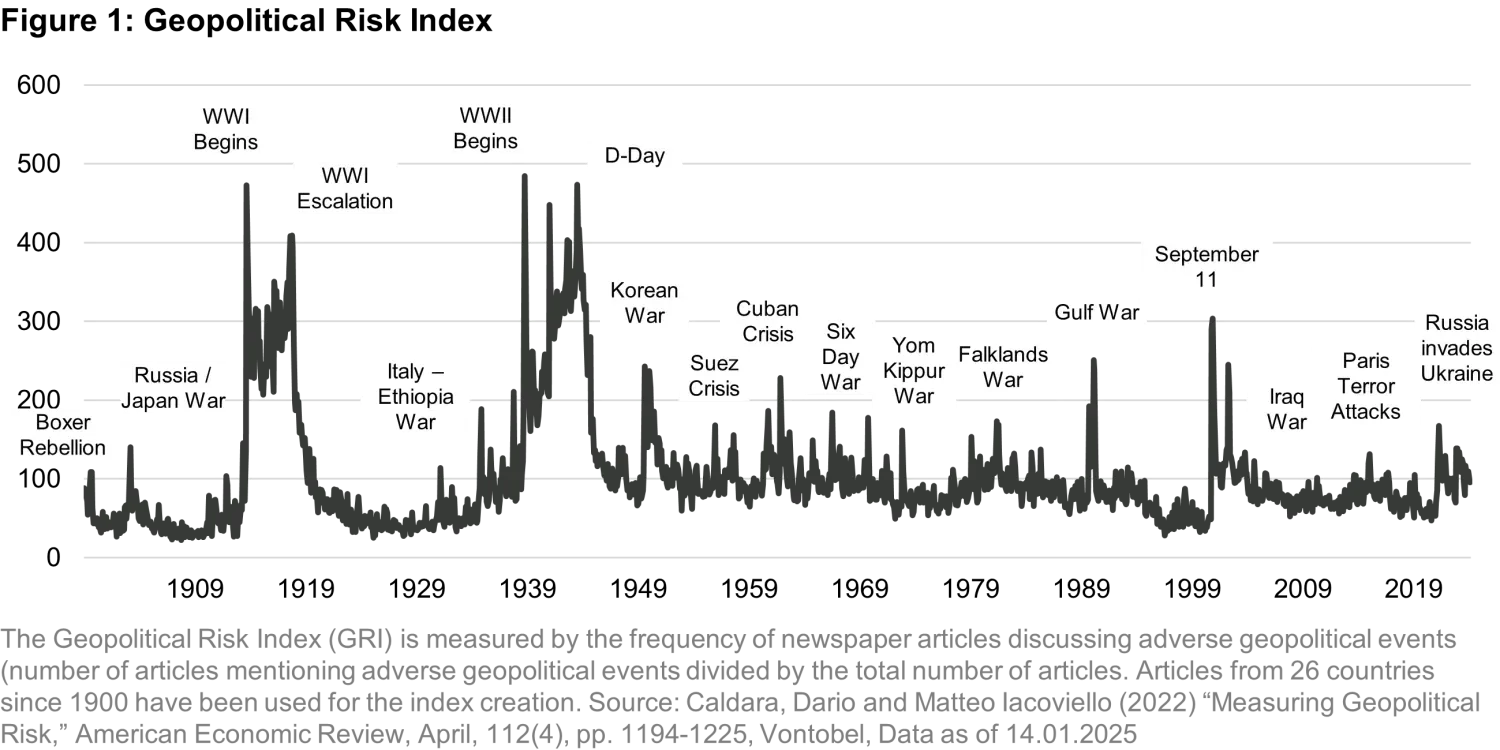
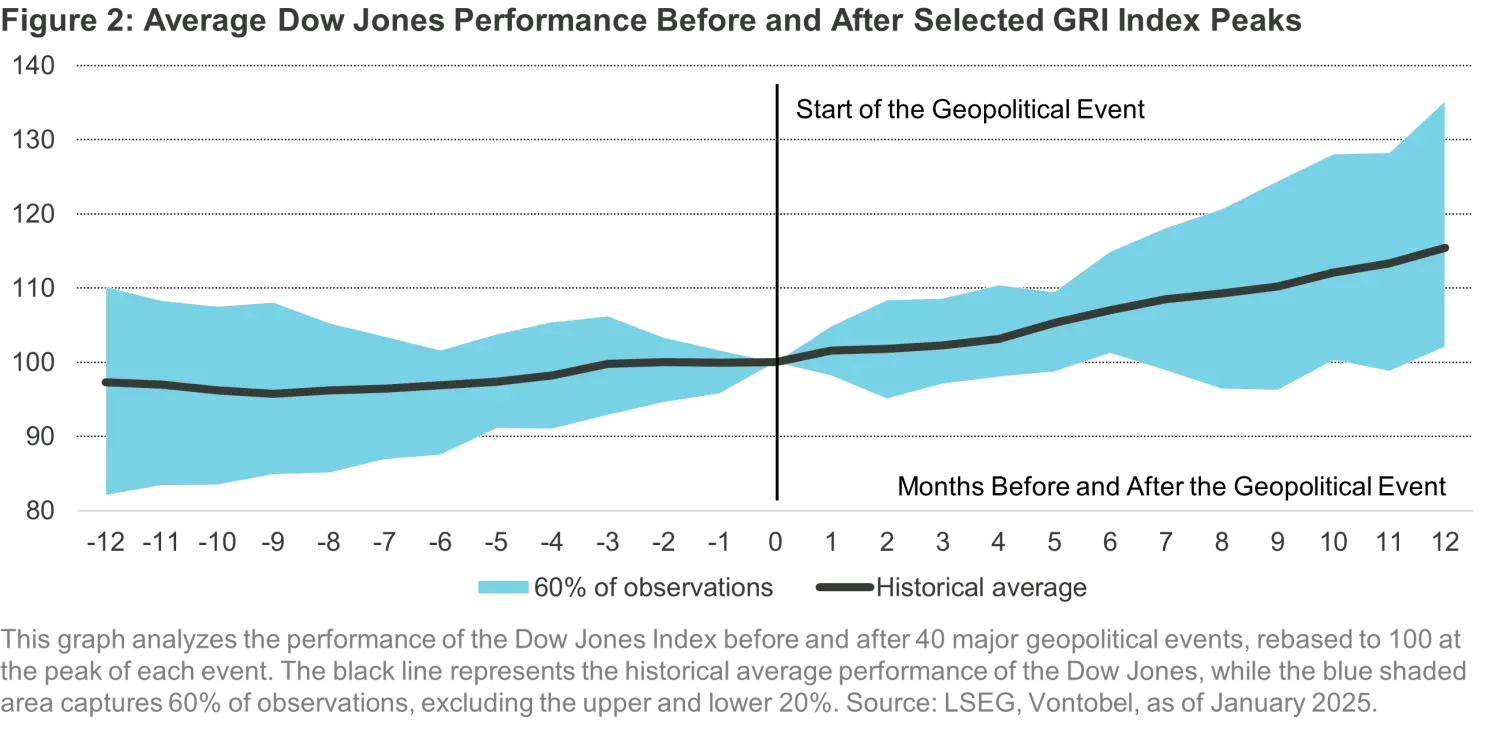
While the Geopolitical Risk Indicator (GRI) proved less effective as an early warning system—often spiking too shortly before an event—it has been invaluable for analyzing how asset classes behave around these events. Our research reveals that, although geopolitical disruptions can cause short-term market volatility, asset prices generally recover relatively fast after the event. For example, as shown in Figure 2, equities traded higher 12 months after the event in 80% of the cases analyzed. Additionally, in 70% of cases, equities had already rebounded within just three months. These results are robust when we divide the sample into different time periods (1900-1950, 1950-2000, 2000-2024)4, as the behavior of equities before and after the geopolitical event is relatively similar across all three sub-samples.
Gold vs. Equities: Resilience in Geopolitical Turmoil
For the analysis illustrated in Figure 3, our sample begins in 1970, when gold became tradable. The graph compares the performance of equities and gold before and after the 18 geopolitical events chosen within the sample period.
The results highlight gold’s appeal as a diversification tool during geopolitical crises. While equities typically weaken after such events—remaining, on average, below pre-event levels for four weeks—gold exhibits remarkable stability. In fact, gold often begins to rally post-event, underscoring its resilience and value as a safe-haven asset.
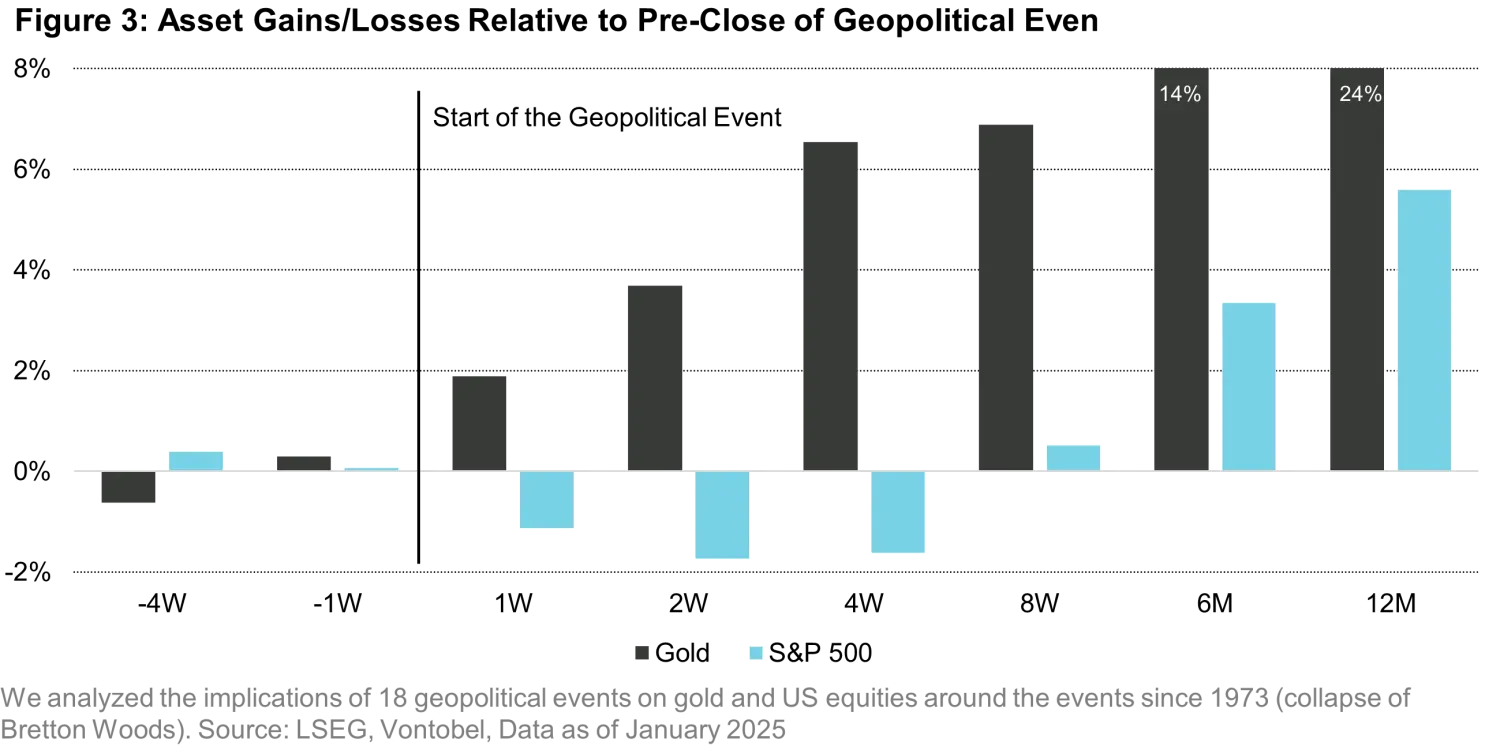
This behavior reinforces the importance of incorporating gold into investment portfolios, particularly for those seeking to mitigate risks associated with geopolitical uncertainty and market volatility.
Gold’s Potential Shines Bright, Even in the Base Case
Beyond its diversification benefits, gold’s prospects remain promising in light of its behavior relative to yields. Historical data, shown in Figure 4, illustrates gold’s historical negative correlation with U.S. real yields, a relationship that has consistently influenced its performance.
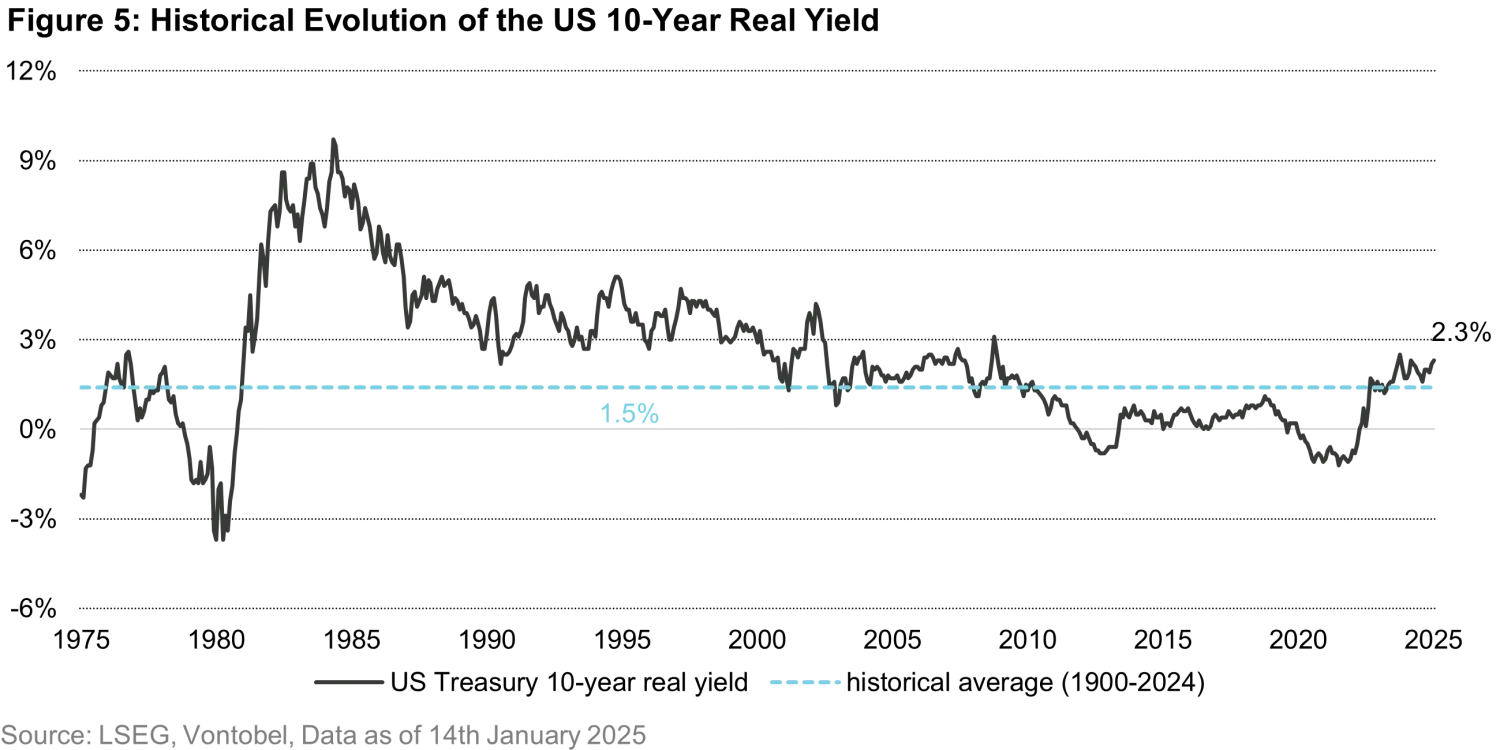
Consider that in conjunction with Figure 5, which shows that real yields have risen significantly in the recent past and currently stand above their historical average (2.3% now vs a historical average of 1.5%). If investors believed that some mean reversion was due, support for gold would ensue, given the inverse relationship with real yields discussed above.

The Federal Reserve’s projections further reinforce gold’s potential. Assuming the Fed’s long-term inflation target of 2% and its natural rate estimate (long-term federal funds projection) of 3%5, the implied long-term real yield estimate is 1%. This figure is slightly below the historical U.S. real yield average of 1.5%, making the case as well for falling real yields and gold support. The major risk to our view would be a significant decrease in geopolitical risks or a further rise in yields within an environment of stable inflation6.
In conclusion, gold’s unique positioning—both as a hedge and as an asset with room for further upside—makes it a compelling choice for investors, even under conservative base case assumptions.
1. As highlighted in the previous edition of our Quanta Bytes, 'Humble New Year Resolutions,' we emphasized the importance of hedges in 2025.
2. See our recent Quanta Byte article, “The golden geese”, to explore why a broader approach to commodity investments can deliver enhanced benefits beyond what gold alone offers.
3. See Caldara, Dario and Matteo Iacoviello (2022) “Measuring Geopolitical Risk”.
4. We selected these periods for their distinct characteristics. The first was shaped by global wars, the second by financial market liberalization, which triggered several regional crises, and the third by the emergence of great power competition between the U.S. and China. This rivalry fueled deglobalization, or “Slowbalization,” as The Economist described it. Moreover, the Pax Americana (peace order) faced growing challenges, including the destabilizing impact of events like the September 11 terrorist attacks. For a deeper analysis, see our white paper, “The Next Digital Superpower”, coauthored with Eurasia Group.
5. We took the natural interest rate from the Fed’s December 2024 FOMC projections. The natural interest rate, also referred to as the long-run equilibrium interest rate, is the short-term interest rate that would prevail when the economy is at full employment and stable inflation. In other words, it is the rate at which monetary policy is neither contractionary nor expansionary.
6. Such a scenario appears possible if growth accelerates due to significant productivity gains. These productivity improvements would increase potential growth, which is a key input in estimating the natural rate of interest.
This marketing document was produced by one or more companies of the Vontobel Group (collectively "Vontobel") for institutional clients. This document is for information purposes only and nothing contained in this document should constitute a solicitation, or offer, or recommendation, to buy or sell any investment instruments, to effect any transactions, or to conclude any legal act of any kind whatsoever. Although Vontobel believes that the information provided in this document is based on reliable sources, it cannot assume responsibility for the quality, correctness, timeliness or completeness of the information contained in this document. Except as permitted under applicable copyright laws, none of this information may be reproduced, adapted, uploaded to a third party, linked to, framed, performed in public, distributed or transmitted in any form by any process without the specific written consent of Vontobel. To the maximum extent permitted by law, Vontobel will not be liable in any way for any loss or damage suffered by you through use or access to this information, or Vontobel’s failure to provide this information. Our liability for negligence, breach of contract or contravention of any law as a result of our failure to provide this information or any part of it, or for any problems with this information, which cannot be lawfully excluded, is limited, at our option and to the maximum extent permitted by law, to resupplying this information or any part of it to you, or to paying for the resupply of this information or any part of it to you. Neither this document nor any copy of it may be distributed in any jurisdiction where its distribution may be restricted by law. Persons who receive this document should make themselves aware of and adhere to any such restrictions. In particular, this document must not be distributed or handed over to US persons and must not be distributed in the USA.
About the author

Related funds
About the author
Explore related topics:
Up next:
Towers and the Starlink ThreatRelated insights

Towers and the Starlink Threat

Quarterly Commodity Outlook - Halftime Whistle: Fundamentals Take the Field

Investors’ Outlook: And now for something completely different

Investors’ Outlook: Adjusting the focus

Investors’ Outlook: Strait forward
