
Quarterly Commodity Outlook – Will the dispersion continue?
Multi Asset Boutique
Introduction
The outlook for risky assets, including commodities, remains positive in 2026. Global GDP is expected to grow above trend, supported by resilient consumption, robust business investment, and accommodative fiscal and monetary policies. A weaker US dollar should further create a favorable environment for commodities. The factors driving U.S. growth outperformance in 2025 are likely to persist in 2026: strong consumption underpinned by healthy household balance sheets and rising wealth, alongside robust business investment, particularly AI-driven capex. The labor market remains a key focus. While some analysts expect it to weaken, it has so far remained resilient with few soft spots. Should the labor market deteriorate, the Fed appears ready to support the economy with further rate cuts, as the recent FOMC meeting has indicated a willingness to tolerate higher inflation to preserve employment. U.S. policy may increasingly focus on the midterm elections, with potential measures including affordability initiatives, fiscal stimulus, and possibly additional geopolitical interventions. In the euro area, growth is expected to gain momentum in 2026, supported by higher defence spending, accommodative monetary policy, and looser fiscal conditions. China continues to operate a “two-speed” economy (strong external demand vs weak domestic demand). Strong exports have enabled Beijing to achieve its 5% growth target despite trade tensions, while domestic consumption lags. If export momentum continues in 2026, fiscal stimulus is likely to remain modest. However, a slowdown in exports would likely prompt targeted stimulus, particularly in housing, to ensure domestic demand helps meet growth objectives. This global environment should generally be beneficial for commodities.
Commodities delivered strong returns in 2025, with the Bloomberg Commodity Total Return Index up 15.8%. Looking ahead to 2026, commodities remain an important consideration for multi-asset portfolios. With accommodative monetary and fiscal policies, commodity allocations are increasingly valuable for diversification and inflation-hedging. Should concerns over Fed independence or renewed trade tensions materialize, commodities could also provide a unique hedge for traditional portfolios. Geopolitical risks are likely to persist, and commodities continue to serve as one of the most effective hedges against such uncertainties. The recent past underscores this: during 2022, when geopolitical risk was high, commodities were the only major asset class to deliver positive returns. The broad commodity universe also offers built-in diversification (as can be seen in 2025). Even if one sector underperforms (crude oil), other sectors can offset losses (industrial metals, precious metals), providing stability in a multi-asset portfolio.
Precious metals
In our last quarterly outlook we spent quite some time talking about the reasons for our overweight in precious metals. And rightly so: precious metals had an unprecedented year chasing one record after the other. Just counting the number of new all-time highs of each spot price – gold #60, silver #66, platinum #47 and palladium #35 – gives an impression of how far prices rallied. What can we expect going forward? While the ascent of recent rallies was certainly remarkable, we believe there is more upside than downside risks for precious metals over the next quarter. Our conviction is to stay overweight with nuances across the individual metals depending on the risk appetite.
We remain firmly bullish on gold and maintain an overweight position. Gold’s strength is increasingly driven by its macro role rather than physical market tightness. In a world marked by persistent policy uncertainty, gold continues to benefit from strong central bank demand, elevated geopolitical risks, and its status as the preferred safe-haven asset. Central banks are buying at an above-average pace, supported by ongoing fiscal expansion and the lack of credible alternatives to the US dollar as a reserve currency.
The broader macro environment remains supportive. Gold offers an effective hedge if global growth slows and the U.S. labor market weakens (a scenario that would likely prompt further Fed rate cuts in 2026). Near-term policy events, including legal uncertainty around U.S. tariffs and ongoing trade tensions, may drive volatility but ultimately reinforce uncertainty around economic policy and fiscal sustainability, both of which are constructive for gold. After an exceptional 2025, periods of consolidation are likely, but the strategic investment case remains intact. Structural demand provides a durable floor: sustained central bank purchases, the revival of ETF inflows, a revival of the Fed easing cycle, and the potential entry of new long-term buyers (such as insurers in China and pension funds in India). In an environment of recurring shocks and policy uncertainty, gold remains a core allocation, and we continue to see attractive upside over the medium term.
Silver’s outlook is best described as cautiously optimistic, but highly volatile. The metal has already delivered an extraordinary rally, rising around 138% in 2025, and we are wary of chasing prices at these levels. Unlike gold, the move lacks strong fundamental backing and has been driven largely by speculative positioning. As the initial “scarcity trade” cools, potential demand destruction and increase in recycling could trigger sharp pullbacks. This is why we went neutral on silver in the strategy.
A key driver of recent price action has been tariff front-loading and market dislocation. Speculation around U.S. import tariffs prompted large volumes of silver to be pre-positioned into COMEX vaults, leaving inventories in London, which is the price-setting market, unusually thin. This has created temporary physical tightness, which is visible in elevated lease rates. Traders are paying up to borrow metal. The result is an unstable setup: high COMEX inventories coexist with scarcity in London, amplifying price moves in both directions. If clarity emerged on tariff policies and silver flowed back out of the US, London liquidity could normalize quickly, opening the door to a sharp correction. If not, tightness and volatility are likely to persist.
For platinum and palladium, we remain in wait-and-see mode. The upcoming U.S. Section 232 investigation1 is key driver for price action, on which we have no insights on the result. Both metals have rallied this year on the broader precious metals upswing, trade tensions, and supply constraints, but much of the gains reflect tariff anxiety and speculation rather than fundamentals. Thus, further upside is fragile at best. The recent rally was sparked by the launch of palladium and platinum futures on the Shanghai Exchange. Within weeks, their open interest surged to a quarter of the CME’s open interest. High volatility for both metals will persist. A trigger for a sharper correction could be the result of the Section 232 investigation.
Industrial metals
Copper has been in the spotlight recently, surging from USD 10,700 per ton in mid-November to a record USD 13,000 in early January, a 20% rally in just six weeks. We took profits in the strategy, as we believe prices are likely to struggle from here. Here’s why:
- Demand destruction looming: Commodity prices are all about supply and demand. At record highs, copper is already seeing demand pushback. This is particularly evident in China, the world’s largest copper consumer, where demand growth has turned sharply negative in recent months.
- US excess imports: The recent rally was supported by the U.S. absorbing surplus copper amid tariff concerns. This material is being stockpiled rather than used. With the COMEX/LME arbitrage now closed, this excess import flow may end soon. We believe that there could be even a ruling against copper tariffs this year due to the Trump administration’s 2026 focus on affordability. This would trigger a sharp correction in copper prices.
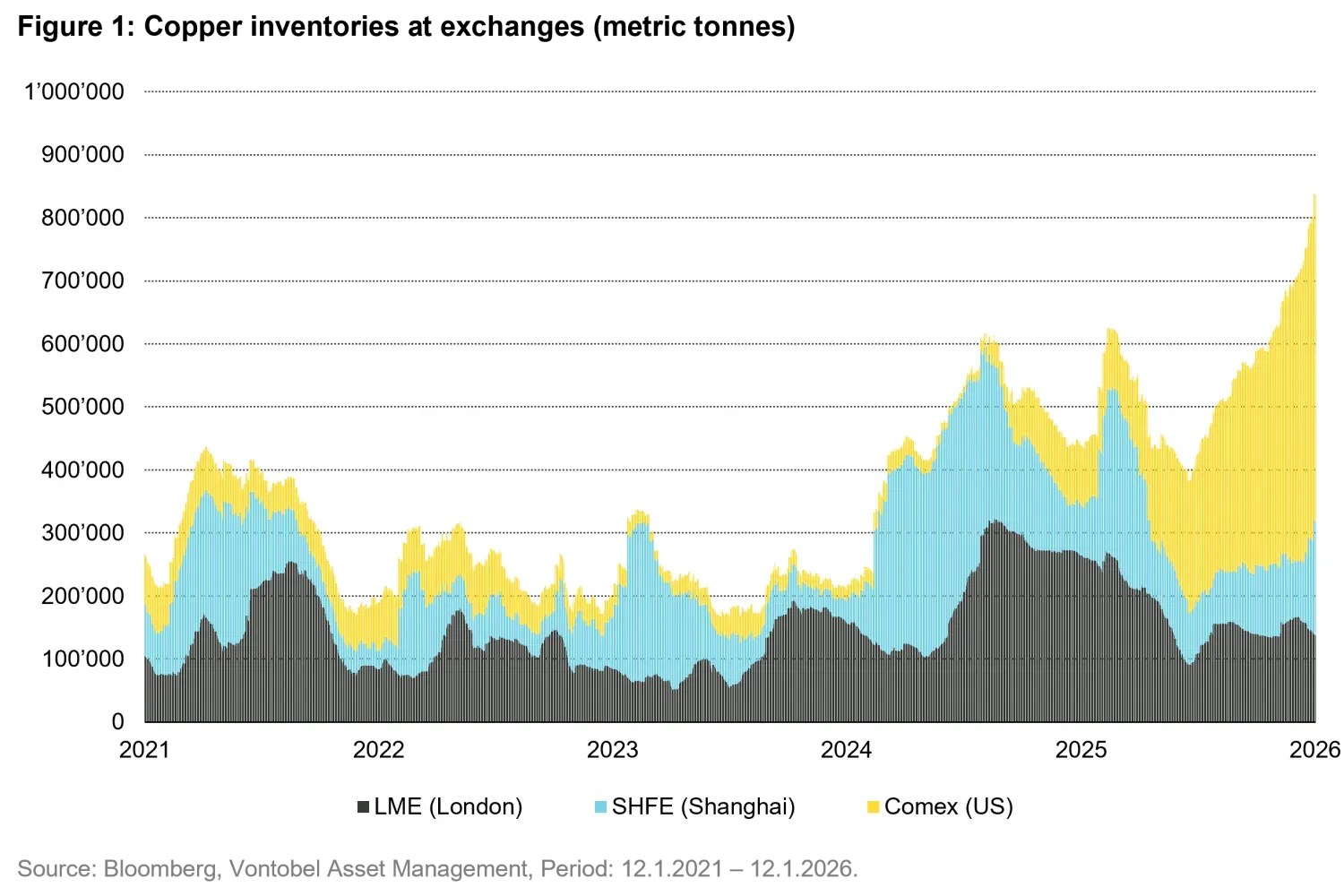
- Fundamentals: Once U.S. excess absorption of copper fades, attention will return to fundamentals: weak Chinese demand and global inventories at a five-year high (see Figure 1 for a split of total inventories by exchange).
- China exports: Historically a net importer, China is now exporting copper due to weak domestic demand. This is likely to replenish LME inventories, echoing the abrupt halt of the H1 2024 copper rally, when China was exporting heavily.
- Market positioning: Positioning for copper futures are currently extremely long. Any price drop could trigger widespread profit-taking, amplifying a correction.
Where could we be wrong and what could push copper prices even higher from here:
- U.S. imports continue: If the COMEX/LME arbitrage reopens and the U.S. keeps importing excess copper, prices could climb further. This depends heavily on tariff developments. The Commerce Secretary indicated that they might recommend to Trump to implement 15% tariffs starting 2027. If tariff uncertainty lingers for longer, it could encourage continued U.S. stockpiling.
- Mine disruptions: 2025 saw more production disruptions than expected. If mines fail to meet output guidance, further supply constraints could tighten the market.
For nickel, we maintain a neutral view, expecting prices to remain range-bound. On the bearish side, abundant supply and elevated inventories weigh on the market. However, Indonesia, the dominant global supplier, is signalling price-supportive measures, including potential quota reductions in 2026.
Aluminium has followed copper higher. We maintain a modest underweight, as prices are trading significantly above the cost curve—a situation that, historically, tends to be temporary.
We continue to hold an underweight in zinc, as demand remains weak while mine supply is expected to recover further in 2026.
Energy
Oil markets are heading into a heavily oversupplied position in 2026, with Q1 set to be particularly weak as seasonal demand drops. Recently, headlines around a U.S. military operation in Venezuela grabbed attention, triggering discussions on the impact on oil markets.
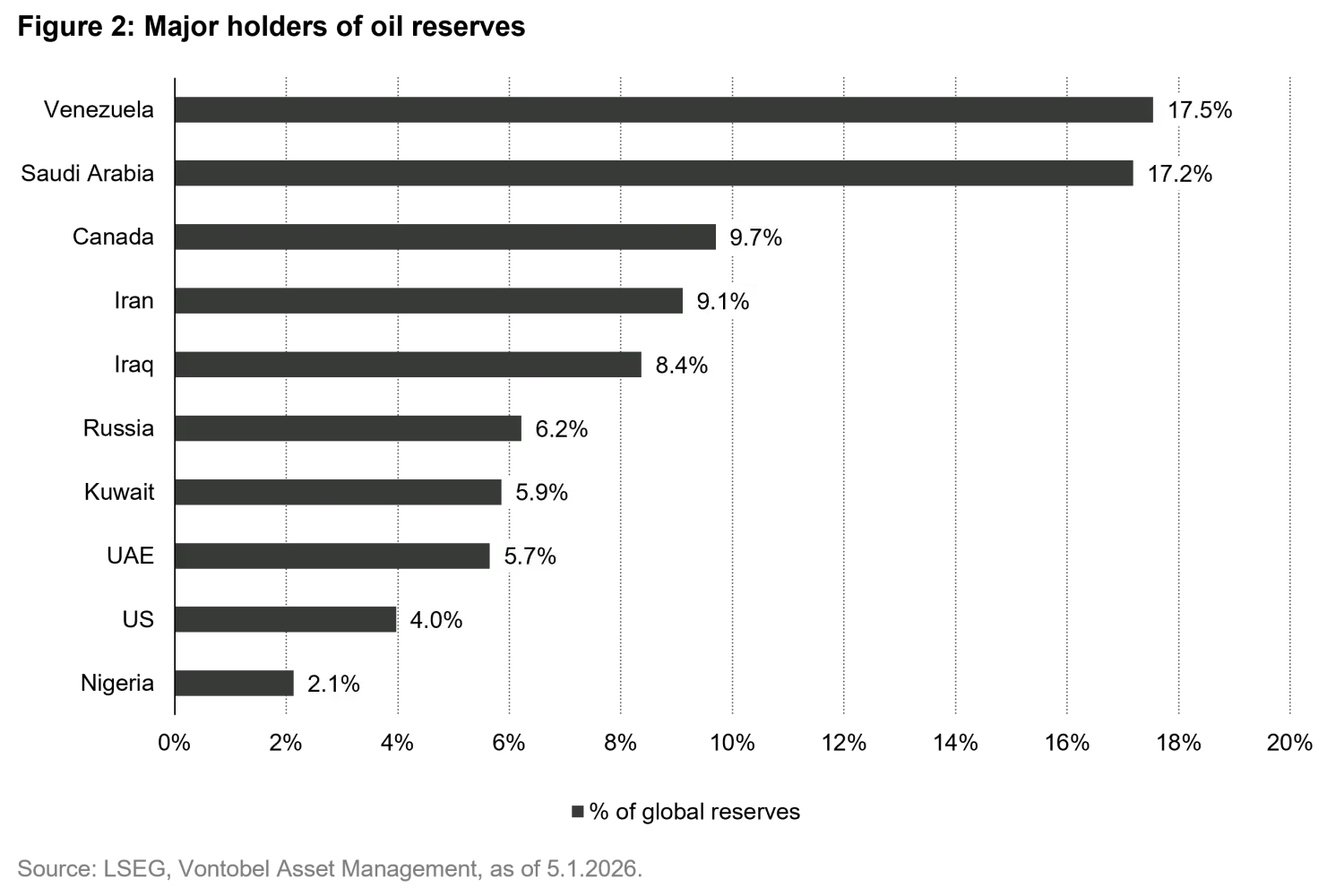
Venezuela’s resource base is undeniably large — as shown in Figure 2. The country holds around 17.5% of global proven heavy crude reserves—yet its actual production tells a very different story. Output has collapsed from more than 3 mb/d in the mid-to-late 1990s to around 0.9 mb/d today, leaving the country contributing less than 1% of global supply. Years of mismanagement, sanctions, and underinvestment have hollowed out the upstream sector, leaving infrastructure severely damaged and capacity impaired. As a result, any meaningful supply response would require substantial capital injection and political stability. After an initial selloff, oil prices recovered, due to industry experts clarifying that Venezuela cannot quickly flood the market. Even in a relatively constructive scenario, e.g., a short-term increase of 100–250 kb/d (compared to 2025 average levels) would likely come from operational tweaks, such as expanded Chevron activity, partial sanctions relief, reactivating damaged wells, and restoring diluent flows. Looking further ahead, a production increase of up to 0.5 mb/d over the next 1–2 years may be achievable, but only with at least upstream investment of around USD 10bn and firm assurances that contracts will be honored under a stable and legitimate government. Anything beyond that appears increasingly difficult. Venezuela represents potential upside to supply in an already oversupplied 2026 oil market, reinforcing downside risks to prices. The only scenario that could flip the narrative would be political deterioration: If the regime survived, or worse, if civil conflict erupted, exports would be disrupted, leading to price spikes. For now, however, Venezuela is more a long-term supply option than an imminent market changer.
Iran: The substantial success of the military action in Venezuela has raised concerns that this momentum could be used for other military operations. Trump has already warned the Iranian regime that continued suppression of protests could trigger further intervention. While it may feel distant, it was only in summer 2025 that Israel and the U.S. launched a joint strike against Iran, an operation that stopped short of threatening the regime’s survival. Direct military support for protesters, however, would likely be seen in Tehran as an existential threat, increasing the risk of severe retaliation (such as blocking the Strait of Hormuz, which would be trigger a marked increase in oil prices). A renewed Middle East crisis cannot be ruled out.
Russia Ukraine: The Russia–Ukraine war remains a continued driver of geopolitical risk. As anticipated last year, a swift peace deal has failed to materialize. Almost daily headlines continue to float new peace proposals, the latest suggesting Russia has rejected Trump’s reported 20-point plan. At the same time, attention is turning to a U.S. bill that would impose tariffs of at least 500% on countries importing Russian petroleum products, with a vote expected in the second week of January. The measure is widely seen as a tool to pressure major buyers such as India, and China. That said, the bill ultimately places the final call in President Trump’s hands. As history has taught us: geopolitical risks can only have a prolonged impact on oil prices if they cause actual production losses. And so far, they haven’t. But there is some danger: Given the large bearish consensus around oil on the street, news around geopolitical events can easily trigger short covering rallies on the futures market. We have seen a few in the first week of the year.
We still hold an underweight position in crude oil in the strategy, in addition to a substantial bear spread on the oil futures curve. With limits to oil-in-transit, this surplus on water will eventually become visible in key pricing centres, requiring a steeper contango across the entire curve.
Henry Hub natural gas prices have been under heavy pressure since early December, driven largely by weather forecasts in the U.S. Current low temperatures over the North Pole are signalling a milder winter across the Northern Hemisphere, keeping demand soft. After a brief price spike in late November/early December, producers ramped up supply to capitalize on higher prices, leaving the market oversupplied in a winter that is again warmer than its 10-year average.
Winter isn’t over yet, though. A forecast shifting towards colder weather in late January or February could trigger a price rally. For now, however, with inventories full and producers quickly responding to price moves, the market would likely present a solid selling opportunity. We stay absent of directional trades for now, but instead hold an extensive bear spread position on the futures curve.
Agriculture
Grain prices fell for a third consecutive year, while the dispersion in soft commodities continued. Coffee prices rallied on the back of supply disruptions whereas cocoa prices halved in 2025. Meanwhile, the livestock sector rose again, supported by tight market fundamentals.
Looking forward, our base case for grains and oilseed prices is to stay under pressure, at least for the first half of the calendar year. Key tail risks include ongoing tariff discussions and unexpected weather events, especially in South America. U.S. corn exports are running ahead of last year’s pace, and we expect Mexico to remain a strong buyer of U.S. corn. However, attention will increasingly shift to the Southern Hemisphere’s second corn crop, which is projected to be historically large, assuming favorable weather. These opposing forces are likely to keep corn prices broadly stable. For soybeans, we remain cautious. It seems that China has bought close to 12 million metric tons of U.S. soybeans as they had indicated. However, they have not committed yet to the 25 million metric tons p.a. for the upcoming years, as announced by the White House. Brazil has significantly increased soybean production in recent years. First indications point to a record large harvest, which starts mid-January. Another year of record Brazilian soybean production should put pressure on soybean prices. We remain bearish in soybeans going forward. However, if we see that China is ramping up their goodwill purchases from the U.S. at the expense of Brazil, we would consider setting the soybean underweight to neutral. Longer-term, continued economic pressure on Brazilian farmer might become an issue and we are monitoring that closely. An upcoming guidance of the usage of soybean oil in renewable diesel in the U.S. might be a bullish catalyst for soybean oil prices and (partially) solve the abundance of soybeans domestically, while this can come on the cost of lower soybean meal prices. We stick to our structural overweight in soybean oil while holding an underweight in soybean meal. Since the world has more than enough wheat stocks, we expect further downside from here, as long as exports from the black sea region are not disrupted in the Russia/Ukraine war, which in February will prolong already 4 years.
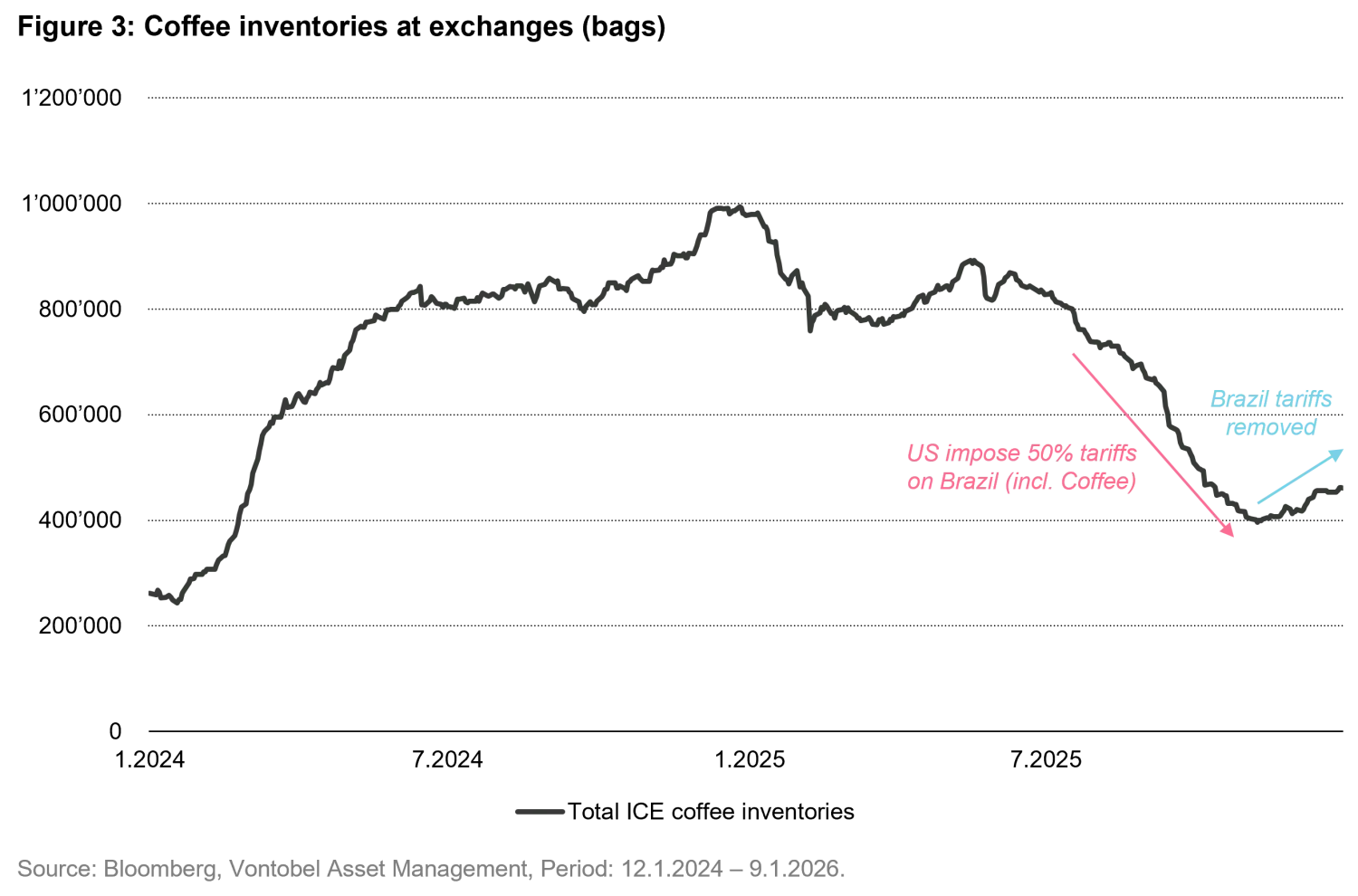
For soft commodities, the removal of the additional 40% tariff on Brazilian coffee in November remains the main reason we expect coffee prices to decline, alongside improving weather conditions in Brazil and Vietnam. We anticipate Brazilian coffee exports will continue to increase, with exchange inventories likely to rise further in Q1 2026. See Figure 3 where the trend reversal post tariff removal is depicted.
Cocoa prices have halved within a year, falling from around USD 12,000 at the end of 2024 to below USD 6,000 by the end of 2025. Supply conditions in West Africa are expected to have eased compared with the tight market in 2024. We therefore expect cocoa prices to remain range-bound, provided weather risks do not materialize and demand weakness persists.
We continue to see value in livestock, particularly cattle, as underlying fundamentals remain supportive. The U.S. cattle herd is at its lowest level in years, and we do not expect the border with Mexico to reopen in the near term, especially in light of the latest screwworm detection just 200 miles across the border. While the U.S. government has recently focused on lowering beef prices, rebuilding the herd will take time.
Conclusion
In the first week of January 2026, the Bloomberg Commodity Index is already up 4%, continuing the stellar performance of 2025. We believe that 2026 will again be a positive year for commodities based on a weaker US dollar, geopolitical risk as well as monetary and fiscal stimulus.
Within the strategy, we aim to provide you with exposure to the broad commodity market while outperforming the Bloomberg Commodity Index. Thus far, our key calls for Q1 2026 on how to achieve the objective are:
- Overweight precious metals, particularly gold
- Underweight crude oil
- Short-term underweight industrial metals (despite being constructive longer-term)
- Neutral natural gas
- Dispersion in agriculture: overweight soybean oil while underweight soybean, soybean meal, wheat and coffee
In figure 4 you will find a visualisation of our current preferences across the main commodity sectors. This preference matrix is updated monthly and reflects our current research and evaluation of the risk-reward profile of each commodity.
1. The Section 232 investigation on critical minerals is a government review to decide whether imports are a national security risk and whether trade restrictions should be imposed on these commodities.
About the authors



Related funds
About the authors
Explore related topics:
Related insights

Quarterly Commodity Outlook – Precious metals in the spotlight as trade tensions flare up
