


Multi Asset Boutique
Fundamental strategies to protect and grow investors’ assets in their chosen markets.

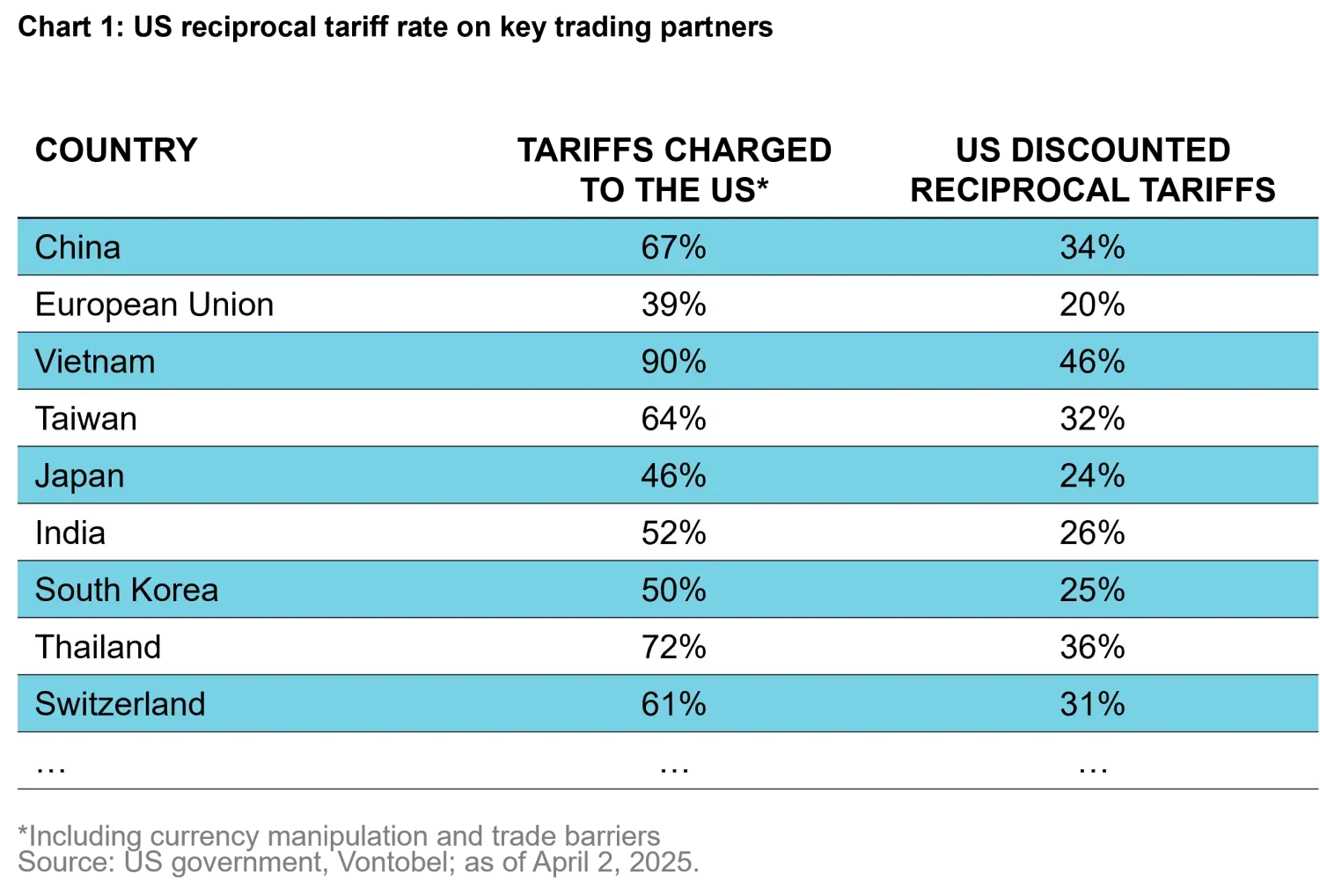
In a widely anticipated event for markets — one the administration branded “Liberation Day” — US President Donald Trump unveiled a new round of “reciprocal” tariffs on key US trading partners. The tariffs imposed also consider non-tariff barriers such as digital taxes, carbon adjustments, and VAT policies. The measures include a total 54% rate on imports from China (34% on top of existing tariffs), 20% on the European Union, 24% on Japan and 31% on Switzerland, expected to come into effect on April 9, 2025. A summary of the tariffs is shown in chart 1.
A minimum baseline tariff rate of 10% will also be applied across the board, effective April 5, 2025. Trump additionally confirmed the previously announced 25% tariffs on all auto imports. The President however shied away from imposing tariffs on Mexico and Canada, with the USMCA exemption expected to continue. Additional exceptions were made on key products such as pharmaceuticals, semiconductors, copper, lumber, and “energy and other certain minerals that are not available in the United States,” according to the order.
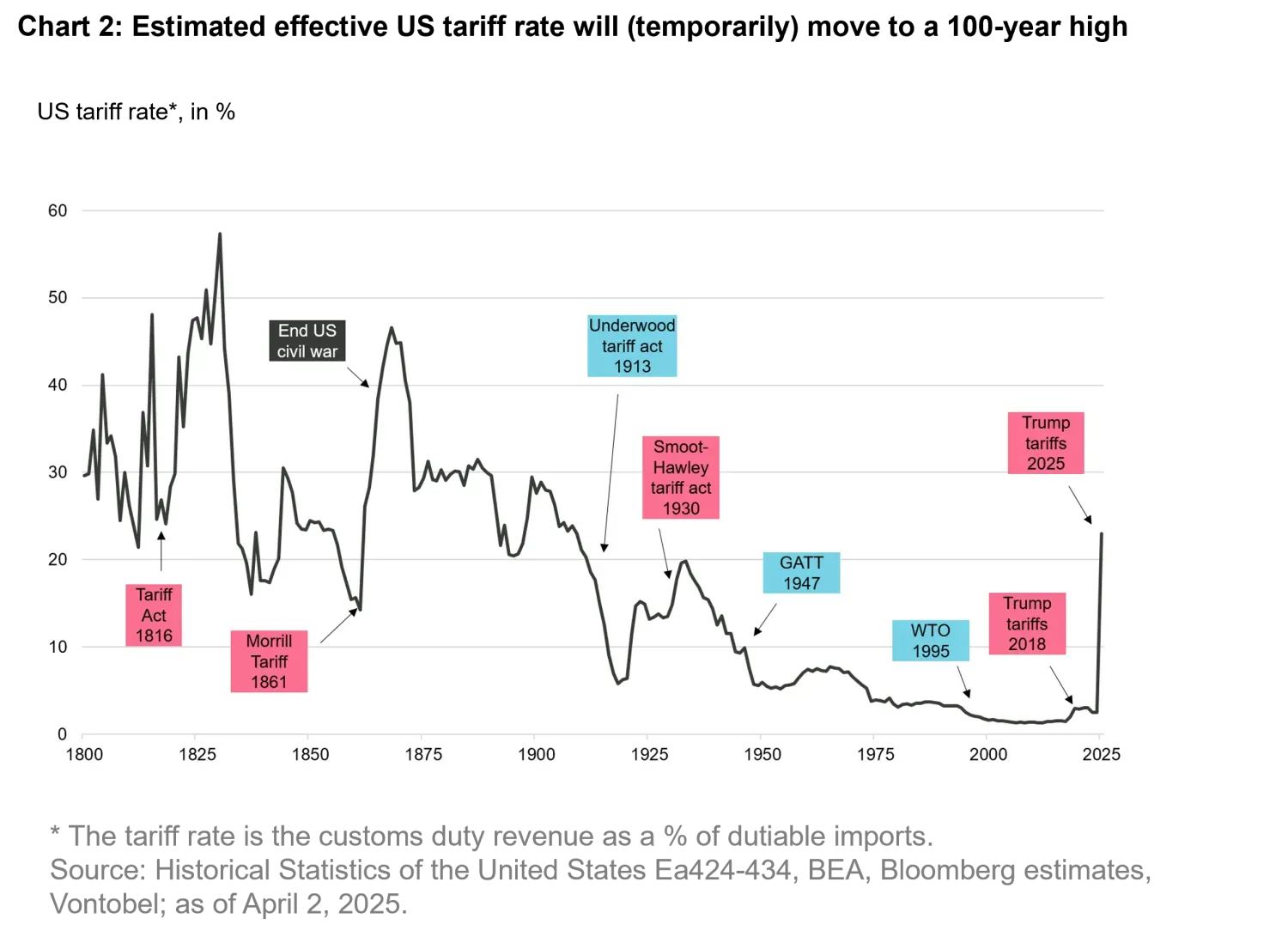
After the announcement on April 2, 2025, the effective tariff rate on US imports is projected to reach over 20% (chart 2), marking a significant increase from the 2.5% level that prevailed before Trump took office.
Some affected countries have already vowed to retaliate against the tariff measures, while a few others intend to prioritize diplomatic negotiations first.
Stock markets fell sharply after the announcement, indicating that the scale of the tariff package was greater than market participants had anticipated. At the time of writing, S&P 500 futures were down about 3.2% while the tech-heavy Nasdaq declined 3.7%. European and key Asian markets also posted losses over the day. Japan’s Nikkei suffered a 2.8% decline, while Hong Kong’s Hang Seng index slid 1.6%. In Europe, both the Swiss SMI and the benchmark Euro Stoxx 50 are down about 2.0%.
The risk-off move triggered a steep decline in US Treasury bond yields. The 10-year government bond yield fell to 4.07%, its lowest level in six months while the dollar index also fell by about 1%.
While Trump’s hawkish rhetoric was expected, the magnitude of the tariff rates and the breadth of affected countries came as a surprise. Additionally, the quasi-immediate implementation leaves no room for negotiations before the tariffs take effect.
Although the overhang and uncertainty from the “Liberation Day” announcement have now been alleviated, it is unclear how long the tariffs will stay in effect. The imposed duties are unlikely to be the endgame and this maximalist move could serve as a starting point for negotiations. The US administration has repeatedly indicated that the reciprocal tariffs would establish a baseline for creating a framework for achieving "fair trade."
The potential for a cycle of retaliation may complicate and extend the negotiating process. Some non-tariff barriers such as VAT policies may be difficult for countries to roll back. Additionally, it appears that the trade deficit played a more significant role in determining the final tariff rate.
Ultimately, this means that policy uncertainty is likely to persist until final agreements are reached, increasing growth risks. While we believe that “Liberation Day” marked the apex of tariff announcements, and headlines could become more supportive going into the rest of the year, we believe that the economic uncertainty remains too elevated to foster a sustained rebound in economic activity.
We have consistently maintained that investors should prepare for an "escalation-first" scenario. What happens next will hinge on key factors: the speed and depth of negotiations, the extent of economic damage in the interim, and whether the US Federal Reserve (Fed) maintains its wait-and-see stance. With uncertainty elevated across all these questions, a more guarded outlook on near-term economic momentum is justified.
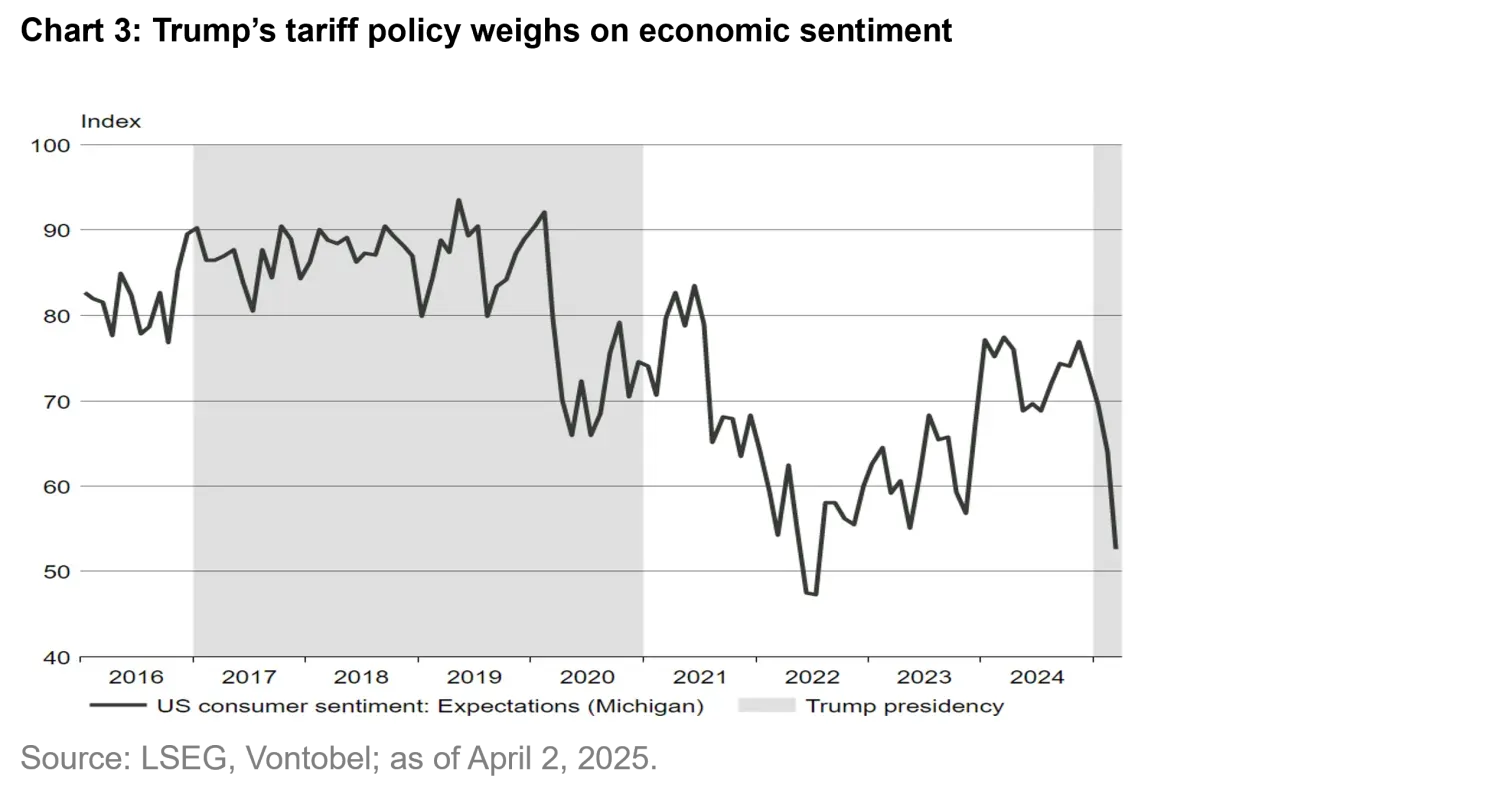
Our outlook for the US economy was predicated on the potential for a more pro-growth agenda from the Trump election, including tax cuts and deregulation as well as an accommodative Fed. However, his trade policy has called these expectations into question. Sentiment surveys such as consumer and business confidence have plunged to pessimistic levels (Chart 3), which are difficult to overlook. As soft data has historically proven to be a poor predictor of economic activity, the critical question is whether this pessimism will translate into hard data: will people lose their jobs, consumers stop spending and corporate profits deteriorate?
So far, hard metrics tell us a more resilient story than sentiment data. However, we see increased concerns that the wave of tariff announcements and the uncertainty could ultimately channels through the hard data and tip the US economy into a “Trump-cession”, a.k.a. a Trump-induced recession. In past interviews, he did not explicitly dismiss the possibility of a downturn. Instead, he described the current situation as a "period of transition" driven by the "very big" measures currently being implemented.
That being said, although the risks are rising, we do not think the US economy is on the brink of a recession just yet. Instead, it may experience a slowdown as the economy is starting from a robust level of growth, with 2025 corporate earnings growth expected in excess of 11% prior to the reciprocal tariff announcement.
The US consumer remains in a robust shape, buoyed by an economy that’s close to full employment (history has shown that if people still have a job, they continue to spend money). While government layoffs may create headline noise, federal jobs account for just 2% of total employment. The strength of the job market is crucial to the health of the US economy and upcoming data will need to be watched closely. Households further benefit from healthy balance sheets and positive real wage growth. Improving financial conditions also support our constructive view. Finally, new fiscal stimulus measures have been announced in Europe and China recently.
While the US administration is now trying to bring tax rate cuts to the fore, we believe the effect from the fiscal stimulus is not going to be sufficient to compensate for the economic damage from the persisting uncertainty and higher tariff rates.
The remaining unknown is the Fed, which has repeatedly stated that it stays in a wait-and-see mode and needs greater visibility about growth and inflation developments before cutting interest rates further. This reactive approach raises the risk of falling “behind the curve”, meaning that rate cuts may not occur soon enough. We hope the Fed has learned from its past mistakes and will also focus on its second mandate of “maximum employment”, prioritizing any disappointing labor market data over temporary increases in inflation.
Admittedly, the longer the tariffs and trade uncertainty remain in place, the more damage will be done to the economy. Without an improvement in headlines or Trump’s stance on tariffs, this sustained uncertainty will continue to erode consumer confidence and business investment, potentially becoming self-fulfilling catalysts for a downturn.
What does this mean for our overall risk take? We reiterate our warning that investors should get accustomed to higher volatility and drawdowns. The uncertainty and the lack of visibility in the current environment warrants a more cautious approach on our risk stance. We downgrade US equities to a neutral position and increase our cash allocation to overweight. Our downgrade of US equities to neutral reflects three converging pressures: An US policy mix and sequencing that is becoming more unfavorable (higher tariffs, spending cuts, delayed tax cuts) whereby uncertainty starts to weigh more on US confidence than elsewhere, rich valuations (S&P 500 trading at 20x forward earnings), and a Fed that remains in a wait and see approach. While corporate America’s fundamentals remain sound, the lack of visibility into trade resolutions and their second-order effects (supply chain disruptions, input cost inflation) tilts the risk-reward balance away from conviction.
While timing a shift towards a more balanced policy can be challenging, we are prepared to reallocate into risk assets as soon as the uncertainty begins to ease.
We remain overweight on emerging-market (EM) equities, as our core investment thesis is still intact. Our conviction is driven by expectations of a weaker US dollar (historically positive for EM assets), along with anticipated monetary and fiscal stimulus in the region this year. The DeepSeek moment may have reignited appetite for investors for Asian assets, where valuation remain attractive even after recent gains. Additionally, EM equities demonstrated relative resilience during the 2018 trade tensions compared to other regions.


