
Momentum, minus the risk
Multi Asset Boutique
Momentum investing is a widely popular and deeply researched investment style among both academics and market practitioners. It has consistently delivered strong performance across a variety of asset classes, market regimes, regions, and time periods. However, momentum strategies often carry higher volatility. Momentum works well, but when trends reverse, risks increase. In this article, we’ll break down what momentum is, how it works, and how you can mitigate its risks. The solution we propose is dynamic hedging, which seeks to minimize drawdowns.
Momentum – why does it matter?
Momentum refers to the idea that past returns positively correlate with future returns. This is not too dissimilar to weather patterns. If it rained yesterday and today, most likely it will rain tomorrow too1. For investable assets, this boils down to saying that if an asset has gone up recently, it is more likely that it will continue to go up. The same holds true in reverse, by the way. This is the core of momentum investing: betting on the continuation of existing trends.
The idea is not new. In fact, a group of commodity traders, armed with the first personal computers in the 80s, were considered the first to systematically exploit the opportunity to their advantages2. And while one would think that over time, as knowledge spreads, the opportunity would vanish, it has actually persisted, to the point that momentum has become a well-known, academically proven investment factor.
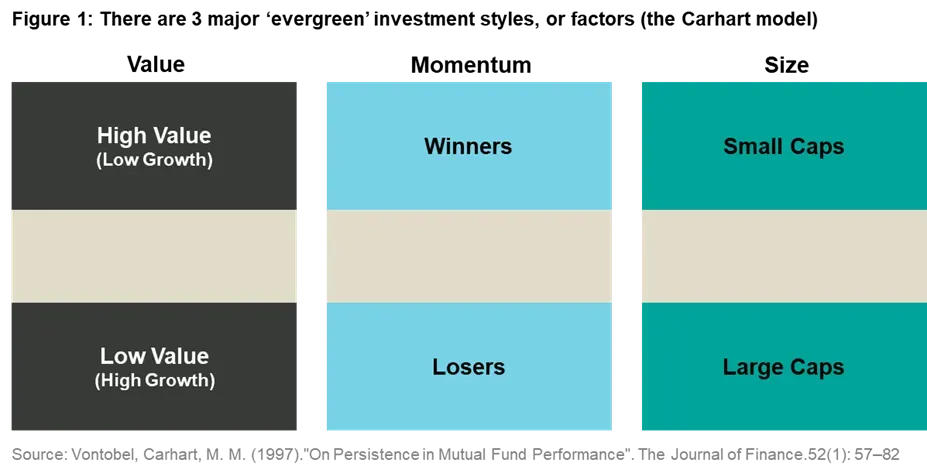
Figure 1 illustrates momentum as an ‘evergreen’ investment style (or factor, if you prefer to call is this way) within the broader framework of style investing, alongside value and size. These three strategies—value, size, and momentum—are fundamental approaches, academically confirmed, that investors use to explain and capture stock market returns.
How do we exploit momentum?
It is quite simple, in theory, to harness momentum. Consider a universe of stocks and rank them based on their recent performance. The top-performing stocks, those showing the strongest upward trends, are selected for the portfolio. By focusing on those, the goal is to capture their potential continued rise.
Momentum investing has shown surprising strength. Research by Cliff Asness, Tobias Moskowitz, and Lasse Pedersen in their paper “Value and Momentum Everywhere”3 demonstrated that the top tercile of stocks ranked by momentum consistently outperforms the bottom tercile, and that by at least 5 percentage points annually. This isn’t limited to specific regions or periods—it holds true globally and across different market conditions. Figure 2, produced from the results of the very same research paper, backs up the claim made earlier. Notably, during the period from January 1972 through July 2011, Europe experienced the most pronounced momentum effect, with high-momentum stocks significantly outperforming low-momentum ones.
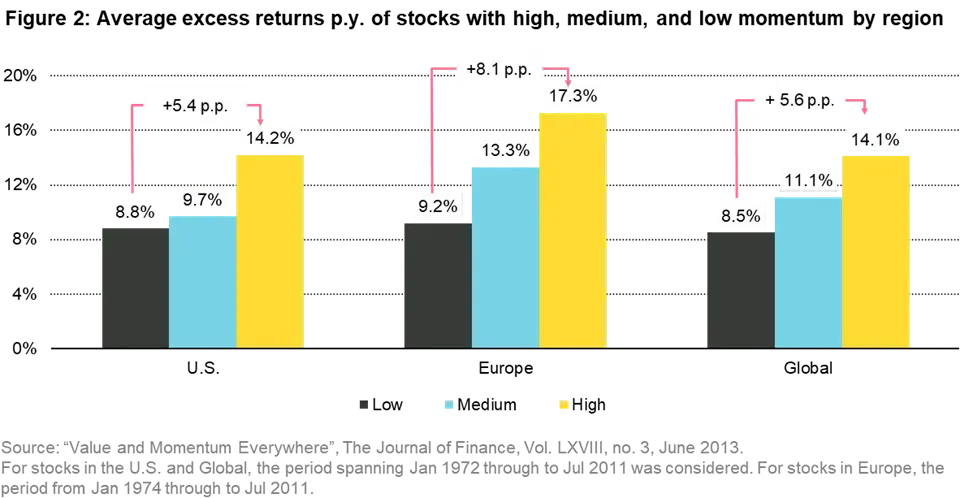
Figure 3 shows that momentum is also resilient across economic cycles. Whether the economy is slowing down, contracting, recovering, or expanding, momentum portfolios have historically outperformed other styles, particularly during slowdowns and recoveries. In these phases, momentum outperformed the benchmark by more than 3 percentage points annually.
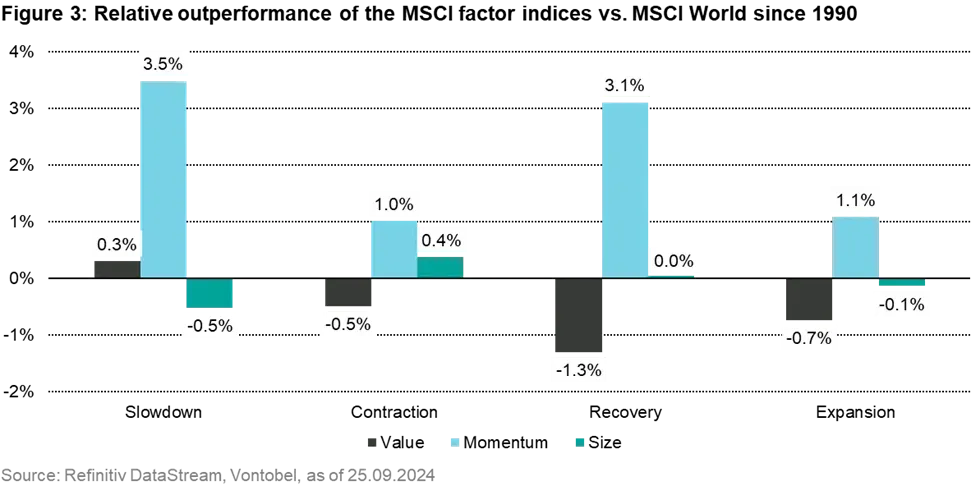
Note: Every month since 1990 is classified into one of the four regimes according to The Wave4 (Slowdown, Contraction, Recovery, and Expansion). For all months within a specific regime, the performance of the MSCI factor sub-indices Value, Momentum, and Size Tilt (abbreviated Size) less the performance of the MSCI World for the following month was calculated (and labeled ‘relative performance’). An average is taken for each combination of relative performance and regime, which is displayed above.
What are the pitfalls with momentum?
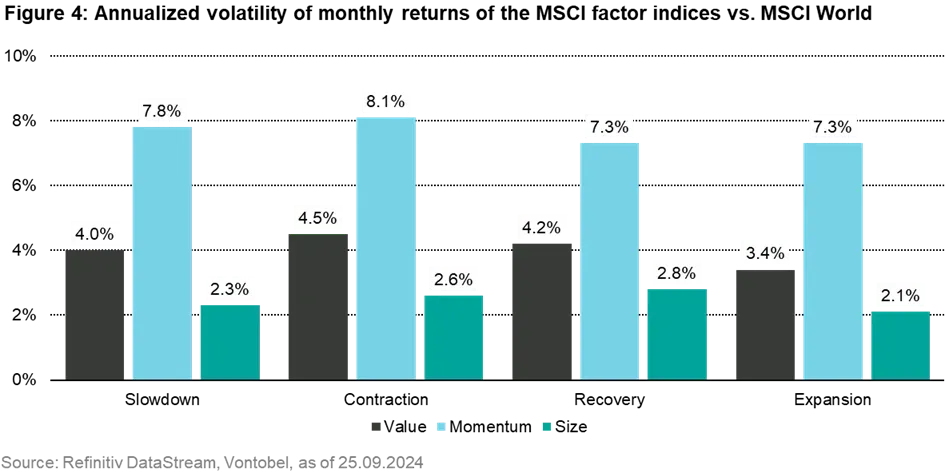
While momentum strategies can deliver strong returns, they come with a significant downside—high volatility. When trends reverse, momentum stocks can experience sharp drawdowns, which translates into increased risk for portfolios. As a result, momentum portfolios can suffer during periods of market stress, making them more volatile than other investment styles like value or size.
Figure 4 confirms that momentum strategies experience the highest volatility across all economic cycles, reinforcing the need for active risk management. Interestingly, the lack of significant differences in volatility across cycles suggests that momentum strategies remain risky regardless of economic conditions. This finding underlines the importance of a dynamic hedging approach that can adapt to rising volatility in any phase of the economic cycle.
How can we play momentum wisely?
The key to improving momentum strategies lies in managing the risk, especially during (or ideally ahead of) turbulent market conditions. Our strategy involves dynamic hedging: when market volatility rises, we implement a short position in the broader market to protect the portfolio. Based on our research, sudden increases in market volatility are a solid predictor of turbulence ahead.
Figure 5 shows the cumulative performance of the MSCI USA index (black line, with levels depicted on the left axis) vs. the portion of the underlying notional exposure that the dynamic hedging approach recommends (blue-shaded areas, with level depicted on the right axis).
The figure qualitatively demonstrates that the hedge kicks in when you most need it (see for example the period during the Global Financial Crisis of 2007-2008).
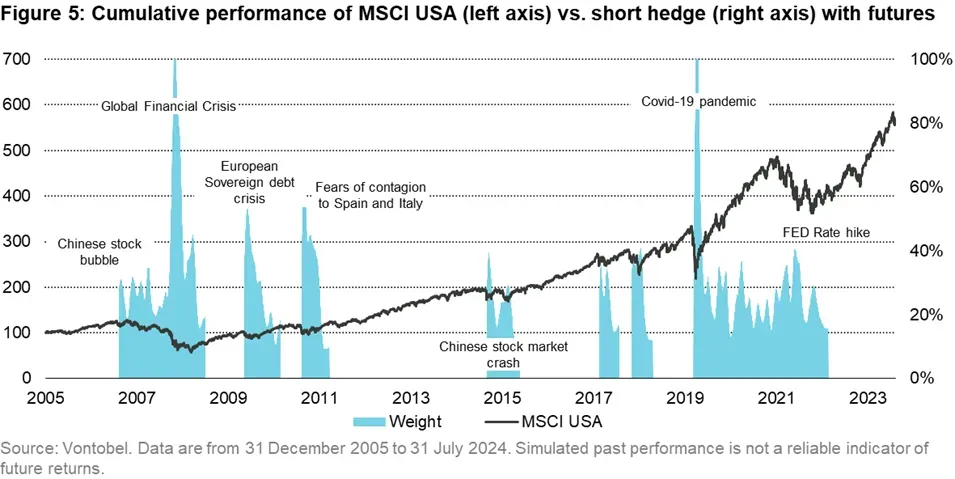
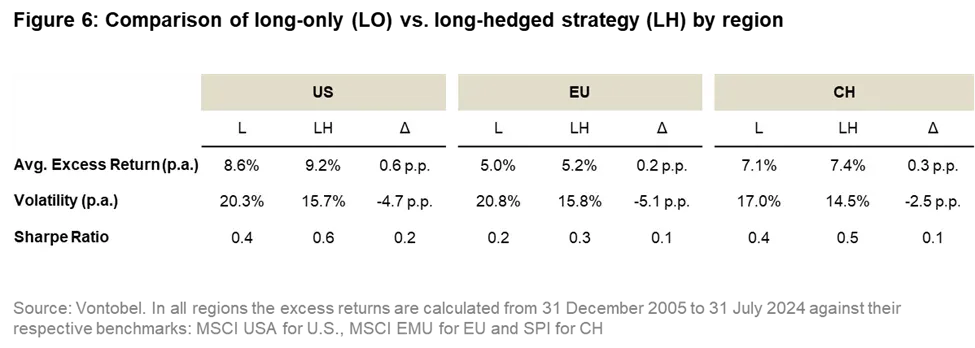
Figure 6 compares return and risk statistics—measured as average excess returns against the respective benchmarks, annual volatility, and Sharpe Ratio—for long-only momentum strategies (LO) versus long-hedged strategies (LH) across the U.S., Europe, and Switzerland. Dynamic hedging enhances returns and significantly reduces volatility, leading to higher Sharpe Ratios across all regions.
In the U.S., dynamic hedging increases excess returns from 8.6 percent to 9.2 percent, with a 4.7 percentage point reduction in volatility. This boosts the Sharpe Ratio from 0.4 to 0.6, making the U.S. the region with the best overall risk-adjusted return improvement.
In Europe, volatility drops by 5.1 percentage points—the largest reduction across regions—while excess returns rise slightly by 0.2 percentage points, improving the Sharpe Ratio to 0.3
For Switzerland, the strategy reduces volatility by 2.5 percentage points and increases returns by 0.3 percentage points, resulting in a higher Sharpe Ratio of 0.5.
While all regions benefit, the U.S. shows the best balance between increased returns and reduced volatility, whereas Europe experiences the most volatility reduction.
Conclusion
Momentum investing offers a powerful way to capitalize on market trends, but it carries risks. Specifically, it is a style prone to sudden and sharp drawdowns. Dynamic hedging provides a solution by protecting portfolios during periods of market stress, allowing investors to benefit from momentum while controlling some of the adverse risks. For those looking to optimize returns and minimize volatility, momentum trackers with hedging strategies offer a smarter, more resilient approach.
1. For a comprehensive review of the persistence of weather patterns (and an analysis of how it’s increased due to climate change), please consult https://doi.org/10.1175/BAMS-D-21-0140.1
2. For an inspiring recount of the events, consult Michael W. Covel, “The Complete TurtleTrader”.
3. Asness, Cliff S. and Moskowitz, Tobias J. and Moskowitz, Tobias J. and Pedersen, Lasse Heje, Value and Momentum Everywhere (June 1, 2012). Chicago Booth Research Paper No. 12-53, Fama-Miller Working Paper, Available at SSRN:https://ssrn.com/abstract=2174501or http://dx.doi.org/10.2139/ssrn.2174501
4. See “The Wave – a superior business-cycle model” for further details

Related insights

Towers and the Starlink Threat

Quarterly Commodity Outlook - Halftime Whistle: Fundamentals Take the Field

Investors’ Outlook: And now for something completely different

Investors’ Outlook: Adjusting the focus

Investors’ Outlook: Strait forward
