

Multi Asset Boutique
Fundamental strategies to protect and grow investors’ assets in their chosen markets.

This summer, Finnish citizens living close to the country’s southern border with Russia witnessed an unusual kind of aurora borealis. A few kilometres away, a blazing fireball loomed above the treetops as Moscow-controlled energy giant Gazprom burned off vast amounts of natural gas it could no longer sell. European gas prices have shot up, but we believe that shipments of the liquefied variety, and efforts to save energy as well as diversify supply, should get Europe through the winter.
Russia’s flaring of a prime export product at the Portovaya plant, part of the infrastructure surrounding the Nord Stream gas pipelines to Europe, is an apt metaphor for what went wrong since Russian President Vladimir Putin started the invasion of Ukraine and the subsequent shut-down of Russia’s gas pipelines, whether through sabotage or for other reasons.
While gas prices have come down significantly from their August all-time high of 330 euros per megawatt-hour, they are still about six times higher than normal for this time of the year. With Europe waking up to the reality of spiking energy prices (see chart 1), a frantic search is on for alternatives. However, nuclear energy heavyweight France is currently overhauling many reactors, and coal doesn’t look particularly cheap with prices having gone up threefold this year due to, among other things, rising demand as well as increased costs to compensate for its negative environmental impact.
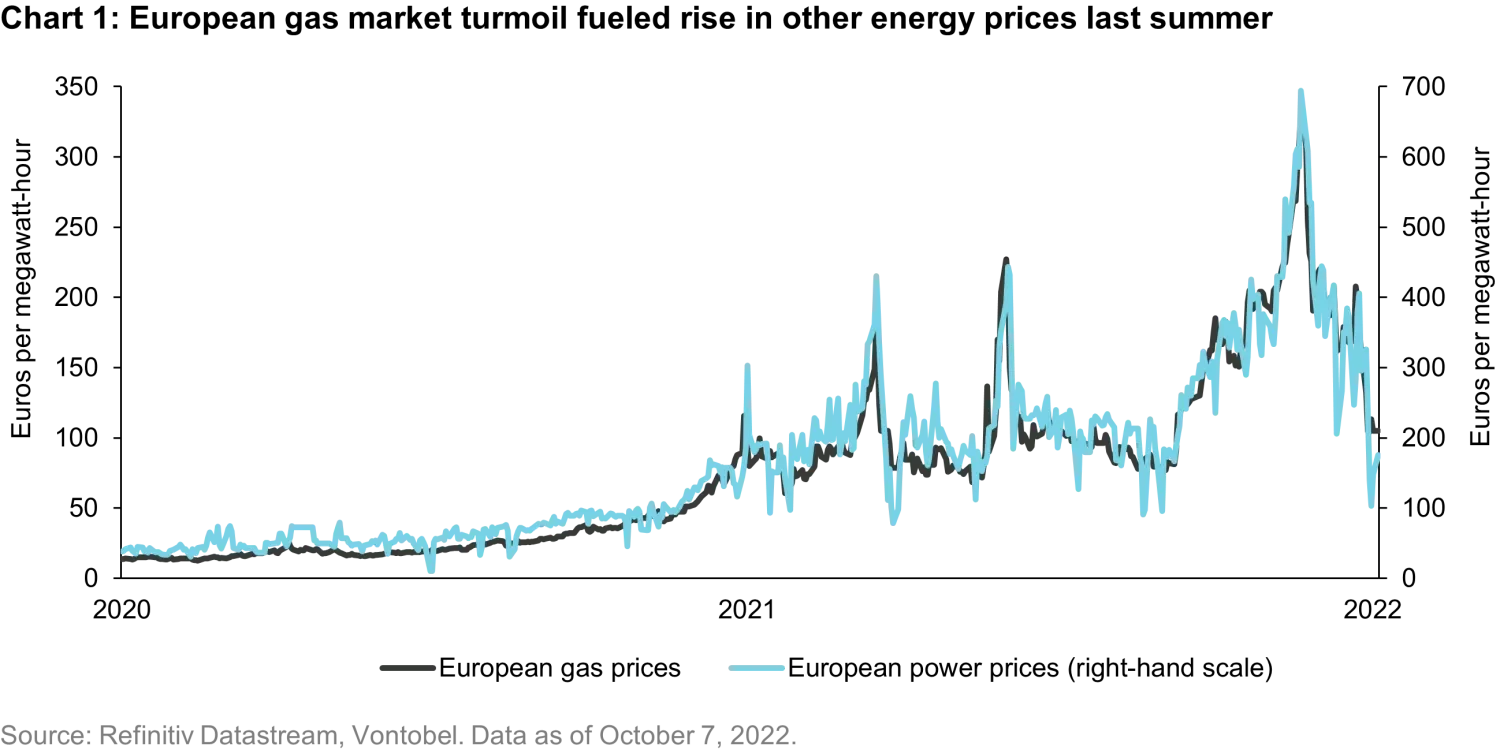
Some progress has been made in the area of liquefied natural gas (LNG) imports. With Europe scrounging around for whatever gas supplies it can get, often outbidding Asian buyers, it saw its gas storage levels surpass 80 percent well before a European Union November 1 deadline. Even so, as the possibility of further LNG imports is limited due to capacity constraints at LNG gasification terminals located at major sea ports across Europe.
To address this, countries at the periphery of Europe have accelerated investments in floating and land-based LNG gasification terminals to accept sea-borne gas cargoes from the US and Middle East. In total, LNG gasification projects announced since the start of the war in Ukraine are expected to replace 83 percent of Russian gas imports to the EU, but even floating terminals are only likely to come on-stream towards the end of 2023, while land-based terminals can take five or more years to become operational1, meaning that LNG imports are a long-term not a short-term solution.Homeowners, who consume roughly half of Europe’s gas, have already received letters from their utility providers stating that energy costs will double, triple or even quadruple, depending on the details of their contracts. As a result, people have turned down their thermostats or delayed switching on heating for winter. Similarly industry and other users have reduced their consumption. Compared with 2021, we already see gas demand reduced by 13 percent year-on-year2.
The undersea explosions in the Nord Stream system on September 27 have made it clear how precarious Russia’s gas deliveries to Europe are. With any reopening of the two pipelines now ruled out in the short term, our scenario number one looks very unlikely. It’s based on the assumption that Russia would continue gas deliveries at the reduced pace seen around August 2022. This would coincide with a 15 percent demand destruction envisaged by the European Union, which should diminish European gas inventories by around 420 terawatt-hours (TWh) until next spring, equating to a less than half of Europe’s gas inventories, which stand at around 1000 TWh. The other three scenarios, which are based around zero supply from Russia, show clearly that Europe’s gas position will depend on the degree to which demand can be reduced, plus whether we are in for the third consecutive “La Niña” year, which typically brings cold weather to the Northern Hemisphere.
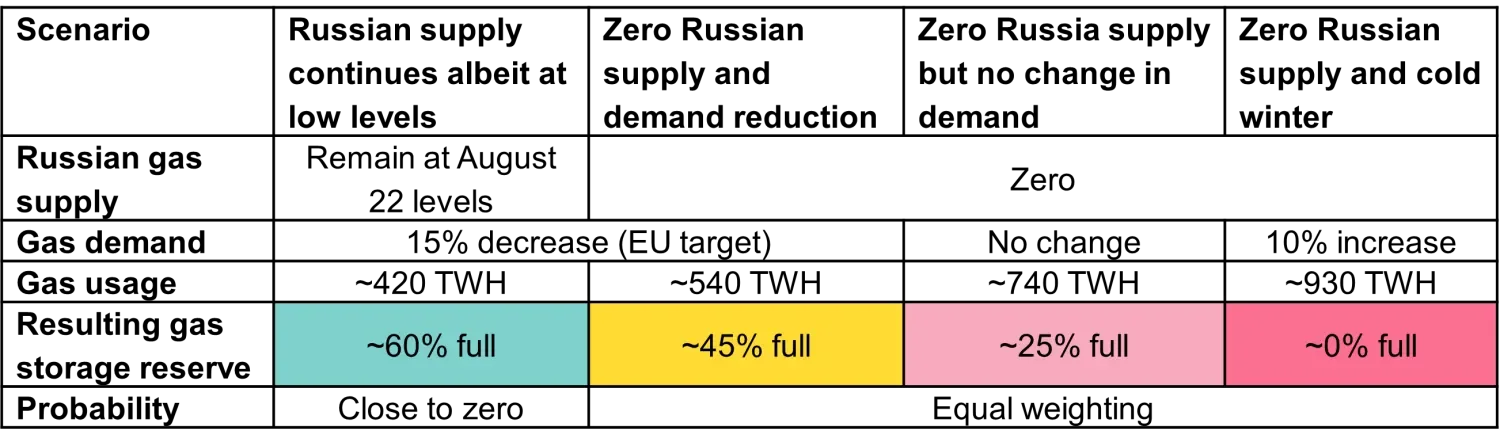
In conclusion, we believe that Europe should be able to get through this winter—even if the fourth scenario materializes. That said, while LNG imports have alleviated immediate supply concerns, even inventories filled to the brim will hardly be enough to prevent some rationing in the winter months as the gas and energy distribution situation in each country is different. Secondly, if Europe arrives in Spring 2023 with zero gas reserves, the situation for winter 2023-24 will be even more precarious. This makes the continent ill-prepared for more energy trouble to come.
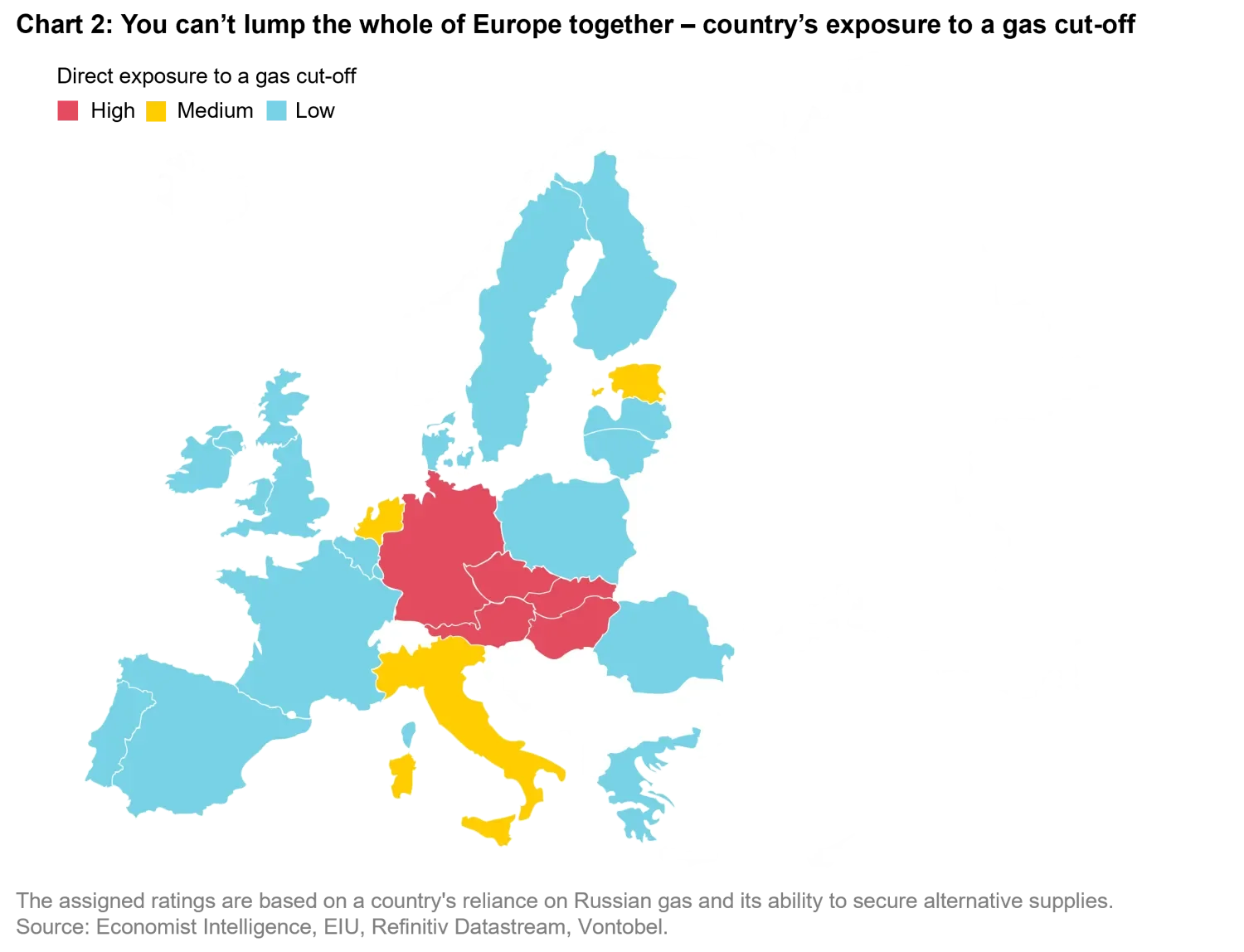
The countries most at risk in terms of reliance on Russian gas and lack of alternatives are Germany, Austria, Czechia, Slovakia, and Hungary, according to the Economist Intelligence Unit (see chart 2). Add varying levels of gas storage per country, where again Hungary is most exposed, plus the greater ability of countries around the periphery of Europe to import gas by sea, and there is an imbalance. In our view, the physical barriers to energy and power delivery are entirely manageable, but it remains to be seen whether political barriers can be overcome. If EU countries can develop a unified response to align measures like subsidies, price caps and resource sharing, then economic impact can be limited. Current animosity around a proposed €200bn German energy subsidy package suggests that political debate will focus on energy throughout the winter. Despite misgivings, we expect the EU to find solutions, even if some are economically far from perfect.
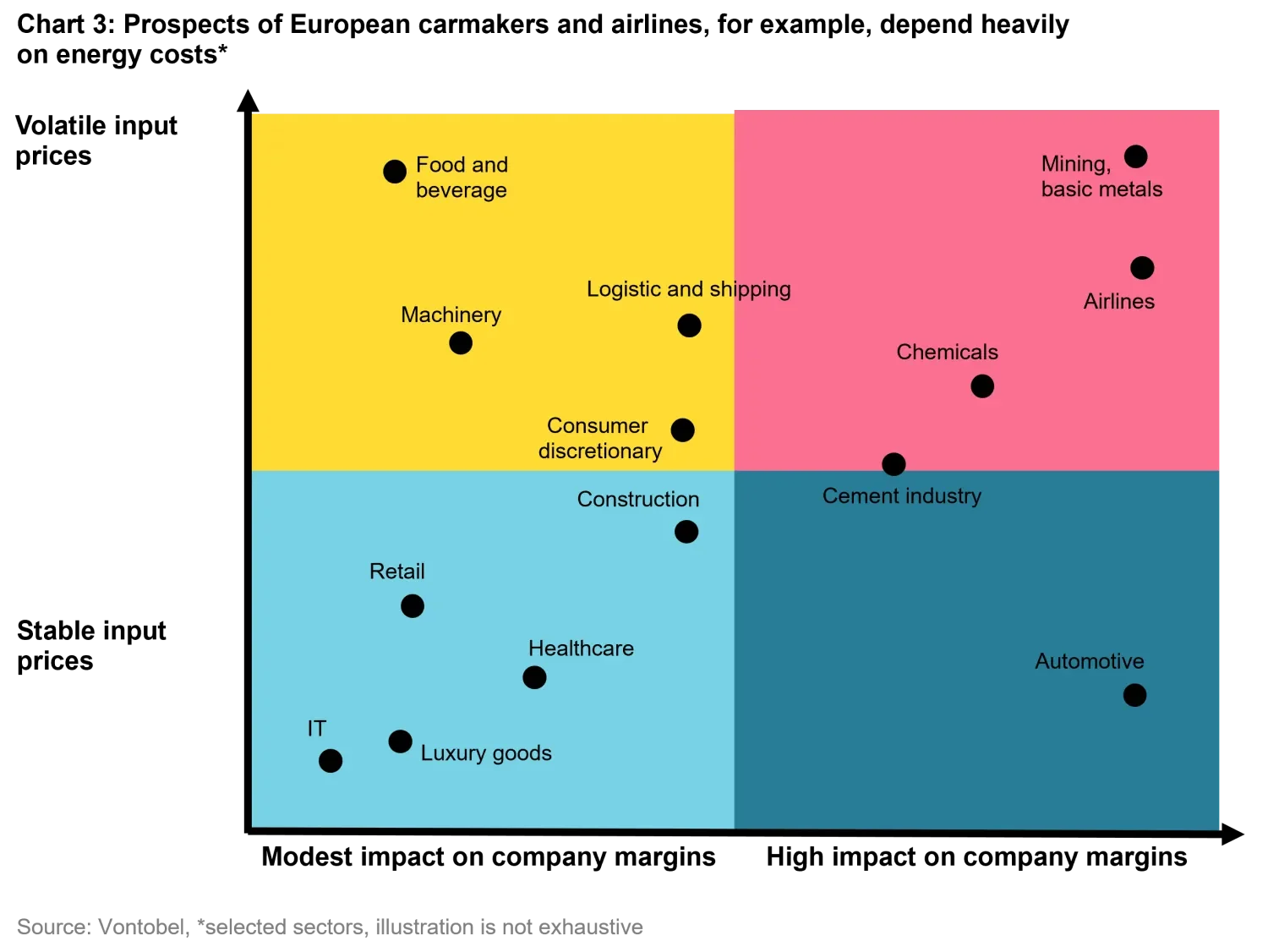
Well-heeled Europeans may be able to spend the cold months on sunny shores, an option few companies have. The different sectors are exposed to varying degrees (see chart 3), but rising energy bills hit most of them on two levels. Firstly, such outlays immediately affect up to 30 percent of total production costs. The higher the intensity or the volume of production, and the higher the energy price, the greater the impact on total expenditure. Obviously, this simplification discounts mitigating factors, such as substitution effects (use of alternative sources of energy), or process changes (increased production of items that require less energy). Moreover, large and flexible corporations can shift industrial production to countries less affected by energy crises. Secondly, a more indirect and often delayed effect of energy-linked spending can impact an additional 30 percent of production costs. With higher energy prices being built into production processes, a company supplying grain to a food group, for example, may suddenly face much higher bills for necessary machinery such as tractors.
While markets are efficient on average, with prices reflecting available information, they are not efficient everywhere, all the time. So, there is no substitute for examining the available information and taking active decisions. Here the key question is whether individual asset prices fairly reflect the current news flow or have perhaps over-reacted and therefore reflect good value. In this note, we leave this question to our stock and bond picking colleagues, but would like to highlight two macro opportunities:
Finally, it’s worth remembering a phrase which applies to both life and investing: “act in haste, repent at leisure.” In such markets, it is generally wise to keep a cool head, and stay invested for the long term.
1. Source: FTI Consulting white paper, May 2022.
2. Source: Morgan Stanley, Vontobel analysis
Important Information: Certain information herein is based upon forward-looking statements, information and opinions, including descriptions of anticipated market changes and expectations of future activity. We believe that such statements, information, and opinions are based upon reasonable estimates and assumptions. However, there is no assurance that estimates or assumptions regarding future financial performance of countries, markets and/or investments will prove accurate, and actual results may differ materially. Therefore, undue reliance should not be placed on such forward-looking statements, information and opinions. Past performance is not a reliable indicator of current or future performance.


