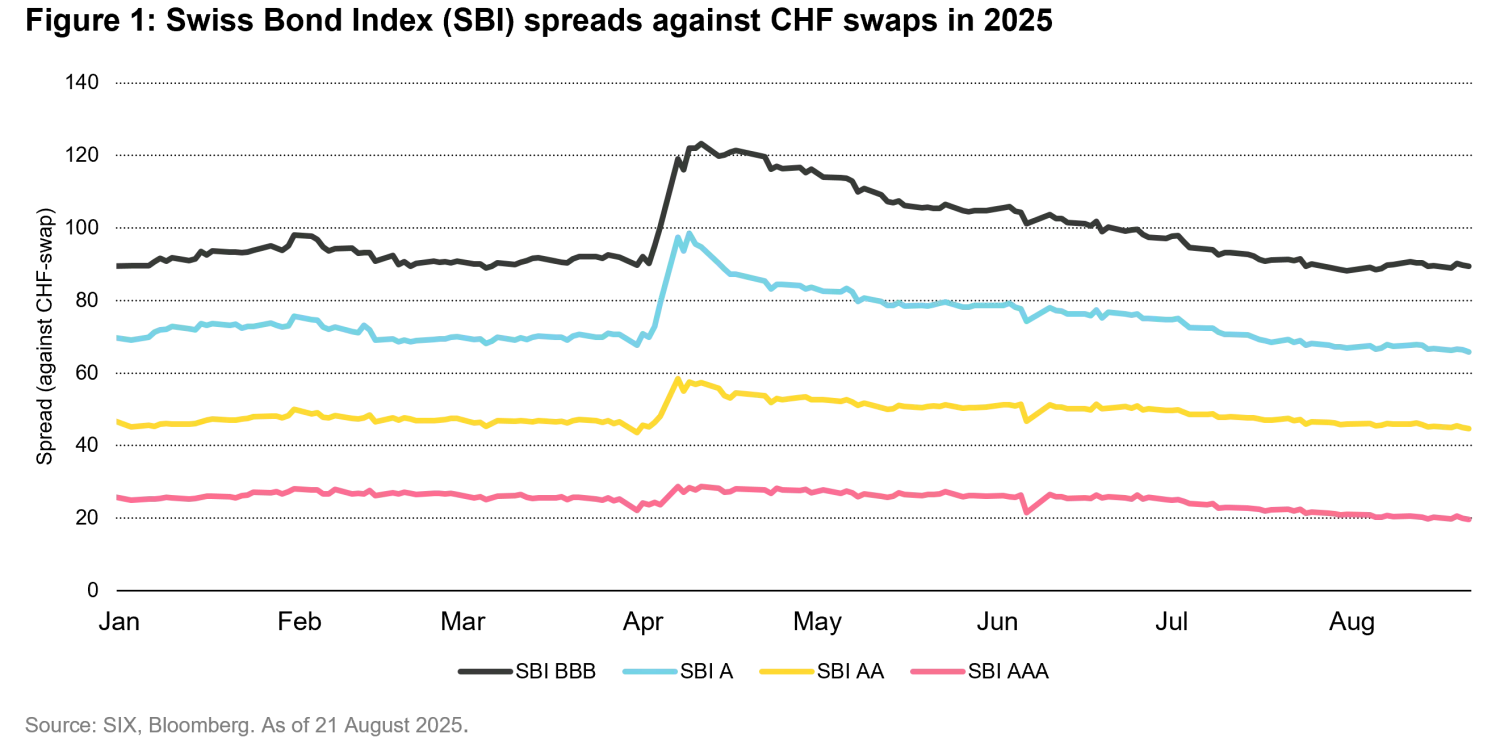
Credit spreads have rallied significantly following the “Liberation Day”-related sell-off in April. The initial recovery was expected, as US tariffs were partially rolled back, incremental trade agreements were reached, and the global economy proved more resilient than feared. In recent weeks, however, the rally has gained further momentum, even as Switzerland faces its own tariff shock.
Swiss companies with substantial US export exposure are under pressure from the 39% tariff imposed on Swiss imports. Smaller firms, in particular, that lack US production capacity and operational flexibility, are struggling to adapt. Given the importance of this segment to Swiss employment, the impact on both GDP growth and the labor market is material. We estimate that Swiss GDP will decline by approximately 0.5%, bringing our 2026 growth forecast down to just a little over 1%.
Currently, it is difficult to predict whether the imposed tariffs are set in stone or if the “deal” can be renegotiated. If tariffs remain at their current levels, we do not expect countermeasures such as retaliatory tariffs. However, alternative measures to ease the burden on Swiss exporters could be considered. One possibility is the introduction of temporary export subsidies to offset high US tariffs, though these may conflict with World Trade Organization (WTO) regulations.
Switzerland could also file a complaint against US tariff policies at the WTO, which would highlight potential US rule violations, although it is uncertain how well this would be received by the US government. This could potentially escalate tensions. Another option would be to reduce Switzerland’s large trade surplus with the US, particularly by adjusting gold exports or changing the jurisdiction in which refined products are sold. About 60–70% of the world’s gold passes through Swiss refineries, yet relatively little value creation accounts for a significant share of the trade imbalance.
Despite the risks, credit spreads have tightened to levels at or below those seen at the start of the year (see Figure 1), leaving limited room for further compression. While robust fundamentals are weakening, technical factors continue to provide strong support. Ample liquidity and negative yields at the front end of the Swiss curve are driving investors to reach for spread. As a result, we do not expect significant near-term widening, but we see valuations as stretched.
In this environment, we advocate a cautious stance. We choose to selectively reduce exposure to very expensive domestic corporates and reallocate to high-grade issuers where compensation for risk remains attractive to us. Cantonal banks, for example, currently offer compelling spreads relative to their credit quality. Looking ahead, once the summer lull passes and primary issuance resumes, we expect new opportunities to arise. These opportunities could allow investors to add credit risk at more favorable valuations and to benefit from higher carry once again.