Multi Asset Boutique
Fundamental strategies to protect and grow investors’ assets in their chosen markets.

Over the past week, tensions in the region have escalated into open conflict. On February 28, the United States and Israel launched a coordinated military operation, referred to by the US as “Operation Epic Fury” and by Israel as “Operation Roaring Lion”. The strikes targeted over 500 sites across Iran, including nuclear facilities, missile silos, and command centers. Most notably, the operation included strikes in Tehran, resulting in the confirmed death of Iran’s Supreme Leader, Ayatollah Ali Khamenei, along with several top officials.
In response, Iran launched ballistic missiles and drones, targeting not only Israel but also US military installations and infrastructure across the Persian Gulf. Neighboring states have also been drawn into the conflict, with countries such as the United Arab Emirates coming under attack. In addition, the Iranian Revolutionary Guard has issued warnings that “no ship is allowed to pass” through the Strait of Hormuz, a move that sent global oil markets into a state of high alert and shifted the conflict’s focus toward energy assets. The situation escalated further on Sunday, March 1, with reports of at least three vessel attacks.
Several shipping firms have announced the suspension of operations around the Strait of Hormuz, with vessel transits continuing at significantly reduced levels.
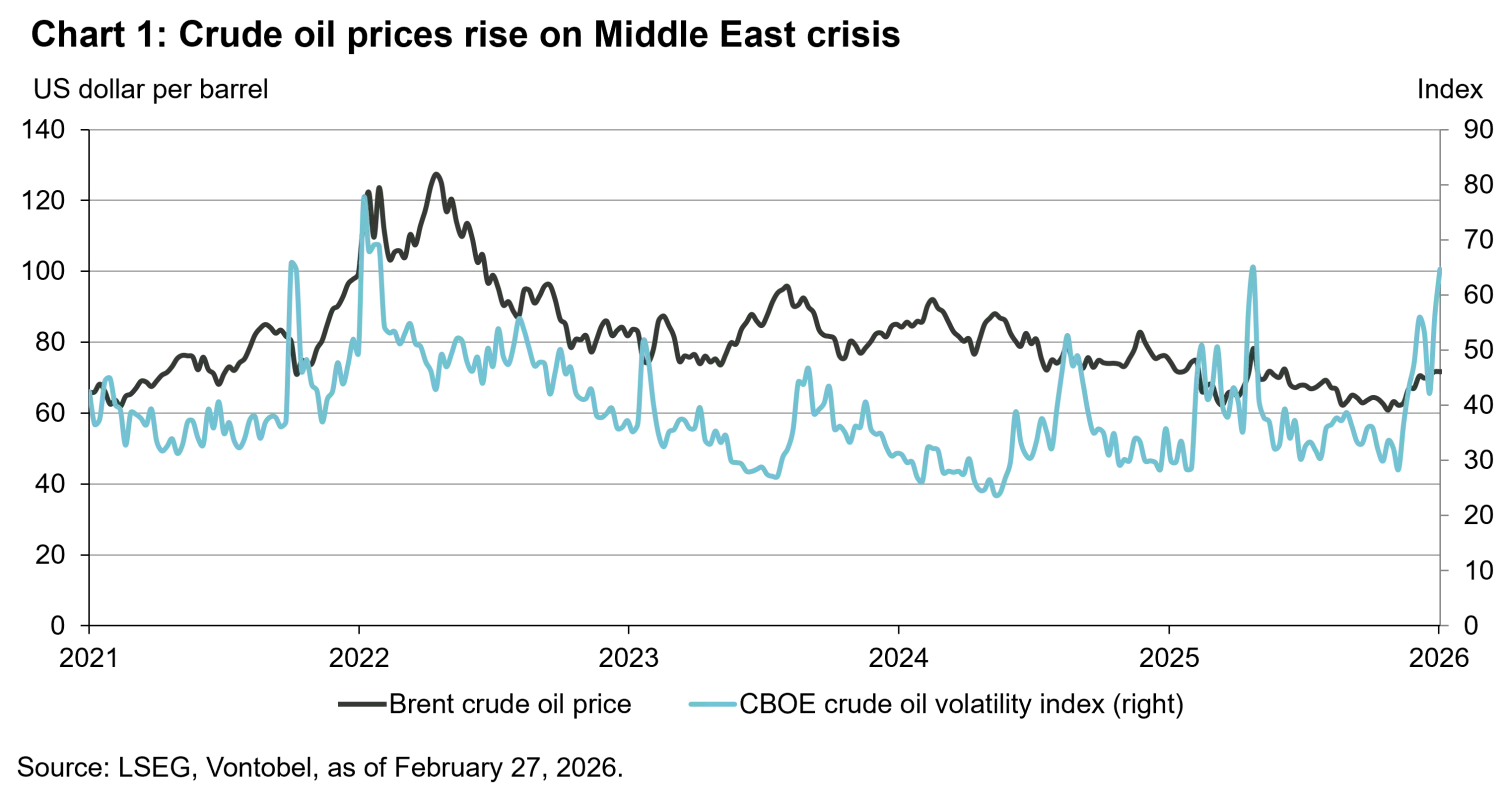
The most significant impact was observed in commodity markets. Brent crude oil rose by 4.4 US dollar per barrel on early Monday morning, while West Texas Intermediate (WTI) climbed by 4.8 US dollar per barrel. This comes after oil prices have already increased by more than 10 US dollar since the start of the year (see chart 1). Meanwhile, investors seeking safe-haven assets drove gold prices up to 5373 US dollar per ounce. Equity markets traded slightly lower, with S&P 500 futures down 0.95%.
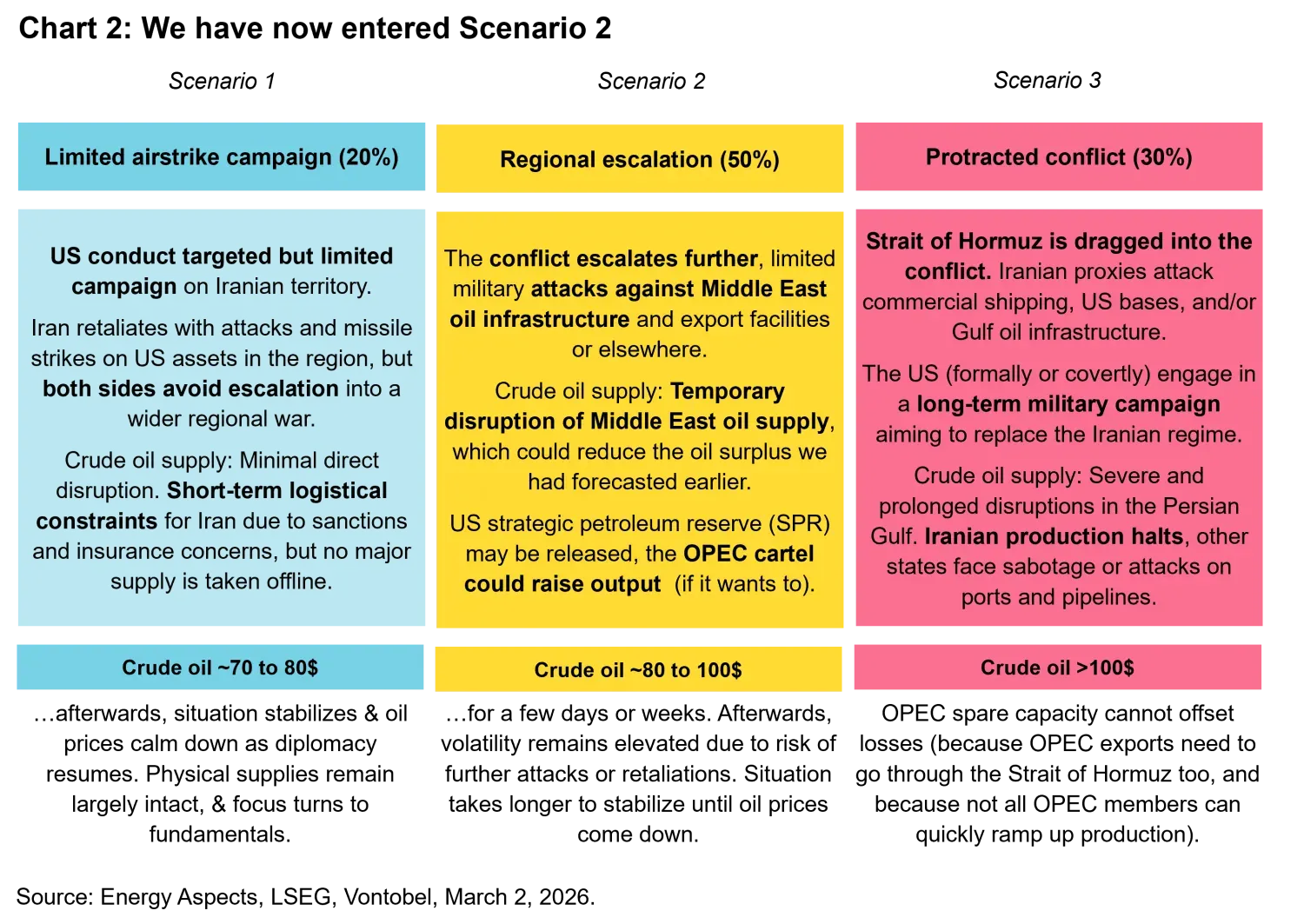
In late 2025, we outlined three potential scenarios for the evolving situation in the Middle East (see chart 2). We have now entered a phase of regional escalation, despite no critical oil infrastructure having been destroyed at the time of writing (“Scenario 2”).
Key members of the Organization of the Petroleum Exporting Countries and its allies (OPEC+) have already responded. The so-called Voluntary Eight (V8) group – a coalition of eight major oil producers within the alliance, including Saudi Arabia, Russia, and several Gulf states directly affected by Tehran’s missile strikes – announced a larger-than-expected increase of 206,000 barrels per day in production quotas on Sunday. Before the meeting, analysts had forecast a more modest increase of around 137,000 barrels per day. In their statement, the V8 group was careful to avoid any direct reference to the ongoing conflict with Iran, one of OPEC’s founding members. Instead, they attributed the production hike to “a steady global economic outlook and current healthy market fundamentals.”
While the increased production quota may provide some relief, it will not take effect until April. Even then, it is unlikely to compensate for the loss of oil supply if the Strait of Hormuz is closed.
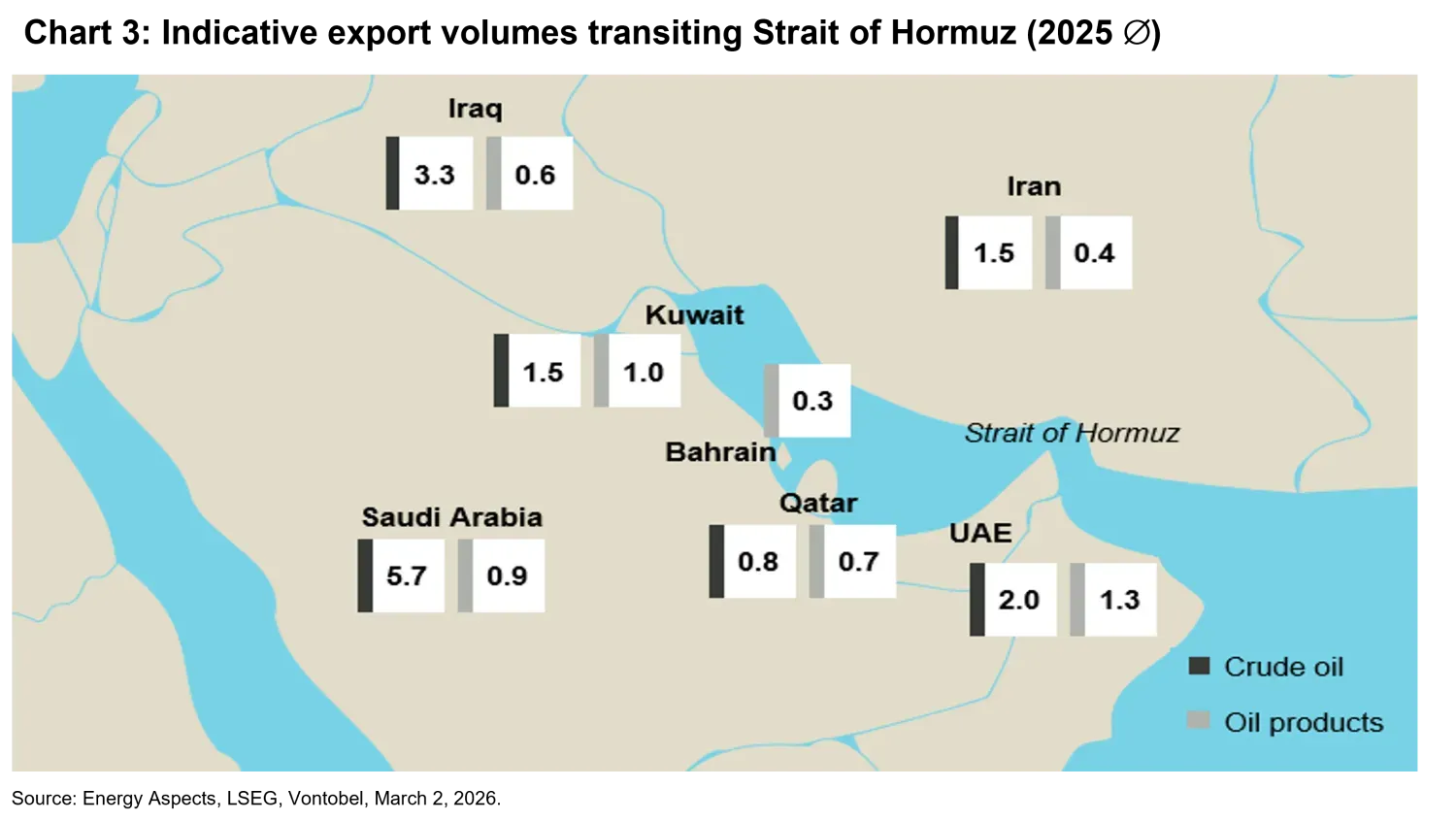
If the Strait were to be closed, we would find ourselves in Scenario 3 (“Protracted Conflict,” with a 30 percent probability). A blockade or significant disruption of the Strait represents the most critical tail risk to the global economy. Each day, approximately 20 million barrels of oil (equivalent to about one-fifth of global consumption) pass through this vital waterway (see chart 3).
As it stands from our perspective, the Iranian regime and its allies find themselves backed into a corner – but this does not mean they are incapable of retaliation, potentially through the use of drones. Iran-aligned groups, such as the Houthi rebels, have already demonstrated their ability to inflict significant damage using low-cost drones. Another potential threat comes from sea mines, which could disrupt vital oil trade routes. In our view, even the mere threat of attacks in the Strait of Hormuz is likely to deter some oil tankers from operating in the global market.
To be fair, regional and global players would have certain levers at their disposal to help mitigate the impact. One such measure is the use of pipelines to transport crude oil directly to alternative ports. The Saudi East-West Pipeline, also known as the Petroline, allows Saudi Arabia to pump oil from its eastern fields near the Persian Gulf across the desert to the Red Sea port of Yanbu. This route avoids the Strait of Hormuz and has an estimated capacity of 5 million barrels per day (mbpd). Similarly, the United Arab Emirates operates the Abu Dhabi Crude Oil Pipeline, which transports crude oil from the inland Habshan fields to the port of Fujairah on the Gulf of Oman, located outside the Strait. This pipeline has a capacity of approximately 1.5 to 1.8 mbpd. Iran has also developed its own pipeline, the Goreh-Jask Pipeline, which runs from the Goreh terminal in Bushehr province to the Jask terminal, just east of the Strait of Hormuz. Its capacity is estimated to range between 300,000 barrels per day and 1 mbpd.
When combined, these pipelines could provide a total bypass capacity of approximately 7 to 8 mbpd. While this is a significant volume, it still falls short of covering the roughly 20 mbpd of oil and refined products that typically transit through the Strait of Hormuz. Another important factor to consider is that, while oil can be transported via pipelines, rerouting liquefied natural gas (LNG) is far more challenging. Qatar, one of the world’s largest LNG exporters, relies almost entirely on the Strait of Hormuz to transport its tankers. This underscores the critical importance of the Strait as a global energy chokepoint, despite the development of alternative routes.
In addition to OPEC output increases and pipeline flows, the United States could also consider tapping into its Strategic Petroleum Reserve (SPR). The SPR is a stockpile of emergency crude oil maintained by the US government. It was established in 1975 following the oil embargo of 1973–1974 to mitigate the impact of future disruptions in oil supply. The SPR is the largest government-owned emergency oil reserve in the world, with storage facilities located in underground salt caverns along the Gulf Coast in Texas and Louisiana. The SPR is designed to provide a buffer against significant supply disruptions, such as geopolitical conflicts, natural disasters, or other emergencies that could impact the availability of oil. After repeated oil withdrawals during the Biden administration, the Strategic Petroleum Reserve (SPR) currently holds just 415 million barrels.
In our current allocation, we maintain an overweight preference for equities over bonds. Parts of our equity portfolio may come under temporary pressure due to the conflict. This is because investors often shift from risk assets like equities to safe havens such as gold and the Swiss franc. Sectors particularly vulnerable include those heavily reliant on oil, such as aviation and airlines, which would face higher jet fuel costs. Conversely, oil companies are likely to benefit from rising oil prices. That said, the longer-term implications for stock markets will ultimately depend on the intensity and duration of the escalation. If oil supplies are not permanently disrupted, equity markets are expected to recover.
In our view, the worst-case scenario for stock markets would involve the Strait of Hormuz, where a disruption could cause oil prices to skyrocket, inflation to surge, and central banks to raise interest rates. Such a scenario would be highly detrimental to both stock and bond markets. However, this is not our base-case scenario, as it is also not in the interests of many influential stakeholders. For example, Donald Trump would likely favor low oil prices ahead of the US midterm elections, and Middle Eastern heavyweights like Saudi Arabia would also prefer stability over chaos.
Lastly, parts of our current allocation are even positioned to “benefit” from the escalation. In January, we upgraded commodities to an overweight position – not because we were speculating on an escalation, but to ensure we are hedged in the event such a scenario unfolds. Given the likelihood of Iranian retaliation targeting oil infrastructure – and the resulting increase in oil prices – we believe it is not yet the right time to close our commodity overweight.
We will continue to closely monitor the situation and adjust our strategy as needed.