


Multi Asset Boutique
Fundamental strategies to protect and grow investors’ assets in their chosen markets.

The US presidential election may still be a while away; the world’s largest economy won’t head to the polls until November 5, 2024. But a glance at the major financial news outlets and social media channels quickly reveals that the election campaign is already in full swing.
Both incumbent Joe Biden and Donald Trump have been challenging each other’s fitness for the highest office. Trump, 77, has called Biden “ grossly incompetent ”, while Biden, 81, when asked about his advanced age, replied, “One candidate is too old and mentally unfit to be president… the other one is me .”
Robert F. Kennedy Jr., son of assassinated Attorney General Robert Kennedy and scion of one of the most prominent political dynasties in the US, has not yet given up hope for one of the most influential jobs in the world.
Attempting to make a call on who will end up moving into the White House is about as helpful as flipping a coin, in our opinion. We don’t think it makes a lot of sense to try to predict the election outcome by using probability calculations. However, thought experiments and asking “what if” questions can be helpful to investors.
In this article, we focus on Trump as opposed to Biden. This is not due to any political tendencies on our side or any conviction that Trump has better chances at winning. Rather, it reflects our belief that a second Trump term would have greater market implications than the re-election of Biden. A Biden re-election would, in our view, be more likely to result in a continuation of the status quo.
Trump's first term in office (2017 - 2021) was eventful: from a trade war with China to the withdrawals from the Iran nuclear deal and the Paris climate agreement and threats to pull out of alliances such as the North Atlantic Treaty Organization (NATO) or the World Trade Organization (WTO), his presidency was also marked by numerous personnel changes, entry bans for certain population groups, the construction of the US-Mexico border wall, impeachment proceedings, stolen secret papers, election fraud allegations, and an armed storming of the Capitol. So, one might think that the hurdles for a second term would be high. However, polls currently indicate a tight race. And the situation doesn’t look too bad in the fiercely contested swing states either.1 Moreover, Trump ended up doing better than polls suggested in the past.
In our opinion, his lingering popularity has a lot to do with social developments and Trump's status as the "enfant terrible” of the establishment. Take, for example, the increasingly frustrated US middle class2, which has felt left behind as globalization has lifted many formerly low-income people into the middle class and benefited developing countries like China in recent decades. In the 1990s, the middle class owned around 37 percent of private household wealth in the US. At the turn of the millennium, this figure fell to around 30 percent. Today, it’s just under 26 percent, according to Fed data.
At the same time, trust in state institutions has been declining for years. According to a Gallup poll , trust in the Supreme Court was just under 60 percent in the 1980s. In 2023, it was only 27 percent. Only trust in newspapers (2023: 18 percent) or Congress (2023: 8 percent) looks worse.
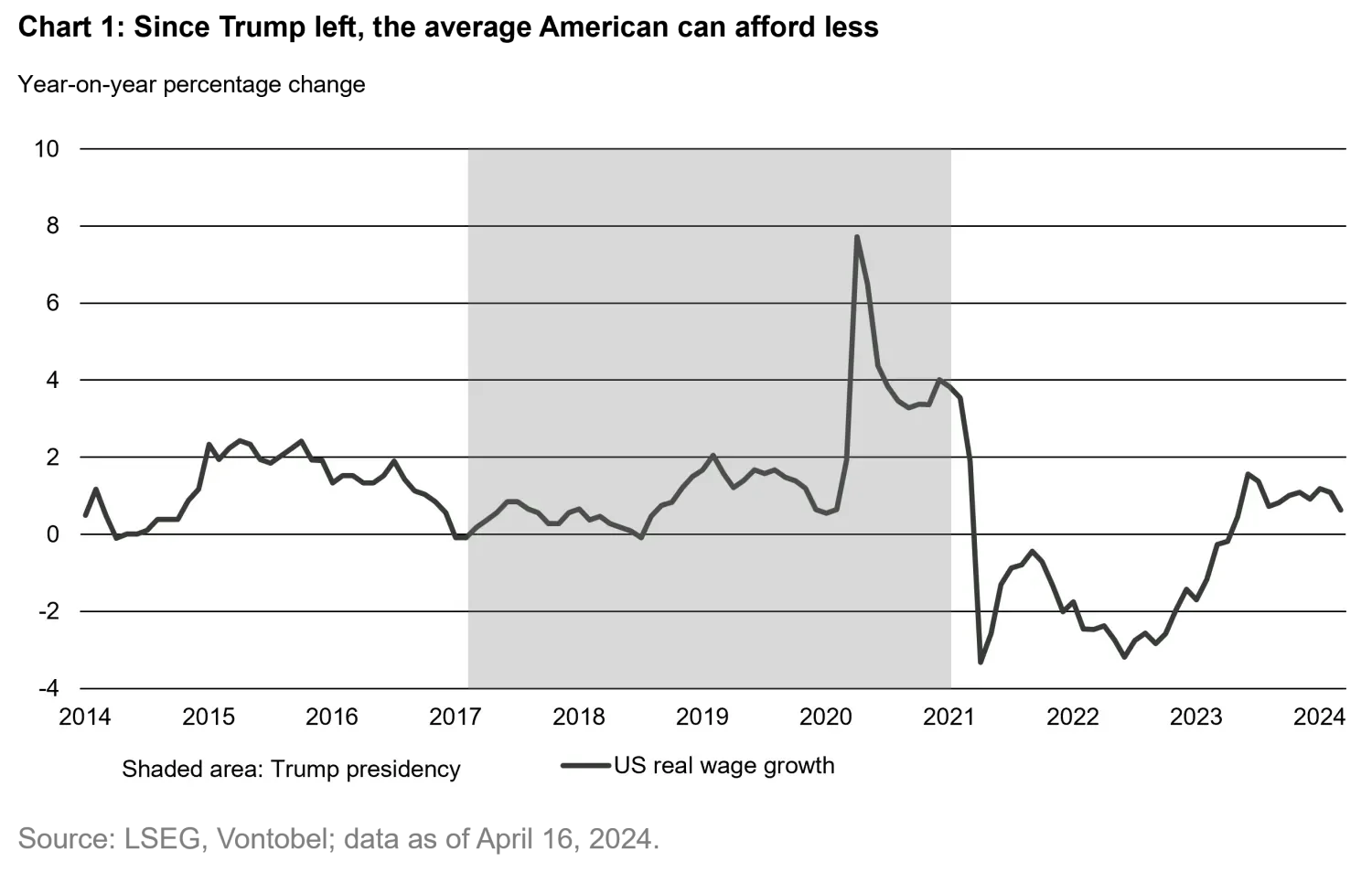
These long-simmering developments have worsened since Trump's departure. One important reason is likely to be the inflation shock, which pushed the real (i.e., inflation-adjusted) wage growth of many Americans into negative territory at the start of 2021 (see chart 1).
What also plays into Trump's hands is Biden's unpopularity. A president’s approval rating is normally a good predictor of his chances of re-election. In the past, the public's opinion of the president depended primarily on their assessment of the economy. Recently, however, this relationship has been turned upside down: The US economy is strong, the unemployment rate remains at a historic low, and even inflation (the groundwork of which was laid before Biden took office) has declined significantly. And yet, Biden's approval rating has plummeted. While his approval rating stood at 53 percent at the beginning of 2021, it’s now at around 40 percent, according to ABC News-owned website FiveThirtyEight . This makes him even less popular than Trump was during his first term.
Many Americans don’t trust Biden to tackle issues that are important to them, according to an Ipsos survey . This applies in particular to social issues such as crime or immigration. The latter has increased significantly since 2022 (partly due to easing pandemic restrictions) and has intensified since. In December alone, Federal agents encountered 10,000 people a day crossing the southern border of the US, according to Bloomberg News . That’s poised to be a breeding ground for populist slogans.
In addition, one of the Democrats' most reliable voting blocs appears to have shifted its opinion. According to a April New York Times/Siena poll , Trump's support among black voters is at 16 percent, an increase of 10 percentage points from 2020. Hispanic voters are also warming to Trump. One possible explanation could be that these groups are disillusioned with Biden and are particularly affected by negative real incomes.
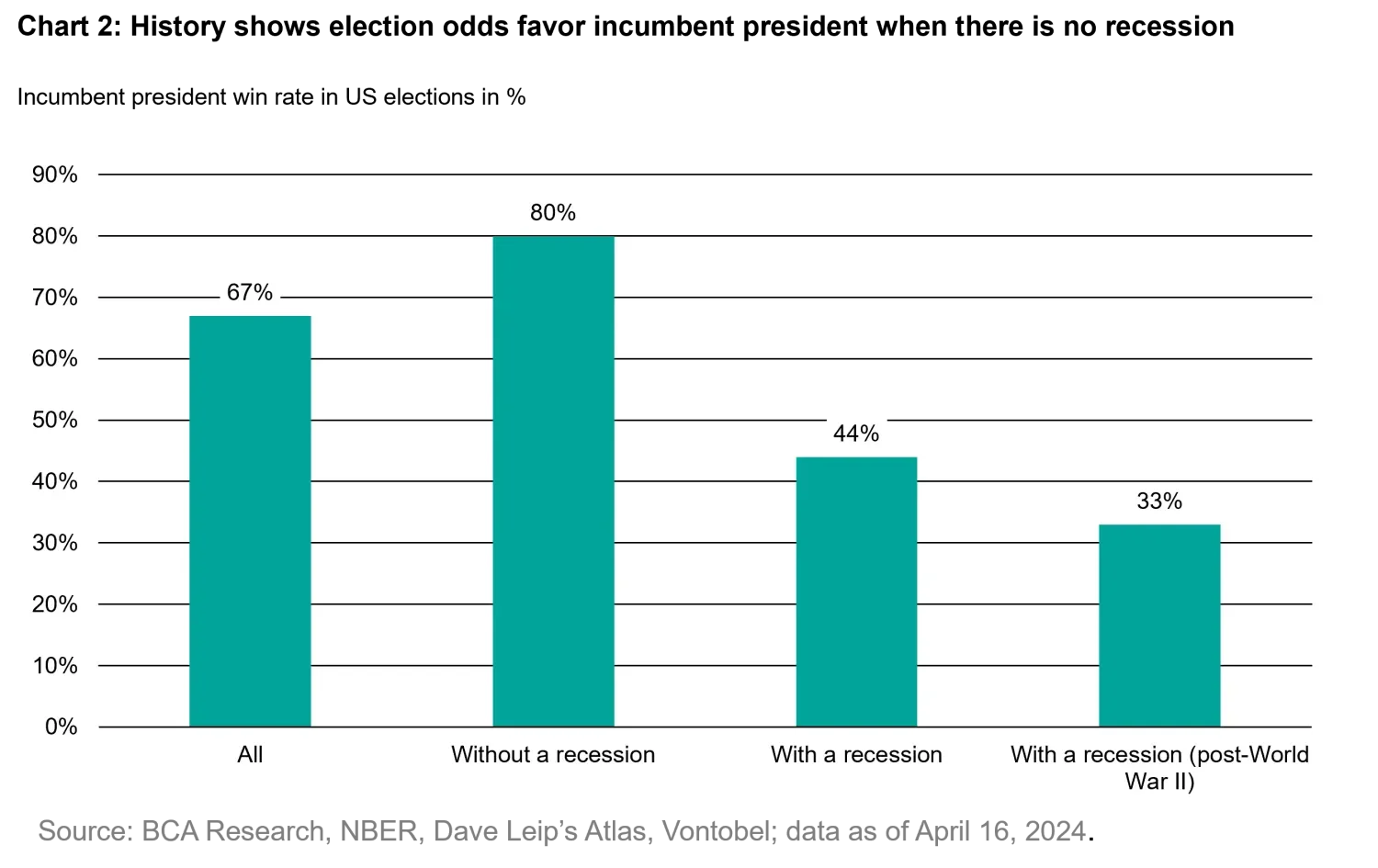
The statistics are on Biden's side. Historically, the incumbent US president is re-elected 67 percent of the time. If the incumbent president manages to avoid a recession, that probability increases to 80 percent. However, if the economy slips into a recession, the president is penalized, and the rate drops to 44 percent (see chart 2). In view of the strong labor market, both in the US in general but also in swing states, it currently looks as if a recession could be avoided before the election.
Trump and Biden currently dominate the headlines. However, investors should also keep in mind that potential third-party candidates could have an impact on the election. A poll conducted by Quinnipiac University in March found that 20 percent of voters would choose a candidate other than Trump or Biden if they had a choice between five candidates instead of two. The independent candidate, Robert F. Kennedy Jr., accounted for 13 percent. However, the Green Party candidate, Jill Stein, was also able to win 4 percent.
The Greens have already thrown a spanner in the works for the Democrats in the past. Just think of 2000, when activist Ralph Nader prevented Al Gore from entering the White House, or 2016, when Jill Stein stole votes from Hillary Clinton.
Another important question is who will win Congress. In our view, two scenarios have the highest probability: either a "red wave" (significant gains for the Republicans) or a stalemate. We think a "blue wave" is less likely.
Why? Congress is divided into the Senate and the House of Representatives. In the Senate, 28 Democratic seats are up for re-election this year; 23 Democratic seats are not up for election and are therefore considered to be "safe". The situation is different for the Republicans: only 11 seats are up for re-election, and 38 are considered to be "safe". According to 270towin's polls , the Republicans are currently ahead. It is therefore quite possible that the Republicans will gain seats and increase their influence in the Senate. Who will be in charge in the House of Representatives will probably depend on the outcome of the election.
In our view, Trump would be less restricted than Biden in the event of an election victory. While Biden would (probably) face a blockade in the event of a victory, Trump could (probably) work with a majority in Congress.
Regardless of who moves into the White House, in our view, protectionism, anti-China policies, rearmament, and high national debt are likely to continue.
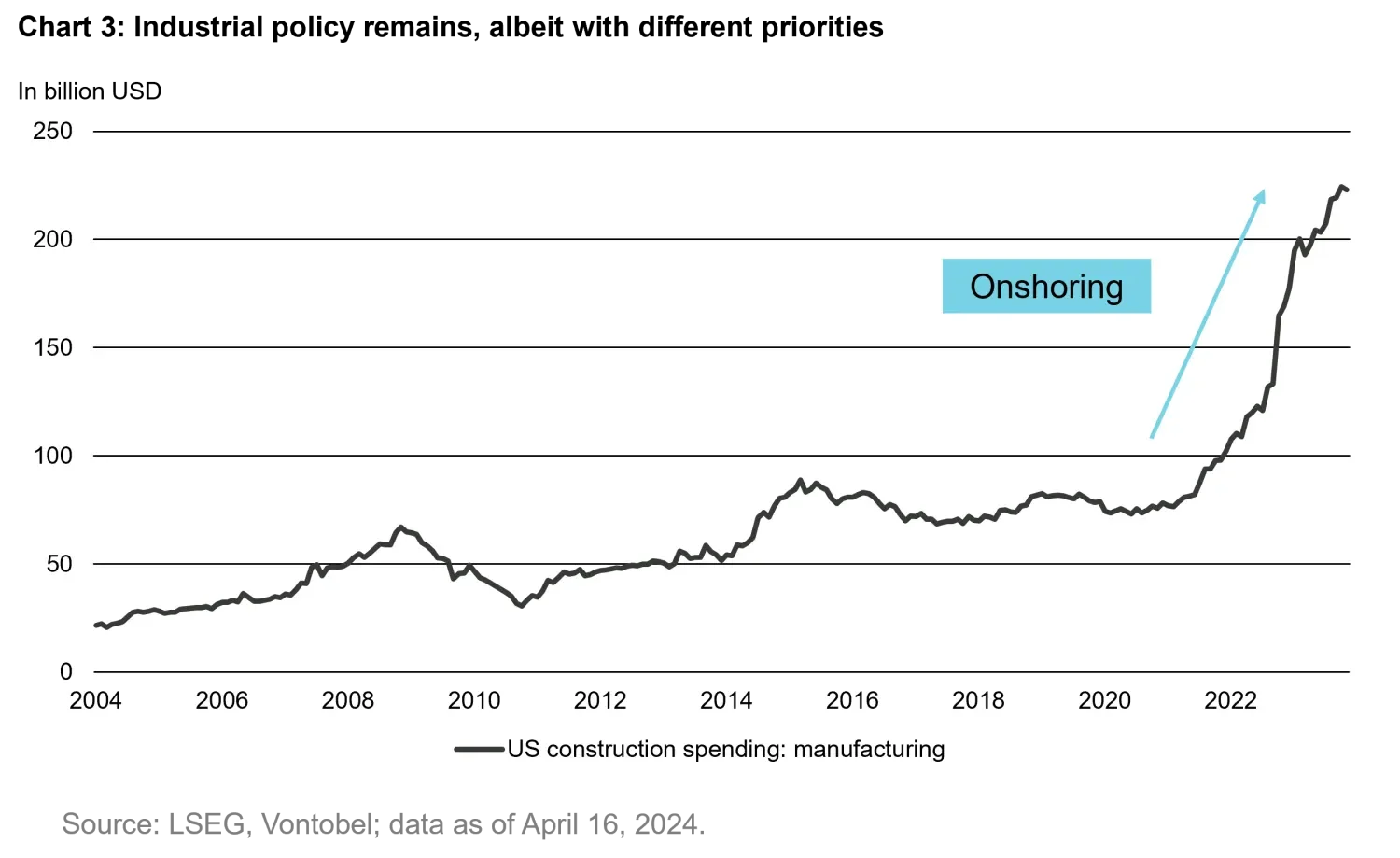
Anyone hoping for a little less "America first" and a little more trade openness from Joe Biden has been proven wrong in recent years. Biden is said to be pursuing a policy of "polite protectionism": he posts fewer angry tweets than his predecessor, but still has America's interests firmly in mind. Many of Trump's national security tariffs or voluntary restrictions that were negotiated with other countries remained intact under Biden. Biden appears to share Trump's view that protecting the US steel industry is a matter of national security. Other measures can also be seen as protectionist. One example is the Chips and Science Act promoted by Biden, which provides billions in investment in semiconductor manufacturing, research, and development and is intended to create more domestic jobs in the manufacturing industry (see chart 3 ).
The attitude towards the world's second-largest economy is also unlikely to change much. Both Republicans and Democrats have learned over the years that an anti-China policy increases voter favorability.
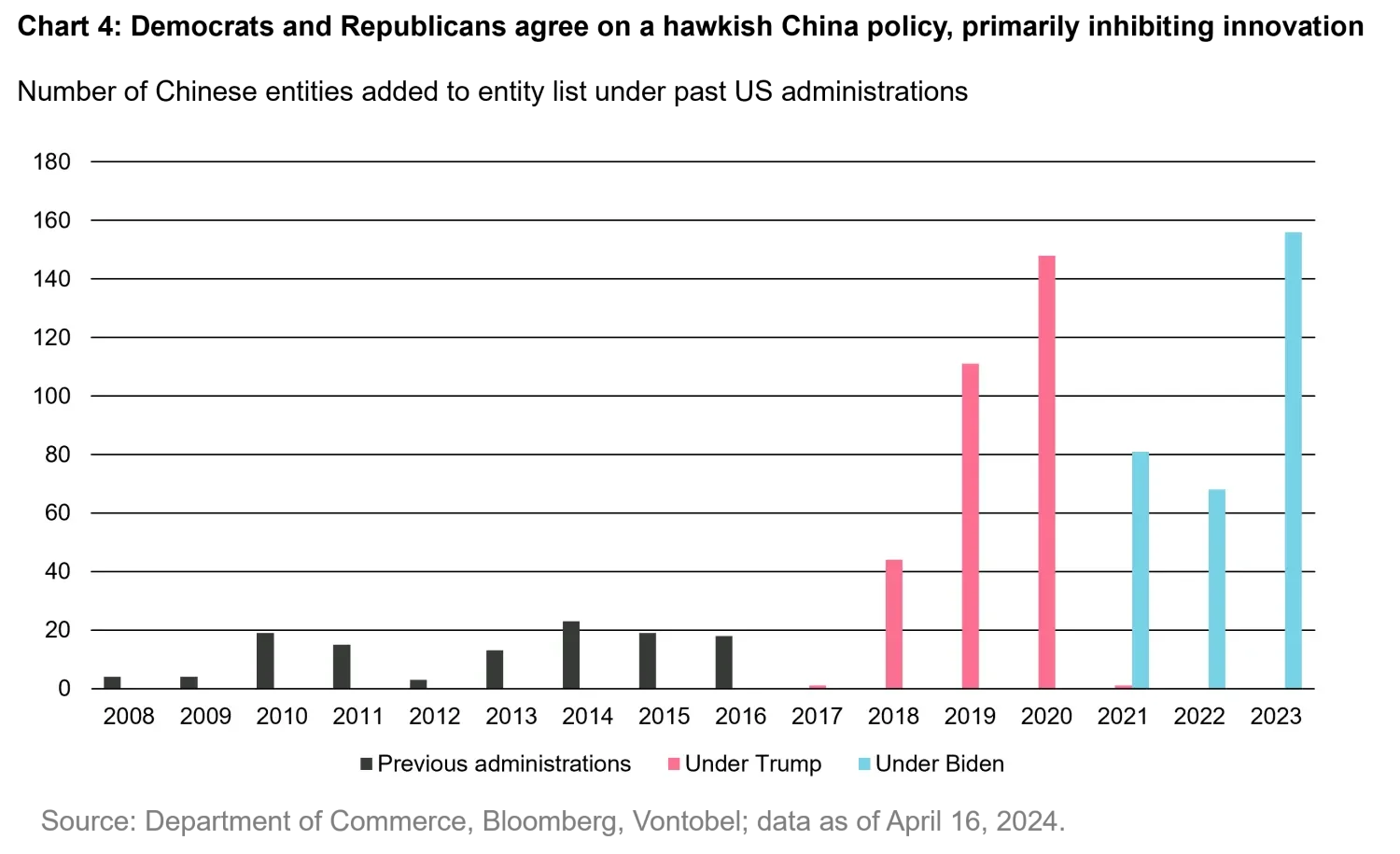
While Trump is openly hostile to China (like his various punitive tariffs imposed by Trump or Trump's statement that Covid-19 is a Chinese virus, Biden's approach is more subtle but no less determined. This becomes clear, for example, if we take a look at the Chinese companies that have been placed on the "entity list" by the US in recent years (see chart 4)3.
Another point is the trend towards military rearmament. Trump has repeatedly called for higher military spending and has also demanded this from other NATO member states. In February, he even announced that he would not stand by NATO allies in an emergency.
Biden also advocates for increased spending - he submitted a budget proposal in March 2024 for fiscal year 2025 that includes a request for $850 billion in discretionary funding for the Department of Defense (+4.1 percent over fiscal year 2023).
The debt issue (and associated questions around the "sustainability" of debt) is also likely to persist. At first glance, ever-increasing government debt is nothing new. Government debt, measured as a percentage of gross domestic product (GDP), has only been heading in one direction for years: upwards. In the 1980s, the national debt was still around 30 percent; now it is over 120 percent. What could soon become a problem, however, is the higher cost of servicing the debt (due to higher interest rates). These are higher than they have been for 40 years.
Summarizing all of Trump's campaign promises is quite ambitious. We will therefore limit ourselves to the five most important areas: Fiscal policy, monetary policy, trade policy, immigration policy, foreign policy.
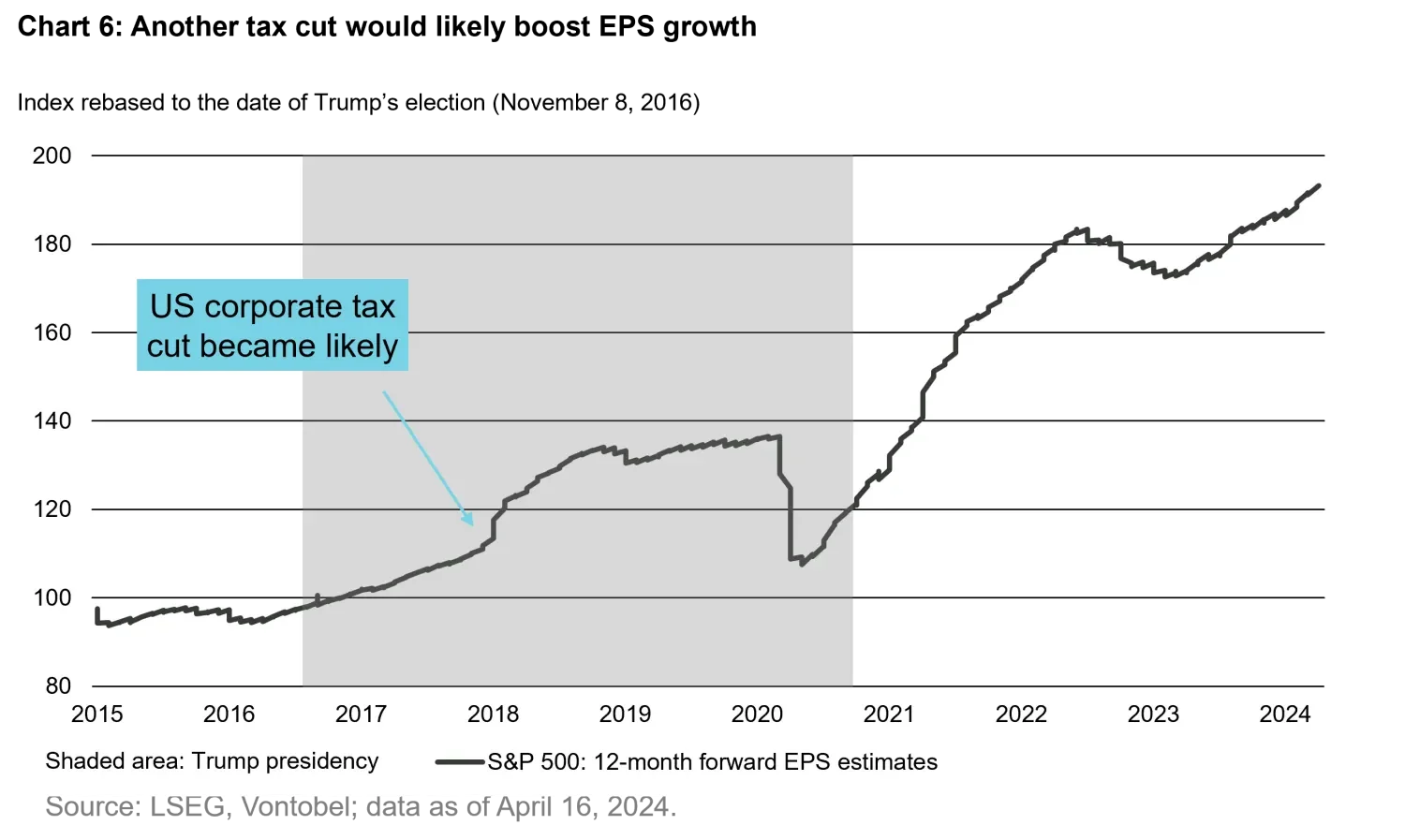
Trump's fiscal policy agenda is primarily aimed at lowering taxes. During his first term in office, he had already attempted to reduce corporate tax from 35 percent to 15 percent. In the end, it was 21 percent. Trump and his advisers have discussed further cuts to corporate tax rates, potentially as low as 15 percent, according to a September article by the Washington Post. Private individuals could also hope for lower taxes under Trump. In the past, lower taxes have weakened budgetary discipline in the US. It can be assumed that the already high budget deficit will continue to grow.
Trump wants to make savings elsewhere and, among other things, discontinue state funding for public broadcasting. Foreign aid, climate subsidies, and investments in sustainable technologies are also to be cut back (Trump sees the expansion of electric cars , for example, as paving the way for mass redundancies in the US car industry).
Trump has primarily zeroed in on Fed Chair Jerome Powell. Trump and Powell share a turbulent history. Trump appointed Powell (who is also a Republican) as Fed Chair in 2017 and praised him at the time as "wise" and experienced. But when Powell raised interest rates in 2018, he fell out of favor. Trump described Powell and the Fed as " clueless " and called for Powell's dismissal. In 2019, Trump even tweeted the question of “who is our bigger enemy” Powell or China's President Xi Jinping. In 2024, Trump hinted that Powell would lower interest rates to help the Democrats and secure Biden’s second term in office.
In our view, Powell's dismissal is likely to be difficult. Legally speaking, the President can only remove a Fed Board member (including Powell) for "cause". Dissatisfaction with the Fed's monetary policy is unlikely to be a valid point.
However, Trump has already announced that if he were to be elected President, he wouldn’t give Powell a second term in office (Powell's four-year term expires in 2026). After that, he could try to appoint a Fed chair he prefers, though Congress would have to give its approval.
Trump continues to strive for an "America first" policy. In the event of a second Trump term, greater trade policy uncertainty can therefore be expected. He has already announced that he would impose import tariffs of 60 percent on goods from China and 10 percent on goods from other countries if he wins the election. The current average tariff rate is 3 percent, or 19 percent in the case of China. If Trump were to push this through, the European Union -- as the US's second-largest trading partner -- would be particularly affected, alongside China.
Restricting Chinese ownership of US infrastructure (e.g., in the areas of energy, technology, telecommunications, and natural resources) is also under discussion. Trump is also considering a ban on investments by US companies in China and a rethink of the US's role in important organizations such as the WTO.
Trump's plans for immigration sound similarly determined. At a recent fundraiser, Trump complained that no people from "nice" countries (Trump's definition: Denmark, Switzerland, and Norway) were immigrating to the US. Instead, he said, we have to contend with people from other countries. But legal immigration and the right to citizenship for babies born in America should also be put to the test.
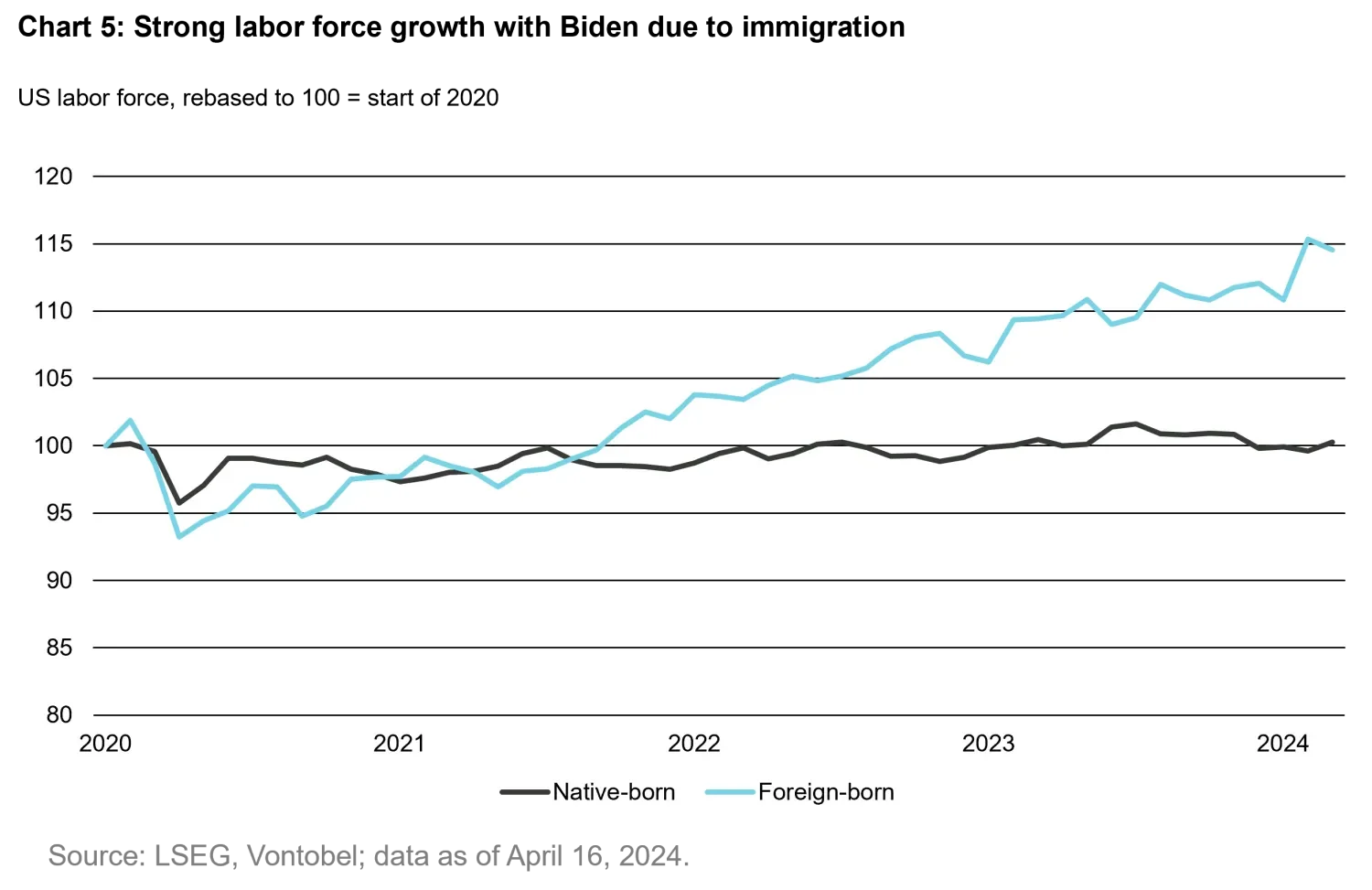
Although stricter immigration policy would be welcomed by populist voters, it could have negative consequences for the labor market.
Strong immigration under Biden has had a relaxing effect on the tight labor market (see chart 5). The latter has been struggling for some time with too high a demand for labor and too low a supply of labor. Lower immigration would exacerbate the shortage of labor and further fuel wage pressure (and thus inflation).
Apart from China policy, relations with Russia are also likely to be one to watch. Trump appears to have a good relationship with Russian President Vladimir Putin. While Trump's statement that he would settle the Ukraine war within 24 hours may be a bit ambitious, one way he could influence the war would be by cutting off financial aid to Ukraine, which is what Hungarian Prime Minister Viktor Orban claims Trump told him in a meeting in March. That would, however, require convincing a Russia-sceptic Congress.
A "forced" settlement of the war would not necessarily be market-relevant in our view: while oil prices rose significantly after Russia's invasion, they have fallen since the end of 2022, i.e., the "geopolitical risk premium" of the Russia-Ukraine war is no longer really present. Instead, other conflicts (Israel-Hamas) are driving the oil price.
Trump's Iran policy could have more of an impact on the oil price. For Trump, sanctions seem to be the only way to prevent Iran from enriching uranium (and thus from making a nuclear bomb) in the future. Iran is one of the largest oil producers in the world and ranked 7th in 2016 with a production of 4.4 million barrels per day. After Trump's surprising withdrawal from the Joint Comprehensive Plan of Action (JCPOA) nuclear deal in May 2018, the price of oil rose by 60 percent within a short period of time. According to estimates, two to four million barrels of oil disappeared (at least temporarily) from the world market.
In the rest of the Middle East, Trump impressed with his diplomatic skills. The Abraham Accords (2020), brokered by his administration, normalized diplomatic relations between Israel and some Arab states. The signatories - the United Arab Emirates (UAE), Bahrain, and Israel - reaffirmed their desire to strengthen peace in the Middle East. The UAE and Israel also concluded a peace agreement. Trump also maintains good relations with Saudi Arabia and the important gas exporter Qatar.
It is not easy to say how a second Trump term would affect key macroeconomic variables.
Firstly, it is not clear whether Trump can win a majority in Congress. Secondly, it is not certain whether the Republicans will go along with all his proposals. This will influence whether (and how) his campaign promises are implemented. Thirdly, the current situation is different: many of Trump's campaign promises would be met with a much tighter labor market today. In other words, the upside risks for inflation are higher than they were during Trump's first term in office. But we believe the following might be a possible scenario:
A second Trump term might be broadly positive for economic growth. The tax cuts planned by Trump should lead to a higher fiscal deficit. This would result in a positive fiscal stimulus. Trump's deregulation plans could also lead to higher productivity. As long as Congress goes along with Trump, this should support the US economy.
In the longer term, however, there would also be negative implications for growth. Lower immigration would probably lead to weaker population growth. Due to increased trade uncertainty, there is also a risk that companies will invest less. Higher tariffs and the associated higher prices could also lead to lower consumption.
A second Trump term is likely to be largely reflationary, i.e., the price level in the US is more likely to rebound amid a stronger economy and private consumption. This is partly due to the presumably higher fiscal deficit and the associated positive demand stimulus, and partly due to lower immigration and the associated risk of an additional shortage on the labor market (higher wage pressure due to lower labor supply). Last but not least, higher tariffs are also likely to be reflected in higher inflation.
A small disinflationary effect could come from lower immigration (fewer immigrants, less demand for housing, and thus less pressure on house and rent inflation).
Between 2017 and 2018 (i.e., during Trump's first term in office, when he had full control of Congress), interest rates (in this case, bond yields) rose. Even if Trump wins another election, interest rates are likely to rise due to higher economic growth, higher inflation, and the prospect of a Republican-controlled Congress. However, trade uncertainty and foreign policy geared towards maximum pressure could somewhat limit the upside potential.
His plans for immigration sound similarly determined. At a recent fundraiser, Trump complained that no people from "nice" countries (Trump's definition: Denmark, Switzerland, and Norway) were immigrating to the US. Instead, he said, we have to contend with people from other countries. But legal immigration and the right to citizenship for babies born in America should also be put to the test.
Although stricter immigration policy would be welcomed by populist voters, it could have negative consequences for the labor market.
In our view, the combination of stronger economic growth, higher inflation, and trade uncertainty harbors upside risks for the US dollar. However, the Federal Reserve's reaction function is crucial here. The prerequisite for a stronger dollar is that the central bank takes decisive action against higher inflation (i.e., raises interest rates). If it does not do this and stands idly by and watches inflation rise, this is more likely to weigh on the dollar.
It’s important to remember that asset classes are also influenced by other factors, such as the global economic cycle, which in turn is influenced by far more than just the outcome of the election.
If history is any guide, equity markets often trend sideways in the run-up to elections. This is hardly surprising: election campaigns are typically accompanied by uncertainty about the future political course, and stock investors don’t like uncertainty. Once a winner was determined, the markets usually went up – even if the incumbent president was not re-elected.
A further tax cut would probably have a positive impact on earnings per share (see chart 6). At the same time, investors should be prepared for higher equity market volatility (similar to 2019), due to the more unpredictable policy.
Within the asset class, developed-market equities are poised to benefit the most. Although Swiss stocks would also benefit from positive economic growth, they would struggle more in an environment of higher interest rates. There could be headwinds for some emerging-market stocks due to the trade war.
Bonds are likely to struggle more in the event of a second Trump term. While the asset class would benefit from a stronger US dollar, the combination of higher growth, higher inflation, and higher interest rates would have a negative impact.
A stronger economy makes equities look more attractive than bonds from an investor's perspective. Higher inflation reduces the purchasing power of a bond's future cash flows. Rising interest rates cause existing bonds to lose value.
If our assumption of a reflationary second Trump term is confirmed, commodities could also benefit. Higher economic growth should also benefit the cyclical asset class. While gold could benefit temporarily from increased geopolitical uncertainty, higher interest rates and a stronger US dollar are likely to weigh on the precious metal (real interest rates and the US dollar generally move in the opposite direction to gold).
1. Source: Institute for the Study of War. understandingwar.org/backgrounder/russian-offensive-campaign-assessment-april-26-2024
2. The CBOE Volatility Index (VIX) reflects the implied volatility of the S&P 500 Index. The VIX is calculated and published in real time by the Chicago Board Options Exchange.
3. The "entity list" is a list compiled by the US government of foreign individuals, companies, and organizations that are classified as a national security risk and are subject to export restrictions and licensing requirements for the export of certain technologies and goods.


