
Timing Factors with Macro Regimes
Multi Asset Boutique
Market volatility is declining, even as Europe awaits its April 2 tariff announcement and despite new tariffs on automanufacturers hitting the news as we write this. Bond and equity swings have calmed since their peak on March 10, when U.S. recession fears were at their highest. More recently, U.S. equities have begun closing the performance gap1 with European markets, driven by two key factors. In a way, markets are telling us that they’ve grown accustomed to political volatility.
First, Donald Trump’s announcement that reciprocal tariffs will be targeted has reassured investors. Markets are now pricing out certain tail risks2, reducing overall uncertainty. Second, late-March economic data showed unexpected resilience. The U.S. Purchasing Managers' Index (PMI) exceeded expectations, easing recession concerns. Our Wave business cycle model3 had already suggested these fears were overdone.
While Europe’s shift away from fiscal austerity—alongside Germany’s ambitious investment plan—should support European equities in the medium to long term4, U.S. equities may have room to extend their rebound in the near term once the dust from tariff announcements has settled.
This raises a key question: which equity styles perform best at this stage of the cycle? In this edition of Quanta Byte we answer that question in two phases. First, we prove that, once you identify the macro regime, the style that best performs is a relatively easy choice. Second, we show that, at this particular juncture, minimum volatility – as a style – offers a practical way to navigate this tumultuous period.
Wave is in Slowdown
Our proprietary Wave business cycle model, which applies a big data approach, currently stands at 55%, as shown in Figure 1, which means that 55% of all economic time series tracked by Wave are showing positive momentum (not that, when isolating developed markets, the figure stands at 57%). However, as this percentage has been declining since late January, our model now signals a slowdown phase.
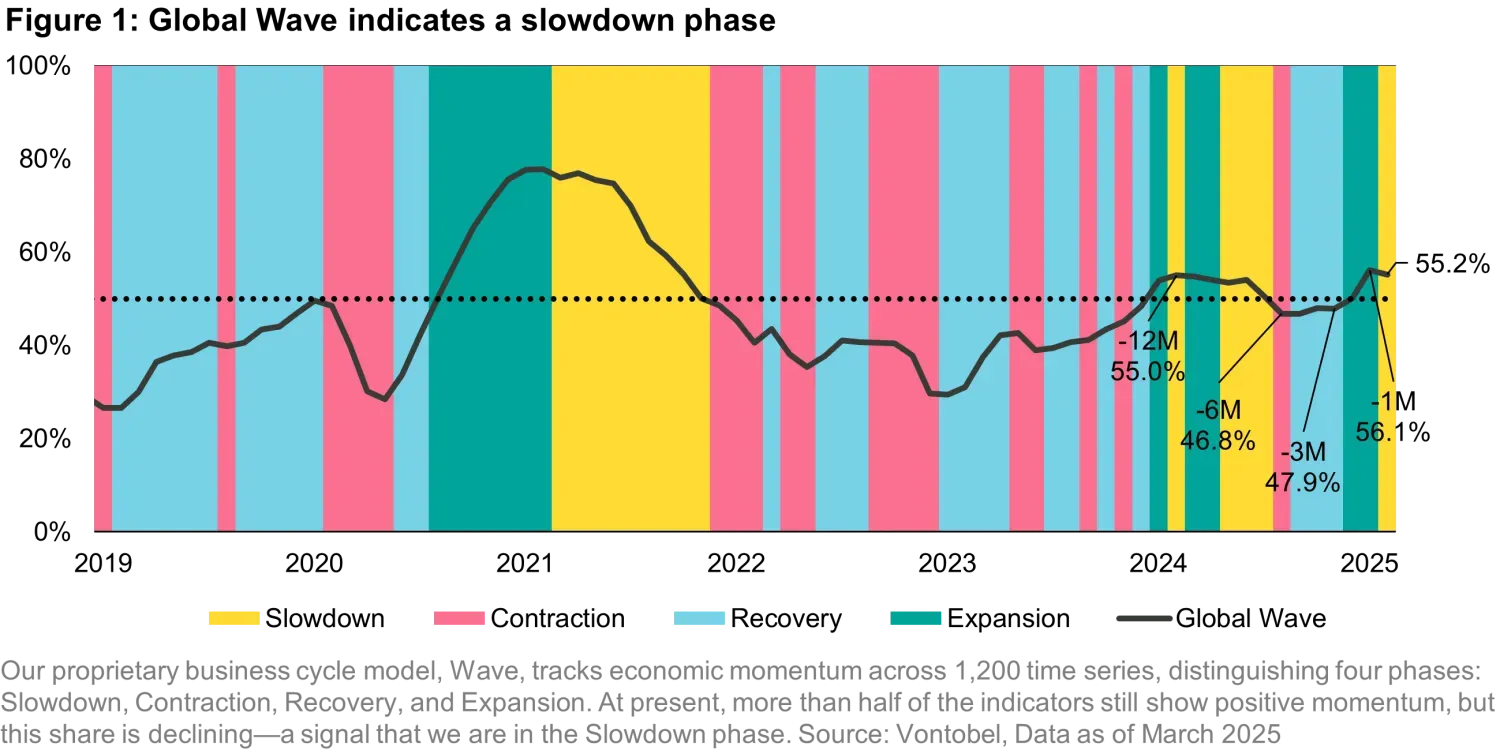
We have previously analyzed the link between equity returns and business cycle states, showing that the largest equity drawdowns historically occur during contraction phases. We also showed that the Wave does a reasonably accurate job at identifying and forecasting macro regimes. For example, the equity market decline following the Russian invasion of Ukraine and the subsequent energy crisis was anticipated by Wave as early as late 2021, when the model started to signal a contraction5.
If we can rely on Wave to determine macro cycle, the next obvious question is: how do different equity factors perform during a slowdown—or across the broader business cycle? While this topic has only recently gained traction in academic research, its importance for investors is clear.
Few factors matter
Since the 1980s, hundreds of equity factors have been introduced in academic literature. However, only a select few have consistently proven their effectiveness through rigorous in- and out-of-sample testing. Among the most widely recognized and studied are low-risk, value, quality, and momentum—factors that have demonstrated resilience across different market environments and continue to shape investment strategies today.
While factor research has a long history, the study of how factor performance evolves over time is relatively new. A key question in this area is whether factor performance depends on the state of the business cycle. Most research relies on traditional cycle indicators, such as the OECD leading indicator or Purchasing Managers’ Indices (PMIs) to define cycle phases and measure factor performance.
Given that Wave has a proven track record of anticipating adverse market regimes—such as recessions—earlier than traditional business cycle models6, we base our factor analysis on our proprietary model. For comparability, we use MSCI’s factor definitions as the foundation for our analysis.
Macro regimes drive factor selection
In our business cycle analysis, we measure the excess return7 of different equity factors by business cycle state8. Figure 2 shows the annualized monthly excess returns by factor, state, and over the full cycle.
We begin with unconditional performance—the average excess return of each factor since 1995. Quality and Momentum are the only factors with double-digit returns, at 11.7% and 11.3%, respectively. All other factors outperform the MSCI World benchmark (+8.1%).
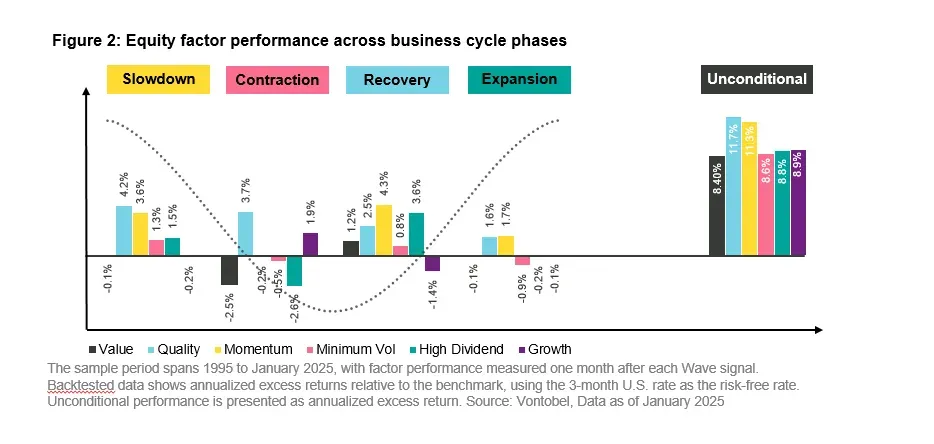
Looking at the breakdown by business cycle state, we observe key trends. First, quality is the only factor to outperform the benchmark across all cycle states. Momentum shows slight underperformance only during contraction phases. Second, during a slowdown, strategies like quality, momentum, minimum volatility, and high dividend have outperformed the benchmark.
Min vol is best for now
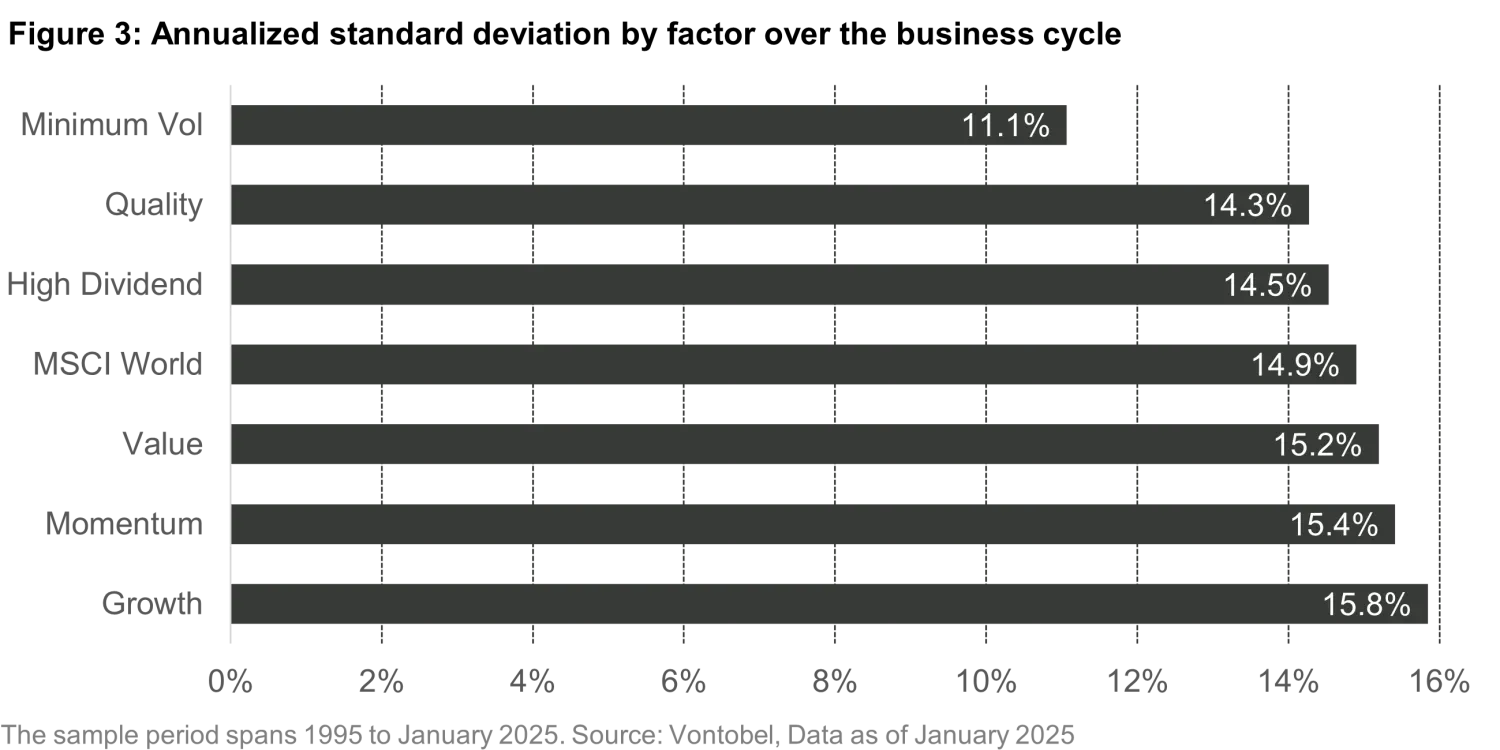
Given that our business cycle model, Wave, is currently in a slowdown, min vol strategies are appealing, even to more risk-tolerant investors. As Figure 2 shows, min vol strategies have outperformed the MSCI World benchmark during slowdown. Since quality, growth and value delivered more than min vol, you may wonder about what motivates our preference for min vol. It's got to do with the volatility of returns, and thus risk-adjusted metrics.
As Figure 3 shows, the annualized standard deviation for min vol stocks is 11.1%, compared to 14%-16% for other strategies, including the benchmark. These results suggest that certain strategies cater to different investor profiles, with min vol being particularly attractive for risk-averse investors. This is especially true as some portfolio hedges, such as long-duration bonds, have failed to protect portfolios this year amid tariff announcements and Europe's shift away from fiscal austerity, which has triggered higher inflation expectations and rising yields.
With European tariffs likely to be announced on April 2, the min vol factor may have room to outperform further in the coming weeks. Therefore, min vol remains a crucial factor that we continue to have exposure to in our portfolios.
1. Since December, the MSCI EMU has outperformed the MSCI U.S. by 20 percentage points. By late March, the U.S. index managed to recover approximately 3 percentage points.
2. In our Quanta Byte, “Navigating the Trade Tensions”, we highlighted a tail risk scenario in which VAT differences could be considered in reciprocal tariffs by U.S. authorities. This scenario would have significant economic consequences for European countries and is likely to trigger sizable retaliation.
3. See “The Vontobel Wave – a superior business-cycle model” for more information on our business cycle model.
4. See “A Turning Point for European Markets?” for the rationale behind our view.
5. This suggests that the economic environment had already worsened before the Russian invasion, which amplified the geopolitical impacts of the invasion on the markets.
6. We have outlined this in our white paper, “The Vontobel Wave – a superior business-cycle model”.
7. We present annualized monthly equity returns for developed markets, subtracting the U.S. short-term interest rate.
8. Our business cycle indicator identifies four distinct states: Slowdown, Contraction, Recovery, and Expansion.
This marketing document was produced by one or more companies of the Vontobel Group (collectively "Vontobel") for institutional clients.
This document is for information purposes only and nothing contained in this document should constitute a solicitation, or offer, or recommendation, to buy or sell any investment instruments, to effect any transactions, or to conclude any legal act of any kind whatsoever.
Although Vontobel believes that the information provided in this document is based on reliable sources, it cannot assume responsibility for the quality, correctness, timeliness or completeness of the information contained in this document. Except as permitted under applicable copyright laws, none of this information may be reproduced, adapted, uploaded to a third party, linked to, framed, performed in public, distributed or transmitted in any form by any process without the specific written consent of Vontobel. To the maximum extent permitted by law, Vontobel will not be liable in any way for any loss or damage suffered by you through use or access to this information, or Vontobel’s failure to provide this information. Our liability for negligence, breach of contract or contravention of any law as a result of our failure to provide this information or any part of it, or for any problems with this information, which cannot be lawfully excluded, is limited, at our option and to the maximum extent permitted by law, to resupplying this information or any part of it to you, or to paying for the resupply of this information or any part of it to you. Neither this document nor any copy of it may be distributed in any jurisdiction where its distribution may be restricted by law. Persons who receive this document should make themselves aware of and adhere to any such restrictions. In particular, this document must not be distributed or handed over to US persons and must not be distributed in the USA.
About the author

Related funds
About the author
Explore related topics:
Up next:
Towers and the Starlink ThreatRelated insights

Towers and the Starlink Threat

Quarterly Commodity Outlook - Halftime Whistle: Fundamentals Take the Field

Investors’ Outlook: And now for something completely different

Investors’ Outlook: Adjusting the focus

Investors’ Outlook: Strait forward
