
The Case for Active Management in Commodities
Multi Asset Boutique
Commodities are known as a portfolio diversifier and inflation hedge for investment portfolios, offering exposure to real assets with a fundamentally different set of economic drivers than equities or fixed income. The main drivers for commodity prices are supply and demand figures, together with geopolitical risk, demographic trends and technological advances. While a passive commodity investment, tracking a broad basket of commodities, is a cost efficient and simple way to get exposure to the asset class, investors should be careful about some pitfalls regarding how common commodity indices are constructed.
Commodity indices are often based on relative production weights, leading to suboptimal allocations such as being skewed to the energy sector, and lagging on diversification. The production based weighting mechanism does also not appropriately represent supply and demand dynamics. Due to its tendency to overweight commodities with a high level of supply, production-based weighting may in fact seek exposure where there is excess supply without any consideration for demand trends, which is against intuition. It is also missing out on structural demand shifts.
Contrary to that, active management in the commodities complex can still benefit from long-term structural trends, but also capitalize on short term mean-reversion due to supply and demand considerations, as well as fast reaction to geopolitical risks.
In this article, we underline the potential of active commodity investment. To do so, we will illustrate the return drivers of common commodity indices, the return dispersion of individual commodities over time, as well as the behaviour of commodity sectors across different economic regimes.
What is a passive commodity investment?
A passive commodity investment follows a commodity market index and gives investors a long only exposure to a broad basket of commodities. The two most common commodity indices – representing a basket of exchange-traded commodity futures – are the Bloomberg Commodity Index (BCOM) and the S&P Goldman Sachs Commodity Index (GSCI), live since the 1990s.
The S&P GSCI Index includes 24 commodities across all sectors, and it is a production-weighted index assigning weights to individual commodities proportionally to their global production. As such, the index heavily overweighs the energy sector (57.4%) with 20% to each WTI and Brent, followed by agriculture (16.7%), industrial metals (11.0%), livestock (9.3%) and precious metals (5.6%).
The Bloomberg Commodity Index also consists of 24 commodities, but its target weights are based 1/3 on world production and 2/3 on futures trading volume and liquidity. Weight caps are applied at the commodity, sector and group levels. This results in a more balanced sector weighting: energy (30.0%), agriculture (30.8%), precious metals (18.8%), base metals (15.1%) and livestock (5.3%). Historically, these target weights have been quite stable as depicted in Figure 1, with approximately 30% allocated to the energy sector. Recently, the allocation to precious metals, in particular gold, has increased mostly at the expense of base metals.
Both indices rebalance only annually – at the beginning of January – back to their target weights. Hence, they can encounter substantial price drifts throughout the year, causing weights to change significantly in-between rebalancings and resulting in significant price pressure ahead of the rebalancing in January. These target weights are known in advance, offering active investors the opportunity to position themselves before the indices rebalance. Furthermore, the universe is relatively static over time (Brent was added in 2012, gasoil in 2019 and lead in 2023), missing out on “new” commodities which are in high demand due to structural trends, such as rare metals, carbon allowances, palladium, platinum, and cocoa.
What are the pitfalls of passive commodity indices?
Traditional equity indices are weighted by market capitalization, an approach which is clearly inapplicable in the commodity space. Instead, the two commodity indices BCOM and GSCI more or less follow production weighting, i.e., commodities produced in larger quantities receive a larger weight in the commodity indices. This leads to three problems.
First, production-based weighting tends to overweight commodities with excess supply. All things equal, greater supply tends to push prices down, not up. Let’s take natural gas as an example: due to the massive expansion of the US shale oil and gas industry since the beginning of the 21st century, the natural gas market was extremely oversupplied. This led to a decade of large negative returns (Bloomberg Natural Gas Subindex lost 99.9% since January 2000).
Second, production weights per definition ignore demand trends. Since we said that commodity prices are a function of supply and demand dynamics, that is equivalent to discarding half of what matters, and sometimes, this leads to missed opportunities. Consider the green energy transition for example, which is triggering a significant increase in copper demand (a crucial material for electric vehicles, photovoltaic plants, power grids). Supply can hardly pick up, which creates opportunity. Existing mines are gradually depleted, and it takes decades to build new ones. This leads to a large deficit and upward price pressure. Given what we said above, passive commodity indices would do exactly the opposite of what fundamentals would recommend.
Third, both BCOM as well as GSCI have strong sector tilts towards the energy complex, leading to suboptimal diversification. Investors seeking commodity exposure as inflation hedge may think it’s a good thing, since energy prices are a big portion of the basket used for inflation calculations. However, inflation shocks can come from different angles, not only energy. The possibility to adapt is thus crucial.
The flaws in the production-weighted index construction become tangible when looking at the cumulative return contribution of each commodity sector since 2000, as shown in Figure 2. One can already see how a passive investment in a commodity index is dragged down by prolonged periods of certain sector underperformance. The period from 2000 to 2008 was dominated by the accelerating demand from emerging markets, in particular China. This led to a strong outperformance of both energy and base metals sectors. This went the other way during the following decade, which was dominated by excessive shale oil and gas production, and a recessionary period after the great financial crisis. Hence, the energy and agricultural sectors were a strong drag on overall performance of the BCOM, while metals continued to benefit from strong Chinese construction growth. Since the outbreak of the Corona crisis in 2020, the ongoing geopolitical risks and trade wars, investors increasingly shifted to safe haven assets leading to a strong outperformance of precious metals.
Besides the shortcomings of the production-based weighting scheme, there is another limitation in the design of the passive commodity indices related to the rebalancing schedule. Both, BCOM and GSCI, rebalance only annually, at the beginning of January back to their target production weights. This arbitrary rebalancing on a fixed date completely misses out on any opportunities arising during the year. Moreover, in-between rebalancings, large price drifts can cause weights to substantially tilt towards the best performing commodity. This might sound good at first. However, commodities can be prone to mean reversion. For example, the natural gas weight within BCOM index more than doubled in 2022 up to almost 18% within the BCOM index in August. When natural gas prices crashed 55% from August until the end of the year, BCOM performance was suffering disproportionally. Last but not least, the index rebalancing date and target weights are published well ahead which creates all sorts of market distortions. Active commodity investors can accordingly position themselves a-priori to take advantage of expected prices pressures caused by passive index rebalancing.
High dispersion favours active investment
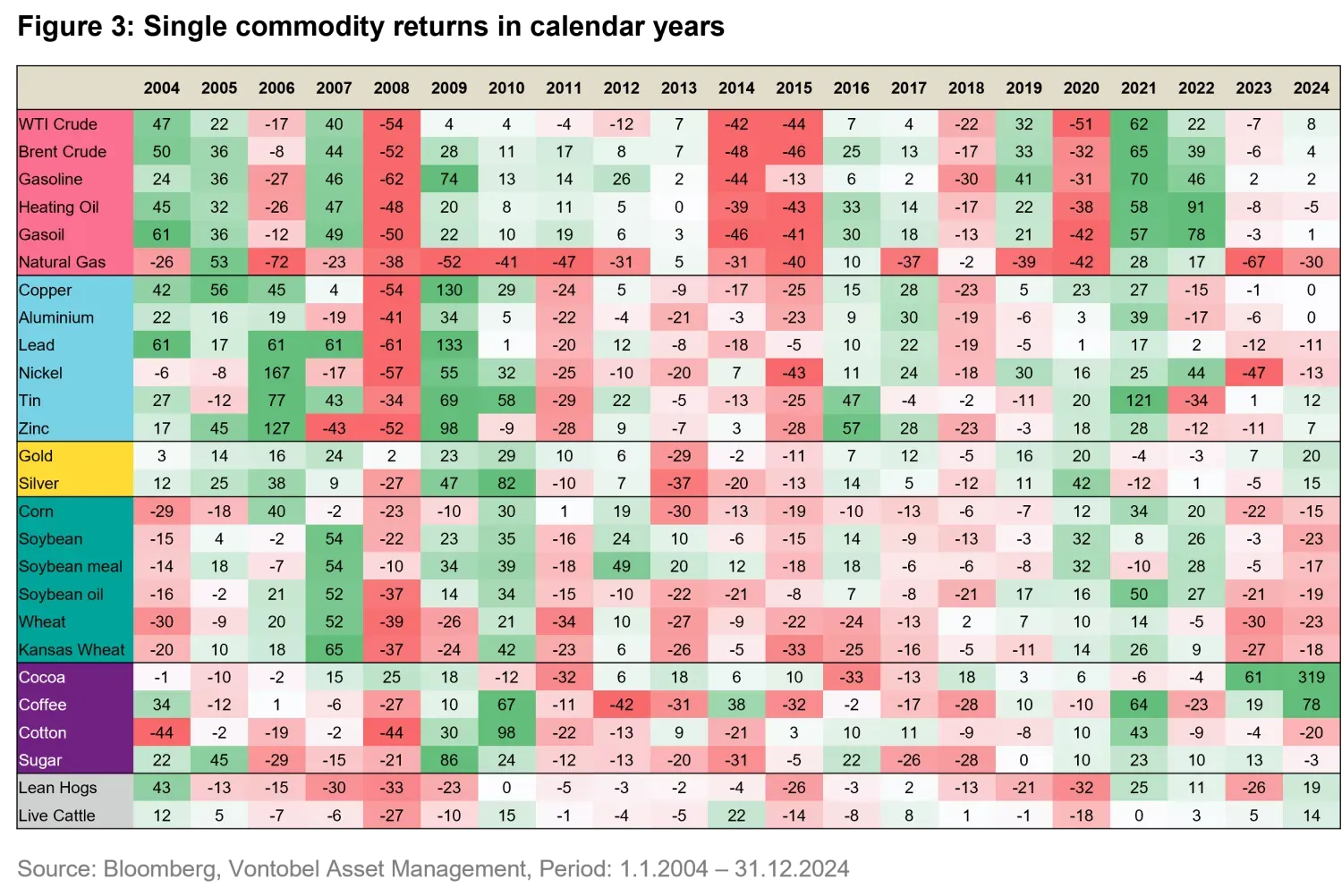
There is a very high return dispersion among individual constituents of the broad commodity indices, which is an ideal environment for an active manager. Figure 3 depicts the yearly return of each commodity within the complex. A few things stand out.
First, there is no single year where all individual commodities posted only negative or positive returns, not even in 2008 where, according to common wisdom, ‘everything corrected downwards. Figure 3 shows what it shows because supply and demand dynamics that affect prices and performance vary significantly, and do not necessarily correlate to one another. For example, natural gas prices are mostly dependent on US weather, while oil prices are driven by global economic growth and OPEC supply policy. Base metals are closely connected to the Chinese credit cycle, while precious metals correlate with monetary policy. Grains and softs on the other hand depend on regional weather regimes. For example, West Africa is relevant for cocoa, while Russia, Ukraine, and the U.S. are important for wheat; and South America is the primary supplier of soybeans and corn.
Second, when a particular sector outperforms, the trend often continues for one or two more years, until it starts to mean-revert, another very characteristic behaviour of commodity markets. This is because supply and demand imbalances require more time to correct. For example, an oversupplied grains market, will rebalance in the subsequent 1-2 years when farmers decide to shift their planting towards more favorable crops. Another example is rising metals demand that leads to a multi-year process of mining ramp ups.
Third, commodity markets are not only driven by multi-year trends but are also prone to short-term news: whether it is geopolitics, macro news, or weather events, resulting in huge spot price movements. Active management can react quickly and adjust positions accordingly.
Commodity investing and cycles
Figure 4 shows the performance of the various commodity sectors during various market cycles, as quantified by our proprietary indicator Wave. Two things stand out.
First, different sectors behave differently through different cycles. Figure 4 makes a strong case for active management to capitalize on the dispersion and avoid structural inefficiencies by static weightings. In the slowdown phase, energy and base metals typically offer positive returns despite weakening industrial activity. Grains and softs also show historically strong performance as their return drivers are not solely influenced by economic growth. During a contraction, energy and industrial metals are negative, reflecting reduced global consumption, while precious metals tend to outperform as investors seek safe-haven assets. Meanwhile, soft commodities can be more resilient, driven by weather patterns and inelastic demand (e.g., sugar).
As economies enter the recovery phase, energy is usually the first sector where demand comes back. However, returns are normally still slightly negative, while grains see a recovery as global demand, and the food industry start to pick up again. In the expansion phase, broad economic strength lifts most sectors—energy and base metals offers positive returns as capacity tightens and demand surges, while livestock benefits from increased meat consumption. Precious metals might underperform in this stage, as rising real yields and risk-on sentiment reduce their appeal.
These sectoral shifts across the cycle underscore the limitations of passive commodity exposure and reinforce the value of an active approach that can dynamically adjust positioning to capture alpha and manage downside risk.
Figure 4 highlights one more thing, which is relevant for investors looking at the benefits of a commodity allocation in a multi-asset portfolio. During slow-down phases, when equity allocations typically don’t work, the entire commodity sector tends to shine. This property is useful to any multi-asset investor, since equities typically consume most of the active risk budget.
Conclusion
The unique nature of commodity markets—driven by physical supply-demand imbalances, characterized by high return dispersion, and sensitive to sector-specific dynamics —makes a strong case for active investment. While passive indices offer accessibility and low cost, their backward-looking production-based weighting, sector concentration, and static rebalancing schedules limit their effectiveness and diversification potential. These structural shortcomings can lead to prolonged exposure to underperforming sectors and missed opportunities in high-demand or off-benchmark commodities.
Active management, by contrast, allows investors to dynamically adjust exposures, exploit market inefficiencies, and respond to both structural trends and short-term disruptions. As demonstrated throughout this article, commodities are a highly heterogeneous asset class that requires a flexible, forward-looking investment approach. For investors aiming to fully harness the benefits of commodity allocations, active strategies offer both the precision and adaptability necessary for potential long-term success.
About the authors



Related funds
About the authors
Explore related topics:
Up next:
Towers and the Starlink ThreatRelated insights

Towers and the Starlink Threat

Quarterly Commodity Outlook - Halftime Whistle: Fundamentals Take the Field

Investors’ Outlook: And now for something completely different

Power moves: The new energy order

Investors’ Outlook: Adjusting the focus
