
Middle East: tail risks materialize – what’s next for oil and gold?
Multi Asset Boutique
The situation in the Middle East escalated further over the weekend, culminating in the U.S. military launching a series of strikes on Iranian nuclear facilities—a significant escalation in the regional conflict that began with Israel’s surprise airstrikes on Iranian territory on June 13. These developments have raised serious concerns about the potential for a broader conflict involving Iran, Israel, and the United States, with global financial markets closely monitoring any disruption to oil and gas flows.
While market participants broadly expected higher oil prices and a flight-to-safety sentiment to start the week, the picture observed in European markets this morning is notably different. Brent crude oil futures opened sharply higher in Asia at $81, before pulling back ahead of the European open and are now trading slightly above Friday’s close of $77.10. Across asset classes, risk-off sentiment was muted, with equities trading slightly lower, bond yields marginally lower, and the U.S. dollar strengthening. Interestingly, gold is seeing limited demand despite heightened geopolitical tensions.
The muted response suggests markets are in wait-and-see mode—particularly focused on how Iran will respond in the coming days. Attacking U.S. assets in the region would be a high-risk move, likely triggering additional U.S. strikes on Iranian military targets, oil production, and export facilities. The U.S. could also preemptively target the Iranian fleet and missile positions to reduce risk to shipping traffic. In our view, the following factors will be crucial for energy prices going forward. Until we see a concrete Iranian response, oil prices are likely to maintain a significant geopolitical risk premium.
What does it mean for our positioning in the Vontobel Fund – Commodity? We remain fundamentally bearish on oil and keep our defensive positioning in light of the risk of further escalation. We plan on re-instating our underweight after the situation normalizes, if fundamentals continue to indicate an oversupplied market. Fundamentals for gold remain favorable backing our overweight position, even though the initial reaction to this geopolitical event is muted.
Key Risk – Strait of Hormuz
The most significant concern remains the potential closure or disruption of the Strait of Hormuz, a vital chokepoint through which roughly 20% of global oil and gas trade passes (see Figure 1). The Strait links the Persian Gulf with the Gulf of Oman and the Arabian Sea, separating Iran (to the north) from the Arabian Peninsula (to the south). Nearly two-thirds of the volume comprises crude oil from Iran, Kuwait, Saudi Arabia, Qatar, and the United Arab Emirates, while the remainder includes oil products and natural gas. Iran’s oil production currently stands at approximately 3.3 million barrels per day (bpd), with estimated exports of around 2 million bpd of crude and fuel. The $8 price increase since June 13 reflects the risk premium associated with the potential removal of Iranian barrels from the market.
A complete closure of the Strait of Hormuz would represent the most severe supply disruption scenario. Market polls currently assign a 50% probability of such a development by the end of 2025, and a 30% probability of a shutdown occurring before the end of July 2025.
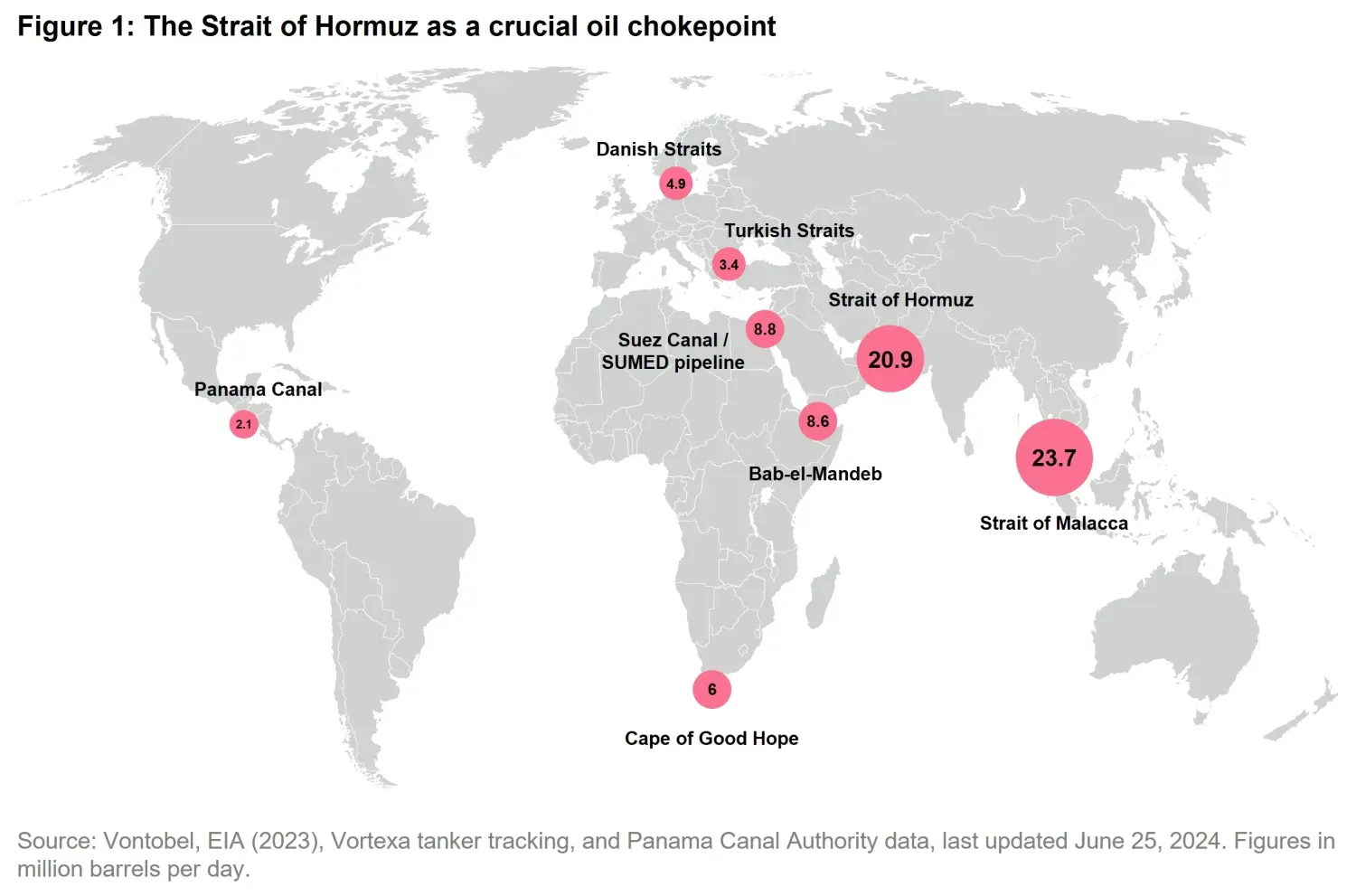
A key question now is how Iran will respond to direct U.S. involvement in the conflict. Given its current diplomatic isolation, Iran cannot rely on support from other regional states. A full and prolonged shutdown of the Strait of Hormuz would significantly impact oil prices but would also hurt the Iranian regime. Despite international sanctions, the majority of Iran’s crude is exported. A shutdown would cut Iran off from global oil markets and deprive the regime of a critical source of war financing. Domestically, Iran relies on natural gas for roughly 85% of its energy needs. In the event of a shortage, Turkey’s energy minister confirmed on June 16 that it could replace the 20 million cubic meters/day of Iranian imports with Russian gas via TurkStream1 and global LNG supplies.
Oil – Three market scenarios
While the U.S. entry into the Middle East conflict marks a new phase of escalation, we maintain our base case and fundamentally bearish long-term outlook for oil, anchored in expectations of an oversupplied market by late 2025. In the short term, the focus will remain on potential missile attacks on oil infrastructure and disruptions to exports. We outline three potential near-term scenarios:
Scenario 1: Airstrike campaign (Base Case)
- Israel carries out strikes on Iran’s nuclear facilities. Iran responds with missile attacks, but both sides avoid broader regional escalation. Neither Isreal nor the U.S. deploy ground troops.
- Oil Supply Impact: Minimal direct disruption. Short-term logistical constraints possible, but no major supply losses. Prices may spike but stabilize as diplomacy resumes.
- Crude Oil Price Range: $70–$80
Scenario 2: Regional escalation
- A broader conflict emerges, involving strikes on oil infrastructure and proxy attacks. Iran retaliates with attacks on U.S. bases in the region.
- Oil Supply Impact: Temporary disruptions prompt a drawdown of the Strategic Petroleum Reserve (SPR) and possible increased OPEC output. Prices rise more significantly and remain volatile.
- Crude Oil Price Range: $80–$100
Scenario 3: Protracted conflict & Strait of Hormuz closure
- The conflict spreads to the Persian Gulf. Iran or its proxies target shipping, oil facilities, and U.S. assets.
- Oil Supply Impact: Severe and prolonged disruption. Strategic reserves and OPEC spare capacity are insufficient to offset losses. A lasting impact on global energy security.
- Crude Oil Price: Above $100
2025 Outlook – Bearish fundamentals still dominate
Looking beyond the immediate risk premium, our year-end 2025 forecast for crude oil remains in the $50–$60 range, supported by:
- Significant spare capacity within OPEC+, which is eager to regain market share.
- Additional non-OPEC supply (e.g., Brazil, Guyana, Canada) expected to bring ~1 million bpd to market.
- Slowing global growth—particularly in Q4—likely reducing demand just as supply ramps up.
Gold – Surprising weakness amid crisis
Gold, typically a go-to safe haven during geopolitical crises, has underperformed expectations. Despite the weekend’s escalation, gold traded lower Monday morning. While Chinese banks were net buyers, ETFs were net sellers overnight. Gold has generally traded sideways over the past week. While geopolitical tensions have offered some support, stronger U.S. macroeconomic data has bolstered the dollar and weighed on precious metals.
We maintain our overweight position in gold as a hedge against geopolitical risk. The current dip is viewed as a potential buying opportunity.
Conclusion – A market on edge
The U.S. strikes on Iranian nuclear targets have pushed the Middle East closer to a broader conflict, yet oil markets remain cautiously priced. As the world awaits Iran's next move, investors should prepare for elevated volatility while acknowledging that historical oil supply disruptions from geopolitical events tend to be short-lived.
Nonetheless, the potential closure of the Strait of Hormuz remains the most significant tail risk—one that could test even the best-prepared energy systems. However, assessing the reaction on the gold market today, the risk for further escalation might not be as high some analysts predict. Even though the geopolitical risk picture is changing, maybe we should not be too complacent about the serious options Iran may still have at its disposal to regain negotiation leverage.
About the authors



Related funds
About the authors
Explore related topics:
Up next:
Towers and the Starlink ThreatRelated insights

Towers and the Starlink Threat

Quarterly Commodity Outlook - Halftime Whistle: Fundamentals Take the Field

Investors’ Outlook: And now for something completely different

Power moves: The new energy order

Investors’ Outlook: Adjusting the focus
