
How Chinese policy shifts alter our view
Multi Asset Boutique
Over the past 18 months, we have favored emerging market debt over equities, driven largely by a downgrade in China’s growth prospects amid a real estate crisis and persistent structural challenges like deflation. However, recent policy announcements from Chinese authorities—catching markets off guard— have prompted us to reconsider this stance, especially with an eye on Chinese and broader emerging market equities. We believe this rally has potential to continue in the near term, given the authorities’ commitment to further easing measures and the still light positioning of global investors. On the monetary front, there is ample room for additional rate cuts and reductions in reserve requirement ratios.
How committed is China?
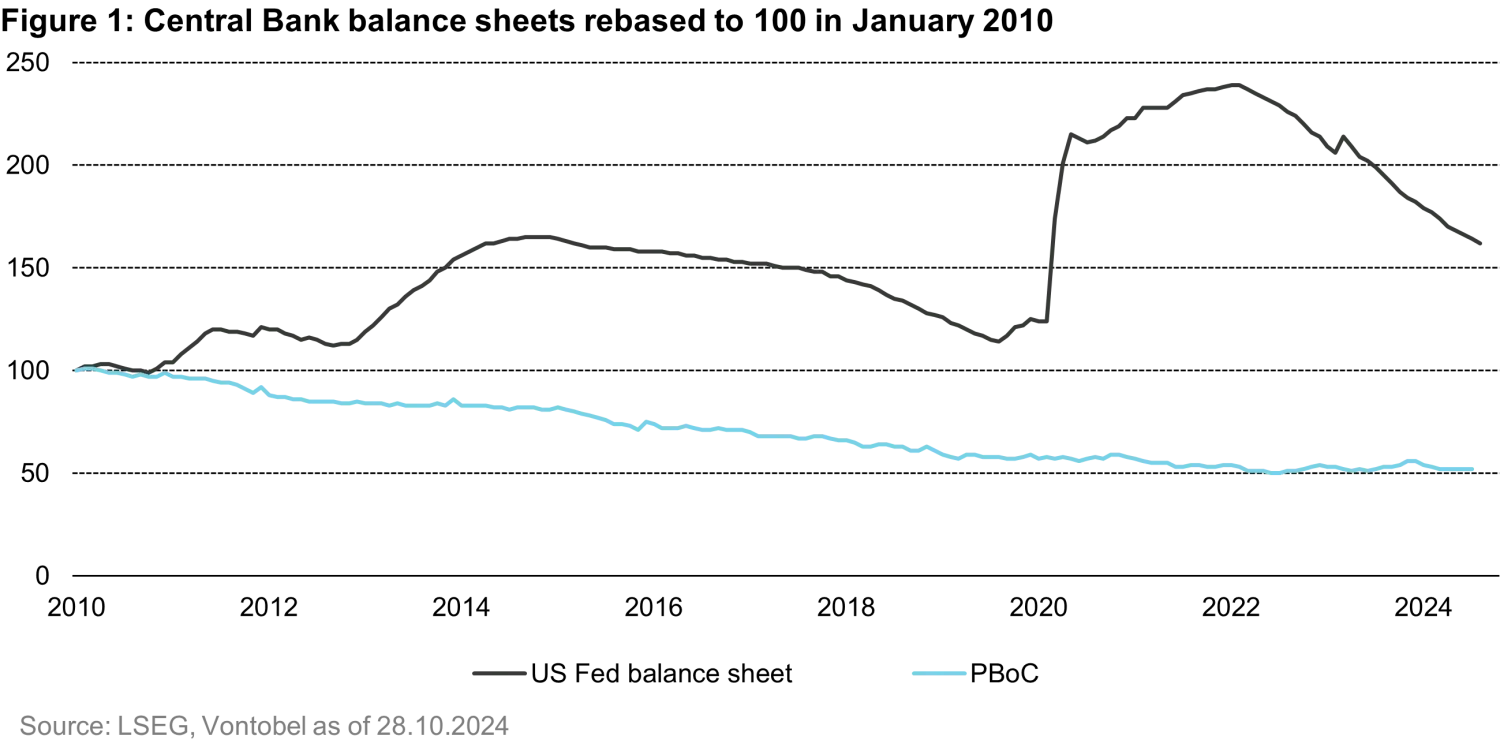
While these actions are encouraging, they do not obscure the reality that resolving the balance sheet crisis—primarily driven by falling asset prices, particularly in real estate—will require a combination of fiscal and monetary stimulus. China is making efforts to incentivize local governments and real estate developers to reduce housing inventory. However, a key question remains: How committed is China to a large-scale fiscal boost, given its focus on deleveraging the economy? Recent years of tight monetary and fiscal policies provide China with some leeway to increase stimulus, but markets may challenge the government’s willingness to fully commit. In Figure 1, we compare the evolution of the size of US and Chinese central bank balance sheets over more than a decade. It shows that China’s stimulus has been much less accommodative than recent Fed policy over the past 10 years.
U.S. Elections Are a Risk
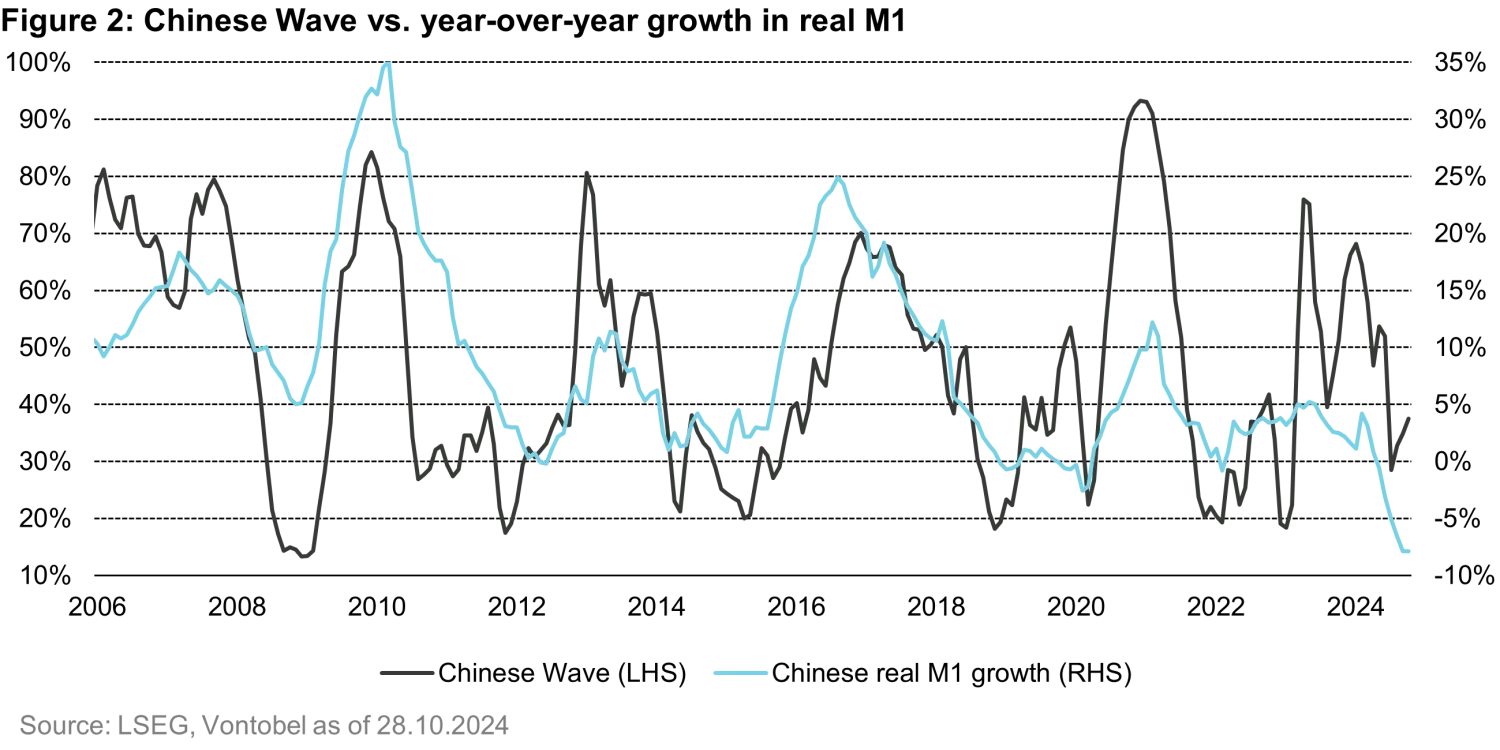
The success of China’s measures will be closely linked to U.S. Federal Reserve policy. We do not believe the timing of China’s stimulus announcements is unrelated to the Fed’s actions. In this regard, we welcome the Fed’s aggressive, front-loaded easing, as it should give China additional room to ease further without significantly weakening the yuan—another key policy objective. Moreover, this positive news comes at a time when our business cycle leading indicator Wave shows signs of stabilization in China. This is illustrated in Figure 2, where the level of the Wave indicator for China (left axis) is compared to real M1 growth (right axis). As a reminder, Wave signals below 50% but rising, like it’s the case for China at the moment, indicate a ‘recovery’ regime1. Note how year-over-year growth in real M1 is at historical lows, we expect announced policy measures to boost liquidity over the next few months.
However, two risks to Chinese and emerging market assets stand out. First, there is the question of commitment, with the National People’s Congress Standing Committee meeting (November 4–8) serving as a possible gauge of sentiment. Markets are hopeful for further announcements on debt and fiscal policies, though current agendas remain silent on these issues, suggesting potential downside risks. The second—and more prominent—risk is the U.S. election. With polling in swing states favoring Trump, Chinese and emerging market assets may face heightened volatility around election day. Trump’s proposal for a baseline tariff of 60% on Chinese imports may simply serve as a negotiating point, but a win for Trump could generate short-term headwinds for Chinese assets.
To sum it up, China’s recent stimulus—the most significant since the pandemic—combined with an under-owned market by global investors, supports our constructive outlook on Chinese equities. Nevertheless, the uncertainty surrounding the U.S. election tempers our position, prompting us to approach China with caution. By having added Chinese equities in early October, where appropriate, we remain prepared to reassess positions around the election, where potential trading opportunities could arise.
Watch the following video for an update on our Hybrid approach.
1. For a comprehensive guide on Wave, please refer to https://am.vontobel.com/en/quantitative-investments
About the author

Related funds
About the author
Explore related topics:
Up next:
Towers and the Starlink ThreatRelated insights

Towers and the Starlink Threat

Quarterly Commodity Outlook - Halftime Whistle: Fundamentals Take the Field

Investors’ Outlook: And now for something completely different

Investors’ Outlook: Adjusting the focus

Investors’ Outlook: Strait forward
