In breve
- Steady income in Europe: Investing in equity and corporate bonds could be a viable strategy for generating a consistent income. These two avenues expose investors to different economic elements. We aim to discuss the advantages and disadvantages of these investments to assist investors in determining the ideal balance between equity and corporate bond income.
- Reassessing Income Streams in Europe: We are focusing on two passive tools, the MSCI EMU index and the Bloomberg core EURO corporate bond index, as benchmarks for this discussion. Both indices have shown strong performance over the past two decades, making European markets particularly appealing for income strategies. Currently, both indices offer a yield of 3%, but which is more appealing?
- Equity and corporate bonds: Comparable Yields, Diverse Returns. Income from equity comes from high-quality companies with pricing power, which are more sensitive to economic cycles but more resistant to inflation. On the other hand, income from corporate bonds is more inclined towards lower-quality companies in need of financing and is more rate-sensitive.
- All weather strategy: a combination of equity and corporate bond income yields stable results across various economic cycles. For investors heavily allocated in corporate bonds, the income from equities can be an advantage.
- Add equity income: Equities should be avoided when valuations are high and require a more active portfolio, leaning towards concentration and higher quality. A portfolio that combines equity and corporate bond income, balancing concentration/diversification and higher/lower quality factors of the two income sources, could be an intriguing barbell strategy, particularly in an inflationary climate.
European equities have a well-established history of providing dividends to shareholders, making the income from equity as appealing as that from corporate bonds. However, the choice between these two income sources does present differences. To explore these opportunities, we turn our attention to two indices available through passive instruments: the MSCI EMU index and the Bloomberg Core Euro Corporate Bond Index. While this choice of indices certainly has its limitations, it serves as a useful starting point for our discussion to broadly identify the key benefits of each strategy. We assume that medium to long term investors are indifferent to daily volatility. At first glance, over a period of several years, income is just income, regardless of where it comes from. However, we will delve into the potential to merge income sources across assets to possibly achieve more stable returns.
Reassessing Income Streams in Europe
At present, both the MSCI EMU Index and the Bloomberg Euro Corporate Bond Index are offering a dividend yield of 3%. As depicted in Figure 1, the yield trajectory of equity and corporate bonds took different paths during the decade spanning 2011-2021. The decline in yield for corporate bonds can be largely attributed to a series of exceptional monetary policies (OTM -bank, Targeted Longer-Term Refinancing Operations, Asset Purchase Program, Pandemic Emergency Purchase Programme). These policies were designed to suppress interest rates and stimulate economic activity, a strategy broadly known as Quantitative Easing. However, in other periods, the yield from the two indices has been largely similar. So, which asset class is more enticing for an investor in pursuit of a dependable income stream? We propose that both have their merits.

Comparable Yields, Diverse Returns
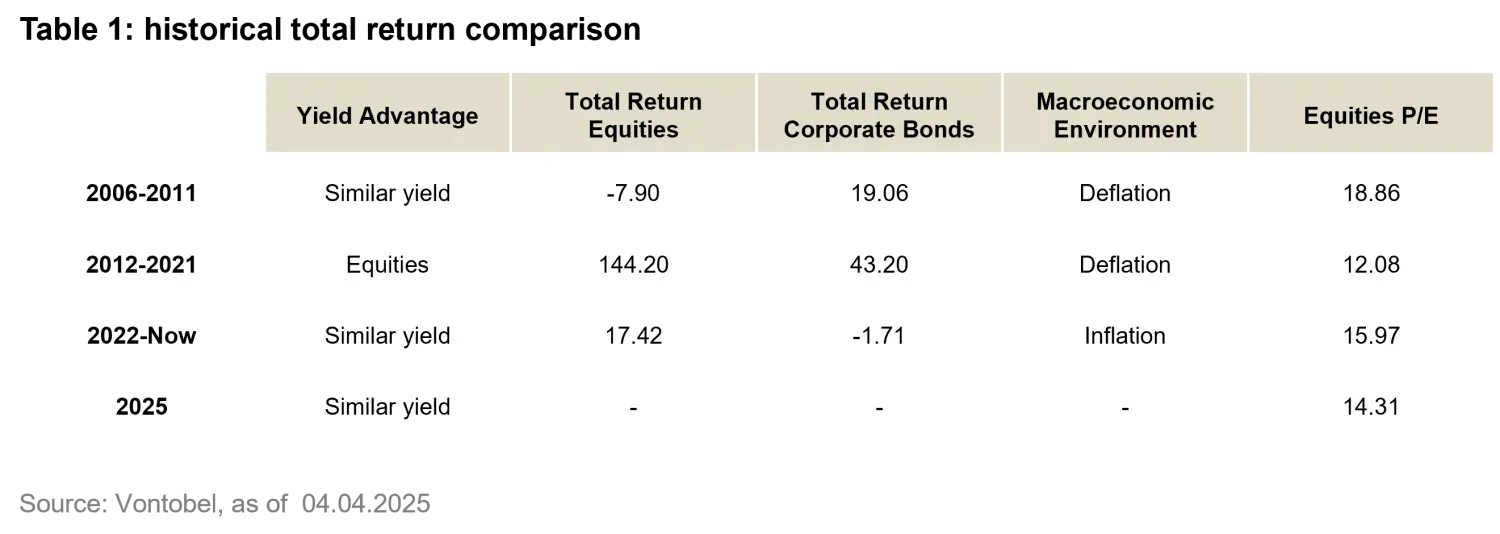
In Table 1, we dissect the historical returns of the two indices into three distinct phases. During the 2006-2011 period, the indices offered a similar yield, but equities were costly (high P/E) at the onset of this period. This phase was notably marked by the 2008 Global Financial Crisis and the 2011 European sovereign-debt crisis. In this deflationary phase, the income from the corporate bond indices yielded better total returns. During the quantitative easing period of 2012-2021, the equity index had a significant yield advantage, a result of strategies implemented by the European Central Bank. Despite a deflationary macro environment that supported a strong positive return for bonds, the total return for equities was considerably higher than for corporate bonds, aided by a low valuation at the start of the period. From 2022 onwards, the nominal yield is once again similar, but against the backdrop of an inflationary regime, equities have yielded better total returns than bonds. In part the robust performance since 2022 is driven by record high buybacks in Europe. A combination of strong cash flow, confidence in operations and the attractive valuation of shares allow management to allocate capital to these programs and could play a significant role for a positive return of European stocks in coming years. Buybacks in Europe have been recently stable at about 1% yield for the MSCI EMU index. The total shareholder yield (i.e. the dividend yield plus the buybacks yield) is a form of income only available to equity investors. It's worth noting that a blend of European equity and corporate bonds income would have resulted in stable returns across various economic cycles and crises , and would have also performed well during an inflation surge.
Concentration, quality, rate sensitivity
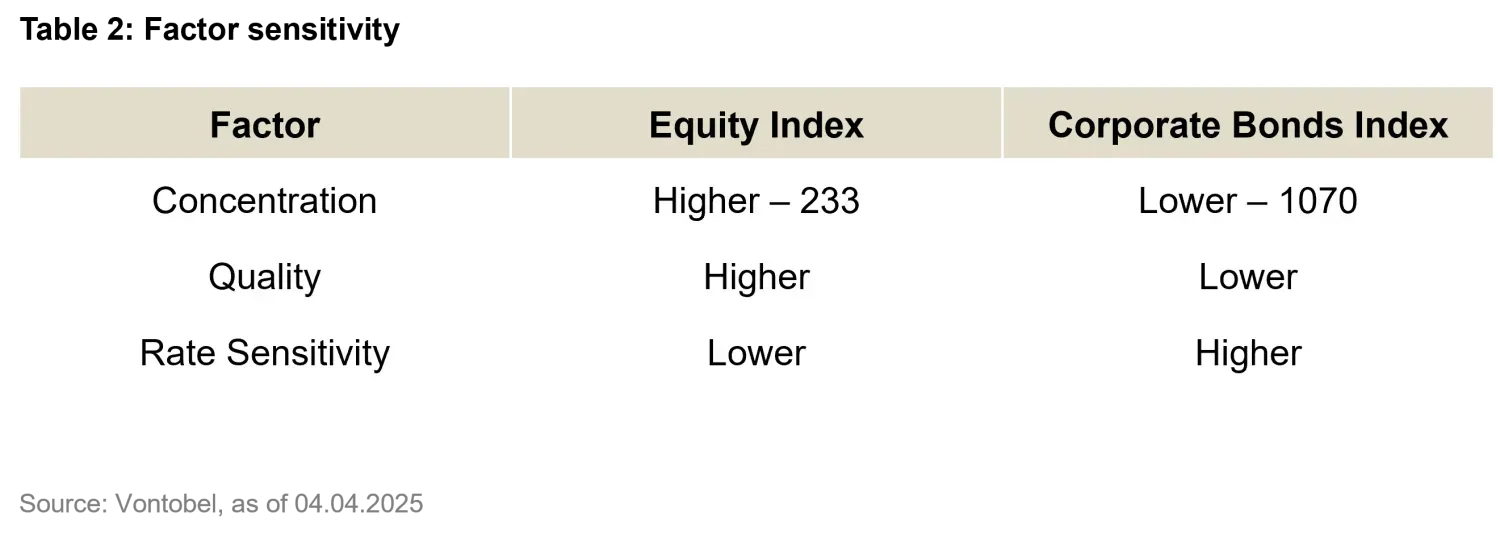
In Table 2, we delve into the specifics factors driving the returns for the two sources. Equity indices are more concentrated than corporate bond indices – in our case, 233 vs 1070 constituents. In addition, equity indices lean generally towards higher quality and this can be explained by two reasons. Firstly, constituents included in the Bloomberg Core Euro Corporate Bond index may have greater financing needs. Secondly, the market capitalization weighting of equity indices favors more established companies with the potential to pay out more persistent income. To quantify the point, we also use MSCI ESG ratings as an additional screen. On this measure, the equity index scores 7. 8 vs 7.2 for the bond index, giving equities a 0.6-point advantage. Finally, high quality companies listed on the MSCI EMU index have strong pricing power for their products or services making them less sensitive to interest rates. This is crucial in understanding rate sensitivity: income from quality equities can better adapt to rate changes than income from corporate bonds.
Add Equity Income
We have demonstrated that European equities can yield an attractive income. Given the current valuations, they present an appealing addition to the portfolio for investors with a medium to long term horizon which is not bothered by daily volatility. Equity income leans towards quality, which can be further emphasized with a quality-centric approach to portfolio selection. This leads to a more concentrated and active equity income management. On the flip side of the barbell strategy, European corporate bonds are best approached with wide diversification. Corporate bonds offer a slightly lower quality compared to equity. Combining two income streams driven by different economic forces strikes a balance between concentration and diversification, enhances overall quality and cushions sensitivity to interest-rate swings. The strategy to incorporate equity income into a fixed income portfolio is beneficial in reducing rate sensitivity and enhancing portfolio quality, regardless of the economic environment, especially when European equities are priced attractively. In recent years, as inflation has made a comeback, the income from European equities has surpassed that from European corporate bonds. Therefore, investors anticipating inflation should favor equity income. The short term daily volatility of equities is less important to long term returns, but over the short term could be a concern for investors. However, equity volatility represents an opportunity for an additional income stream in combination with covered call strategies. Therefore, pairing equity income with an enhanced covered calls strategy further strengthens its appeal to generate a stable income from equities.