Macro
In the second week of October, it became clear that trade tensions remain very much alive. Investors and markets had grown somewhat numb to the issue recently. However, China’s decision to tighten control over rare earths and other key sectors essential for high-tech manufacturing, including electric vehicles and jet fighters, signaled a strategic move to strengthen its leverage ahead of negotiations. Exports of rare earth metals now require a license, giving Beijing tighter control over supply. This provocation quickly drew a response: Trump announced plans to impose additional 100% tariffs on China starting in November. As usual, tensions eased somewhat over the following weekend, but the message was clear: critical commodities such as rare earths, advanced semiconductors, and even soybeans will remain central battlegrounds and no one will give in easily. In our view, there will be a meeting between Trump and Xi on the 31st October in South Korea as too much is at stake at both sides.
The U.S. federal government has been shut down since October 1 and will remain closed until Congress reaches a funding deal. The shutdown has suspended data collection and publication by key agencies such as the Bureau of Labor Statistics and the Census Bureau. It’s still unclear how the timing of data releases will be affected once operations resume. In the meantime, markets are expected to rely more heavily on alternative data to gauge the direction of the economy. Let’s hope that the Fed members get more insights ahead of the FOMC meeting on the 29th October. Despite strong equity and gold rallies and tight credit spreads, markets appear overly confident in a rate cut. However, the September FOMC minutes showed little dovishness, and recent unofficial indicators point to rising, not easing, inflation. For us, the implied probability from Fed fund futures of 96% seems inflated and the risk for disappointment is high.
In China, spending during Golden Week was subdued: The number of tourists grew by 1.6%, but the spending per tourist fell by 0.6%. To support growth, Beijing announced a RMB 500bn mini-stimulus focused on infrastructure. We see a major stimulus as unlikely in the coming weeks, as policymakers remain on track to hit the 5% GDP growth target. The upcoming 4th Plenum (20th -23rd Oct) will shape the 15th Five-Year Plan (2026–2030) and is expected to stress domestic demand. However, as long as the export-led growth model that China is running since 2021, is not running out of steam (exports grew 8.3% in September vs expectations of 6.6%), officials don’t need to worry too much about domestic demand.
Precious metals
Gold’s key drivers constantly shift, and the best scenario is what we’re seeing now: when one driver fades, another takes over. From 2022 to early 2025, central banks, especially in emerging markets, became a major source of demand, seeking to de-dollarize their balance sheets by increasing their gold reserves. Despite heavy ETF outflows caused by high interest rates, strong central bank buying lifted prices, with net purchases averaging about 1,000 tons per year over the past three years. In 2025, that pace has eased to roughly 400 tons in H1 as high prices prompted some banks to hit their reserve targets1.
As central bank buying slows, a new driver has emerged: ETF inflows, back after four years of outflows, with investors adding 14 million troy ounces so far this year. Bar and coin demand also saw its strongest first half since 2013.
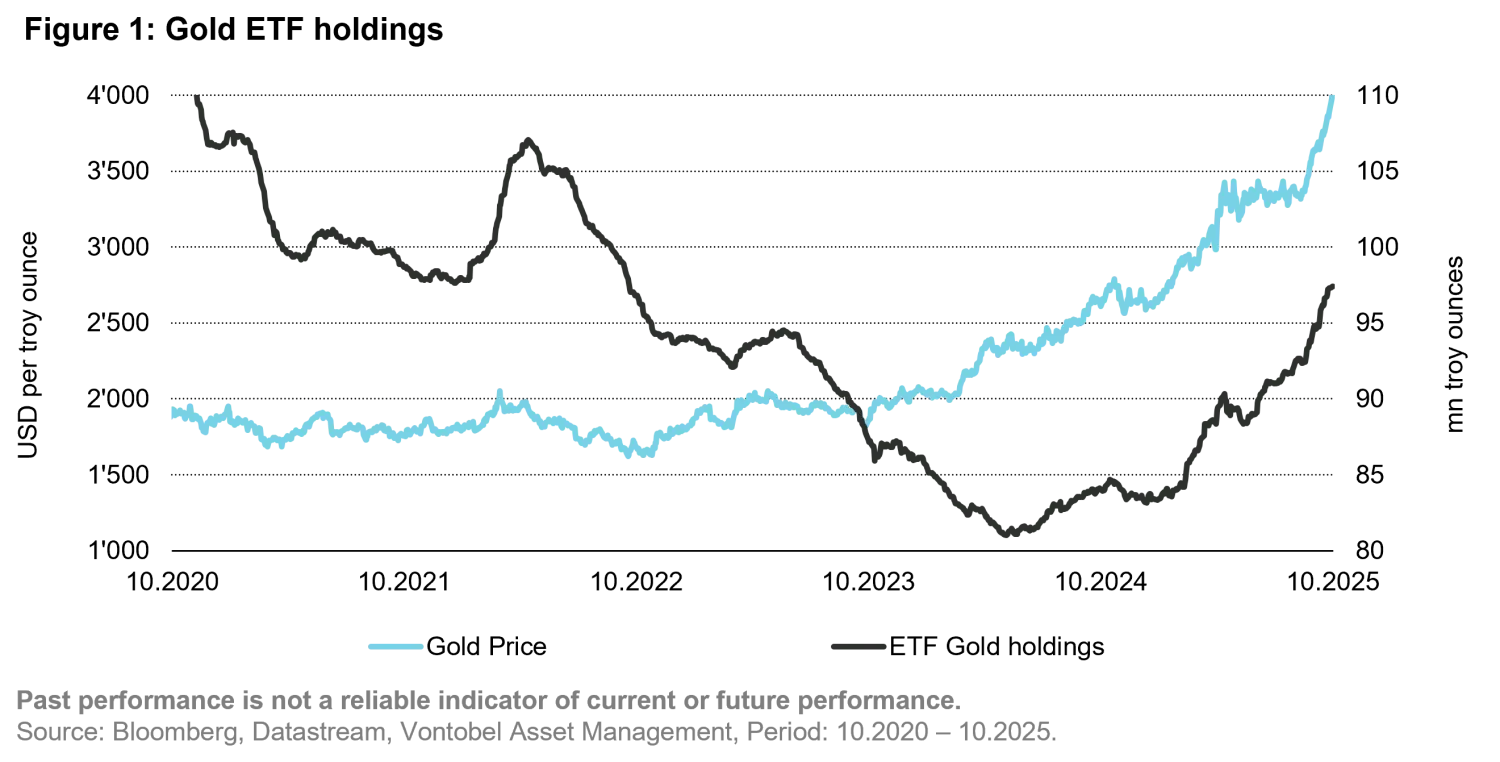
ETF inflows are strong but still have room to reach the 2020 peak of 111 million ounces. Speculative positioning also has upside: net futures held by money managers are rising, yet remain well below the highs seen in 2024 and 2020 (see figure 2).
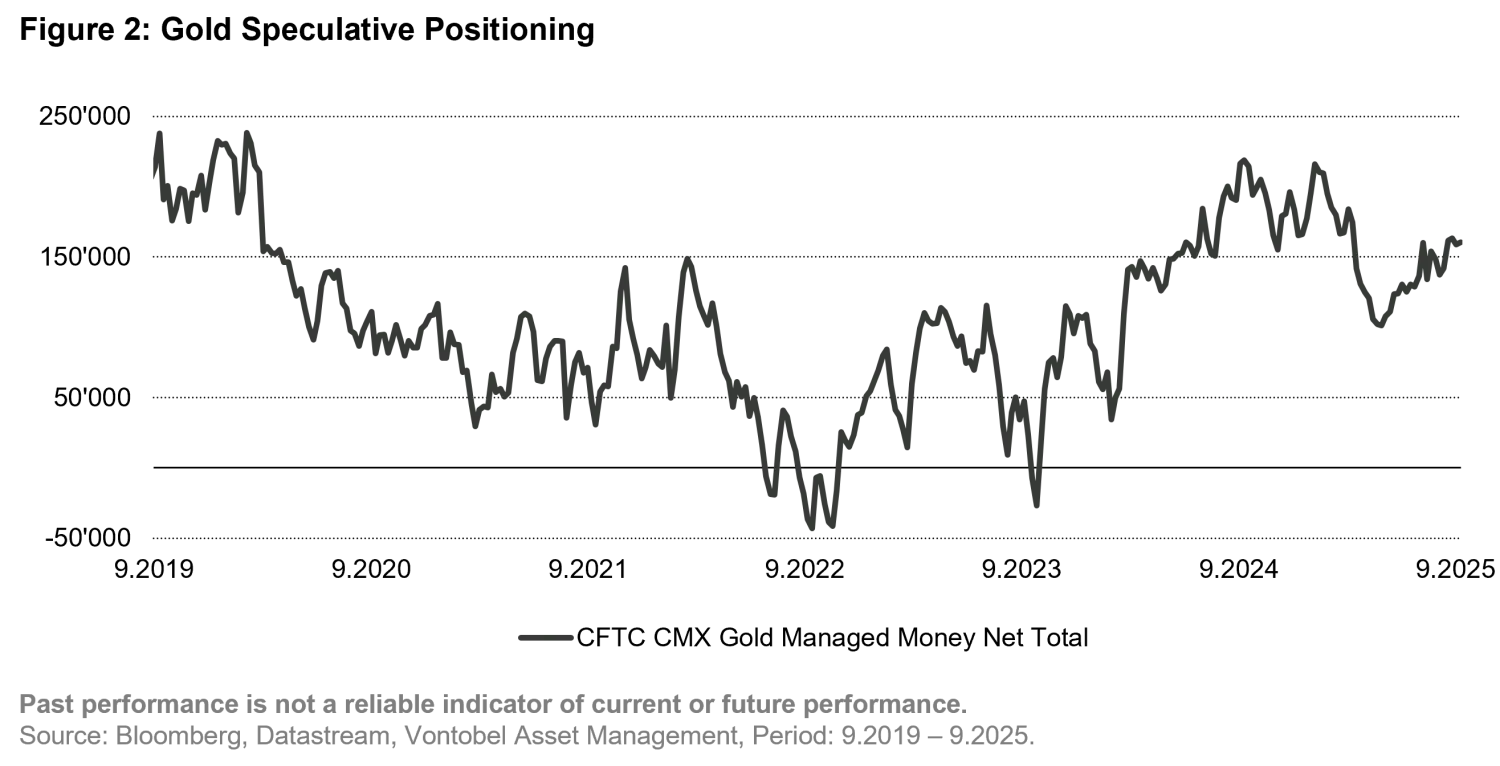
We conclude: there is room for investors to add to positionings. The question is now: why are investors piling into gold at record prices and how long will the trend last?
All the reasons that account for gold attractiveness are not to fade anytime soon:
- Concerns around Fed independence, which is in our view one of the most important factors for safe-haven demand. This is especially relevant until May 2026 gets closer, with the possibility of a Trump-aligned Fed chair and a dovish rate environment.
- Going along with 1): inflation protection. The bond market is not yet pricing in a loss of control over inflation. Instead, gold is being used as a “tail hedge” by investors.
- Concerns about rising government debt levels, particularly in the US.
- Going along with 3): De-dollarization. Investors are looking for ways to de-risk their portfolios vis-a-vis US sovereign risk. Consensus is short USD, but is not quite sure what to purchase instead. This uncertainty leads us straight to gold.
- Growth risks as labor market cools in the US and macroeconomic data worsened in China.
What are the risks?
- Demand destruction: Jewelry consumption, particularly in China and India (which make up 50% of global gold jewelry consumption) is weakening, especially with record high prices.
- ETF flows and speculative futures positioning can be flighty: gold is a non-yielding asset, so it must justify its place in portfolios. If prices pause or decline, this could trigger self-reinforcing selling, particularly if other asset classes performed well.
- So far there is subdued recycling activity as European and US consumption is still healthy and not under stress. If growth concerns materialize in a slowdown, this could change and make more gold available.
We don’t expect gold prices to collapse anytime soon. Major pullbacks have been rare in recent years. However, the recent rapid rally suggests to us that volatility is likely to be higher in coming months and we anticipate more frequent corrections. These dips are likely to be short-lived and quickly bought, rather than signaling sustained weakness. We continue to hold an overweight in gold. The risks and concerns highlighted above are not new. In fact, we expressed them back during Q1 2025. That said, we’re pleased we maintained our overweight in precious metals, particularly gold, during its consolidation phase between April and August.
Industrial metals
The strength of industrial metals surprised us. We expected some headwinds for H2 2025, as we anticipated some fading of frontloaded goods and export demand, while higher tariffs weighing on global industrial production. However, a weak US-dollar, supply disruptions and low European (LME) inventories supported prices and kept curves in backwardation.
Since the tariff-induced correction end of July, copper recovered around 16%2. While the first half of the year was driven by strong (Chinese) demand and copper related tariff fears, the second half of 2025 is dominated by supply disruptions. Major production downgrades, from Teck’s Quebrada Blanca mine in Chile (-80kmt for 2026), Grasberg in Indonesia (-270–280kmt) and disruptions at Congo’s Kamoa-Kakula mine have removed roughly 350kmt from 2026 global supply in recent weeks. Declining ore grades, which push miners to dig into harder rock, are causing a rise in accidents.
Demand seems to remain resilient for now, supported by long-term optimism around AI-driven electrification. Positive macro sentiment and expected Fed rate cuts add tailwinds. Therefore, we reduced our underweight in industrial metals by increasing the fund`s copper positioning. We still have a sizeable underweight in zinc as we believe that rising copper inventories in China should soon spill over into the almost depleted LME zinc inventories.
Energy
While geopolitical tensions between Israel and Iran have eased in recent months, the Russia-Ukraine war continues to impact oil markets. Ukrainian drone strikes on Russian energy infrastructure have intensified, taking more than 1 million barrels of refined crude capacity offline. As the world’s second-largest diesel exporter, disruptions to Russian infrastructure matter. The challenge for Moscow is clear: its vast airspace is nearly impossible to defend against swarms of small, low-flying drones that evade radar detection. What’s particularly striking is the shift in geopolitical restraint. In recent years, both in this conflict and during the Iran tensions earlier this summer, there was a strong focus on avoiding damage to energy infrastructure, most likely to prevent price spikes. The latest strikes, however, suggest a change in approach - implying tacit US approval to target energy assets.
Refinery attacks are bullish for diesel and gasoline but bearish for crude oil. With Russia unable to refine part of its crude, it’s exporting more unprocessed oil, a dynamic that’s weighing on prices for now. However, this effect has limits. Damage to pumping stations at export terminals is constraining Russia’s export capacity, forcing it to store more crude itself. Once storage fills up, production cuts or even “shut-ins” will likely follow, which would flip the outlook and turn bullish for crude.
Excluding geopolitical tensions, which are the wildcard for oil prices, there are two other topics that are dominant in oil price development for the months to come: China crude oil purchases and OPEC export ability.
One key reason oil prices have fallen only about 7.5% year-to-date3 (Brent), despite a significant global inventory build, is that China has absorbed much of the surplus while OECD inventories remain near multi-year lows. Since OECD stocks still drive global crude benchmark pricing, this has helped keep prices firm and the market in backwardation. The key question is whether China will continue buying at the same pace. We believe it will continue buying however at a slower pace. Recent stockpiling appears driven less by spot prices or short-term fundamentals and more by broader strategic goals: de-dollarization, energy security, and protection against domestic currency risk. Oil remains a strategic asset for China, which is particularly exposed to geopolitical disruptions given it imports around 12 million barrels per day (mbpd) of its 16 mbpd demand.
The other reason for oil prices to hold up for now is that OPEC`s exports in recent months are lacking substantially the amount that was implied by the increase of production quota since April. What happens in October will be very important: will OPEC increase their export program as their oil consumption falls after summer season, or are they simply constrained due to spare capacity? Increasing supply could show how much spare capacity really exists. It could help producers who are still able to boost output. gain market share and counter the idea that spare capacity is plentiful. The market seems to have started to question the real spare capacity of OPEC as well, as the longer end of the oil futures curve is ticking up lately.
While we recognize that there are several question marks around OPEC`s export ability as well as Chinese future oil buying, we believe that oil price risks are skewed to the downside for Q4 2025 and Q1 2026. More Russian crude supply, higher NON-OPEC production and refinery maintenance are likely to lead to an oversupplied oil market and eventually to OECD inventory builds as well. Therefore, the fund holds an underweight in crude oil while keeping an overweight in oil products, such as diesel and heating oil. We think that risk for oil products is skewed to the upside due to Russian refinery outages and the new EU sanction package that is banning products refined from Russian crude oil from 2026 on.
Agriculture
Grain prices faced a tough third quarter in 2025. Near-perfect US growing conditions, record plantings of grains and oilseeds, and the ongoing tariff dispute - keeping China, the US’s largest usual buyer, on the sidelines - have all weighed on prices.
Looking ahead to the final quarter, harvest pressure typically limits large price recoveries. But as amount and quality of the corn and soybean crop harvest become clearer, export demand takes center stage. Mexico is expected to continue importing large volumes of US corn, especially as the US/Mexico cattle border closure forces them to feed cattle domestically. China, normally buying ~25% of US soybeans, has yet to secure any. China has already secured its soybean needs from Argentina and Brazil up to November, leaving only a narrow window for potential US purchases. From January onward, China typically resumes buying from Brazil, further limiting opportunities for US exporters. While the upcoming Trump-Xi meeting will touch on agricultural trade, a Phase 1–style deal is unlikely. China has indicated it will return to US soybeans only if fentanyl tariffs are lifted, but the US currently collects around USD 90bn annually from these tariffs and prefers a USD ~10bn direct farmer bailout instead. These payments may encourage farmers to hold crops, reducing urgent sales to generate liquidity in the short term. However, a farmer bailout is rather a bearish sign medium to long term. We have held on to our bearish positioning in grains for most of the year. But will likely reduce risk ahead of the Trump-Xi meeting end of October.
In soft commodities, we’re watching Brazil’s sugarcane crop closely. So far there are no constructive fundamental news around sugar. Cocoa prices are likely to fall further amid weakening demand, while coffee remains caught in tariff uncertainty. Brazilian coffee beans are so far not excluded from the 50% US import tariff, causing a reshuffling of trade flows which keeps coffee prices artificially high. We believe that this rally will fade and are comfortable with our underweight in coffee. Seasonally, the US cattle market softens early in Q4, but tight fundamentals, herd rebuilding, and lingering screwworm concerns in Mexico should keep prices supported.
Conclusion
Inflation, the US dollar and supply conditions will dictate much of how commodities will do for the remainder of the year. Precious metals are likely to lead the pack not just in commodity markets as a whole but also as the main outperformance drivers in our Vontobel Fund – Commodity that is 5.5% ahead of the Bloomberg Commodity Total Return Index per 10.10.2025 since the start of the year. In the unlikely event that the precious metals rally loses steam in the short term, our fund is well positioned to make use of return dispersions being broadly diversified across roughly 30 different commodities, each of which responds to a different set of drivers.