
Costa de Roll: How to ride the commodity curve?
Multi Asset Boutique
Commodity futures are widely used by investors, asset managers, and corporations to gain exposure to raw materials such as energy, metals, and agricultural goods. While most market participants focus on spot price movements, the performance of a long-only futures investment depends on more than just the underlying commodity’s price.
A key but often underappreciated element is the roll return. Roll returns can substantially impact long-term investment results, particularly in commodities where futures curves exhibit persistent contango or backwardation. This article explains the existence and the role of roll returns, situates them within the total return decomposition of a long futures position, and relates them to the cost-of-carry framework. Finally, it highlights the impact of roll costs on long-only commodity futures index investments. Fortunately, there are ways investors can mitigate roll costs, and take advantage of a roll optimized commodity investment strategy like the actively managed Vontobel Commodity Fund.
Total return from a long futures position
When an investor takes a long position in a futures contract, the return generated is not as straightforward as the change in the underlying commodity price. Instead, the total return of a fully collateralized long futures investment can be decomposed into three components: (see Erb & Harvey, 2006):
$$ R_t^{\text{total}} = R_t^{\text{spot}} + R_t^{\text{collateral}} + R_t^{\text{roll}} $$
The spot return \(R_t^{\text{spot}}\) reflects changes in the nearby futures price, which converges to the spot price at maturity. It provides the investor with direct price exposure to the underlying commodity.
Since futures require only some initial margin, the notional capital is typically invested in short-term, risk-free collateral such as U.S. Treasury bills. The collateral return \(R_t^{\text{collateral}}\) reflects the interest earned on that collateral.
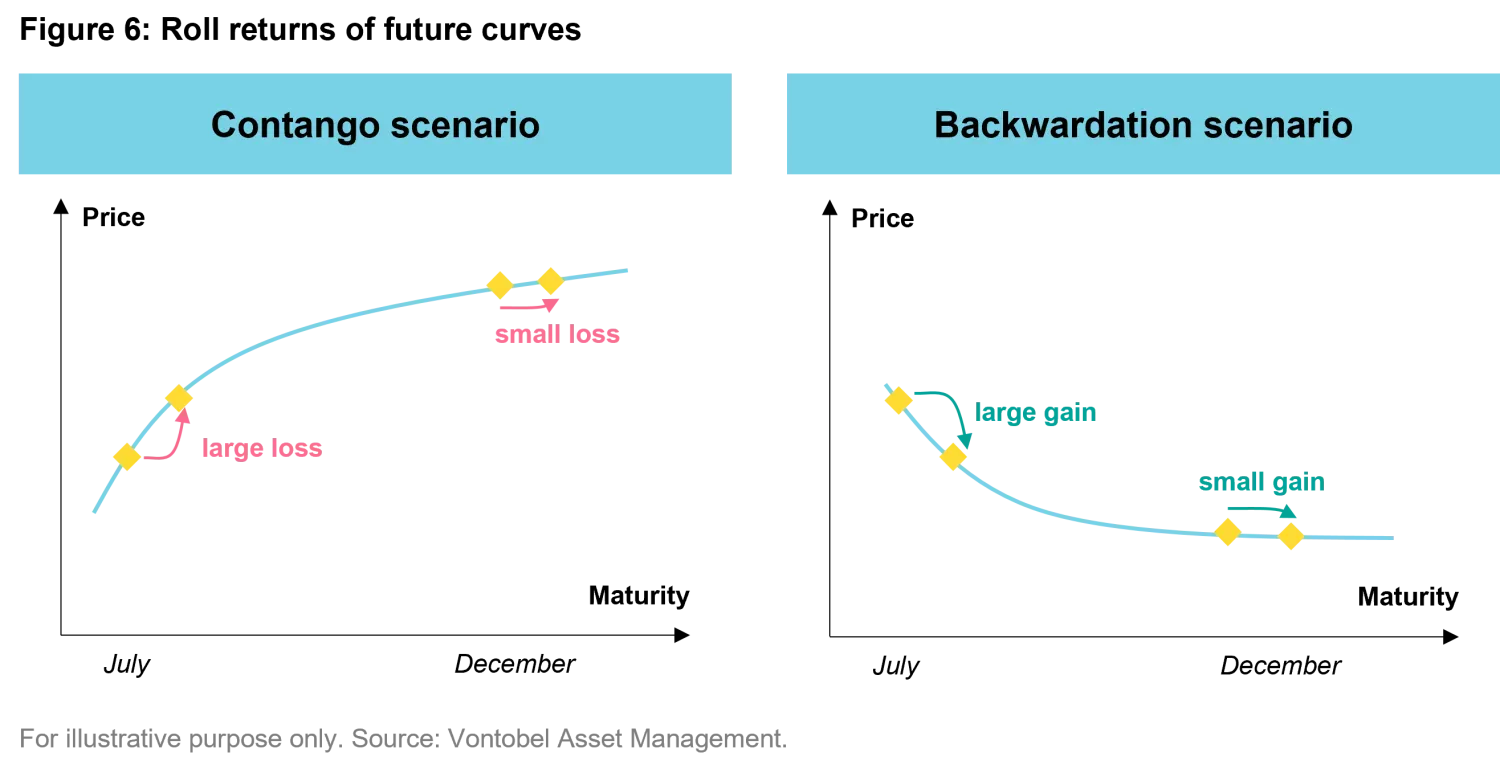
The roll return \(R_t^{\text{roll}}\) arises because futures contracts have a pre-defined maturity date and must be rolled into a later-dated contract to maintain exposure. If the futures curve is in contango (longer maturities priced above near maturities), rolling involves selling the expiring contract low and buying the next one high, resulting in a negative roll return. If the curve is in backwardation (longer maturities priced below near maturities), the process produces a positive roll return.
This decomposition explains why commodity indices or ETFs based on futures may diverge significantly from the underlying spot commodity’s performance. The spot return is the most intuitive and it reflects the underlying market trend. The collateral return depends on prevailing interest rates and collateral policies and most commodity index investors assume collateral is fully invested in short-term US Treasuries. The roll return captures the cost or benefit of maintaining exposure in a market where futures contracts deviate from spot prices. It reflects the market’s view of storage costs, convenience yield, and financing (more on that below). Finally, the excess return on a futures position is simple the spot return plus roll return1.
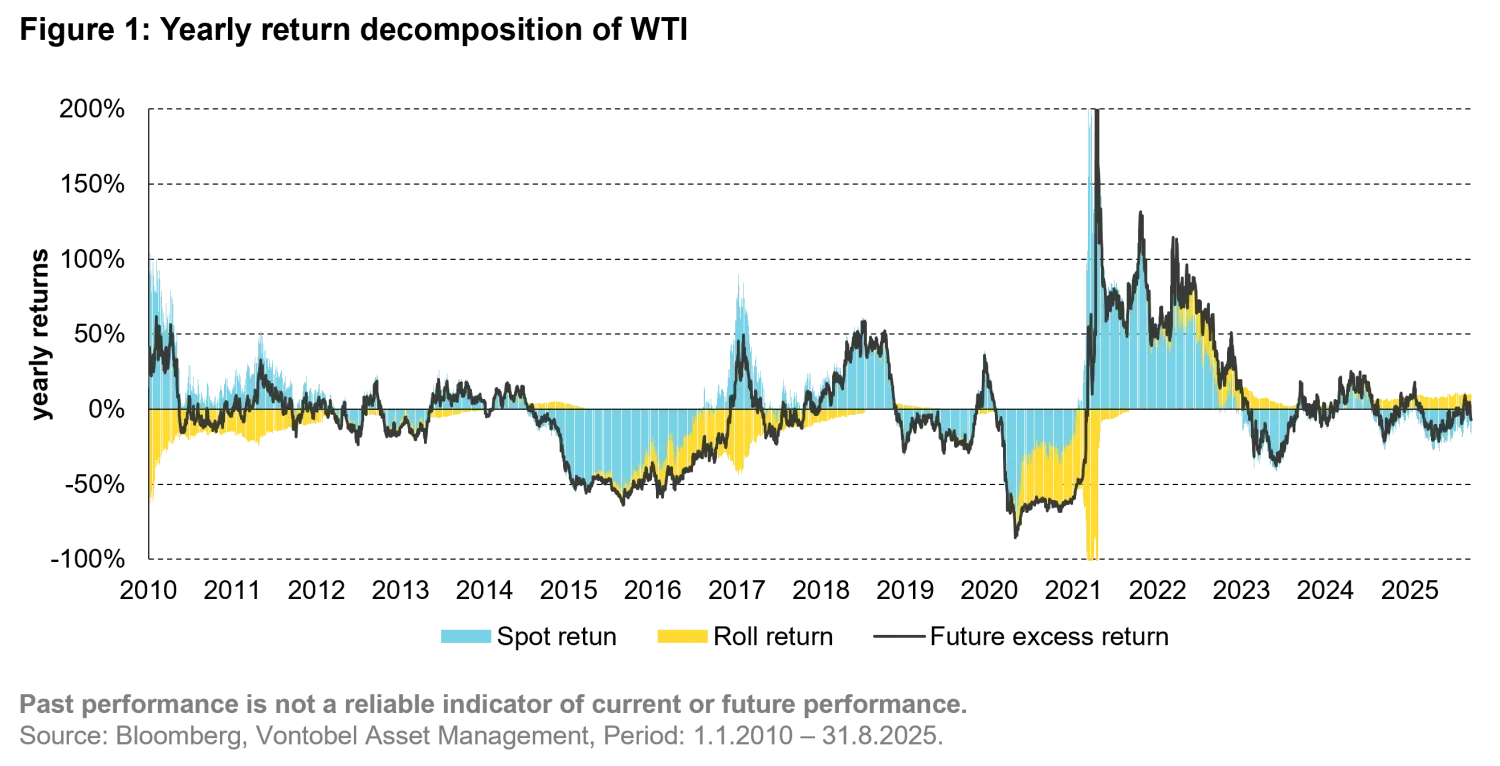
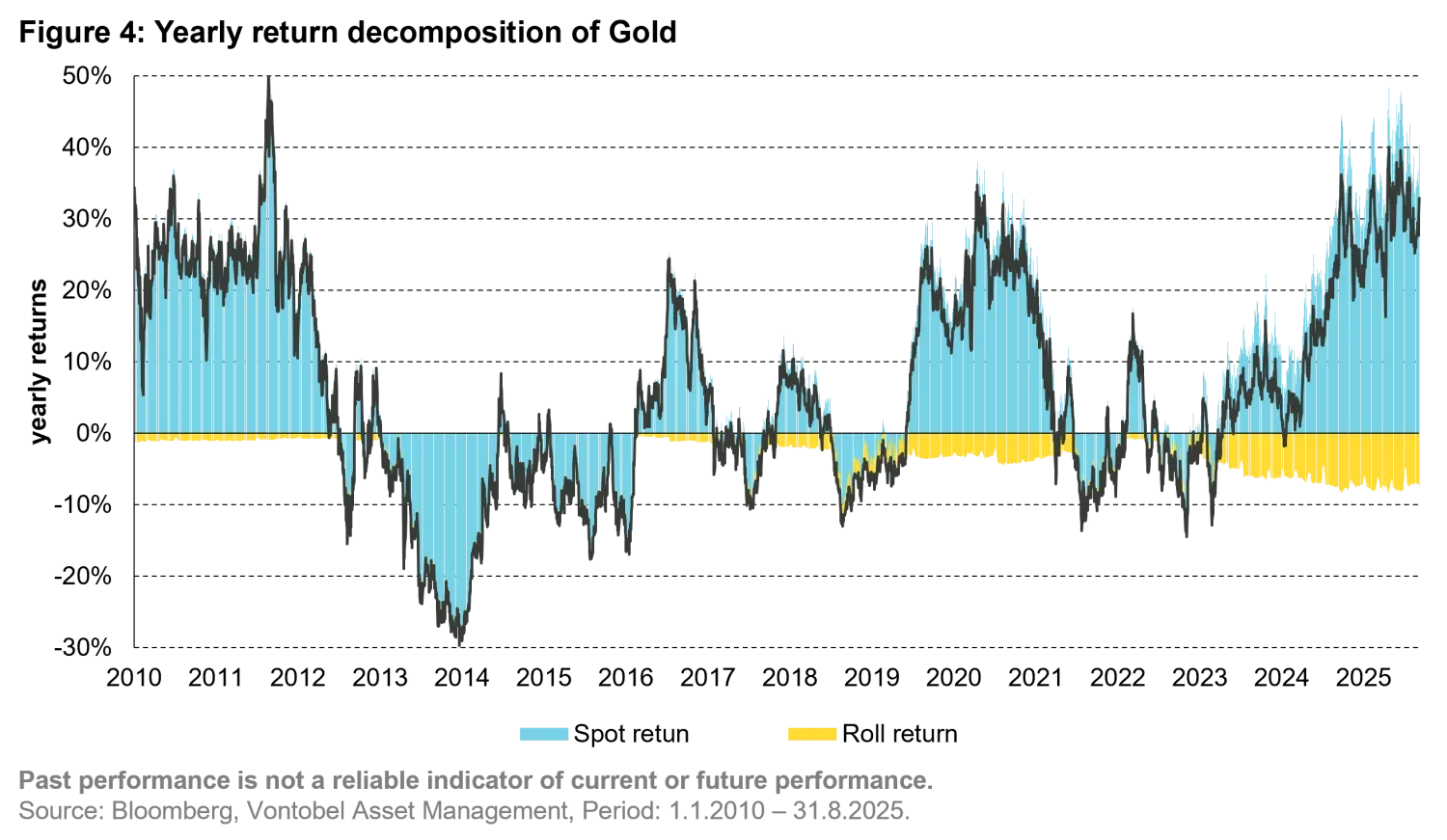
We will discuss some historical examples to better understand the return decomposition and the effect of spot and roll returns on commodity futures excess returns. The charts below decompose yearly returns on the front futures contract into the spot return and roll return component.
- Oil Markets: WTI crude futures often traded in contango during the shale oil boom in the 2010s. Investors in oil ETFs frequently experienced losses from negative roll returns, even in periods when spot prices were stable (2010-2019). During the “oil price war” between Saudi Arabia and Russia in 2020, the futures curve turned into a super-contango, meaning an investor that needed to roll at the beginning of April from May into July contract (such as BCOM index), already lost more than 40% just by rolling from one future into the next. When the energy crisis started in 2022, oil curves shifted into backwardation, and positive roll returns gave a cushion to often negative spot returns. Since OPEC started with its production cuts in 2023, they artificially generated quite stable positive roll returns until today.
- Natural Gas is a very seasonal commodity, with peak demand and high incentive for producers to release storage during winter, leading to a backwardated futures curve typically from January to April. On the other hand, excess production and high incentives for producers to build up storage during the rest of the year (until start of winter) tends to shift the curve into deep contango. Besides these storage dynamics, during winter spot prices have the tendency to spike up as a result of cold weather shocks (e.g. December 2013 and 2018, or March 2023), pulling the futures excess return shortly into positive territory. Nevertheless, the average annual return on the natural gas front contract has been deeply negative, close to -25% p.a. from 2010 up until the energy crisis in 2022. This is mainly due to a structural contango caused by excess production from the US shale revolution starting around 2010.
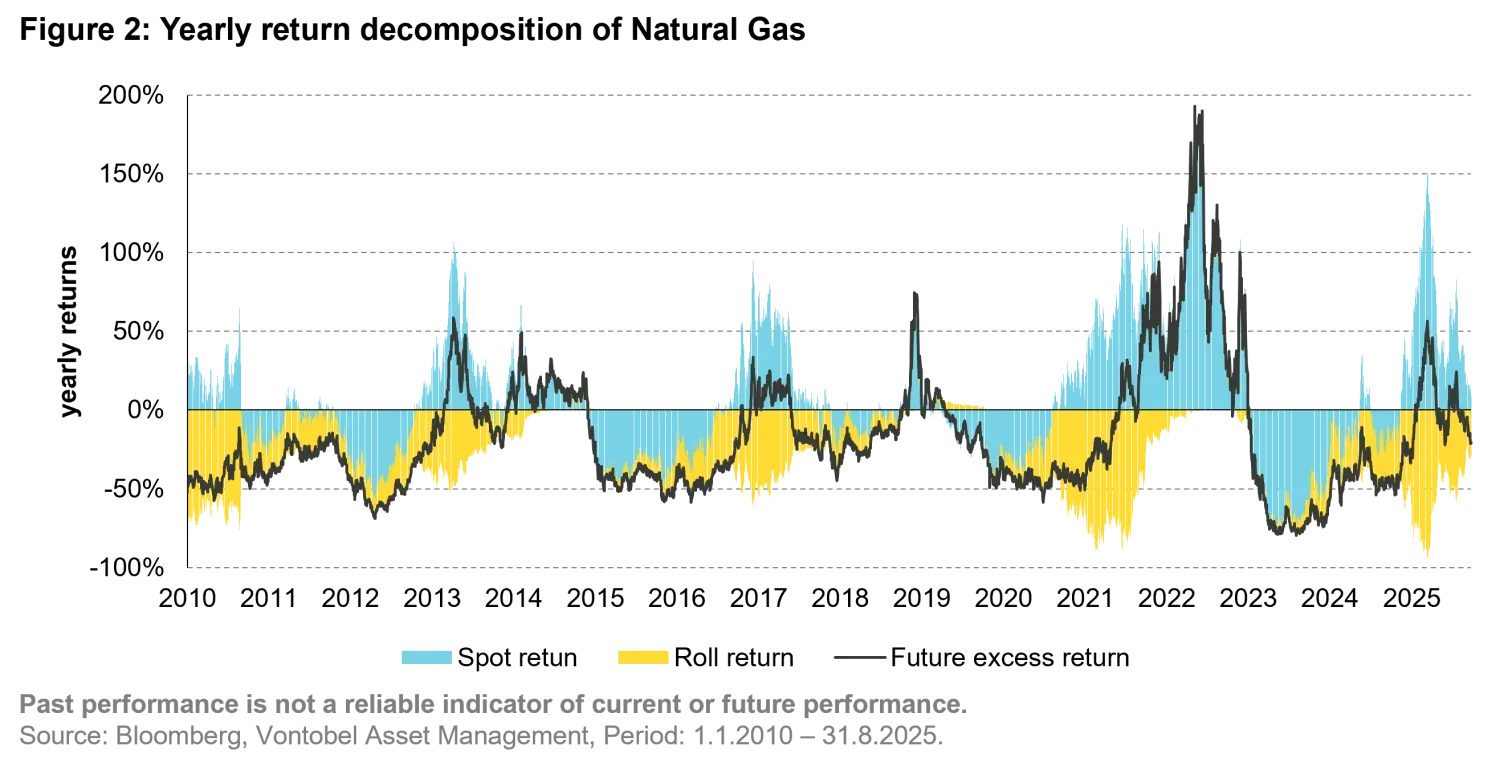
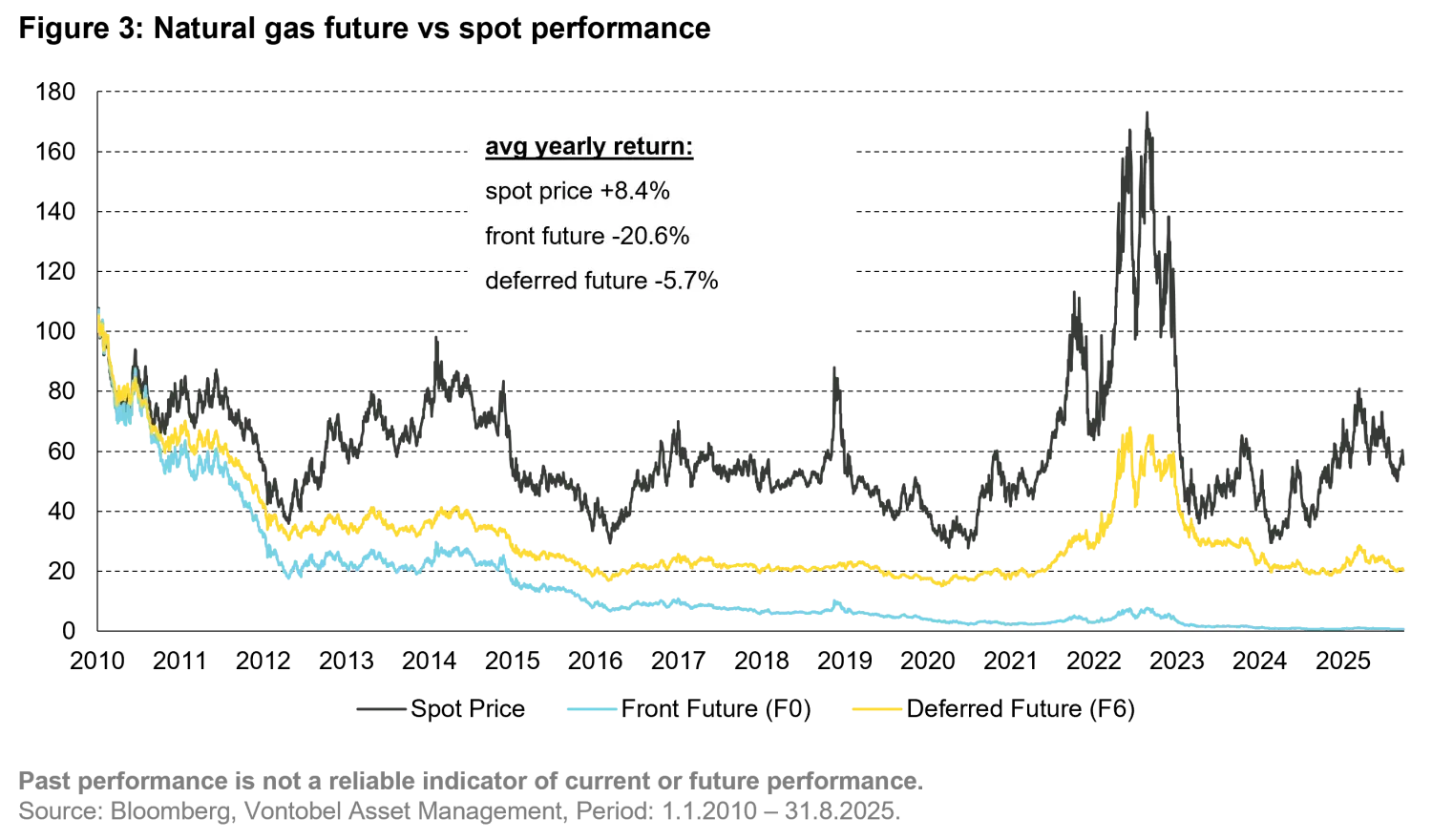
Figure 3 visualizes how much a contango structure can erode your return potential. The natural gas futures contract at the front underperforms the spot contract (that does not need to roll) massively due to negative roll costs most of the time. You can dampen some of the roll costs by moving away from the front of the futures curve. For example, the deferred natural gas future performs better over time. It can matter a lot over the long term, where you are positioned on the futures curve!
- The Gold futures are typically in a structural contango, reflecting interest rates, which are the main opportunity cost for gold as a non-yielding asset. Thus, roll returns are slightly negative over time. Compared to other commodities like natural gas though, roll returns tend to matter less in absolute terms. Spot returns are very close to excess returns most of the time.
Overall, these examples highlight the importance of both return components. Investors can be right on the direction of a commodity (i.e., making a good call on spot prices), but can see their efforts annihilated by a futures curve positioned unfavorably.
The cost-of-carry model and the term structure of futures prices
The fact that future prices are higher or lower than spot prices is mainly dependent upon the fundamentals of the physical markets and the level of inventories: backwardation reflects a market in deficit and contango reflects a market in surplus. The shape of the futures curve, and the behavior of roll returns is best understood through the cost-of-carry model (see Hull, 2022):
$$ F_{t,T} = S_t \, e^{(r + u - y)(T - t)} $$
Where \(F_{t,T}\) is the futures price at time t for delivery at time \(T, S_t\) is the spot price at time \(t,r\) is the risk-free interest rate (financing cost), \(u\) is the storage cost (including insurance, warehousing, etc), and \(y\) is the convenience yield (benefit of holding the physical commodity).
The relationship between costs and convenience yield of holding the physical commodity determines the slope of the futures curve, as seen below in Figure 5. If the costs of holding the physical commodity are higher than the convenience yield, longer-dated futures price are more expensive than near-dated ones (i.e., the spot price). Thus, the futures curve is upward sloping (contango), and roll returns are negative. If the convenience yield of holding the physical commodity is higher than its associated costs, longer-dated futures prices are cheaper than the spot price. Hence the futures curve is downward sloping (backwardation), and roll returns are positive.
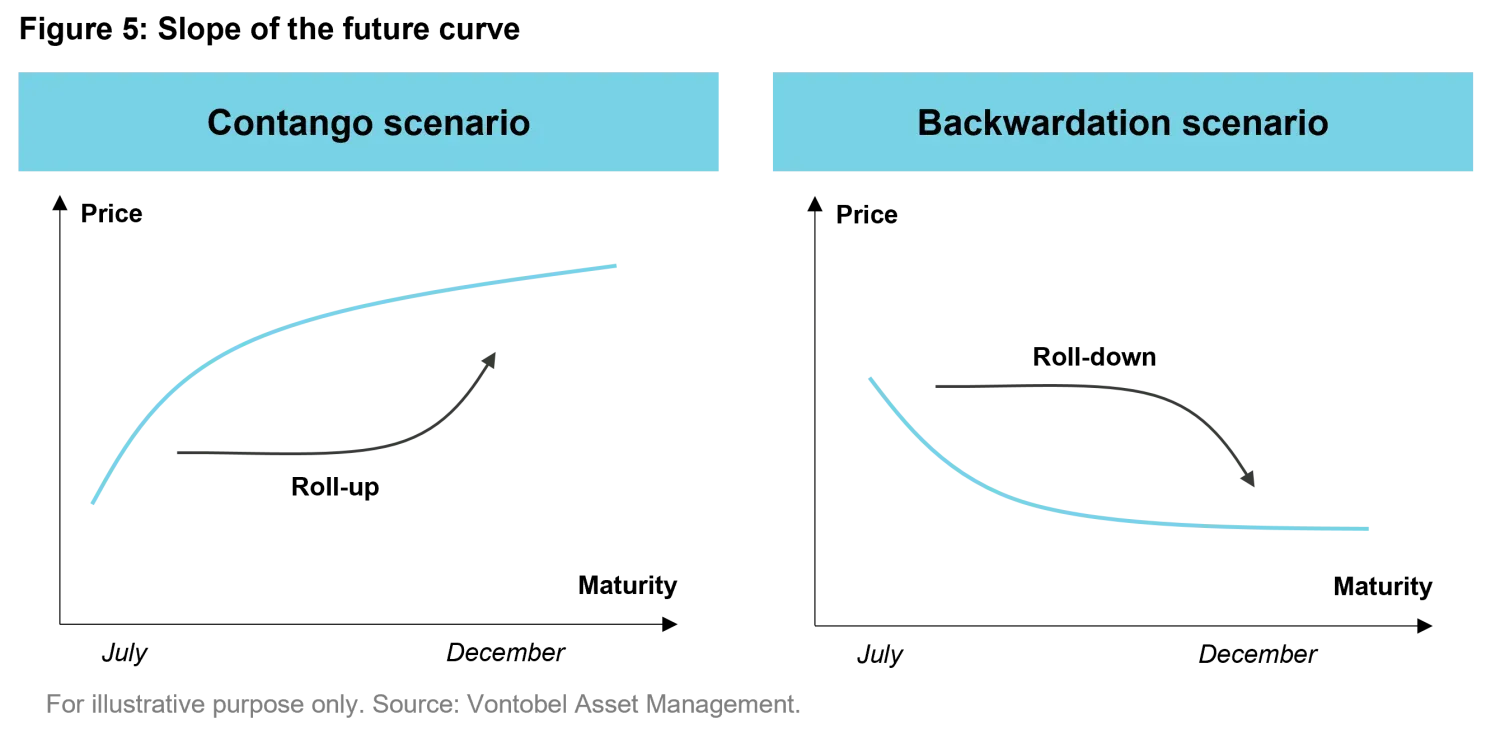
From an investor’s perspective this means that negative roll returns occur in contango, where storage and financing costs outweigh convenience yield. This typically represents a situation with abundant supply and high inventories. Rolling in this case means selling the expiring low (near-term contract) and buying high (longer-term contract), leading to a negative roll return. Alternatively, positive roll returns occur in backwardation, where scarcity and a high convenience yield make holding the commodity valuable. Convenience yield at first sounds a bit abstract. Imagine a car manufacturer who needs aluminum. If there was scarcity in aluminum, the car manufacturer would be willing to pay a premium in order to have the “convenience” to hold the metal physically and keep on producing cars. Not having aluminum would cause his production facilities to stand still, which comes along with massive costs. This is associated with a tight supply/demand balance, leading to low inventories. Rolling in this case means selling high and buying low, resulting in a positive roll return.
Thus, roll returns are the realized payoff of cost-of-carry dynamics when the futures positions are rolled forward. This dynamic helps to explain why some commodity indices underperform even when spot prices are stable, or why certain strategies benefit disproportionately from backwardated markets.
The shape of the futures curve and implications for commodity investors
Commodity futures curves are rarely linear. In practice, they are often steep at the front end and flatter at the longer maturities. This curvature reflects how storage costs, financing, and convenience yields impact different parts of the curve. In an oversupplied market (contango), the storage and financing costs are most burdensome in the short run (i.e., steepest premium in near maturities), but as the maturity horizon extends, incremental costs diminish. Alternatively, in periods of scarcity (backwardation), the benefit of holding the physical commodity (convenience yield) is very high in the short term but declines as maturity extends, flattening the curve at the back end.
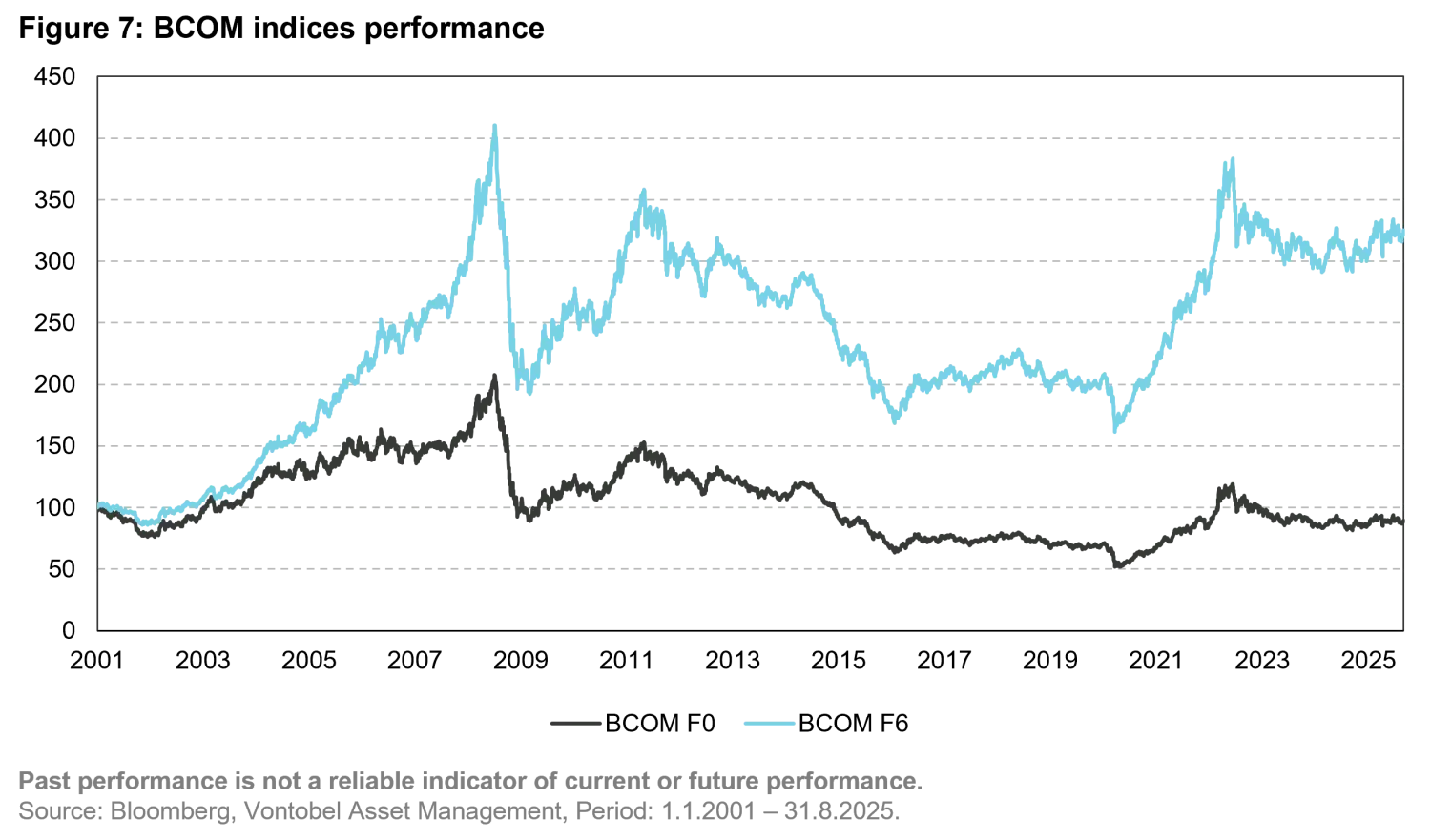
Contango curves are typically concave while backwardated curves tend to be convex. The curvature of futures curves has direct consequences for roll returns. When rolling in contango, the largest negative roll yields occur at the short end of the curve (where the steepness is greatest). As a result, indices rolling every month at the front of the curve (e.g., BCOM F0) suffer persistently from negative roll drag, as illustrated in Figure 6. By contrast, indices that roll into longer-dated contracts (e.g., BCOM F6, which holds contracts six months out) avoid the steepest part of the curve. Since the curve flattens further along, the negative roll impact is reduced. In backwardated markets, the reverse holds: roll benefits are strongest at the front. Investors rolling further out may capture less of the positive roll yield. Active managers can position themselves and harvest the roll returns by taking long or short positions based on the expected roll returns.
The implication of the curve shape on roll returns can best be seen at the performance gap between the Bloomberg Commodity Front-Month Index (BCOM F0) and the six-month forward version (BCOM F6). Over the last 20 years, BCOM F6 has significantly outperformed BCOM F0, shown in Figure 7. This is because many commodities were persistently in contango (as can be seen from the return decomposition above) with steep short-end curves, causing F0 to realize large negative roll returns. The difference between the F6 and the F0 (i.e. going long F6 and short the F0) is the standard curve carry investment strategy, monetizing the difference in roll returns along the commodity futures curve.
Conclusion
Roll returns are a critical but often overlooked driver of commodity futures performance. While spot prices attract most attention, the slope and curvature of the futures curve, shaped by storage costs, financing, and convenience yields, can have an equally large impact on investor outcomes. Persistent contango erodes returns through negative roll costs, while backwardation provides a structural tailwind. Historical cases across commodities show that these effects can dominate long-term results, explaining why commodity indices often diverge from spot market performance.
For investors, the implications are clear. Long-only indices such as the S&P GSCI or Bloomberg Commodity Index derive much of their return variation from roll yield, making performance attribution incomplete without it (Gorton & Rouwenhorst, 2006). For hedgers, roll costs can materially affect outcomes, particularly in commodities like natural gas where persistent contango magnifies the drag on positions. And for active managers, “smart roll” or term-structure–based strategies provide a way to exploit these dynamics by favoring contracts in backwardation or minimizing exposure to steep contango (S&P Dow Jones Indices, 2020).
In short, storage and scarcity dynamics embedded in the futures curve make roll returns a decisive factor in commodity futures investing—whether for index investors, corporate hedgers, or active managers.
References
1. As an example, let’s assume WTI crude is in steep contango but spot prices rise. If crude prices rise from $70 to $75, the nearby futures contract also gains value, hence the spot return is positive. f the collateral (e.g., Treasury bills) yields 3% annually, this accrues regardless of price changes. If the investor must sell the expiring contract at $75 and buy the next month at $77, the roll generates a loss of $2 per barrel equivalent, i.e., a negative roll return. Thus, even though spot prices rose, the overall portfolio may deliver disappointing returns because the negative roll yield outweighs the gains.
Erb, C. B., & Harvey, C. R. (2006). The Strategic and Tactical Value of Commodity Futures. Financial Analysts Journal.
Gorton, G., & Rouwenhorst, K. G. (2006). Facts and Fantasies about Commodity Futures. Financial Analysts Journal, 62(2).
Hull, J. C. (2022). Options, Futures, and Other Derivatives. 11th Edition. Pearson.
Keynes, J. M. (1930). A Treatise on Money. Macmillan.
P Dow Jones Indices (2020). A Dynamic Approach to Commodity Investing: The S&P GSCI Dynamic Roll Index Series.



Insight correlati

Towers and the Starlink Threat

Quarterly Commodity Outlook - Halftime Whistle: Fundamentals Take the Field

Investors’ Outlook: E ora qualcosa di completamente diverso

Power moves: The new energy order

Investors’ Outlook: Mettere a fuoco
