
Dynamic FX hedging as alpha
Multi Asset Boutique
Clearing the air
We realize that purist investors out there may frown at the title, calling it an oxymoron, a contradiction in terms. Hedging, so goes the definition, should not be about generating alpha, but rather about smoothing the ride, or factoring out unwanted risk drivers. To add evidence to the argument, there is quite a graveyard of healthy corporates who went bankrupt because their treasurers did exactly that: instead of hedging their firm’s currency exposures, they wanted to turn a profit. And in doing so, they accumulated losses which brought their companies down.
If you were a treasurer of a global gold mining firm, we would agree with that. You have costs in multiple emerging market currencies, revenues in US dollars, shipping costs in a multitude of developed market currencies, and a fine line to balance among all those.
But. If you are the CIO of a pension fund and you invest globally, FX exposure is part of the trade. You can’t decouple the US dollar from a portfolio of US corporate bonds. It’s an inherent risk you’re taking. We argue that you almost can’t have a view on a foreign asset without having a view on its underlying currency. Otherwise, bad surprises may be in store.
The USD thus far
Donald Trump’s win in this year’s presidential election has given a boost to the US dollar, producing winners and losers across the globe. Already before the elections, “long USD” was one of the most popular Trump trades. In fact, it led the US dollar to appreciate against the Euro by more than 3.8 percent from end of September until election day1. The US dollar may have strengthened for now, but the effects of the Trump administration’s envisaged policy changes are likely to result in more US dollar volatility against other currencies. Volatility can be an opportunity if you do something about it, it’s risk if you don’t.
Despite the compelling arguments for the trade, many investors choose to do nothing about it. Most in fact keep their US dollar exposure statically hedged. This is costly. Being positioned on the wrong side without a hedge can have as much adverse portfolio impacts as does static hedging that leaves aside positive effects through currency diversification.
The USD looking ahead
When looking at Trump’s electoral program, the US dollar has many reasons to celebrate: tax cuts, deregulation, extensive investment programs, and tariffs on all imports. All these initiatives are designed to strengthen the domestic economy, boost US growth, and enhance the productivity and competitiveness of the United States. This should stimulate demand for the US dollar. Restrictive trade policies, in conjunction with reduced trade deficits usually bolster the stability of a currency, and its attractiveness in return.
However, Trump’s agenda poses potential risks to the US dollar as well. Key concerns include rising budget deficits and national debt, which could erode confidence in the currency. Trump’s strong critical stance toward the Federal Reserve, including past accusations of overly restrictive policies that would damage the US economy, raises concerns about the Fed’s independence. A politicized and overly expansionary monetary policy could increase market uncertainty. Additionally, escalated trade conflicts, particularly with China, could fuel inflation, heighten economic uncertainty, and weigh on the US dollar.
The jury is out as to what will happen, and we don’t have the crystal ball to say. After all, the Trump administration is running an unprecedented macro experiment, and only time will tell. However, what we can say for sure is that the moves will offer opportunities. Again, as we said, if investors do something about it.
Sizeable alpha opportunity
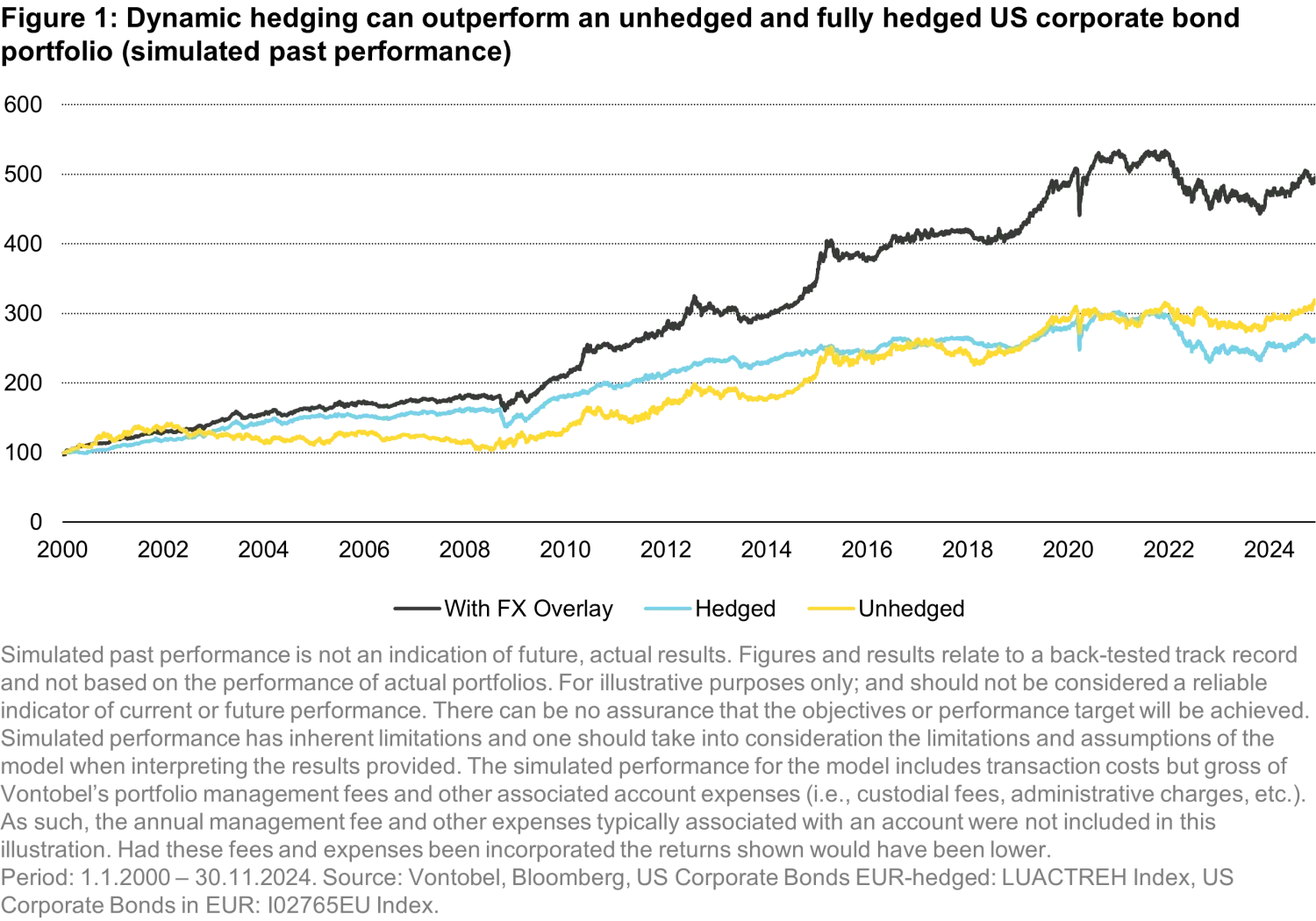
Considering the expected moves in the US dollar in the medium to long term, an active US dollar overlay can transform the common pitfalls of a static FX hedging approach into opportunities. Figure 1 below shows the potential value add that an active approach to FX management could have based on a simulated performance analysis of a US corporate bond portfolio from the perspective of a European investor.
In this example, we compare three portfolios. The blue and yellow lines refer to a portfolio that’s either fully hedged at all times, or not hedged at all. As one can see, returns are comparable over the time span covered.
The third portfolio (depicted as dark grey line in the chart) is one where the hedge is dynamically adjusted between 0 percent (fully unhedged) and 100 percent (fully hedged) depending on the signals delivered by our proprietary models.
The impact is significant, as quantified by the risk / return statistics summarized in Figure 2. The annualized returns increase from 4.5 percent and 3.8 percent for the unhedged vs. hedged portfolios to 6.2 percent for the dynamically hedged on a simulated basis. This results in a situation where the dynamic hedge added 170 and 240 bps depending on whether you compare it to the unhedged vs. hedged portfolio, respectively.
We chose a U.S. corporate portfolio for a reason. Given the lower annualized returns compared to, say, a portfolio of U.S. equities, the impact of the dynamic FX hedge is very tangible, and comparable in magnitude to the returns of the asset class itself. The results can, of course, be seamlessly applied to a US stock portfolio.

Under the hood
The valuation of exchange rates depends heavily on the economic strength and monetary stability of the respective currency regions. Key macroeconomic drivers to evaluate currencies include metrics like GDP growth and inflation expectations.
Against this backdrop, a quantitative model based on macroeconomic factors appears ideally suited for an active management of currencies. Our model leverages three of the most widely used and empirically validated currency risk premia: carry2, value and momentum3.
1. Carry Component:
The carry, as the most common and systematic source of return, is employed using the 2-year interest rate differential.
2. Value Component:
The value component consists of two distinct factors. First, we assess the relative valuation of currencies based on a common approach using purchasing power parity (PPP) to identify the under-/overvaluation of the US dollar accordingly. Additionally, we utilize insights from our proprietary WAVE business cycle model, which employs a big data approach to evaluate the dynamics of the two economies.
3. Momentum Component:
The momentum component incorporates two separate signals. In addition to a pro-cyclical trend model covering several time horizons of up to one year, speculative market positioning complements the spectrum of signals as a counter-cyclical element.
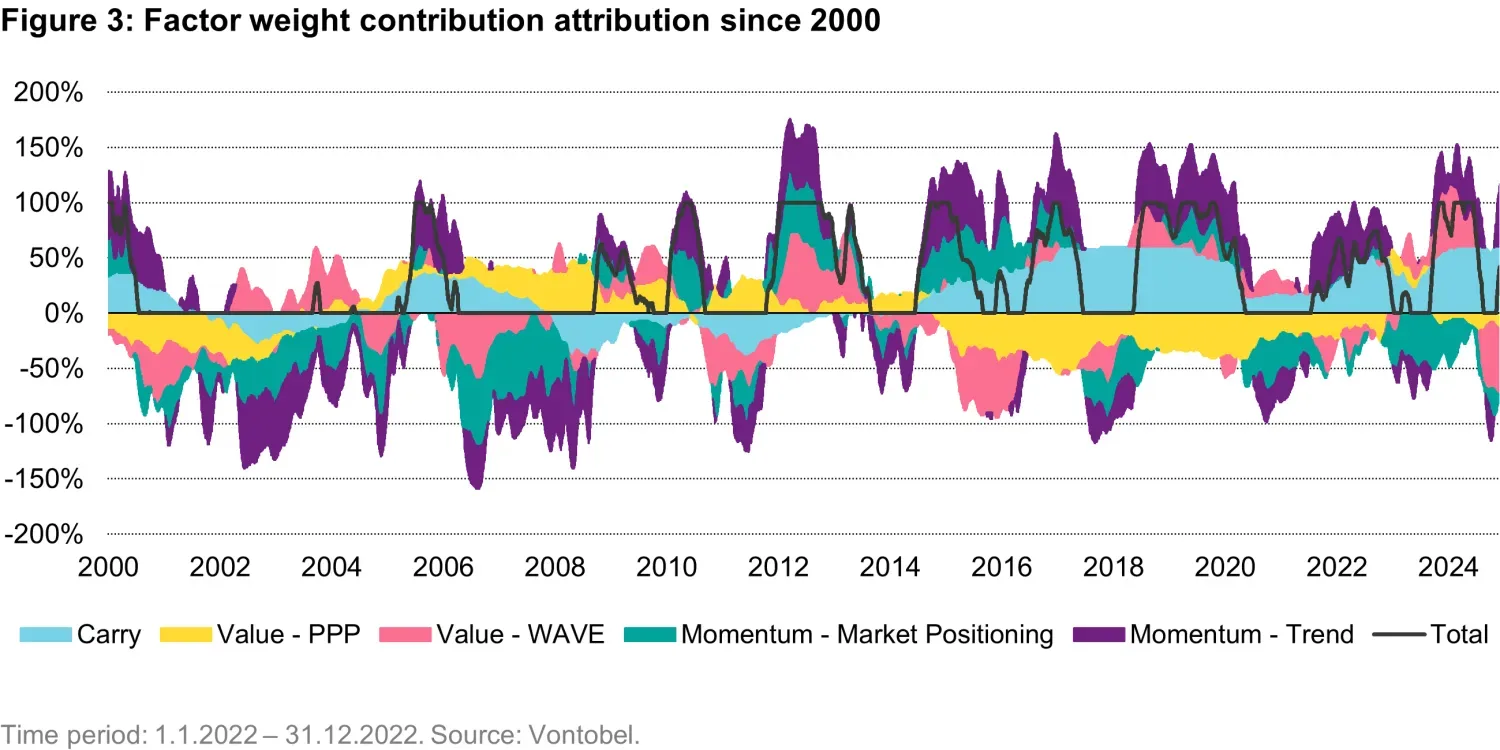
The transformation of variables into allocations follows a consistent approach: the current state of a variable, evaluated against its historical distribution, provides a measure of attractiveness for the US dollar. A stronger signal translates into a higher allocation.
The model's structurally simple design further facilitates the seamless aggregation of individual sub-allocations into a unified overall allocation. The results are shown in figure 2: active US dollar allocations ranging from 0 to +100 percent tailored to the economic environment, with dynamic inputs from all contributing factors.
Two Case Studies
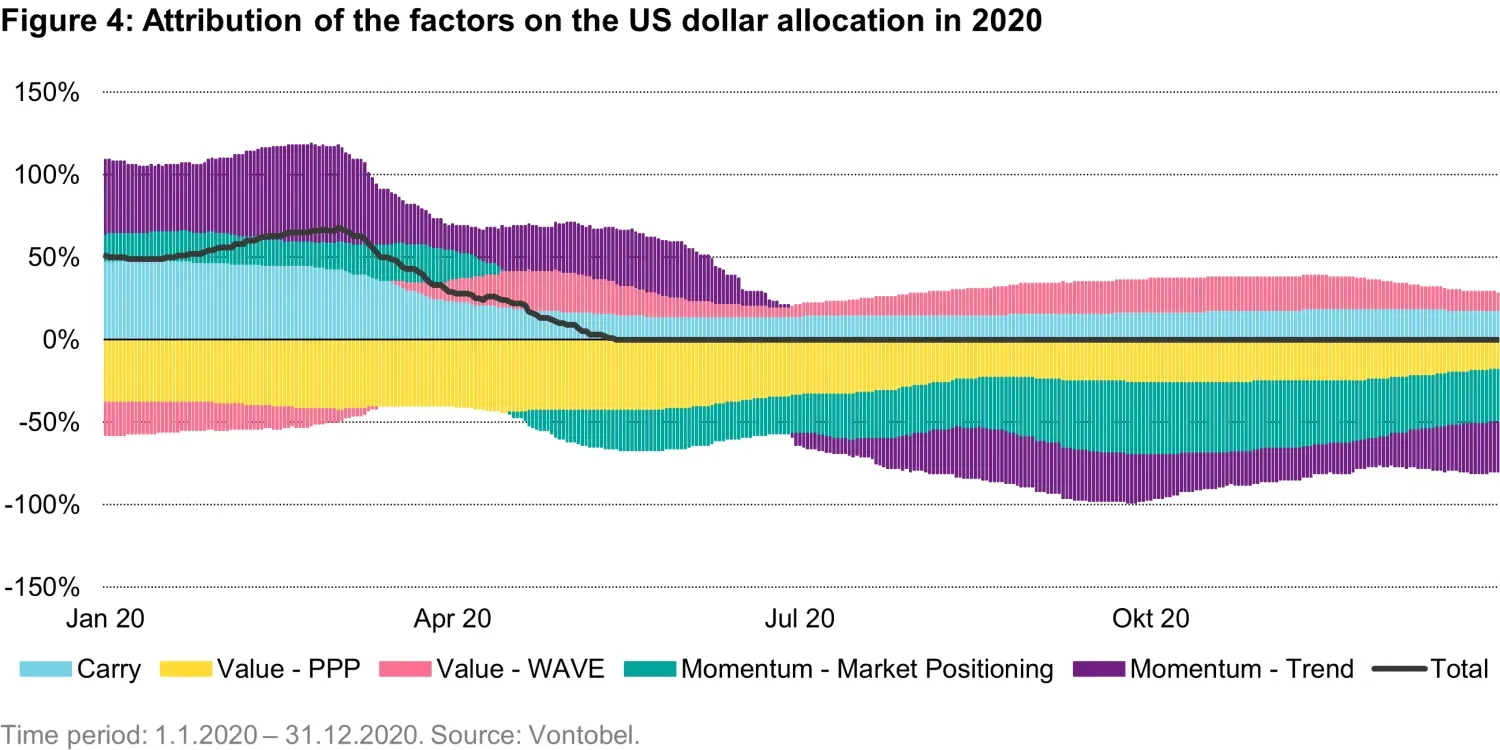
In 2020, the COVID crisis was one of the most profound crises of recent years. The increased volatility and uncertainty, of course, did not spare the currency markets. Global equity markets hit their trough on March 23, 2020. By that date, the US dollar, serving as a safe haven, had gained 4.6 percent in value against the Euro since the beginning of the year. However, the stabilization in equity markets was accompanied by a severe repricing of EUR/USD over the remaining course of the year. By the end of 2020, the US dollar had depreciated by 8.2 percent.
In this difficult and challenging environment, the actively managed portfolio showed a significant performance of 9.4 percent against the unhedged portfolio on a simulated basis. How was that accomplished? In the beginning of 2020, the model indicated a long US dollar allocation, which was gradually reduced throughout the second quarter and was even hitting 0 percent mid-May. This fully hedged allocation persisted until year-end.
As shown in Chart 3, the significant reduction in the US dollar allocation was driven in part by the two momentum sub-components: strong speculative market positioning and weakening trend dynamics in EUR/USD. Additionally, the U.S. interest rate differential to European rates indicated a less attractive environment for the US dollar. Equally important was the consistent short allocation through the PPP value component.
Thanks to this dynamic positioning, the portfolio was initially able to benefit from US dollar strength during COVID-19 crisis and, in the second half of the year, was able to avoid FX losses from the subsequent reversal and associated US dollar weakness.
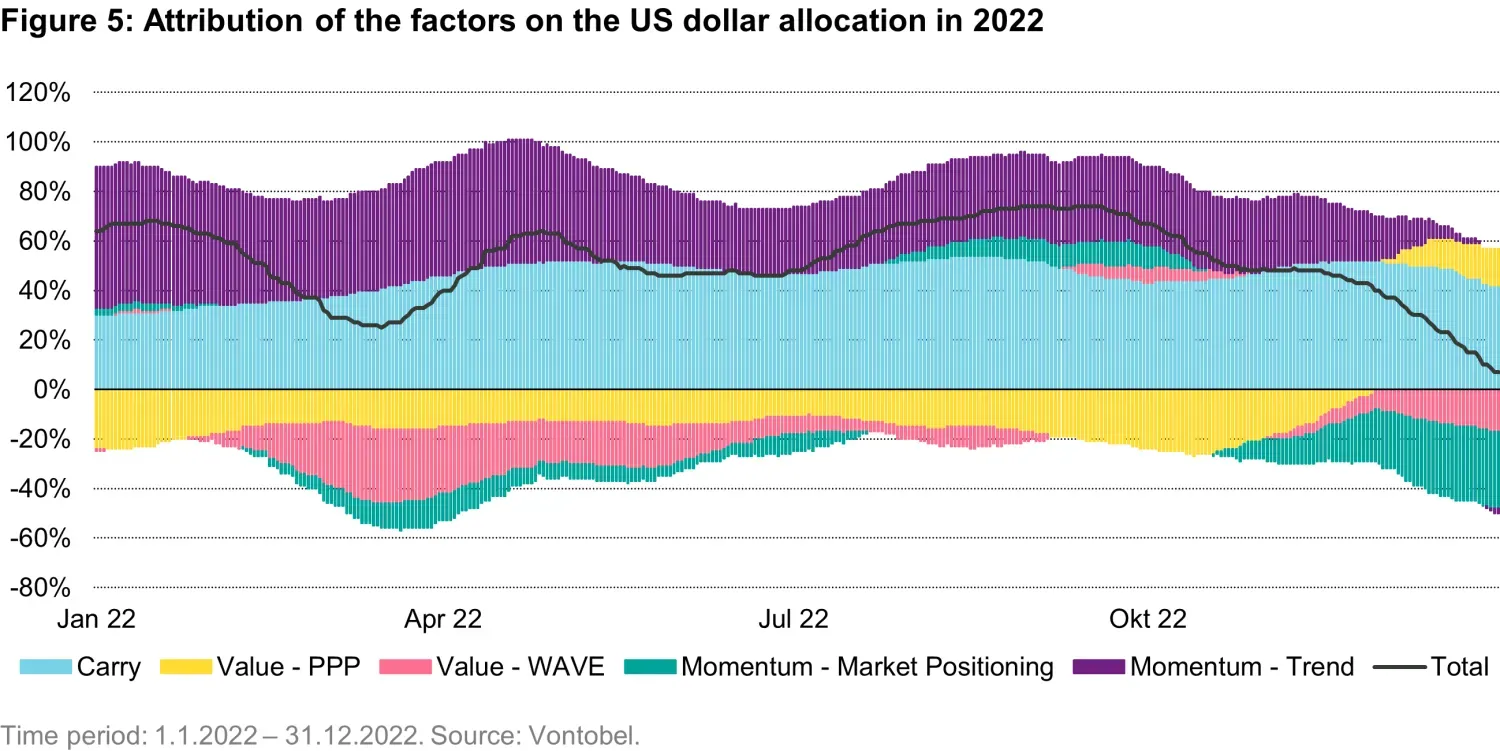
The advantages of active FX management, particularly during market turmoil, are also evident when analyzing 2022. Showing simultaneous, double-digit losses in equities and bonds, the year 2022 was an exceptional difficult one for both traditional asset classes. In these times, US dollar exposure should be seen not merely as an additional risk but also as an opportunity to leverage the diversification benefits of the world's primary reserve currency.
As shown in Chart 4, going into 2022, the model signaled a pronounced long US dollar position. Carry and momentum components have been the main drivers of it. Having the Fed on a more restrictive path than the ECB and having the US dollar strengthening 14.8 percent until September4, these two factors provided the basis for long US dollar positioning.
In this environment of sharp US dollar appreciation, the active FX portfolio resulted in an performance of 5.5 percent in 2022 compared to the fully hedged portfolio.
Conclusion
The environment for EUR/USD has experienced significant shifts in recent years: the departure from zero interest rate policies, reduced monetary support, diverging fiscal support as well as rising protectionist tendencies. What remains unchanged, however, is the inherent uncertainty surrounding the pair's future trajectory. We anticipate that macroeconomic trends and developments will play an even more prominent role in shaping the valuation going forward. In this context, actively managing US dollar exposure presents a valuable opportunity to enhance the efficiency of a global portfolio including FX risks. We would be happy to discuss potential options with you—feel free to reach out!
1. Time period: 30.09.2024 - 06.11.2024, Source: Bloomberg, Ticker: USDEUR Currency
2. Source: H. Lustig and A. Verdelhan. "The Cross Section of Foreign Currency Risk Premia and Consumption Growth Risk.", American Economic Review, 97 (1): 89–117.
3. Source: C. Asness, T. Moskowitz and L. Pedersen. " Value and Momentum Everywhere", Journal of Finance, 68 (3): 929–985.
4. Time period: 01.01.2022 – 30.09.2022, Source: Bloomberg, Ticker: USDEUR Currency
A propos des auteurs


Fonds apparentés
A propos des auteurs
Sujets :
Afficher le suivant :
Towers and the Starlink ThreatInsights apparentés

Towers and the Starlink Threat

Quarterly Commodity Outlook - Halftime Whistle: Fundamentals Take the Field

Investors’ Outlook : Et maintenant, quelque chose de totalement différent

Investors’ Outlook: Ajuster la focale

Investors’ Outlook: Sans détour
