
The long-lived Trump trade
Multi Asset Boutique
Earlier this year, we advocated that investors wanting to play U.S. equities actively (and seek outperformance) should have paid attention to how the presidential race unfolded. To that end, we launched our Democratic and Republican U.S. election index strategies, tracking stocks which stood to benefit from the policies of the respective parties.
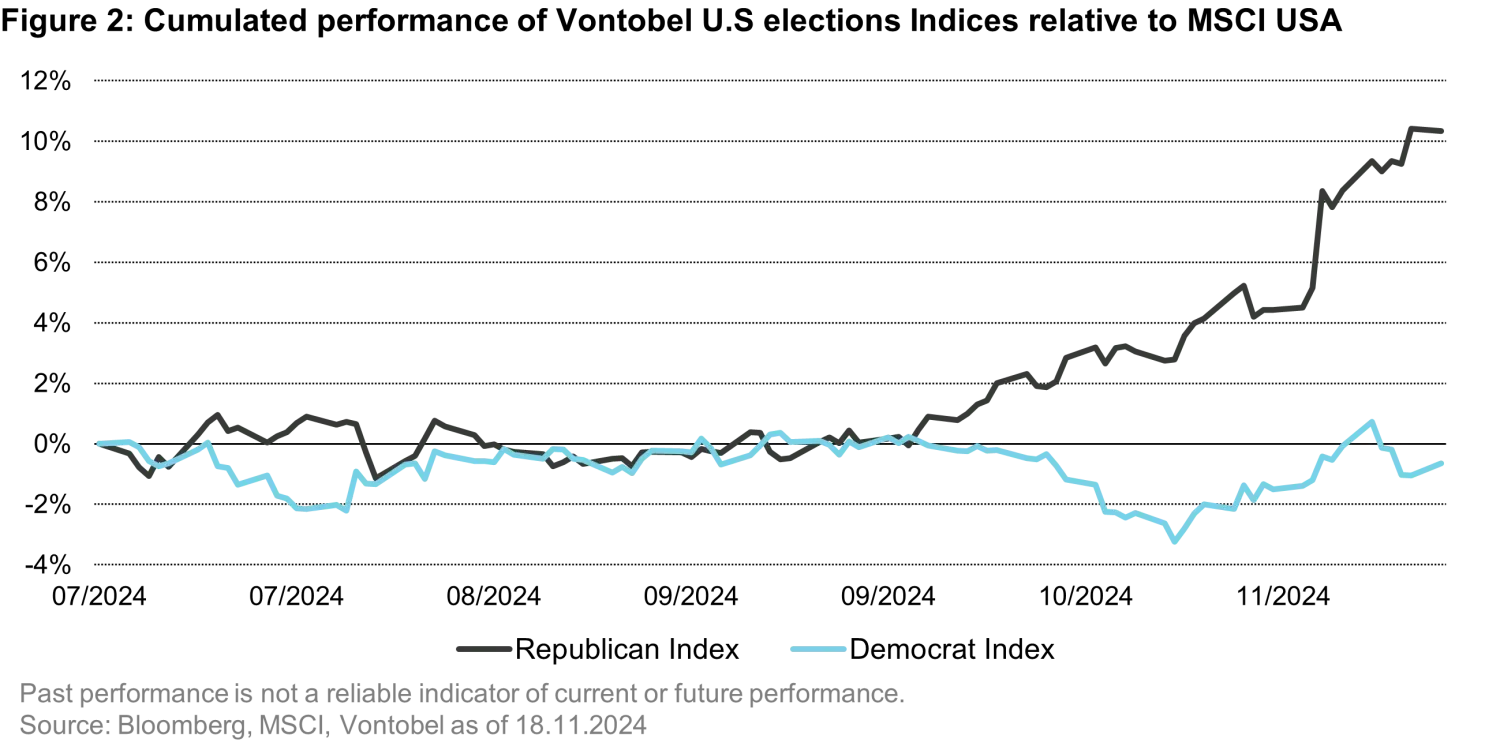
Looking back, our opinion yielded positive results, with the Republican Index outperforming the MSCI USA Index by roughly above 10 percentage points in the period from July 1st through to November 18th, 2024, a few days after it become known that Donald Trump would be the new president.
In this piece, we share our learnings by recollecting the key events of the campaign and highlighting how they affected polls and markets. In a nutshell, we found that market moves anticipated poll results (and thus seem to be a more reliable, leading indicator). Also, we found that the election winning theme (the Republican U.S elections index) kept performing even after election day, disproving somehow the heuristic “buy the rumor, sell the fact”. One may say that the results of this election gave life to the heuristic “buy the rumor, hold it through the fact”.
Early Momentum: Republican surge (1st July – 21st July)
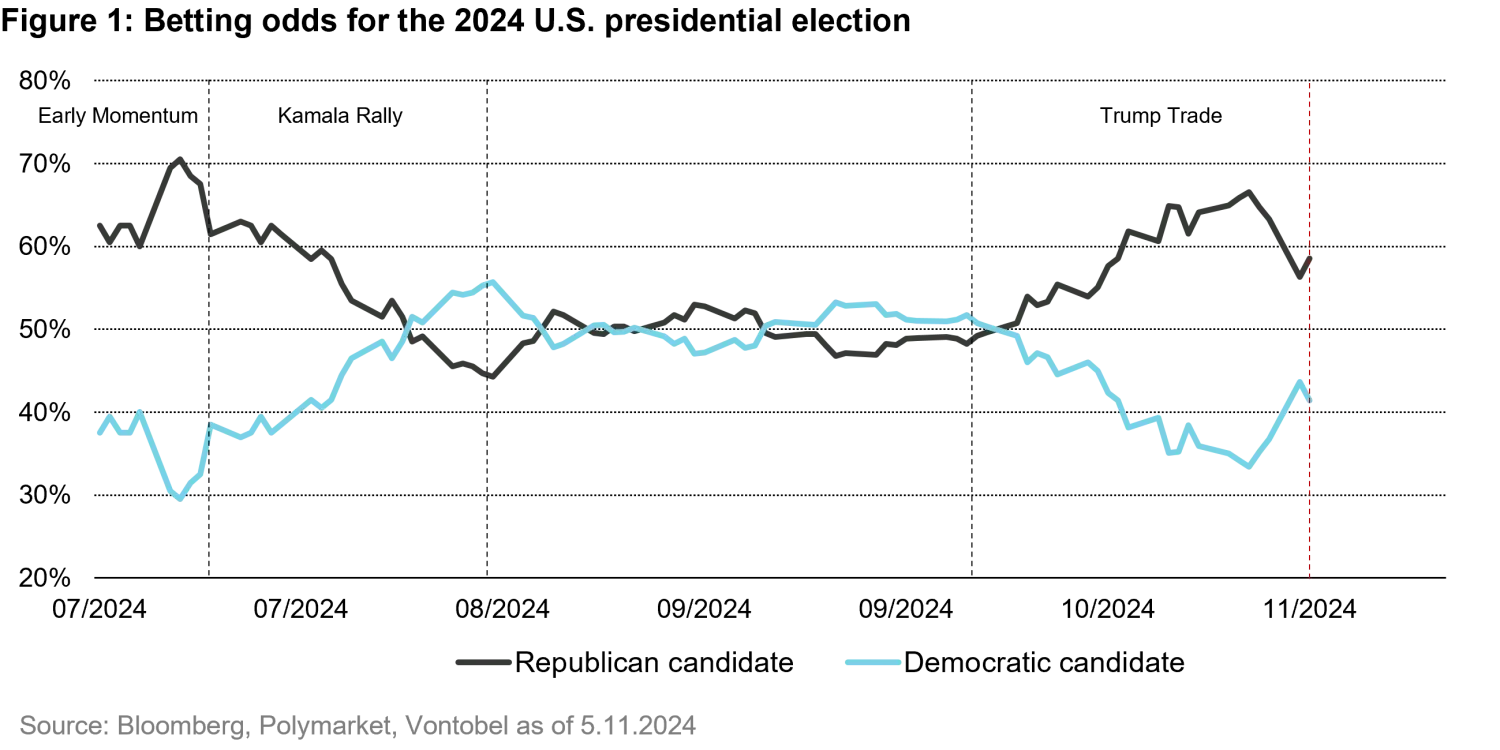
In July 2024, a failed assassination attempt on Trump shifted public opinion dramatically. Betting markets and polls showed strong Republican momentum (figure 1), mirrored by the outperformance of the Vontobel Republican U.S. Election index (figure 2). While poll results clearly favored a Trump victory, markets only reacted mildly, with the Republican index slightly gaining over the Democrat one, and the benchmark.
The "Kamala Rally": Democrats gain ground (21st July – 15th August)
The Democratic Party responded with the nomination of Kamala Harris as their candidate. A robust media campaign and Harris's appeal spurred a "Kamala rally," narrowing the gap between the two parties in both polls and market performance. The convergence of Democratic and Republican Vontobel U.S. Election index performance reflected growing uncertainty among investors, as a more competitive race introduced new variables into market expectations.
Late-Stage twist: The "Trump Trade" (1st October – 5th November)
As election day approached, betting markets decisively shifted back toward Trump. Tight polling in key swing states like Pennsylvania, Wisconsin, and Michigan fueled confidence in a Republican victory. High-profile events showcasing Trump’s resilience and support further bolstered his position. This late-stage surge, dubbed the "Trump trade," drove the Republican index higher, signaling market optimism about the likely implementation of Republican policies.
Post-election momentum
The final outcome validated market expectations. With Republicans securing the presidency and both houses of Congress, the Republican U.S. election index surged, doubling its performance immediately after the election. Investors reacted positively, anticipating pro-business policies and robust legislative momentum. As anticipated earlier, this was the second learning of this campaign, which we labeled “buy the rumor, hold it through the fact”.
Conclusion: A tight link between politics and markets
The 2024 election demonstrated that it paid off to invest in the U.S. market actively by looking at Republican and Democrat investment themes, made of stocks that stood to profit from the policies of the respective parties.
It also showed that markets signaled the winner slightly before opinion polls, making financial markets a better leading indicator of the election results. Betting odds and indices all reflected investor sentiment leading up to the event. It appears that before elections, markets discounted the Republican victory in line with the sentiment expressed by betting polls.
Somewhat to our surprise, and against the heuristics of “buy the rumor, sell the fact”, the Republican U.S. elections index kept performing through election date. In fact, roughly 30% of the total 10.3% outperformance of the Republican index vs. the MSCI USA index materialized during the days after the election (from November 5th through to November 18th).
The market’s rally on election day underscored the extent to which political outcomes shape expectations for policy direction and economic governance. As the U.S. embarks on another Republican-led term, investors will closely watch the administration's actions to assess their impact on sectors and broader market performance. While we expect the impact of policy statements to be more muted moving forward, it’s something that investors should keep an eye on for U.S. Equities.

Zugehörige Insights

Towers und die Starlink-Bedrohung

Quartalsausblick Rohstoffe – Halbzeitpfiff: Fundamentaldaten betreten das Spielfeld

Investors’ Outlook: Kommen wir nun zu etwas völlig anderem

Investors’ Outlook: Den Fokus justieren

Investors’ Outlook: Gerade heraus
